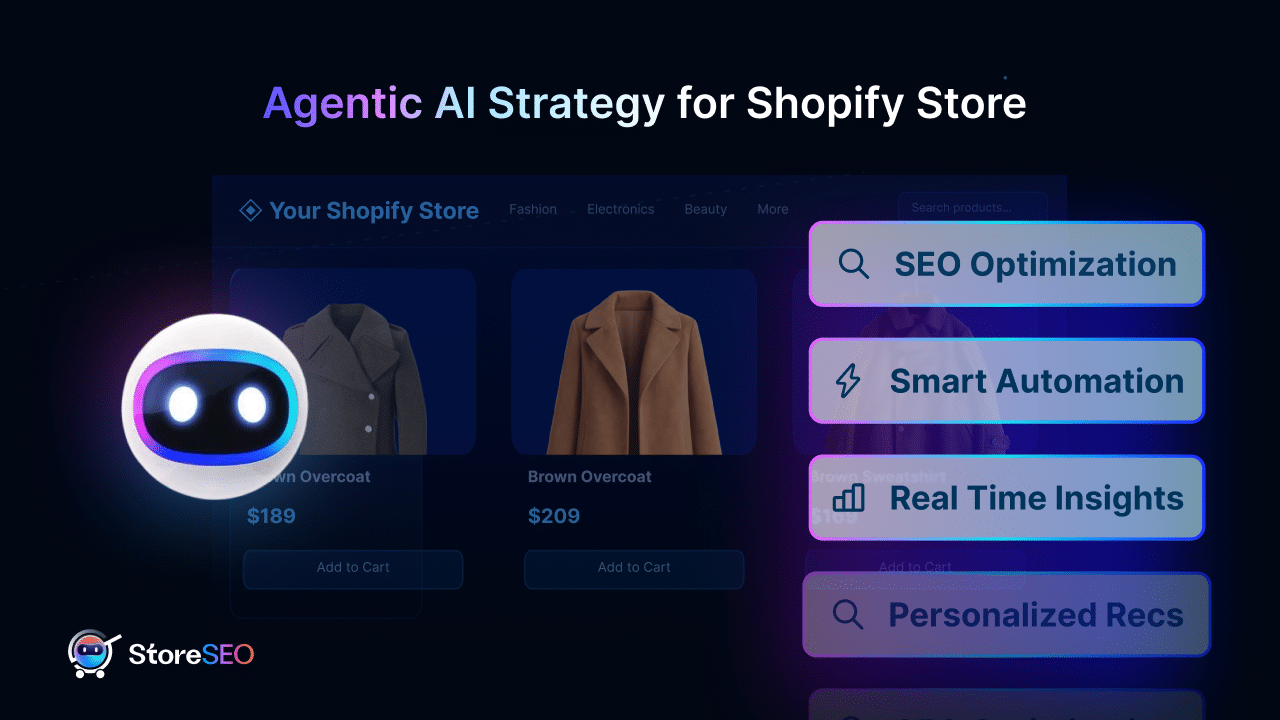

Le SEO ne se limite pas à un meilleur classement ; il s'agit d'être trouvé aussi bien par les humains que par l'IA. Avec l'évolution de la recherche vers une découverte optimisée par l'IA via ChatGPT, Google AI Overviews, Perplexity et Gemini, le SEO de vos pages de collection Shopify doit désormais être compatible avec les algorithmes et les moteurs de recherche. StoreSEO vous accompagne dans cette nouvelle transition grâce à ses fonctionnalités intégrées de GEO (optimisation générative pour les moteurs de recherche) et d'AEO (optimisation pour les moteurs de réponse), qui rendent vos collections Shopify compatibles avec les citations, rapides à charger et riches en contenu.
TL;DR (trop long ; pas lu)
Les fonctionnalités de StoreSEO, basées sur l'IA, peuvent transformer les pages de collection Shopify en véritables concentrés de référencement (SEO) grâce à l'optimisation des métadonnées (titre et description), des citations IA dans le fichier LLMs.txt, de l'optimisation des images, du balisage de schéma SEO et des stratégies AEO/GEO, générant ainsi 3 à 4 fois plus de trafic organique tout en étant mis en avant dans ChatGPT, Perplexity et les aperçus de l'IA de Google.
Pourquoi les pages de collection sont plus importantes que jamais en 2026
Soyons directs : Si vous n'optimisez pas vos pages de collection Shopify, vous laissez passer des opportunités de vente.
Les pages de collection occupent une place centrale dans votre hiérarchie e-commerce. Plus générales que les pages produits, mais plus spécifiques que votre page d'accueil, elles constituent des cibles idéales pour les requêtes de recherche à forte intention. Lorsqu'un internaute recherche “ chaussures de running homme ” ou “ produits de soin bio ”, il ne cherche pas un article précis : il navigue, compare et est prêt à acheter.
Voici ce que la plupart des propriétaires de boutiques Shopify ignorent : les pages de collection peuvent générer plus de trafic organique que les pages produits individuelles réunies. Elles ciblent des mots clés de catégorie à fort volume de recherche tout en maintenant une forte intention d'achat. Une page de collection bien optimisée se positionne simultanément sur des dizaines de mots clés associés, agissant comme un véritable aimant à trafic pour l'ensemble de votre gamme de produits.
Avis d'expert : Après avoir analysé des centaines de boutiques Shopify, nos experts en référencement ont constaté que les boutiques disposant de pages de collection optimisées génèrent 3 à 4 fois plus de trafic organique que celles qui se concentrent uniquement sur le référencement de leurs pages produits. La raison ? Les pages de collection correspondent parfaitement à la façon dont les gens font réellement leurs achats en ligne ; ils veulent des options, pas seulement un seul article.
Comportement de recherche des utilisateurs en 2026 : une découverte axée sur l’IA
Le paysage du référencement a radicalement changé. Il ne s'agit plus seulement de figurer parmi les 10 premiers résultats de Google. En 2026, vos pages de collection devront exceller dans les domaines suivants :
- Google AI Overviews (anciennement SGE) propose des résumés générés par l'IA avec des citations.
- Interfaces d'achat et de commerce conversationnel ChatGPT
- Perplexity AI effectue des recherches là où les citations numérotées favorisent la découverte
- Gemini et d'autres moteurs génératifs qui recommandent directement des produits
Ce changement signifie que vos pages de collection doivent être optimisées à la fois pour le référencement naturel traditionnel et pour l'optimisation générative des moteurs de recherche (GEO). StoreSEO comble cette lacune grâce à des fonctionnalités spécialement conçues pour une découverte basée sur l'IA.
Comment StoreSEO optimise les pages de collection Shopify : le système complet
StoreSEO n'est pas une simple application SEO.; Il s'agit d'un agent SEO IA qui prend en charge les aspects les plus complexes du référencement des pages de collection. Je vais vous expliquer en détail comment il fonctionne.
1. Sélection et analyse des mots-clés principaux
L'optimisation d'une page collection repose avant tout sur le choix du bon mot-clé principal. L'IA de StoreSEO analyse le contenu de votre collection et vous suggère des mots-clés à fort impact en fonction de :
- Volume de recherche et niveaux de difficulté
- Signaux d'intention d'achat (requêtes transactionnelles vs requêtes informationnelles)
- Opportunités de mots clés de longue traîne qui convertissent mieux
- Variations sémantiques que les moteurs de recherche IA comprennent
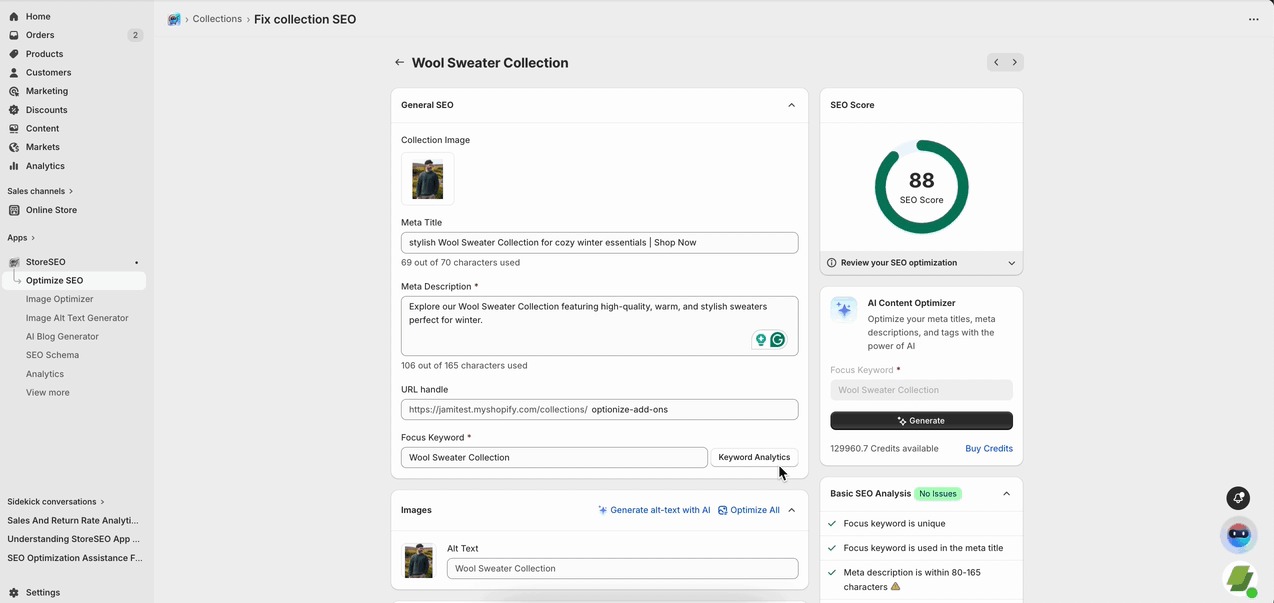
Une fois votre mot-clé principal sélectionné, le système de double analyse de StoreSEO se met en marche :
Vérifications de base en matière d'analyse SEO :
- Mettez l'accent sur l'unicité des mots clés dans votre boutique.
- Placez les mots clés de manière optimale dans le titre et la description méta.
- longueur en caractères de la méta-description
- Longueur des caractères du titre Meta
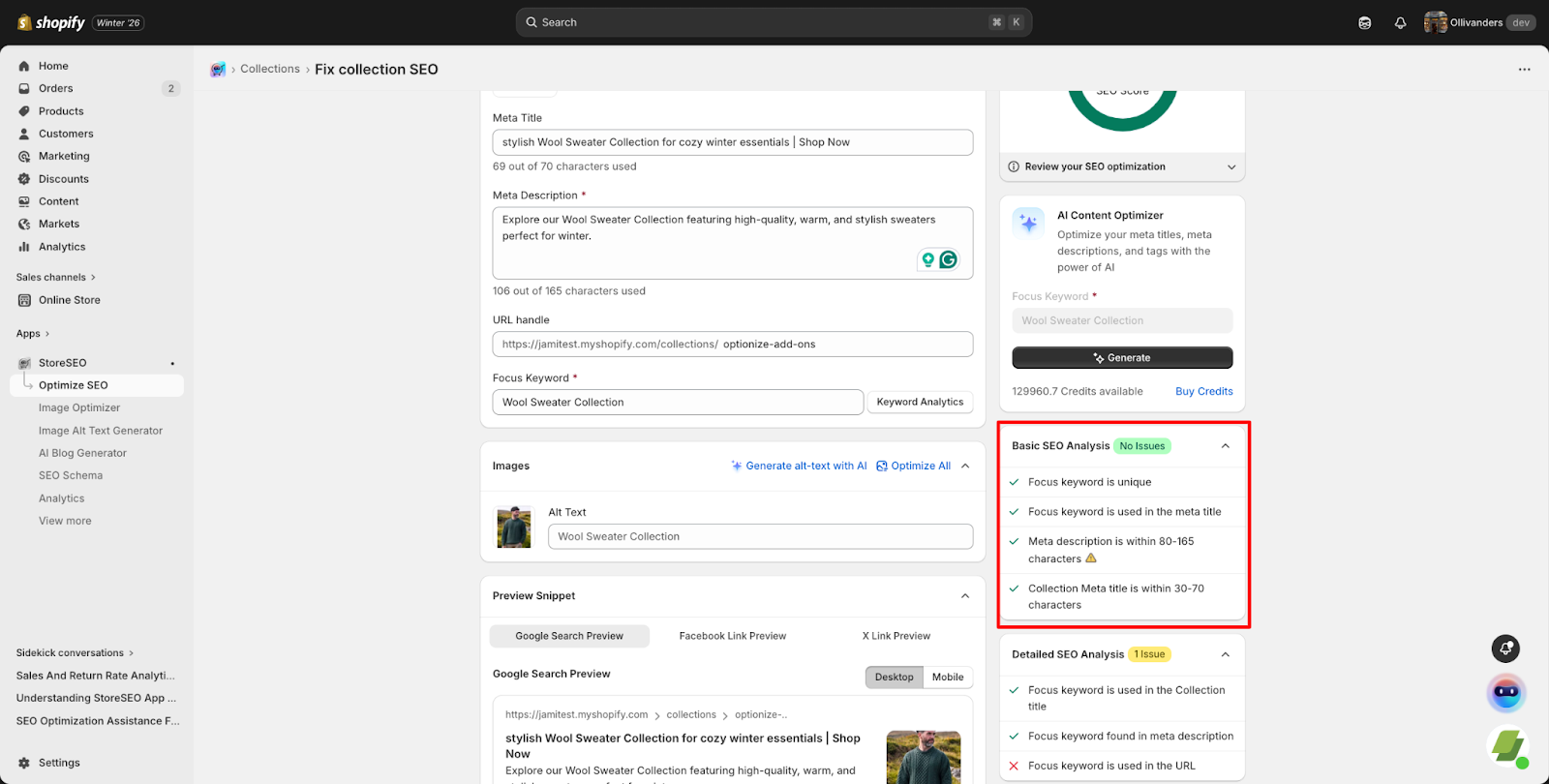
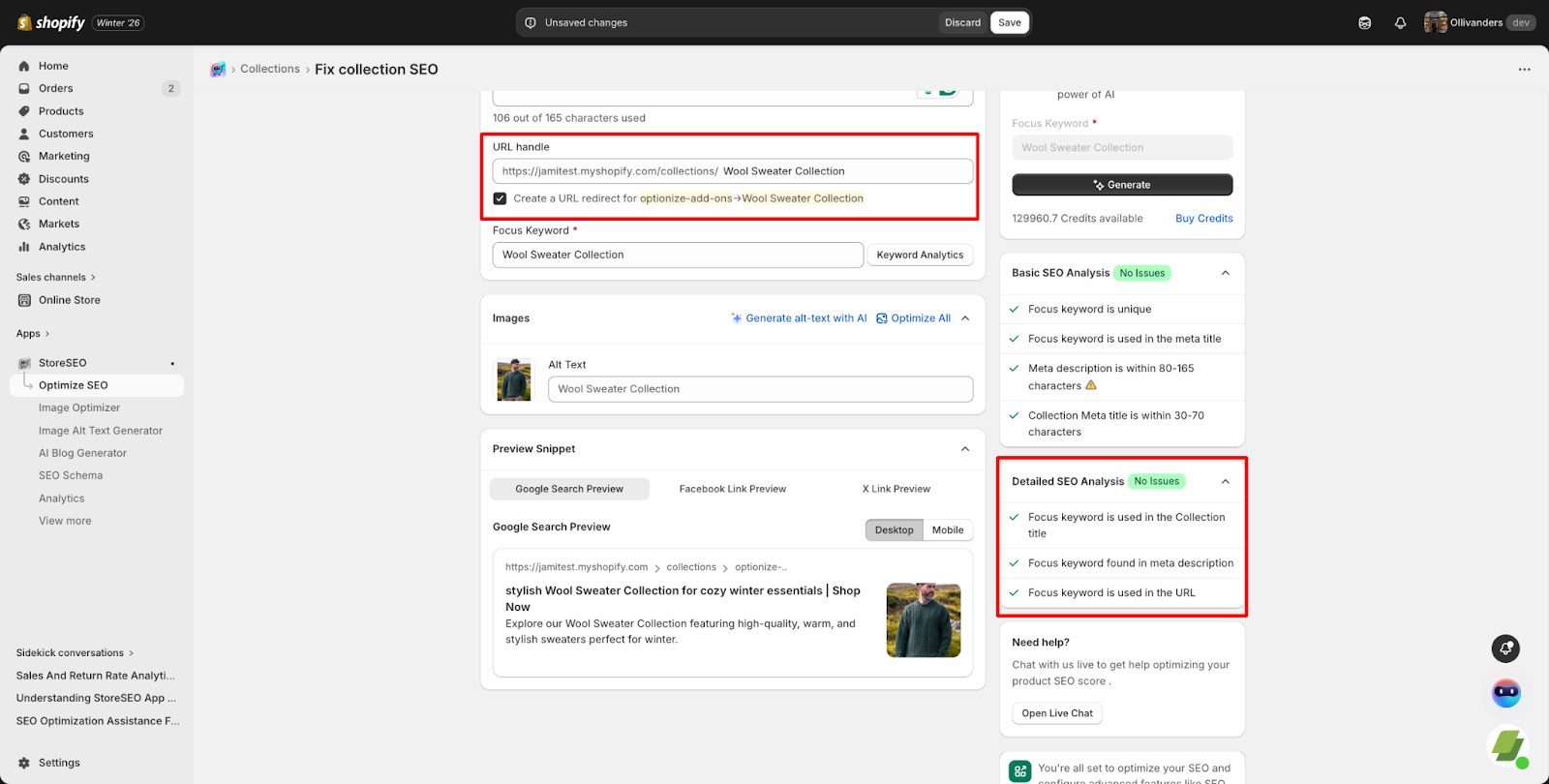
L'analyse SEO détaillée évalue :
- Le mot clé Focus est utilisé dans le titre de la collection
- Mot-clé ciblé trouvé dans la méta description
- Le mot clé Focus est utilisé dans l'URL
Cette approche à deux niveaux garantit qu'aucun détail n'est négligé. Vous obtenez à la fois des résultats rapides et des analyses d'optimisation approfondies.
2. Optimisation automatisée des métadonnées
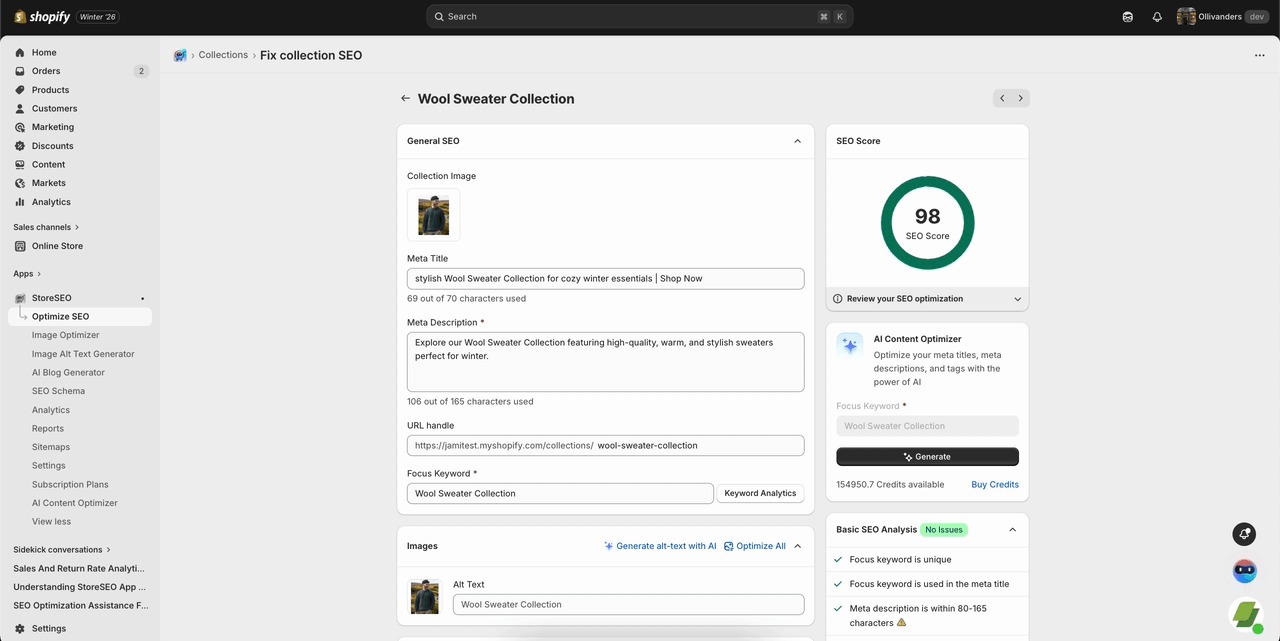
Les balises méta constituent la première impression que votre page de collection donne dans les résultats de recherche. StoreSEO automatise l'intégralité du processus :
Meta Title :
- Limite les titres à 60-70 caractères pour un affichage optimal
- Place stratégiquement les mots-clés principaux au début
- Garantit l'unicité de 100% sur toutes les pages de la collection
- Inclut les mots-clés secondaires lorsque le nombre de caractères le permet.
Méta description :
- Maintient une plage de caractères optimale de 150 à 160.
- Rédige des descriptions attrayantes et incitant au clic.
- Intègre le langage naturel que l'IA peut analyser.
- Ajoute des informations pertinentes sur la catégorie de produits
Voici à quoi cela ressemble en pratique : au lieu d'un modèle générique
À retenir : Des balises méta bien optimisées améliorent non seulement le classement, mais augmentent également le taux de clics de 20 à 30 % selon nos données. Un taux de clics élevé indique à Google que votre page est le meilleur résultat, créant ainsi un cercle vertueux d’amélioration du classement.
3. Optimisation avancée des images pour les pages de collection
Les images ralentissent la plupart des boutiques Shopify. L'optimiseur d'images de StoreSEO, basé sur l'IA, résout trois problèmes critiques :
Compression intelligente :
- Réduit la taille des fichiers image jusqu'à 70% sans perte de qualité visible.
- Redimensionne automatiquement les images aux dimensions recommandées.
- Convertit aux formats modernes lorsque cela est avantageux
- Priorise le chargement des images visibles au chargement de la page.
Génération de texte alternatif en masse :
- Utilise l'IA pour analyser les images des produits et générer des textes alternatifs descriptifs.
- Intègre naturellement les mots-clés pertinents
- Rend les images consultables dans Google Images
- Améliore l'accessibilité pour les lecteurs d'écran
Impact du référencement des images :
- Des vitesses de chargement de page plus rapides améliorent les scores Core Web Vitals
- Un meilleur texte alternatif génère du trafic sur Google Images
- Réduction du taux de rebond grâce à des temps de chargement plus rapides
- Améliorations des performances mobiles (essentielles pour plus de 751 000 acheteurs)
Une page de collection qui se charge en moins de 2 secondes convertit trois fois plus qu'une page qui met 5 secondes. StoreSEO garantit la rapidité de vos pages de collection.
4. Balisage de schéma et extraits enrichis
Balisage de schéma SEO StoreSEO est l'arme secrète pour optimiser la visibilité de votre page collection. Elle indique aux moteurs de recherche (et aux modèles d'IA) précisément le contenu de votre page. StoreSEO implémente le balisage SEO en quelques clics :
Schéma de collection de produits :
- Définit la catégorie de collection et la hiérarchie du fil d'Ariane
- Affiche les informations de prix sur l'ensemble des produits
- Inclut l'état de disponibilité
- Points saillants : notes, évaluations et nombre
Schéma du fil d'Ariane :
- Affiche clairement la hiérarchie du site aux moteurs de recherche
- Aide l'IA à comprendre les relations entre les produits
- Crée une navigation structurée dans les résultats de recherche
- Améliore l'autorité des liens internes
Programme d'aide aux entreprises locales (le cas échéant) :
- Ajoute une pertinence géographique aux recherches locales
- Comprend des informations commerciales
- Améliore la visibilité dans les résultats de recherche “ à proximité ”.
Extraits enrichis de Un schéma approprié peut augmenter les taux de clics par 30-40%. Lorsque votre page de collection affiche les notes par étoiles, les fourchettes de prix et la disponibilité directement dans les résultats de recherche, vous vous démarquez de la concurrence.
5. Implémentation de LLMs.txt : L’amplificateur de visibilité de l’IA
C’est là que StoreSEO prend véritablement l’avantage en 2026. LLMs.txt est essentiellement du “ SEO pour l’IA ” — un fichier standardisé qui indique aux grands modèles de langage quelles pages prioriser lors de la génération des réponses.
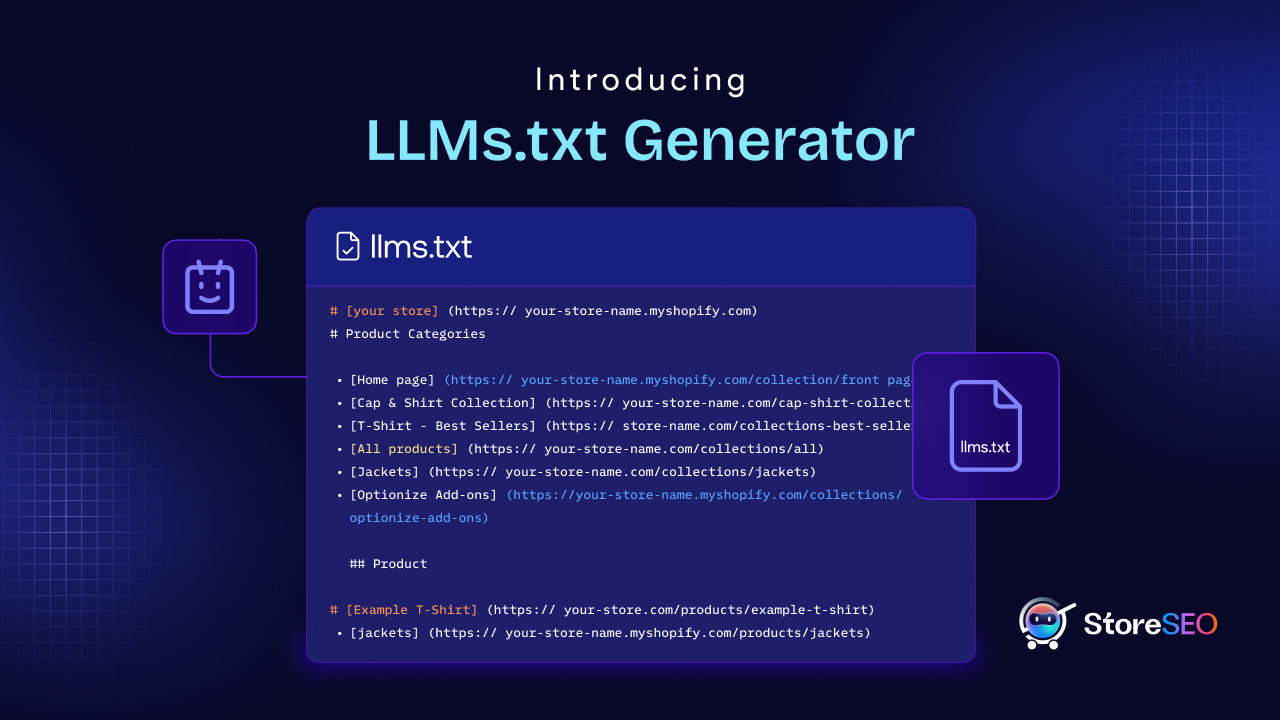
Que fait le générateur LLMs.txt de StoreSEO ?
Crée un index structuré de vos pages de collection les plus importantes dans un format optimisé pour les modèles d'IA (Markdown propre). Oriente ChatGPT, Claude, Perplexity et autres assistants IA vers vos collections de produits de référence. Réduit le “ bruit ” rencontré par les robots d'exploration IA, facilitant ainsi la compréhension de la structure de votre boutique. Augmente la probabilité d'être cité dans les recommandations d'achat générées par l'IA.
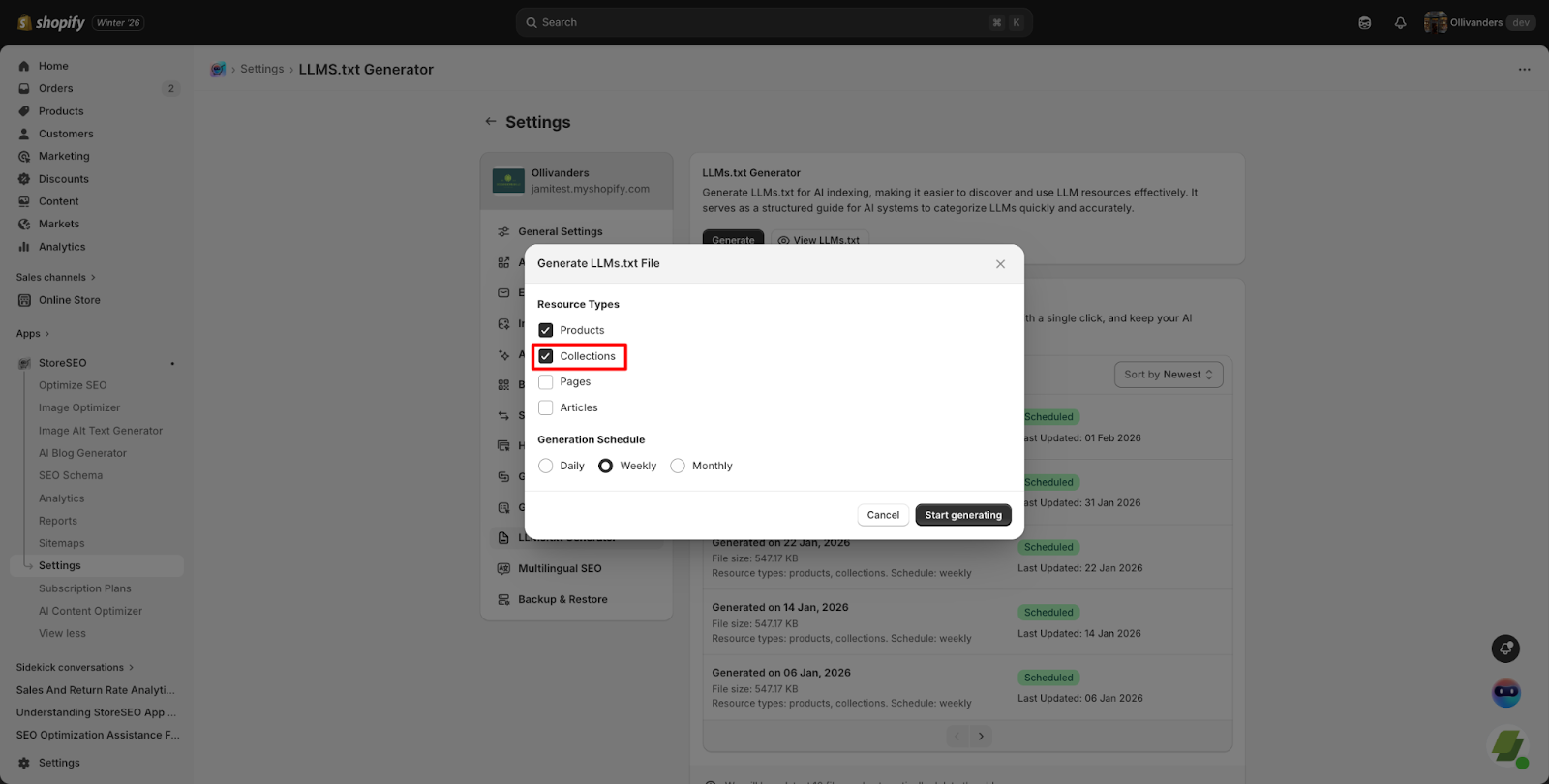
Exemple concret :
Entreprises mettant en œuvre Le fichier LLMs.txt rapporte 10-15% de nouvelles inscriptions provenant de ChatGPT. et d'autres outils d'IA similaires. Lorsqu'une personne demande à une IA “ Quels sont les meilleurs produits de soin bio ? ” et que votre page de collection contient le fichier LLMs.txt, vous avez trois fois plus de chances d'être cité comme source.
Avis d'expertLLMs.txt est encore en développement, mais les premiers utilisateurs constatent déjà des avantages concrets. Considérez-le comme un moyen de pérenniser votre stratégie SEO. À mesure que le shopping piloté par l'IA se généralise, les boutiques intégrant LLMs.txt bénéficieront d'un avantage concurrentiel majeur en matière de citations et de recommandations basées sur l'IA.
6. Optimisation du contenu et score SEO
StoreSEO ne se contente pas d'auditer, il vous guide vers une optimisation 100% avec un système de notation en temps réel :
Tableau de bord du score SEO :
- Représentation visuelle de l'état de votre page de collection (échelle de 0 à 100)
- Priorisation des problèmes par code couleur (critique, important, mineur)
- Instructions de résolution étape par étape pour chaque problème
- Suivi des scores avant/après
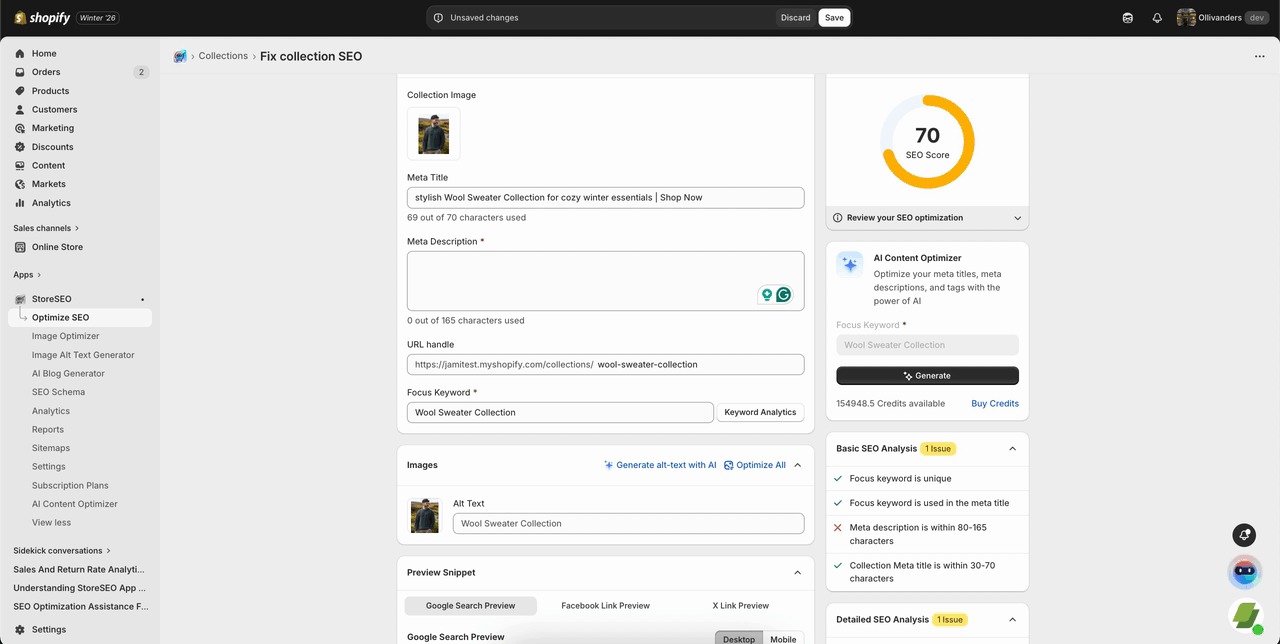
Recommandations de contenu :
- Longueur optimale de la description de la collection (200 à 300 mots minimum)
- Suggestions de placement des mots clés
- Possibilités de liens internes vers des collections connexes
- Recommandations de la FAQ pour l'optimisation des extraits optimisés
Facteurs liés à l'expérience utilisateur :
- vérifications de la réactivité mobile
- Analyse de la structure de navigation
- Optimisation des fonctionnalités de filtrage et de tri
- Placement clair de l'appel à l'action
L'objectif est simple : obtenir un score SEO de 95% ou plus pour chaque page de collection. À ce niveau, vous rivalisez avec les pages les mieux optimisées de votre secteur.
L'avantage des citations IA : comment StoreSEO vous permet d'être mis en avant dans les résultats de recherche IA
Le référencement traditionnel consistait à se classer parmi les 10 premiers résultats. En 2026, il s'agira d'être cité par l'IA.
| 🔍 Catégorie | ⚡ Optimisation pour les moteurs de réponse (AEO) | 🌐 Optimisation générative des moteurs (GEO) |
| 🎯 Concentration sur l'essentiel | Fournir des réponses claires et directes aux questions des utilisateurs afin que l'IA puisse facilement citer ou résumer. | Développer une autorité thématique et une couverture contextuelle complètes pour les moteurs génératifs. |
| 🧠 Objectif du contenu | Aidez les moteurs de recherche et de réponse à extraire des réponses courtes et factuelles. | Aidez les moteurs génératifs à comprendre, connecter et étendre le domaine de connaissances de votre marque. |
| 📘 Structure du contenu | – Des explications claires du type “ Qu'est-ce que [catégorie de produit] ? ”. – Des résumés en une phrase. – Des sections FAQ pour les questions courantes. | – Plusieurs pages de collection sur des sous-thèmes connexes. – Blogs et groupes de contenu soutenant chaque collection. – Avis clients ou contenu généré par les utilisateurs liés aux pages. |
| 🪶 Style de mise en forme | – Titres au format question H2. – Listes à puces. – Tableaux comparant les caractéristiques des produits. – Listes des avantages et des caractéristiques. | – Variation sémantique des mots clés. – Contenu riche en entités définissant la marque et les sujets. – Collections internes interconnectées. |
| 📚 Qualité de la source | – Descriptions originales et non dupliquées. – Affirmations étayées par des données et des sources vérifiables. – Qualifications de l’auteur attestant de son expertise. | – Nombreuses références internes et externes. – Commentaires d'experts ou analyse de la marque. – Couverture des concepts connexes pour une meilleure compréhension du contexte. |
| ⏱️ Signaux de fraîcheur | – Mises à jour fréquentes du contenu pour la confiance dans l'IA. | – Expansion thématique continue via de nouvelles pages, des blogs et du contenu généré par les utilisateurs. |
| 💬 Ton du contenu | – Informatif, concis, axé sur la réponse. | – Contextuel, narratif et axé sur l'expertise. |
| 📍 Boosters supplémentaires | – Balisage de schéma FAQ. – Ciblage des extraits optimisés. | – Vidéos intégrées, tableaux comparatifs et témoignages. – Mentions géolocalisées (contexte basé sur la localisation). |
En combinant les stratégies AEO et GEO via StoreSEO, vos pages de collection deviennent de véritables aimants à citations. Les études montrent que les pages optimisées à la fois pour le SEO traditionnel et les citations IA bénéficient d'une visibilité accrue sur tous les canaux de découverte.
Étape par étape : Optimisation d’une page de collection avec StoreSEO
Permettez-moi de vous expliquer le processus en détail, comme si vous étiez assis à côté de moi en train d'optimiser votre première page de collection.
L'optimisation de vos pages de collection Shopify est essentielle pour capter un trafic qualifié issu des moteurs de recherche. StoreSEO simplifie ce processus grâce à un système structuré d'audit et de correction qui garantit que chaque page de catégorie respecte les normes SEO actuelles.
Étape 1 : Accédez à l'optimisation de la collection StoreSEO
Connectez-vous à votre boutique Shopify. Ensuite, à partir de la barre de recherche en haut ou du bouton «Applications' dans la barre latérale gauche, recherchez l'application StoreSEO et cliquez dessus. Depuis le tableau de bord StoreSEO, accédez à l'option 'Optimiser le référencement' onglet. Cliquez maintenant sur l'onglet 'Collections' option.
Une fois vos pages de collection correctement synchronisées, vous verrez votre liste de collections sur cette page. Choisissez celle que vous souhaitez optimiser et cliquez sur le bouton «Résoudre le problème' bouton.
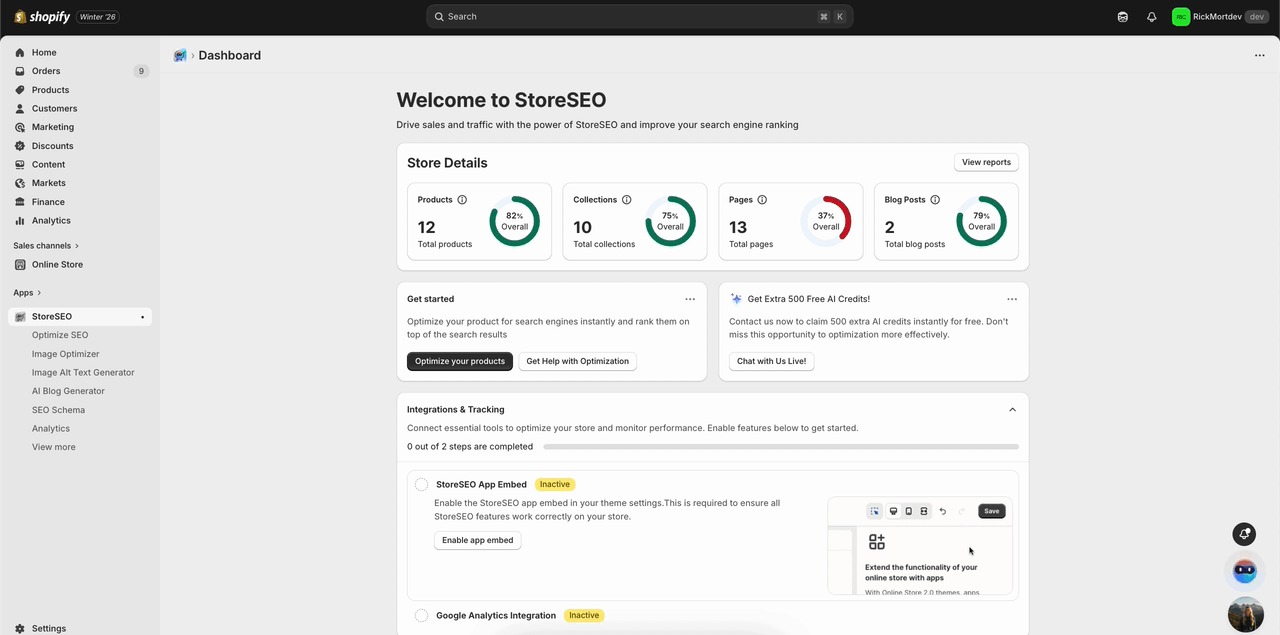
Étape 2 : Optimisez votre page de collection sur Shopify
Il est maintenant temps d'optimiser le Référencement de la page de collection Shopify. Comme vous pouvez le voir sur l'image ci-dessous, les détails SEO de votre collection sélectionnée sont affichés par StoreSEO. Dans le panneau latéral droit, vous trouverez également Analyse SEO de base et Analyse SEO détaillée pour trouver les facteurs clés qui doivent être traités pour améliorer le score SEO.
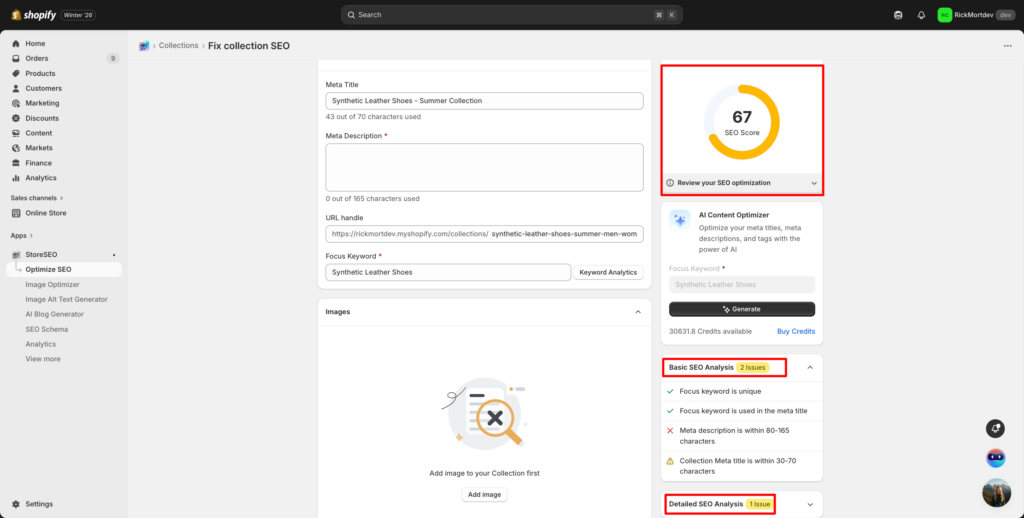
Analyse SEO de base
Commençons par Analyse SEO de base. Ici, nous devons nous assurer de différents critères tels que l'utilisation d'un mot-clé unique, son placement dans le méta-titre et le respect de quelques autres exigences. Nous allons maintenant vous montrer comment procéder un par un.
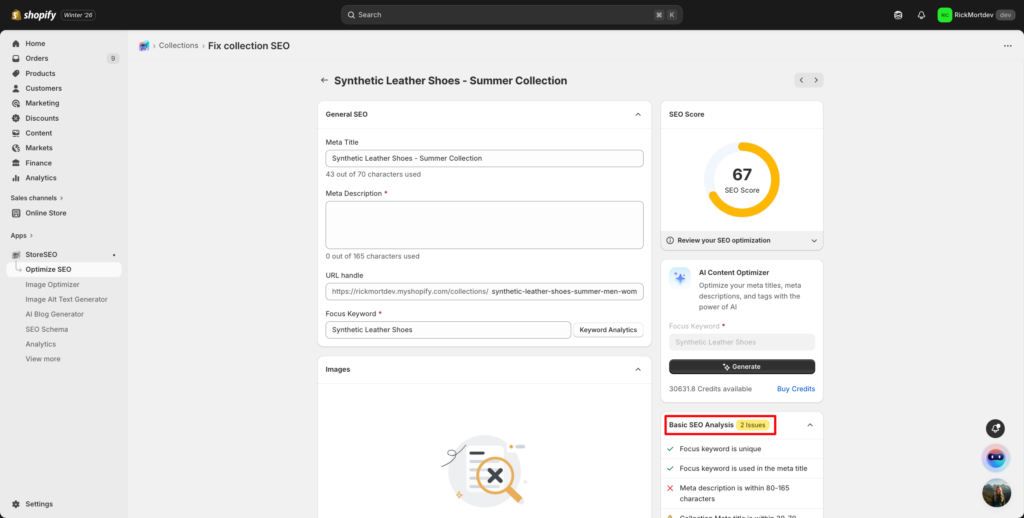
Une fois les étapes d'analyse SEO de base terminées, passez à l'analyse SEO détaillée.
Analyse SEO détaillée
Nous allons maintenant passer à la Analyse SEO détaillée. Pour cela, il est essentiel de veiller à ce que le mot-clé principal figure dans le titre de la collection, la méta-description et l'URL. Voici comment procéder.
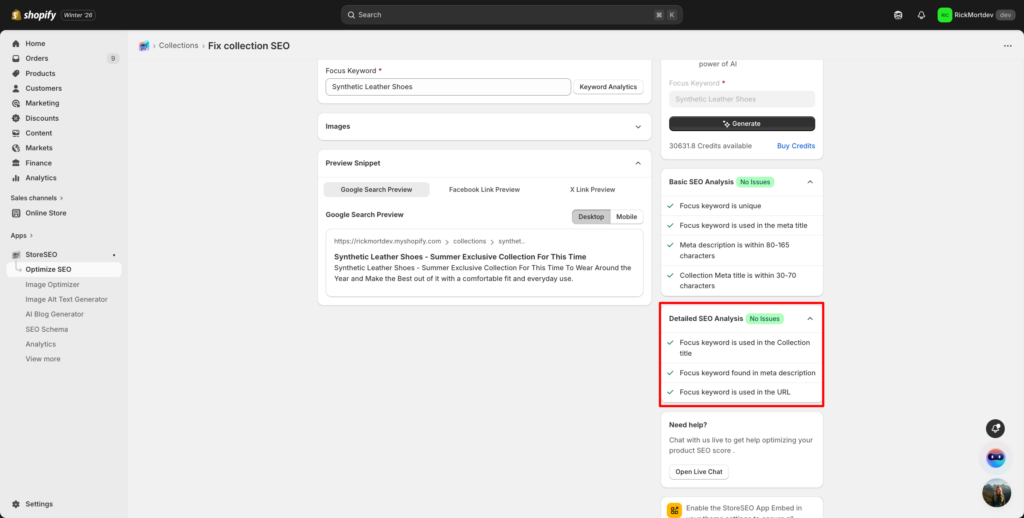
Pour une présentation complète avec captures d'écran et conseils avancés sur la recherche de mots clés et l'optimisation de contenu pilotée par l'IA : Consultez la documentation complète sur le référencement de votre boutique.
Aussi, n'hésitez pas à contacter notre équipe de soutien dédiéepour tout type de requête.
Stratégies avancées pour les pages de collection en 2026
Une fois les bases maîtrisées, ces tactiques avancées distinguent les bons magasins des excellents.
| 🧭 Zone stratégique | 💡 Tactique | 🧱 Détails de mise en œuvre | 🚀 Avantage SEO | 🧰 Prise en charge par les fonctionnalités StoreSEO |
| 🎯 Créer des variantes de collection axées sur l'intention | Ciblez différentes intentions de recherche avec des collections dédiées | – Créez plusieurs collections basées sur l'intention de l'utilisateur au lieu d'une seule version générique. – Exemples : – “ Chaussures de course pour hommes ” → spécifique au genre. – “ Chaussures de course légères ” → spécifique à une caractéristique. – “ Chaussures de trail imperméables ” → spécifique à un cas d'utilisation. – “ Meilleures chaussures de course pour débutants ” → spécifique à un public. – Personnalisez les descriptions et les métadonnées pour chaque variante. | – Augmente la couverture des mots clés pour de multiples intentions de recherche. – Capture les segments de recherche de niche et de longue traîne. – Améliore les taux de conversion en correspondant précisément à l'intention de l'utilisateur. | ✅ Contrôle automatisé des doublons. ✅ Outils de variation des mots clés. ✅ Modèles de métadonnées SEO uniques. |
| 🏗️ Mettre en œuvre des hiérarchies de collections intelligentes | Élaborer une hiérarchie de catégories claire et liée | – Organisez les collections par niveaux : - Niveau supérieur : Général (Chaussures, Vêtements, Accessoires). - Niveau intermédiaire : Spécifique (Chaussures de course, Chaussures décontractées, Chaussures habillées). - Niveau inférieur : Niche (Chaussures de trail, Chaussures de marathon). - Utilisez des liens internes et un fil d’Ariane pour indiquer la structure. | – Renforce les liens internes et les signaux de hiérarchie. – Aide les moteurs de recherche à comprendre les relations thématiques. – Distribue efficacement le PageRank. | ✅ Prise en charge intégrée du schéma de fil d'Ariane. ✅ Optimisation de la structure des URL. ✅ Liaison intelligente entre les collections parentes et enfants. |
| 📅 Tirez parti des collections saisonnières et tendances | Créez des collections temporaires ou basées sur les tendances | – Ajouter des collections à durée limitée pour : - “ Équipement de course d’hiver 2026 ” - “ Vêtements de sport durables ” - “ Essentiels d’entraînement pour marathon ” - “ Nouveautés ” / “ Éditions limitées ” - Optimiser rapidement le contenu grâce à l’édition en masse. - Archiver ou rediriger après la saison. | – Capture le trafic ciblé et urgent. – Maintient le contenu à jour et l'engagement des moteurs de recherche. – S'aligne sur le comportement des acheteurs lors d'événements spécifiques. | ✅ Outils d'édition SEO en masse. ✅ Gestion des archives et des redirections. ✅ Suivi saisonnier des mots-clés. |
| 🗣️ Optimisation pour la recherche vocale et conversationnelle | Adapter les collections aux requêtes en langage naturel et vocales locales | – Utilisez des mots-clés conversationnels de longue traîne, ressemblant à des questions posées à l'oral. – Ajoutez une FAQ répondant aux questions “ meilleur ”, “ près de chez moi ” et “ comment faire ”. – Rédigez des descriptions naturelles. – Incluez des modificateurs de lieu lorsque cela est pertinent. | – Améliore la visibilité dans les recherches vocales et mobiles. – Cible les extraits optimisés et les résultats conversationnels. – Améliore la pertinence du référencement local. | ✅ Analyse des mots clés pour les requêtes vocales. ✅ Intégration du schéma FAQ. ✅ Options de ciblage local et géographique. |
| 🧩 Créer des hubs de contenu centrés sur les collections | Intégrez des blogs et des guides qui renvoient vers des collections | – Créez des articles de blog thématiques avec des liens internes : - “ Le guide ultime pour choisir des chaussures de course ” → liens vers plusieurs collections de chaussures. - “ 10 essentiels indispensables de la garde-robe ” → liens vers des vêtements. - “ Comment créer une garde-robe capsule ” → liens vers plusieurs catégories connexes. - Utilisez un texte d’ancrage contextuel et des groupes de sujets. | – Développe l'autorité thématique et les signaux EEAT. – Améliore la profondeur des liens internes. – Augmente le temps de consultation et la valeur de la session. | ✅ Analyse des liens entre les blogs et les collections. ✅ Informations sur le regroupement des sujets. ✅ Suggestions de liens internes basées sur l'IA. |
Mesurer le succès : les indicateurs clés de performance qui comptent vraiment
L'optimisation sans mesure n'est que pure conjecture. Suivez ces indicateurs pour prouver le retour sur investissement :
| 📊 Catégorie métrique | 🔎 Indicateurs clés | 📘 Comment mesurer / interpréter | 🚀 Pourquoi c'est important | 🧰 Suivi par StoreSEO / Outils de support |
| 🌱 Principaux indicateurs SEO | Croissance du trafic organique | – Surveiller les sessions mensuelles sur la page de collection. – Suivre le ratio entre les nouveaux visiteurs et les visiteurs réguliers. – Mesurer les visites provenant des mots clés cibles dans les outils d'analyse. | – Indique la santé du trafic et la visibilité. – Permet d'identifier si le nouveau contenu attire de nouveaux utilisateurs ou fidélise les utilisateurs existants. | ✅ Tableau de bord analytique StoreSEO. ✅ Google Analytics / GA4. ✅ Rapports marketing Shopify. |
| Classement des mots clés | – Suivre les positions SERP des mots clés principaux. – Surveiller les variations de classement des mots clés de longue traîne. – Identifier les gains ou les pertes des extraits optimisés. | – Mesure la progression de la visibilité à travers les différentes étapes du tunnel de conversion. – Vous assure de posséder un espace de recherche précieux. | ✅ StoreSEO Keyword Tracker. ✅ Google Search Console. ✅ Intégrations Ahrefs / SEMrush. | |
| Données de la Search Console | – Examiner le nombre total d'impressions, de clics et le CTR dans Search Console. – Analyser l'évolution moyenne des positions au fil du temps. – Évaluer les tendances du CTR pour les pages de collection les plus performantes. | – Relie directement les efforts SEO clés au comportement des utilisateurs dans les résultats de recherche. – Révèle ce qui fonctionne dans les SERP. | ✅ Vue intégrée de la Search Console de StoreSEO. ✅ Accès direct à Google Search Console. | |
| 🤖 Métriques de visibilité de la recherche IA | Citations et références en IA | – Suivre les mentions de la marque/du produit dans ChatGPT, Perplexity ou Google AI Overviews (manuellement ou avec des outils de surveillance). – Mesurer la fréquence des citations ou des références par les LLM. | – Reflète l’autorité et l’inclusion dans les expériences de recherche génératives. – Nouvelle frontière de visibilité à mesure que la recherche par IA se développe. | ⚙️ Suivi manuel / outils de visibilité IA tiers.📄 Rapports StoreSEO (section IA personnalisée). |
| Performances LLMs.txt | – Surveiller la fréquence d'exploration des robots d'IA via les journaux du serveur. – Vérifier le trafic de référence provenant de sources générées par l'IA. – Suivre les augmentations du volume de recherche de la marque après son inclusion dans les données LLM. | – Indique la qualité de l'indexation de votre site par les moteurs LLM et IA. – Met en corrélation l'activité d'exploration de l'IA avec l'augmentation de la notoriété de la marque. | ⚙️ Surveillance des journaux du serveur. ✅ Informations d'indexation IA StoreSEO. 📊 Google Trends pour la recherche de marque. | |
| Signaux d'engagement | – Mesurer le temps passé sur la page (viser 2 minutes ou plus). – Maintenir le taux de rebond en dessous de 40%. – Suivre les pages par session (objectif 3 ou plus). | – Un fort taux d'engagement signale la qualité et la pertinence tant pour les utilisateurs que pour les systèmes d'IA. – Favorise un meilleur classement et une plus grande probabilité de citation. | ✅ Analyse comportementale StoreSEO. ✅ Rapports d'engagement Google Analytics. | |
| 💰 Indicateurs d'impact commercial | Attribution des revenus | – Attribuer les revenus générés par les pages de recouvrement. – Suivre le taux de conversion par type de recouvrement. – Surveiller la valeur moyenne des commandes (AOV) par type de recouvrement. | – Établit un lien direct entre les performances SEO et les résultats commerciaux. – Identifie les collections qui offrent le meilleur retour sur investissement. | ✅ Analyse des ventes Shopify. ✅ Rapports de suivi des revenus StoreSEO. |
| Gains d'efficacité | – Mesurer le temps gagné grâce à l'automatisation par rapport au référencement manuel. – Calculer le coût par acquisition (CPA) à partir du trafic organique. – Évaluer le retour sur investissement du référencement de la boutique par rapport aux alternatives payantes. | – Quantifie les améliorations opérationnelles et le retour sur investissement de la plateforme. – Utile pour les revues de performance trimestrielles. | ✅ Journaux d'optimisation SEO de la boutique. ✅ Rapports internes sur le retour sur investissement. |
Visez une augmentation de 30 à 501 TP3T du trafic organique de votre page de collection dans les 60 à 90 jours suivant l'optimisation. C'est le critère de réussite.
Erreurs SEO courantes à éviter pour les pages de collection
Même avec StoreSEO, vous pouvez compromettre vos résultats. Évitez ces pièges :
Erreur n° 1 : Contenu dupliqué dans plusieurs collections
Utiliser des descriptions identiques pour des collections similaires pénalise fortement votre référencement. Chaque collection nécessite un contenu unique (100%), même si certains produits se recoupent. L'outil d'optimisation de contenu IA de StoreSEO vous aide à générer rapidement des descriptions uniques.
Erreur n° 2 : Négliger l’expérience mobile
Plus de 751 millions de consommateurs naviguent sur mobile. Si votre page collection n'est pas optimisée pour mobile, vous perdez des ventes. Testez !
- Boutons et filtres tactiles
- Texte lisible sans zoom
- Temps de chargement rapides (moins de 3 secondes)
- Navigation et tri faciles
Les contrôles d'optimisation mobile de StoreSEO détectent ces problèmes.
Erreur n° 3 : Pages au contenu pauvre
Une collection ne comportant qu'un titre et une grille de produits ne sera pas référencée. Exigences minimales :
- Plus de 200 mots de contenu descriptif unique
- Proposition de valeur claire
- Informations utiles pour l'achat
- Suggestions de produits connexes
Ajoutez du contenu sous la grille des produits pour éviter de repousser les produits vers le bas.
Erreur 4 : Mauvaise maillage interne
Les collections restent isolées si elles ne sont pas correctement liées. Bonnes pratiques :
- Lien vers les collections associées dans les descriptions
- Utilisez un texte d'ancrage descriptif
- Créer des suggestions de collection “ Vous pourriez aussi aimer ”
- Créer une navigation de collection dans l'en-tête/le pied de page
Le maillage interne répartit l'autorité et aide les moteurs de recherche à comprendre les relations entre les éléments.
Erreur n° 5 : Oublier le contenu frais
Les collections obsolètes sont mal classées. Mettez-les à jour régulièrement :
- Mise à jour mensuelle de la sélection de produits
- Mettre à jour les descriptions en fonction de la saisonnalité
- Ajouter de nouveaux avis clients
- Modifier les balises méta pour les mots-clés tendance
Le suivi du score SEO de StoreSEO vous aide à identifier les collections nécessitant des mises à jour.
L'avenir du référencement des pages de collection : quelles sont les prochaines étapes ?
À mesure que nous avançons dans l’année 2026 et au-delà, l’optimisation des pages de collection évoluera dans trois directions principales :
L'optimisation par l'IA devient la norme
Le référencement traditionnel ne disparaîtra pas, mais l'optimisation par l'IA deviendra un prérequis :
- L'implémentation de LLMs.txt sera universelle
- Le balisage Schema sera étendu pour inclure des métadonnées spécifiques à l'IA
- Le contenu sera structuré par défaut pour l'analyse par IA.
- Une mise en forme prête à être citée sera exigée.
StoreSEO a déjà une longueur d'avance grâce à ses fonctionnalités d'optimisation par IA intégrées.
Personnalisation à grande échelle
Les pages de collection s'ajusteront dynamiquement en fonction de :
- Comportement de l'utilisateur et historique de navigation
- Situation géographique et tendances locales
- Produits saisonniers et tendance
- préférences individuelles et achats antérieurs
L'optimisation SEO devra prendre en compte ces éléments dynamiques tout en maintenant une optimisation de base solide.
Intégration de la recherche vidéo et visuelle
Les pages de collection comporteront de plus en plus de :
- Vidéos de démonstration de produits
- vues de produits à 360 degrés
- Fonctionnalités d'essayage en réalité augmentée
- fonctionnalités de recherche visuelle
L'optimisation des images et des vidéos pour la recherche sera aussi importante que l'optimisation du texte.
StoreSEO continue d'évoluer au rythme de ces tendances, garantissant ainsi la compétitivité de votre boutique Shopify.
Conclusion : Plan d'action pour votre page Collection
Les pages de collection sont votre atout SEO le plus sous-exploité. Grâce aux outils d'optimisation basés sur l'IA de StoreSEO, vous pouvez les transformer en véritables leviers de trafic et de conversion.
Votre plan d'action sur 30 jours :
Semaine 1 : Audit et priorisation
- Installez StoreSEO sur votre boutique Shopify
- Effectuez une analyse SEO sur toutes les pages de la collection.
- Identifier les 5 collections les plus prometteuses en termes de potentiel de trafic
- Définissez des indicateurs de référence dans Google Analytics
Semaine 2 : Optimiser les collections à haute priorité
- Intégrez les mots-clés principaux et les balises méta.
- Optimiser toutes les images de la collection
- Ajoutez le balisage de schéma et activez LLMs.txt
- Augmentez le contenu à plus de 200 mots
Semaine 3 : Développer et affiner
- Optimisez 10 pages de collection supplémentaires
- Créer de nouvelles collections spécifiques à l'intention
- Élaborer une structure de liens internes
- Ajouter des sections FAQ aux collections principales
Semaine 4 : Mesurer et itérer
- Améliorations du classement des avis
- Analyser les variations de trafic et de conversion
- Identifier les collections sous-performantes
- Planifiez le prochain cycle d'optimisation
Les boutiques qui réussiront en 2026 ne seront pas celles qui proposent le plus de produits, mais celles dont les pages de collection sont les mieux optimisées. StoreSEO vous donne les outils pour les rejoindre.
Et pour des mises à jour et des nouvelles plus intéressantes, abonnez-vous à nos blogs. Bonne chance!
Points clés à retenir
- Les pages de collection ciblent des mots clés à forte intention de recherche avec un volume de recherche supérieur à celui des pages produits individuelles, ce qui les rend essentielles à la croissance du trafic organique.
- StoreSEO automatise la complexité technique du référencement des pages de collection, des balises méta au balisage de schéma en passant par l'implémentation du fichier LLMs.txt
- L'optimisation pour la recherche par IA (AEO et GEO) n'est plus optionnelle : les pages de collection doivent être prêtes pour la citation dans ChatGPT, Perplexity et les aperçus de l'IA de Google.
- L'optimisation des images a un impact direct sur les indicateurs clés Web et les taux de conversion ; des images correctement compressées améliorent la vitesse de chargement des pages de 40 à 501 TP3T.
- La création de plusieurs variantes de collections axées sur l'intention (spécifiques au genre, aux fonctionnalités ou aux cas d'utilisation) génère plus de trafic de recherche que les collections génériques uniques.
- Mesurer le succès nécessite de suivre à la fois les indicateurs SEO traditionnels (classements, trafic) et les indicateurs de visibilité IA (citations, recommandations IA).
- Des mises à jour régulières et du contenu frais signalent la pertinence aux moteurs de recherche, empêchant ainsi la stagnation du classement des pages de collection.