
We have been watching a massive shift happen in how people discover products and brands online. Search is no longer just about Google. Today, shoppers are typing questions directly into Claude, ChatGPT, and Perplexity and getting curated, conversational answers that recommend specific stores, products, and services. If your Shopify store is not showing up in those answers, you are missing a growing slice of high-intent traffic clearly because you don’t have LLMs.txt on your Shopify store.
That is exactly why LLMs.txt matters right now. It is a relatively new but fast-gaining standard that helps large language models (LLMs) understand your store better, so they can reference you confidently when answering buyer questions. Think of it as a robots.txt file built specifically for AI.
In this blog, we are going to walk you through everything you need to know. What LLMs.txt is, why it matters for Shopify specifically, how to create and implement it step by step, and how to optimize it so that AI search engines like Claude, ChatGPT, and Perplexity actually cite your store in their responses.
| Krótko mówiąc As shoppers shift from Google to AI assistants like Claude, ChatGPT, and Perplexity, Shopify stores must adapt to Generatywna optymalizacja silnika (GEO). The key to staying visible is LLMs.txt—a plain-text Markdown file that acts as a “robots.txt for AI,” providing models with a structured summary of your brand, products, and most important content. |
Understanding LLMs.txt: What It Is and Why It Exists
The Problem LLMs.txt Solves
Large language models are trained on massive datasets, but they cannot crawl every website in real time the way Google does. When a user asks Claude or ChatGPT to recommend a Shopify store selling organic skincare products, the AI has to work with whatever it already knows about your site, plus any retrieval augmented generation (RAG) layer that supplements its knowledge.
The problem is that AI models often encounter Shopify stores that are rich in JavaScript-rendered content, dynamic product listings, and paginated catalogs that are notoriously difficult for LLMs to parse cleanly. That means the AI might skip over your store entirely, even if you sell exactly what the user needs.
LLMs.txt addresses this by giving you a clean, structured, plain-text file at the root of your domain that tells AI systems what your store is about, what pages matter most, and how to understand your catalog. It is a direct communication channel between your store and the AI.
| NOTE: LLMs.txt was first proposed by Answer.AI founder Jeremy Howard in September 2024. The format has since been adopted by hundreds of websites and is gaining formal recognition from AI companies as a preferred format for machine-readable site summaries. |
How LLMs.txt Differs from robots.txt and sitemap.xml
It is worth clarifying the difference between these three files because each one serves a distinct purpose in how machines interpret your site.
robots.txt tells crawlers what they can and cannot access. sitemap.xml tells search engines where your pages are. Neither of these files explains what your content means or why it matters.
LLMs.txt does something different. It provides a concise, human-readable (and AI-readable) summary of your site in Markdown format. It explains your brand, your product categories, your key pages, and your content in a structured way that language models can parse and retain as context when generating answers.
| EXPERT INSIGHT: From our experience working with hundreds of Shopify merchants through StoreSEO, the stores that structure their content for machine readability consistently outperform those that focus only on visual design. LLMs.txt is the next step in that philosophy applied directly to AI search. |
The Rise of Generative Engine Optimization (GEO)
You may have heard the term GEO, or Generative Engine Optimization, floating around in SEO circles. GEO refers to the practice of optimizing your content and technical setup specifically to rank in AI-generated answers, not just traditional search result pages.
LLMs.txt sits squarely at the intersection of GEO and traditional SEO. It is a technical signal you can send directly to AI systems that says: here is what we do, here is what we sell, here is why you should cite us when users ask about products in our niche.
This is not some distant future concern. Right now, in March 2026, a significant and growing percentage of product discovery journeys begin with an AI query. If your Shopify store is not optimized for generative engines, you are already losing ground to competitors who are.
How AI Search Engines Like Claude, ChatGPT, and Perplexity Discover Shopify Stores
The Role of Web Retrieval in AI Responses
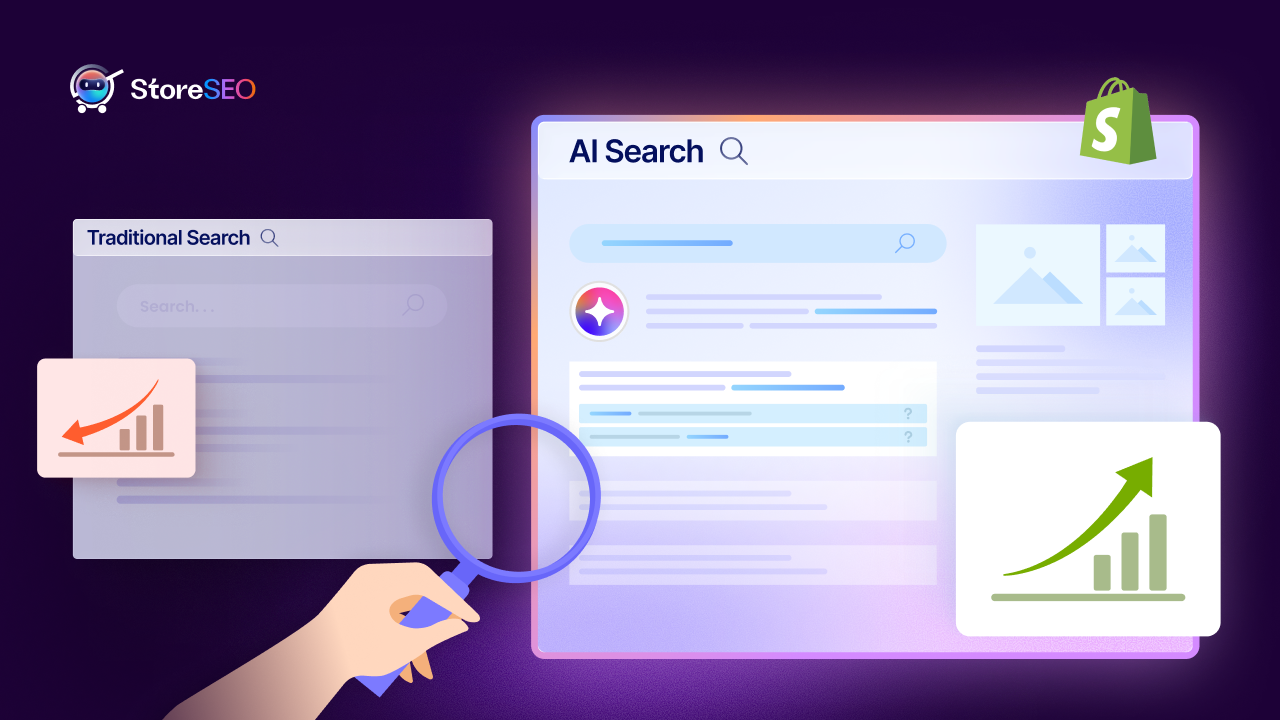
Modern AI assistants do not operate from a static knowledge base alone. Claude, ChatGPT (when web search is enabled), and Perplexity all have the ability to retrieve live web content and incorporate it into their answers. This retrieval process, often called RAG or retrieval augmented generation, means that well-structured, accessible web content directly influences what the AI recommends.
When a user asks Perplexity for the best Shopify stores for handmade jewelry, Perplexity crawls the web, finds relevant content, and synthesizes an answer. The stores that get cited are the ones whose content is clear, authoritative, and machine-parseable. LLMs.txt improves your chances of being among them.
What These AI Engines Actually Look For
Based on how these systems work, there are a few core factors that influence whether your Shopify store gets cited in an AI-generated answer.
- Clarity of purpose: Does the AI immediately understand what your store sells and who it serves?
- Content depth: Do you have enough substantive content, such as blog posts, FAQs, and detailed product descriptions, for the AI to draw from?
- Structured data: Have you implemented schema markup so machines can parse product details, reviews, and pricing?
- Authority signals: Are you cited or linked from credible sources that AI training data recognizes?
- Machine readability: Is your content accessible without JavaScript execution, which many AI crawlers cannot perform?
| NOTE:Perplexity has publicly stated that they index content differently from traditional search engines. Their crawler focuses on content clarity and semantic structure. Shopify stores that rely heavily on JavaScript rendering for product display are at a significant disadvantage with these crawlers. |
Why Shopify Stores Face Unique Challenges
Shopify is a fantastic platform for building stores, but it has some characteristics that can create friction for AI crawlers. Dynamic collection pages, JavaScript-heavy themes, paginated product listings, and thin product descriptions are all common on Shopify and all problematic for LLM-based discovery.
LLMs.txt on your Shopify store helps you compensate for these platform-level limitations by creating a static, accessible summary of your most important content. It does not replace good on-page SEO, but it gives AI systems a reliable fallback when they cannot parse your dynamic content cleanly.
Anatomy of a Well-Structured LLMs.txt File
The Core Format
LLMs.txt follows a simple Markdown structure. The file lives at yourdomain.com/llms.txt and is publicly accessible. Here is what the core sections look like and what each one communicates to an AI system.
| # [Your Store Name] > [One-paragraph brand summary: who you are, what you sell, who you serve] ## About[Detailed description of your store, brand values, and product philosophy] ## Products[Overview of your main product categories with brief descriptions] ## Key Pages- [Page Title](URL): [Brief description of the page]- [Page Title](URL): [Brief description of the page] ## Blog & Resources- [Post Title](URL): [What a reader learns from this post] ## FAQs[Common questions your customers ask with clear answers] ## Contact & Policies[Shipping, return, and contact information] |
Breaking Down Each Section
The H1 Header: Your Store Name
This is the anchor of your LLMs.txt file on your Shopify store. It should be your exact brand name as you want it cited by AI systems. Consistency matters here because AI models associate citations with specific entities. If your store is called Green Leaf Botanicals, that is exactly what should appear here, not a keyword-stuffed variation.
The Blockquote Summary
This is arguably the most important section of the entire file. It is a concise, single-paragraph summary of your store that an AI can lift almost directly when answering a user query. Write it the way you would want to be introduced to a potential customer. Be specific about what you sell, who you sell it to, and what makes you different.
The About Section
This is where you expand on your brand story and values. AI systems use this section to understand your positioning, which helps them match you to the right user queries. If you sell eco-friendly baby products, say so explicitly. If you are a Shopify store focused on handcrafted goods, make that clear here.
Products Section
List your main product categories with enough detail that an AI can match you to specific product queries. Do not just say shoes. Say handcrafted leather dress shoes for men, sizes 6 to 16. Specificity is what gets you cited in specific queries.
Key Pages
This is your curated list of the most important URLs on your store. Include your homepage, main collection pages, your most popular products, your about page, and any landing pages that explain your brand well. Each entry should have a brief description explaining what the page contains.
Blog and Resources
If you have a Shopify blog (and you should), list your most informative posts here with brief descriptions. AI systems love citing authoritative content when answering questions. Your blog posts are your opportunity to be the cited source.
Często zadawane pytania
This section is gold for AEO, or Answer Engine Optimization. Write out the actual questions your customers ask most frequently and give clear, complete answers. When someone asks an AI the same question, your store becomes a candidate to be cited as the source of the answer.
| EXPERT INSIGHT:At StoreSEO, we have seen that stores with well-structured FAQ sections in their LLMs.txt files get cited significantly more often in conversational AI responses related to product questions. The AI essentially treats your FAQ as a trusted reference document. |
Optional: LLMs-Full.txt on Your Shopify Store for Deeper AI Indexing
There is an extended variant called llms-full.txt that some advanced implementers use. Where LLMs.txt is a concise summary, llms-full.txt is a more comprehensive document that includes fuller descriptions of all your pages, complete product details, and extended content. This is particularly useful if you have a large catalog or a content-rich store with many blog posts.
For most Shopify stores starting out, the standard LLMs.txt file is the right starting point. We recommend adding llms-full.txt once you have the standard version well optimized.
Step-by-Step: How to Create LLMs.txt on your Shopify Store
Step 1: Audit Your Store Content Before Writing
Before you write a single line of LLMs.txt on your Shopify store, spend time auditing what your store actually contains. You want to know your top-performing collection pages, your most visited product pages, your best-performing blog posts, and the questions your customer support team answers most often.
This audit does not have to be complex. Pull a simple report from your Shopify analytics and Google Search Console to identify your top 20 pages by traffic and your most common search queries. These pages and topics should form the backbone of your LLMs.txt content.
Step 2: Write Your Brand Summary Carefully
Your blockquote brand summary needs to be tight, specific, and keyword-rich without feeling forced. Write it as a confident, one-paragraph introduction of your store that you would be proud to have an AI read aloud to a potential customer.
Here is an example of a weak brand summary versus a strong one:
| WEAK:> We sell great products at good prices with fast shipping. STRONG:> Bloom & Craft is a Shopify store specializing in handmade> botanical candles and home fragrance products made from 100%> soy wax and ethically sourced essential oils. We serve eco-> conscious homeowners across the US and Canada who want clean,> non-toxic home fragrance without compromising on luxury. |
The strong version gives an AI system everything it needs to cite you accurately when users ask about soy candles, eco-friendly home fragrance, or clean-burning candle brands.
Step 3: List Your Products with Semantic Specificity
When listing your products, think in terms of the specific queries users might type into an AI assistant. A user is not going to ask an AI for shoes. They are going to ask for wide-width running shoes for women with plantar fasciitis. Your product descriptions in LLMs.txt should reflect this level of specificity.
Group products by category and give each category a two-to-three sentence description that captures the key attributes, use cases, and target customers. This semantic richness is what makes your LLMs.txt file valuable for AI matching.
Step 4: Curate Your Key Pages List Thoughtfully
You do not need to list every page on your store. In fact, listing too many pages dilutes the signal. Focus on the pages that best represent your store to a new visitor who has never heard of you before. These typically include:
- Your homepage, with a note about what a visitor will find there
- Your 3 to 5 most important collection or category pages
- Your 5 to 10 best-selling or most representative product pages
- Your About page, especially if it communicates your brand story well
- Any pages that explain your unique value proposition, such as a sustainability page or a craftsmanship page
- Your FAQ or Help Center page if it has substantial content
Step 5: Upload LLMs.txt on Your Shopify Store Root
This is where Shopify adds a small technical wrinkle. By default, Shopify does not allow you to upload arbitrary files to your domain root through the standard theme editor. There are a few ways to handle this.
Method A: Using Shopify’s Theme Files (Simplest Option)
You can create a page template in Shopify Liquid that renders your LLMs.txt content and configure it to be accessible at /llms.txt using a URL redirect. Here is the process:
- In your Shopify admin, go to Online Store and then Themes.
- Open the theme editor and navigate to the templates folder.
- Create a new template called page.llmstxt.liquid.
- Paste your LLMs.txt content into the template, formatted as plain text.
- Create a new Shopify page and assign it the page.llmstxt template.
- Set up a URL redirect from /llms.txt to the page you just created.
| NOTE:If you use this method, make sure the template strips out all HTML and renders only plain text. An LLMs.txt file served with HTML markup loses much of its value because AI parsers will need to filter out the formatting. |
Method B: The StoreSEO LLMs.txt Generator Approach
At StoreSEO, we have been working on integrations that allow Shopify merchants to generate and serve LLMs.txt files directly from within their SEO workflow. If you are already using StoreSEO on your Shopify store, keep an eye on our app updates as we continue rolling out AI SEO features made specifically to the LLMs.txt standard.
Krok 1: Przejdź do opcji Ustawienia
Z pulpitu nawigacyjnego Shopify przejdź do Aplikacje sekcja i wybierz 'SklepSEO.' Po przejściu do panelu StoreSEO kliknij „Ustawienia” następnie przewiń w dół i wybierz Generator plików LLMs.txt opcja.
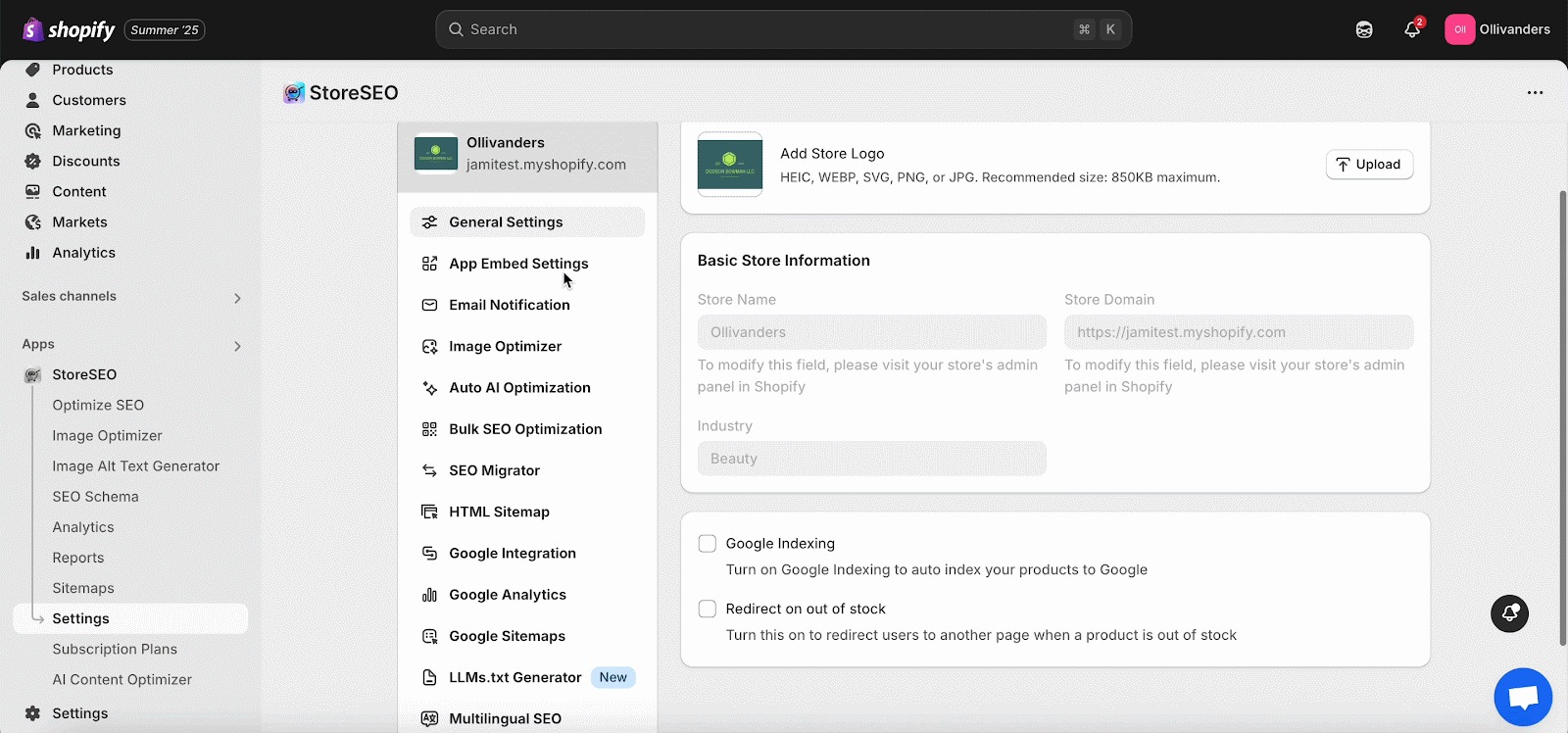
Krok 2: Wygeneruj plik LLMs.txt
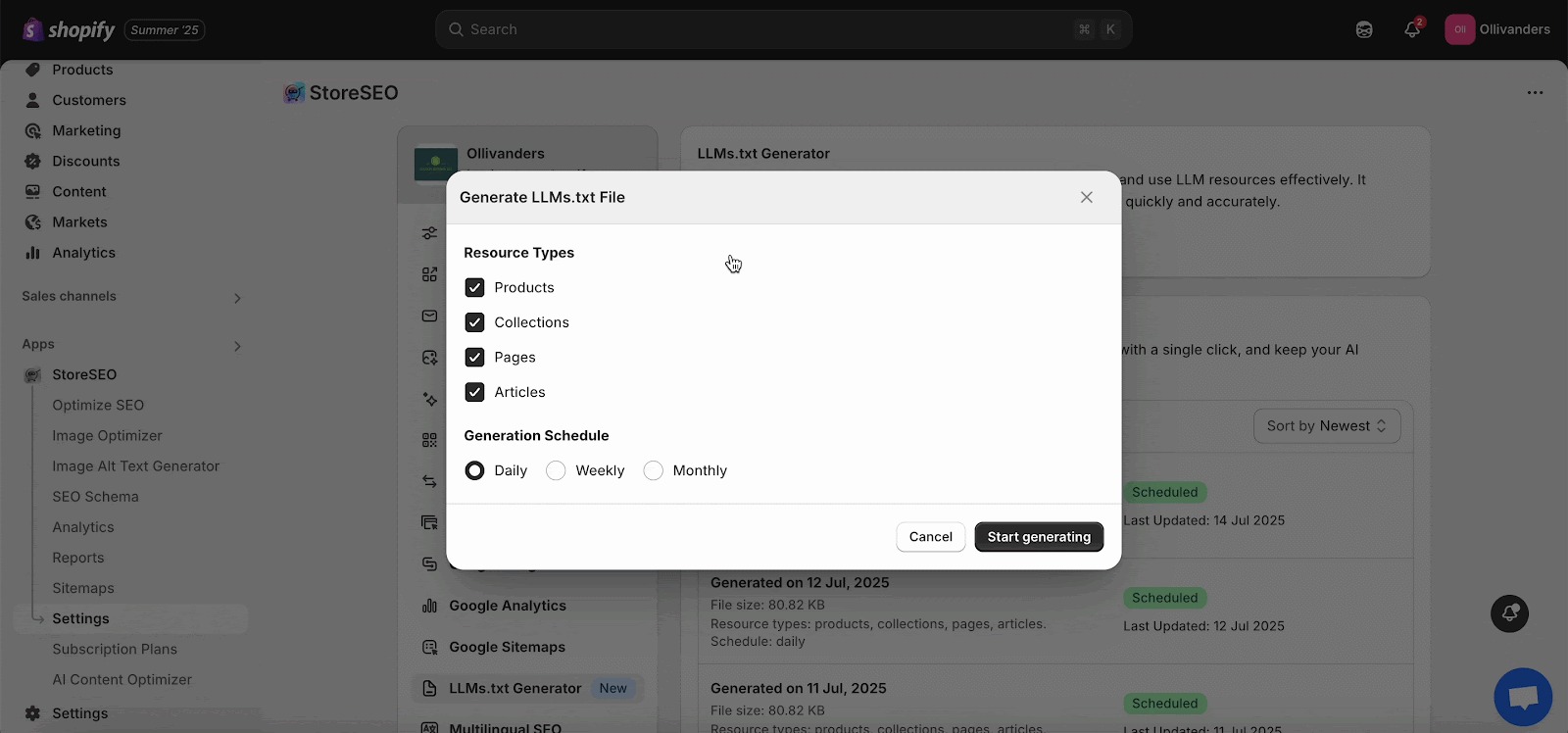
Teraz wystarczy kliknąć "Spowodować" przycisk. Zobaczysz komunikat: „Pokolenie w kolejce” Co oznacza, że proces się rozpoczął. Poczekaj chwilę, a wkrótce wygenerowany plik pojawi się na liście i będziesz mógł go obejrzeć.
Możesz również wybrać konkretne typy zasobów do utworzenia pliku. Dostępne opcje to produkty, kolekcje, strony, artykuły i harmonogramy generowania. W przypadku harmonogramów możesz wybrać harmonogram dzienny, tygodniowy lub miesięczny, w zależności od potrzeb. Ułatwia to dostosowanie procesu generowania do bieżących potrzeb.
Krok 3: Wyświetl wygenerowany plik
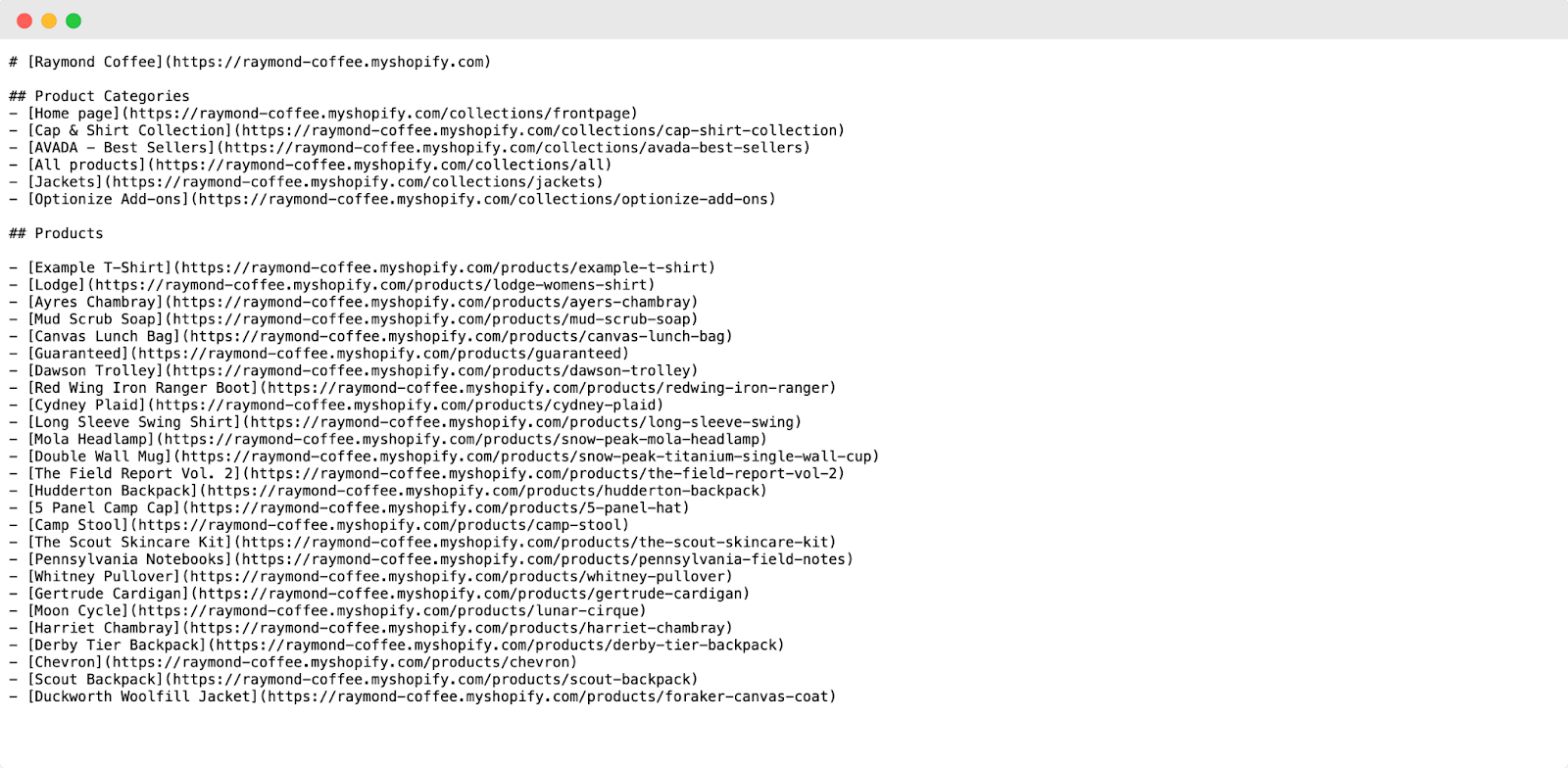
Gdy plik LLMs.txt będzie gotowy, możesz go łatwo wyświetlić, klikając ikonę oka lub podglądu, jak pokazano poniżej. Spowoduje to otwarcie pliku tekstowego do pobrania.
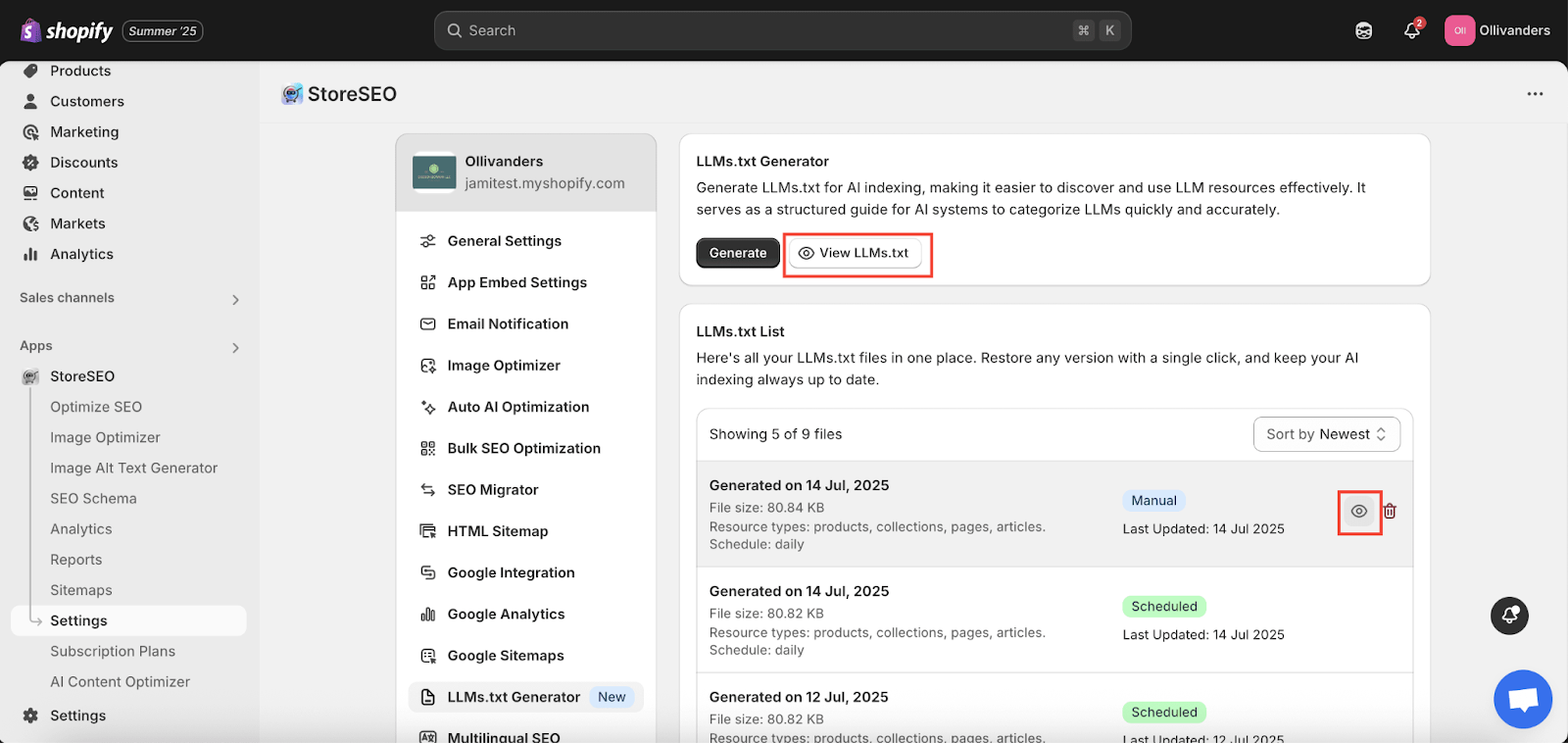
Notatka: Przechowujemy 10 najnowszych wygenerowanych plików do wglądu. Po wygenerowaniu nowego pliku najstarszy zostanie automatycznie usunięty, dzięki czemu na liście zawsze zobaczysz 10 najnowszych plików. Pomaga to zachować porządek i aktualność.
Read the detailed documentation on how to use this feature step by step, or watch the video tutorial here:
Optimizing LLMs.txt for Claude, ChatGPT, and Perplexity Specifically
How Claude Processes Site Context
Claude, made by Anthropic, is particularly attentive to the clarity and internal consistency of content it encounters. When Claude retrieves or references your store, it is looking for a coherent brand narrative. Inconsistent messaging across your LLMs.txt, your product pages, and your blog posts will reduce Claude’s confidence in citing you.
For Claude specifically, we recommend that your LLMs.txt brand summary closely mirrors the language on your About page. Consistency between these two surfaces signals to Claude that your brand identity is stable and trustworthy.
How ChatGPT’s Web Browsing Picks Up Your Store
When ChatGPT has web browsing enabled, it retrieves content similarly to how a traditional crawler would, but it prioritizes clean, navigable content structures. Your LLMs.txt file acts as a quick orientation document that ChatGPT can use to immediately understand your store before diving into individual pages.
For ChatGPT optimization, make sure your Key Pages section is comprehensive and that every URL you list is working and returns clean content. ChatGPT’s browsing tool will sometimes follow links from your LLMs.txt, so broken links or slow-loading pages will negatively affect your representation.
| EXPERT INSIGHT:We tested a scenario where we added a Shopify store’s LLMs.txt file and then asked ChatGPT (with browsing enabled) to recommend stores in that niche. The store with the well-structured LLMs.txt was cited within the first three recommendations, while competing stores without the file were not mentioned at all, despite having similar product quality and pricing. |
How Perplexity Indexes and Cites Shopify Stores
Perplexity is arguably the most aggressive web-retrieval AI assistant right now. It actively crawls and indexes web content in near-real time, making it particularly responsive to fresh, well-structured content. For Perplexity, your LLMs.txt file is most valuable when combined with active content production.
Perplexity tends to cite stores that are referenced by multiple sources, have substantial blog content on relevant topics, and have clear, specific product information. Your LLMs.txt file sets the stage, but your blog and product content is what Perplexity will actually cite in its answers.
Universal Optimization Principles Across All Three Platforms
While each AI platform has its nuances, there are optimization principles that work across Claude, ChatGPT, and Perplexity:
- Be specific over generic: Generic descriptions get ignored. Specific, detailed descriptions get cited.
- Use natural language, not keyword stuffing: Write for how people actually ask questions, not for traditional keyword density.
- Keep information current: An outdated LLMs.txt file with discontinued products or old prices undermines trust in AI systems.
- Mirror your schema markup: The product and organization information in your LLMs.txt should match your structured data markup exactly.
- Cite your own authority: If you have press mentions, awards, or notable partnerships, include them in your About section.
Complementary Strategies: Building the Full AI SEO Stack for Shopify
Ustrukturyzowane dane i znaczniki schematu
LLMs.txt is most powerful when it works in combination with proper schema markup on your Shopify store. Schema markup, implemented through JSON-LD in your theme, tells search engines and AI crawlers exactly what type of content each page contains.
For Shopify stores, the most important schema types to implement are Product schema (with price, availability, and review data), Organization schema (with your brand information), BreadcrumbList schema (for navigation context), and FAQPage schema (for your FAQ content).
| NOTE: StoreSEO has SEO schema markup for for Shopify stores. If you are managing schema manually, make sure your JSON-LD output for product pages includes all fields that AI systems use to match products to user queries, including brand, material, color, size range, and product category. |
Optimizing Product Descriptions for AI Queries
Your product descriptions are a critical part of your AI discoverability stack. Thin product descriptions with just a few lines of text are not enough to earn AI citations. Each major product or product category should have a description that covers what the product is, who it is for, what problem it solves, key specifications or attributes, and what makes it different from alternatives.
Think of each product description as a mini-article that answers every question a shopper might have before buying. This depth of content is exactly what AI systems look for when deciding which products to recommend.
Your Shopify Blog as an AI Citation Engine
If you want AI systems to cite your store as an authority, your blog is your most powerful tool. AI systems are built on training data that heavily weights authoritative, informative content. When your Shopify blog publishes genuinely useful guides, comparisons, and how-to content, you create assets that AI systems draw from when answering related questions.
The key is to write blog posts that directly answer the questions your target customers ask. If you sell running shoes, write posts that answer questions like how to choose running shoes for wide feet or what is the difference between stability and neutral running shoes. These are exactly the queries that send people to AI assistants, and if your post is the best answer available, you will get cited.
Building Topical Authority Through Content Clusters
Topical authority is the concept of becoming a recognized expert on a specific topic by publishing comprehensive, interconnected content around that topic. AI systems, like traditional search engines, favor sources that demonstrate deep expertise in a specific domain over generalist sites that cover everything superficially.
For Shopify stores, this means building content clusters around your core product categories. If you sell pet supplies, you want a cluster of content covering pet nutrition, pet grooming, pet behavior, and pet health, all linking back to relevant products. This interconnected web of content sends strong authority signals to both traditional search engines and AI systems.
Getting Cited by AI-Indexed Sources
AI indexing systems weigh content from authoritative third-party sources very highly. Getting your store mentioned in industry publications, roundup posts, and comparison articles dramatically increases your chances of being cited by AI systems, because those third-party sources carry authority that the AI inherits when it synthesizes information from them.
Strategies for earning these citations include digital PR outreach to industry publications, getting listed in curated gift guides and product roundups, earning verified reviews on platforms like Trustpilot or Google, and building backlinks from relevant niche sites and blogs.
Measuring Success: How to Know If Your LLMs.txt Is Working
Direct Citation Testing
The most straightforward way to test whether your LLMs.txt is having an effect is to directly query Claude, ChatGPT, and Perplexity with the types of questions your target customers might ask. Note whether your store appears in the responses. Do this before and after implementation to establish a baseline comparison.
Be systematic about this. Create a list of 20 to 30 queries that are relevant to your store and test each one monthly. Track which AI platforms cite you, how frequently, and how accurately they describe your store and products.
Traffic Analysis for AI Referrals
In your Shopify analytics and Google Analytics, look for referral traffic from domains associated with AI systems. Perplexity in particular sends identifiable referral traffic because users click through from Perplexity’s interface to the cited sources. A growing stream of referrals from Perplexity is a strong indicator that your AI SEO efforts are paying off.
You may also see changes in direct traffic patterns as more users arrive at your store after having your brand mentioned by an AI assistant. These users often bypass traditional search entirely, arriving directly because they heard your store name from an AI recommendation.
Brand Mention Monitoring
Set up brand monitoring alerts for your store name using tools like Google Alerts, Mention, or Brand24. As AI-generated content proliferates across blogs, social media, and forums, you will start seeing your store name cited in content that was itself generated with AI assistance. This second-order effect is a meaningful indicator of growing AI visibility.
| EXPERT INSIGHT: A practical metric we track internally at StoreSEO is what we call the AI Citation Rate: the percentage of relevant test queries across Claude, ChatGPT, and Perplexity that result in a mention of the store being tested. For optimized stores, this rate tends to be 3x to 5x higher than for stores without LLMs.txt and accompanying AI SEO work. |
Common Mistakes to Avoid When Implementing LLMs.txt on Shopify
Writing for Keyword Density Instead of Clarity
The instinct to stuff your LLMs.txt with keywords the way you might approach a traditional meta description is understandable but counterproductive. AI systems are built to understand language naturally. They respond to clear, accurate, specific writing, not to unnatural keyword repetition. Write your LLMs.txt the way you would describe your store to a smart friend.
Listing Too Many Pages
Including every URL on your store in the Key Pages section dilutes the signal and makes it harder for AI systems to identify your most important content. Be selective. Five to fifteen carefully chosen URLs with good descriptions are far more valuable than fifty URLs with no context.
Neglecting to Update the File
An LLMs.txt file that reflects your store from two years ago is worse than no file at all, because it will cause AI systems to describe your store inaccurately. Set a calendar reminder to review and update your LLMs.txt file at least quarterly, or whenever you launch a major new product category or make a significant brand change.
Ignoring the Rest of the AI SEO Stack
LLMs.txt is a valuable component, but it is not a magic solution by itself. Stores that see the best results from LLMs.txt implementation are those that also have strong structured data, rich product descriptions, an active blog, and external citation signals. LLMs.txt amplifies a good foundation; it cannot create one from scratch.
Serving the File with HTML Headers
If your LLMs.txt implementation uses a Shopify page template and accidentally serves HTML markup around the Markdown content, the file loses much of its value. Always verify that your file is serving as clean plain text by checking the page source and response headers after implementation.
The Future of AI SEO for Shopify: What to Expect Next
LLMs.txt Is Becoming an Expected Standard
The LLMs.txt standard is moving toward mainstream adoption at a pace that is reminiscent of how SSL certificates moved from optional to effectively required in the mid-2010s. Right now, early adopters are gaining a meaningful first-mover advantage. Within the next 12 to 24 months, having an LLMs.txt file will likely be considered table stakes for any serious e-commerce operation, much like having a sitemap is today.
AI-Native Search Interfaces Will Keep Growing
The trend toward AI-native search interfaces is not slowing down. Anthropic, OpenAI, and Perplexity are all investing heavily in making their products the starting point for product discovery, not just question answering. As these platforms grow their user bases and improve their shopping-related features, the stakes for AI discoverability will only increase.
Shopify merchants who build a strong AI SEO foundation now will be well-positioned as these platforms mature and potentially introduce commerce-specific features like direct product carousels, AI-driven shopping assistants, and affiliate-style citation programs.
StoreSEO’s Commitment to AI-Ready Shopify SEO
At StoreSEO, our mission has always been to make Shopify SEO accessible, effective, and forward-thinking. LLMs.txt is a central part of what we are building toward as we evolve our platform to serve the AI search era. We are committed to giving Shopify merchants the tools, insights, and automation they need to stay visible as the search landscape continues to transform.
If you are not yet using StoreSEO on your Shopify store, we encourage you to visit storeseo.com and see how we can help you build a complete AI-ready SEO strategy, starting with the technical foundations and extending all the way to content strategy and performance measurement.
Wrapping Up: Your Action Plan for LLMs.txt on Shopify
We have covered a lot of ground in this guide, so let us summarize the key action steps you should take to implement LLMs.txt on your Shopify store and start building your AI search visibility.
- Audit your store content to identify your most important pages, products, and blog posts.
- Write a specific, detailed brand summary that accurately represents what you sell and who you serve.
- Create your LLMs.txt file using the Markdown structure outlined in this guide.
- Implement the file on your Shopify store using one of the three methods we described.
- Verify that the file is accessible at yourdomain.com/llms.txt as clean plain text.
- Test your AI citation rate by querying Claude, ChatGPT, and Perplexity with relevant customer queries.
- Complement your LLMs.txt with strong schema markup, rich product descriptions, and regular blog publishing.
- Monitor your results monthly and update your LLMs.txt file quarterly.
| START HERE: Visit storeseo.com to explore how StoreSEO’s Shopify SEO tools can help you implement AI-ready optimization across your entire store, including automated schema markup, content analysis, and the AI SEO features we are rolling out throughout 2026. |
The shift to AI-powered search is already underway. Shopify merchants who move quickly on LLMs.txt and broader AI SEO will build a compounding advantage over competitors who wait. The stores that get cited by Claude, ChatGPT, and Perplexity today are the stores that will dominate AI-mediated product discovery tomorrow.
We are here to help you be one of them.