
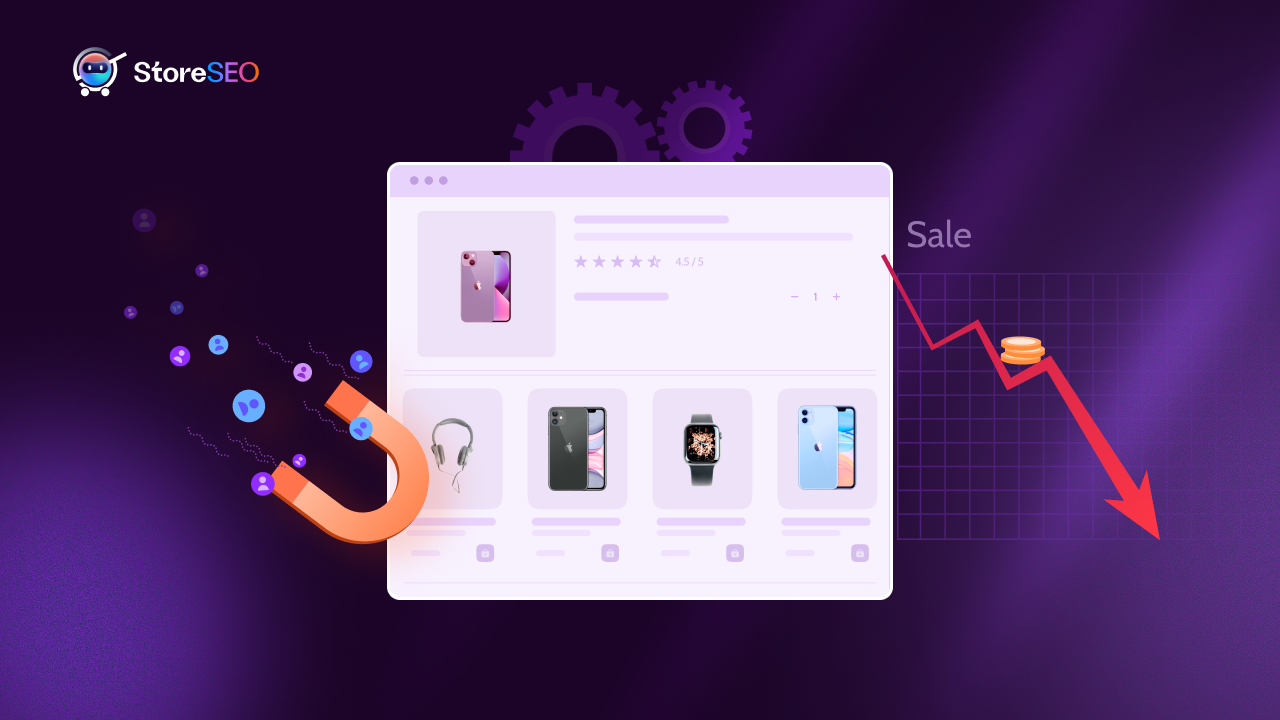
If a Shopify store attracts traffic but no sales, the issue rarely stems from traffic volume—it’s execution. Common culprits include poor website performance, unclear user flows, weak trust signals, complicated checkout processes, mobile optimization gaps, and misaligned visitor expectations. Each friction point silently drives potential customers away. This comprehensive guide identifies 13 specific conversion barriers and provides actionable solutions backed by industry research and proven optimization strategies.
Master Conversion Issues Table: Why Your Shopify Store Attracts Traffic But No Sales
| Issue Category | Primary Problem | Impact on Conversions | Fix Difficulty | Priority Level |
| Page Speed | Load times >3 seconds | Abandonment rate increases 32% per second[1] | Średni | Critical |
| Sygnały zaufania | Missing reviews/security badges | 70% abandonment due to trust concerns[2] | Niski | Critical |
| Strony produktów | Poor descriptions/images | 90% drop between landing and cart[3] | Średni | Wysoki |
| Mobile Experience | Non-responsive design | 60% of traffic converts poorly[4] | Wysoki | Critical |
| Checkout Friction | Mandatory account creation | 24% cart abandonment[5] | Niski | Critical |
| Nawigacja | Confusing menu structure | Users leave within 5 seconds[6] | Średni | Wysoki |
| Pricing Transparency | Hidden fees at checkout | 48% abandon due to unexpected costs[7] | Niski | Critical |
| Call-to-Action | Weak or unclear CTAs | 300% lift possible with optimization[8] | Niski | Średni |
| Product Selection | Decision fatigue (100+ products) | Paralysis leads to zero purchases[9] | Średni | Wysoki |
| Value Proposition | Unclear differentiation | Visitors don’t understand “why buy here”[10] | Średni | Wysoki |
| Dowód społeczny | No customer testimonials | Trust deficit prevents conversion[11] | Niski | Wysoki |
| Return Policy | Unclear or restrictive | Major hesitation factor[12] | Niski | Średni |
| Search Functionality | Poor on-site search | 30% rely on search to find products[13] | Średni | Średni |
Understanding Where Visitors Drop Off
Before diagnosing why visitors leave, store owners must identify where they exit. Shopify Analytics provides critical insights into user behavior at each stage of the conversion funnel[3].
The Two Critical Drop-Off Points
Most Shopify stores lose potential customers at two distinct stages:
Stage 1: Landing to Product Page
Visitors bounce immediately after landing on the homepage, collection page, or product page. This scenario indicates problems with first impressions, messaging clarity, or product presentation.
Stage 2: Cart to Checkout
Visitors add items to their cart but abandon before completing the purchase. This points to checkout friction, unexpected costs, or trust concerns at the final conversion moment.
Diagnostic Metrics to Review
Store owners should analyze these key metrics in Shopify Analytics:
- Sessions vs. Add to Cart Rate: A gap exceeding 90% suggests product page issues
- Add to Cart vs. Reached Checkout: A drop-off greater than 80% indicates cart experience problems
- Reached Checkout vs. Completed Purchase: Significant differences reveal checkout friction
- Average Session Duration: Under 30 seconds typically means immediate bounce
- Pages Per Session: Less than 2 pages suggests navigation or engagement issues
These metrics pinpoint where to focus optimization efforts. A store with strong landing page engagement but poor checkout completion faces entirely different challenges than one where visitors immediately bounce.
Reason 1: Slow Page Load Speed Kills Conversions
Website performance directly impacts conversion rates. When pages load slowly, potential customers simply leave—often before fully seeing the product they intended to purchase.
The Speed-Conversion Connection
Research consistently demonstrates the relationship between page speed and sales:
- Pages loading in 1 second convert at 2.5 times the rate of pages loading in 5 seconds
- Each additional second of load time decreases conversion rates by approximately 7%
- Mobile users abandon sites that take longer than 3 seconds to load at a rate exceeding 50%
Google’s Core Web Vitals have established speed as both a ranking factor and conversion predictor. Shopify stores competing for visibility cannot ignore performance optimization.
Common Speed Bottlenecks
Several factors typically slow Shopify stores:
Heavy Themes: Some pre-built themes include excessive code, unused features, and poor optimization
Excessive Apps: Each installed app adds JavaScript and CSS files that increase load time
Unoptimized Images: Large product photos without compression significantly delay rendering
Third-Party Scripts: Tracking pixels, chat widgets, and marketing tools can block page rendering
Proven Speed Optimization Fixes
Compress Images Systematically
Use tools like TinyPNG or Shopify’s built-in image optimizer to reduce file sizes by 60-80% without visible quality loss. StoreSEO’s AI Image Optimizer automatically compresses product images while maintaining visual appeal. This powerful feature from Storeware enables bulk image optimization, reducing file sizes without compromising quality—a critical factor for maintaining fast page speeds.
Audit and Remove Unnecessary Apps
Each app adds overhead. Store owners should regularly review installed apps and remove those providing minimal value. A common rule: if an app hasn’t been actively used in 30 days, it’s a candidate for removal.
Choose Performance-Optimized Themes
Lightweight themes like Dawn (Shopify’s default) prioritize speed over visual complexity. When selecting themes, review performance benchmarks and PageSpeed Insights scores.
Wdrożenie funkcji Lazy Loading
Configure images to load only when users scroll to them, reducing initial page load requirements. Most modern Shopify themes include this feature by default.
Use a Content Delivery Network (CDN)
Shopify automatically provides CDN services, but store owners should verify proper configuration and ensure resources load from geographically optimized servers.
Reason 2: Missing or Weak Trust Signals
Online shoppers cannot physically examine products or interact with salespeople. Trust signals compensate for this digital distance by providing social proof and credibility markers that reduce purchase anxiety.
Why Trust Matters for Conversions
Studies reveal that 70% of shoppers abandon purchases due to trust concerns about website security or legitimacy. For new stores without established brand recognition, this barrier becomes even more significant.
Trust particularly influences first-time visitors who lack familiarity with the brand. Without recognizable trust indicators, potential customers default to skepticism rather than risk their payment information.
Essential Trust Elements
Opinie i oceny klientów
Product pages with customer reviews convert at rates 270% higher than those without. Reviews serve multiple functions:
- Provide authentic social proof from real buyers
- Answer common questions through customer experiences
- Reduce perceived purchase risk
- Improve search engine optimization through user-generated content
Storeware’s TrustSync app simplifies review collection from multiple platforms including Google, Trustpilot, Yelp, and Etsy, consolidating social proof in one centralized dashboard. StoreSEO helps optimize review schema markup, making star ratings visible directly in search results, significantly improving click-through rates from search engines.
Security Badges and SSL Certificates
Display recognizable security logos (Norton, McAfee, Trustpilot) near payment forms. Shopify provides SSL certificates automatically, but stores should prominently indicate “Secure Checkout” to reassure visitors.
Clear Return and Refund Policies
Transparent, customer-friendly return policies reduce purchase hesitation. Display return information on product pages, not just buried in footer links. The more generous and visible the policy, the lower the perceived risk.
Professional Design and Copy
Grammar errors, low-quality images, and unprofessional design immediately trigger skepticism. High-quality photography, error-free copy, and cohesive branding signal legitimacy.
About Page with Real Information
Include founder stories, team photos, physical address, and contact information. Anonymity breeds suspicion; transparency builds trust.
Implementation Strategy
Start with reviews. TrustSync by Storeware provides an efficient solution for collecting and displaying customer feedback across multiple review platforms. Send automated review requests 7-14 days after delivery when customers have had time to use products.
Add security badges near the checkout button and in the cart. Even if providers don’t require badge display, the visual reinforcement reduces anxiety.
Make the return policy a feature, not fine print. Frame it positively: “Love it or return it—free 60-day returns” converts better than legalistic policy language.
Reason 3: Poor Product Page Optimization
Product pages serve as the digital equivalent of in-store sales conversations. When these pages fail to answer questions, demonstrate value, or overcome objections, visitors leave to continue shopping elsewhere.
Anatomy of Conversion-Killing Product Pages
Weak Product Descriptions
Generic manufacturer descriptions or feature lists don’t sell. Effective descriptions paint pictures of product benefits, explain use cases, and address customer pain points. The shift from “what it is” to “what it does for you” dramatically improves conversion.
Insufficient Visual Content
Single product photos from one angle create uncertainty. Customers want to examine products from multiple perspectives, see scale in context, and understand details through zoom functionality. Video demonstrations increase conversion rates by up to 80%. Vidify, Storeware’s AI-powered video generator, enables store owners to create stunning product videos instantly from images—dramatically enhancing product page engagement without expensive video production.
Missing Specifications
Technical buyers need dimensions, materials, compatibility information, and specifications. The absence of this data forces visitors to look elsewhere for complete information—and they often don’t return.
Unclear Value Proposition
If visitors can’t immediately understand why they should buy from this store versus competitors, they’ll compare the shop. Unique selling points must be obvious, not assumed.
Optimization Strategies That Convert
Write Benefit-Focused Descriptions
Transform feature statements into benefit explanations:
- Instead of: “Made with 100% cotton.”
- Write: “Breathable 100% cotton keeps you cool during hot summer days.”
Address the customer’s internal questions: “Will this work for me? Why is this better than alternatives? What problems does this solve?”
Implement Comprehensive Visual Strategy
Minimum requirements for high-converting product pages:
- 5-7 high-resolution images from multiple angles
- Lifestyle photos showing the product in use
- Scale reference (product next to common objects)
- Zoom capability on all images
- Video demonstration, if applicable
Structure Information for Scanners
Most visitors scan rather than read. Use:
- Bullet points for key features
- Bold text for important details
- Tabs or accordions for detailed specifications
- Visual callouts for standout benefits
Add Comparison Tables
When selling products with variations or competing with similar items, comparison tables help customers make informed decisions without leaving the site.
Optimize with StoreSEO
StoreSEO’s product optimization features help store owners improve meta titles, descriptions, and image alt text—boosting both search visibility and on-page conversion factors. The app’s keyword research tools identify terms actual shoppers use, enabling more effective product descriptions that resonate with target audiences.
Reason 4: Mobile Experience Failures
Mobile commerce now accounts for over 60% of e-commerce traffic, yet many Shopify stores provide frustrating mobile experiences that fail to convert this majority audience.
The Mobile-Desktop Conversion Gap
Desktop visitors typically convert at rates 2-3 times higher than mobile visitors. While some disparity stems from user intent differences, much results from poor mobile optimization. Mobile shoppers face:
- Tiny buttons difficult to tap accurately
- Text requiring pinch-to-zoom for readability
- Forms with excessive fields
- Slow load times on cellular connections
- Navigation menus that don’t adapt to small screens
Mobile Optimization Requirements
Touch-Friendly Interface Design
Minimum button and link sizes should measure 44×44 pixels to prevent accidental taps. Space clickable elements adequately to avoid mis-clicks that frustrate users.
Simplified Navigation
Mobile users can’t process complex mega-menus. Implement hamburger menus with clear categories and minimize navigation depth. Products should be reachable within 2-3 taps from the homepage.
Mobile-First Form Design
Minimize form fields to absolute essentials. Enable autofill functionality. Use appropriate input types (number pads for phone numbers, email keyboards for email fields). Provide guest checkout options.
Thumb-Zone Optimization
Place primary calls-to-action within easy thumb reach (bottom third of screen). Users shouldn’t stretch to reach “Add to Cart” buttons.
Page Speed for Mobile
Mobile connections are slower than desktop. Optimize images aggressively for mobile viewports. Consider implementing AMP (Accelerated Mobile Pages) for key landing pages.
Testing and Validation
Store owners must test their stores on actual mobile devices, not just desktop browser emulators. Real-world testing reveals touch interaction issues, readability problems, and performance bottlenecks that simulators miss.
Use Google’s Mobile-Friendly Test tool to identify technical issues. Review mobile analytics separately from desktop to understand mobile-specific behavior patterns.
Reason 5: Complicated or Untrustworthy Checkout Process
Cart abandonment averages 70% across e-commerce, with checkout friction accounting for the majority of these losses[13]. The checkout experience represents the final barrier between browse and buy—any unnecessary complexity or concern costs sales.
Major Checkout Friction Points
Mandatory Account Creation
Forcing visitors to create accounts before purchasing drives 24% of cart abandonment. First-time buyers want to complete transactions quickly without additional commitment.
Lengthy Forms
Every additional form field decreases completion rates. Shoppers grow frustrated when asked for unnecessary information. The perception that “this is taking too long” triggers abandonment.
Unexpected Costs
Surprise shipping fees, taxes, or handling charges at checkout cause 48% of cart abandonment. Shoppers feel deceived when final costs significantly exceed estimated totals.
Limited Payment Options
Not offering preferred payment methods creates immediate friction. Modern shoppers expect options: credit cards, PayPal, Apple Pay, Google Pay, and buy-now-pay-later services.
Lack of Security Indicators
Checkout pages must clearly display security badges, SSL indicators, and payment processor logos. The moment of payment information entry is peak anxiety—visible security reassurance is essential.
Checkout Optimization Solutions
Enable Guest Checkout
Shopify allows guest checkout by default, but store owners should verify this setting remains enabled. Offer optional account creation after purchase completion rather than requiring it upfront.
Minimalizuj pola formularza
Request only information essential for order fulfillment: shipping address, email, and payment details. Delay requests for phone numbers, marketing preferences, or account creation until after the primary transaction completes.
Display Total Costs Early
Show estimated shipping and taxes on product pages or early in checkout. Use shipping calculators that allow visitors to preview costs before entering payment information.
Implement Progress Indicators
Multi-step checkouts should clearly indicate current step and remaining steps. Progress bars reduce anxiety by setting expectations about process length.
Add Multiple Payment Options
Integrate Shop Pay, PayPal, Apple Pay, and Google Pay alongside traditional credit card processing. Each additional payment method captures customers who prefer that specific option.
Optimize Form Validation
Provide real-time validation feedback as users complete fields. Green checkmarks for valid entries and immediate error messages for problems prevent frustration at final submission.
Remove Distractions
Checkout pages should eliminate header navigation, sidebar content, and promotional messages that might divert attention from completing the purchase.
Reason 6: Decision Fatigue from Too Many Choices
Paradoxically, offering more product options can decrease sales. When faced with overwhelming selection, shoppers experience decision paralysis and often choose nothing rather than risk making the wrong choice[9].
The Psychology of Choice Overload
Classic research demonstrates that jam displays offering 24 varieties generated more initial interest but fewer purchases than displays showing just 6 varieties. The limited selection produced 10 times more actual sales.
This principle applies directly to e-commerce. When collection pages display 50, 100, or 200 products without guidance, visitors don’t know where to start. The cognitive load of evaluating extensive options exhausts decision-making energy.
Symptoms of Excessive Choice
- Long collection pages with dozens of similar products
- Insufficient product differentiation
- No curated recommendations or “best sellers” highlights
- Every product receiving equal visual weight
- Absence of filtering guidance or product finders
Solutions for Guided Selling
Implement Product Recommendation Systems
Show “Staff Picks,” “Best Sellers,” “Most Popular,” or “Recommended for You” sections. These curation layers help visitors quickly narrow options to vetted choices.
Create Purposeful Collections
Instead of one massive “All Products” collection, organize inventory into specific use cases, occasions, or customer types. “Gifts Under $50” or “Beginners” collections reduce decision complexity.
Use Product Finder Quizzes
Interactive quizzes ask 3-5 simple questions and recommend specific products based on answers. This guided approach eliminates browsing overwhelm while personalizing recommendations.
Improve Filtering and Search
Effective filters allow visitors to progressively narrow options by relevant attributes: price range, size, color, features. However, filters alone don’t solve choice overload—they require visitors to understand their own criteria.
Limit Initial Display
Show 12-20 products initially with clear options to view more. This prevents overwhelming first impressions while allowing deeper exploration for motivated shoppers.
Add Comparison Features
For stores selling similar products with variations, side-by-side comparison tables help customers understand differences and make confident decisions.
Reason 7: Unclear or Weak Value Proposition
Visitors must immediately understand what makes a store worth buying from. Without clear differentiation, shoppers default to price comparison—a race to the bottom that erodes margins and loyalty.
Common Value Proposition Failures
Generic Messaging
“Quality products at great prices” communicates nothing distinctive. Every competitor makes identical claims. Visitors can’t identify any reason to choose this store over alternatives.
Buried Differentiators
Sometimes stores possess genuine advantages—better guarantees, unique sourcing, expert curation—but fail to prominently communicate these benefits. If visitors can’t immediately see what’s special, they won’t discover it through exploration.
Focus on Features vs. Benefits
Describing what products are rather than what they do for customers misses persuasive opportunities. “Ergonomic design” means less than “reduces back pain during long work sessions.”
Crafting Compelling Value Propositions
Identify Genuine Differentiators
What can the store claim that competitors cannot? Possibilities include:
- Specialized expertise or curation
- Exceptional customer service or support
- Unique product sourcing or quality standards
- Social responsibility or ethical practices
- Superior guarantees or return policies
- Community or educational resources
Lead with Benefits
Transform the homepage headline from product description to customer outcome. Instead of “Handmade Leather Goods,” try “Heirloom-Quality Leather That Lasts Decades, Not Seasons.”
Display Social Proof Prominently
Customer testimonials about specific benefits (“This solved my problem”) prove value propositions more effectively than marketing claims. Feature reviews that emphasize unique advantages.
Use Strategic Placement
Value propositions belong:
- Above the fold on the homepage
- In the header or banner visible on every page
- On product pages near the add-to-cart button
- In checkout confirmation messaging
Test and Refine
Run A/B tests comparing different value proposition statements. Conversion rate improvements indicate resonant messaging that connects with target audiences.
Reason 8: Ineffective Call-to-Action (CTA) Design
Call-to-action buttons and links guide visitors toward conversion. Weak, unclear, or poorly designed CTAs fail to motivate action—or worse, go completely unnoticed[8].
CTA Failures That Kill Clicks
Generic Button Text
“Submit,” “Click Here,” or “Continue” provide no motivation. These passive phrases don’t communicate value or create urgency.
Poor Visual Contrast
Buttons that blend into page backgrounds become invisible. If the CTA doesn’t immediately draw the eye, many visitors will simply overlook it.
Unclear Next Steps
Visitors shouldn’t wonder what happens when they click. Ambiguous CTAs (“Learn More” could lead anywhere) create hesitation.
Weak Positioning
Burying CTAs below the fold, at page bottoms, or in locations requiring scrolling reduces visibility and clicks. Primary actions deserve prominent placement.
High-Converting CTA Strategies
Use Action-Oriented, Benefit-Focused Text
Transform generic buttons into compelling invitations:
- Instead of: “Submit”
- Write: “Get My Free Guide”
- Or: “Start My Trial”
- Or: “Claim My Discount”
Apply Color Psychology
Use contrasting colors that stand out from the surrounding design. Test variations:
- Orange and green typically perform well for action
- Red creates urgency but may signal caution
- Blue conveys trust but can be less attention-grabbing
Size Matters
CTAs should be large enough to notice and tap easily (especially on mobile) but proportional to page design. Buttons that look clickable perform better than text links.
Add Urgency and Scarcity
Time-sensitive language motivates immediate action:
- “Shop Now—Sale Ends Tonight”
- “Only 3 Left in Stock”
- “Join 10,000+ Happy Customers”
Test Placement Variations
Strategic CTA locations include:
- Above the fold on landing pages
- After product descriptions
- In sticky headers or footers that follow scrolling
- At natural decision points in content
Minimize Competing CTAs
Each page should have one primary action. Multiple equally-weighted buttons create confusion about what visitors should do next.
Reason 9: Poor Traffic Quality and Misaligned Expectations
Sometimes the problem isn’t the store—it’s the traffic source. Visitors arriving with incorrect expectations or low purchase intent will never convert, regardless of store optimization[18].
Signs of Traffic Quality Issues
High Bounce Rates (70%+)
If the majority of visitors leave immediately after landing, they likely didn’t find what they expected. This suggests misalignment between traffic sources and site content.
Low Pages Per Session
Visitors who view only one page before leaving demonstrate little engagement or interest. Quality traffic explores multiple products or pages.
Traffic from Irrelevant Keywords
Ranking for search terms that don’t match product offerings brings unqualified visitors. Someone searching “free shipping calculator” won’t purchase products when they land on a shipping policy page.
Geographic Mismatches
Traffic from countries where the store doesn’t ship, or where shipping costs make purchases impractical, wastes bandwidth without conversion potential.
Improving Traffic Quality
Review Search Console Data
StoreSEO’s Google Search Console integration reveals which search queries drive traffic. Store owners should identify irrelevant keywords and either optimize to match intent or use negative keywords in paid campaigns.
Audit Ad Campaign Targeting
For paid traffic, review:
- Audience demographics and interests
- Geographic targeting settings
- Keyword match types and search terms
- Ad copy alignment with landing pages
Match Landing Pages to Traffic Sources
Different traffic sources require different landing experiences:
- Blog traffic needs educational content before product pitches
- Social media traffic responds to visual, benefit-focused messaging
- Search traffic expects direct answers to specific queries
Improve Ad-to-Page Consistency
Ensure advertising claims match landing page reality. If an ad promises “50% off all winter coats,” the landing page must immediately display that offer. Inconsistency feels like bait-and-switch deception.
Focus on High-Intent Keywords
Prioritize keywords indicating purchase intent:
- “Buy [product]”
- “[Product] reviews”
- “Best [product] for [use case]”
- “[Brand] vs [competitor]”
These searches come from visitors further along the buying journey than informational queries.
Reason 10: Inadequate Product Information and FAQs
Uncertainty kills conversions. When potential customers have unanswered questions, they either abandon the purchase or seek information elsewhere—and competitors may capture them[19].
Common Information Gaps
Missing Sizing Information
Apparel and footwear stores must provide detailed size charts with measurements. “Small, Medium, Large” without dimensions creates return risk that prevents purchases.
Compatibility Questions
Technical products require compatibility specifications. Will this phone case fit the latest model? Which devices does this cable support? Unanswered compatibility questions stop sales. For stores selling products with complex options or customizations, EasyFlow by Storeware simplifies the process of creating advanced option sets, allowing customers to configure products accurately—reducing returns and support inquiries.
Usage Instructions
Complex or novel products need usage guidance. How does this work? What’s the learning curve? Visitors want to understand before committing.
Care and Maintenance
Especially for premium products, customers want to know: How do I clean this? What maintenance is required? How long will it last with proper care?
Solutions for Comprehensive Information
Implement FAQ Sections
Add FAQ sections to product pages addressing:
- Sizing and fit questions
- Shipping timeframes and costs
- Return and exchange processes
- Usage and care instructions
- Warranty information
- Common troubleshooting issues
StoreFAQ by Storeware enables store owners to create comprehensive FAQ pages with AI assistance, providing instant answers to common customer questions. This reduces support pressure while improving customer confidence during the purchase decision process.
Use Expandable Accordions
Organize detailed information in collapsible sections to prevent overwhelming visitors with walls of text while keeping information accessible.
Create Size Guides and Comparison Tools
Interactive size guides help customers measure and select correctly. Comparison charts showing how sizing relates to common brands reduce uncertainty.
Add Video Demonstrations
Short videos showing products in use, demonstrating scale, or explaining features answer questions more effectively than text descriptions. Vidify makes creating these demonstration videos accessible even for stores without video production resources.
Enable Customer Questions
Allow visitors to ask questions directly on product pages. Public Q&A sections benefit all future visitors with similar concerns.
Optimize FAQs for AI Search
StoreSEO’s schema markup capabilities help FAQ content appear in search results and AI-generated answers, driving qualified traffic while addressing common concerns.
Reason 11: No Personalization or Behavioral Targeting
Treating all visitors identically ignores their different needs, preferences, and shopping stages. Personalized experiences convert at significantly higher rates than generic one-size-fits-all approaches[20].
The Personalization Opportunity
Modern shoppers expect relevant recommendations and tailored experiences. Amazon’s “Customers who bought this also bought” and Netflix’s recommendation engine demonstrate personalization’s power. Shopify stores can implement similar strategies at smaller scales.
Personalization Strategies for Shopify
Segment Visitors by Behavior
Different experiences for:
- First-time vs. returning visitors
- Cart abandoners vs. browsers
- Email subscribers vs. non-subscribers
- Traffic sources (social vs. search vs. direct)
Geographic Personalization
Display relevant information based on location:
- Appropriate currency
- Region-specific shipping information
- Local holidays and seasonal relevance
Product Recommendation Engines
Implement apps that suggest:
- Frequently bought together items
- Recently viewed product reminders
- Products matching browsing history
- Complementary accessories
Behavioral Triggers
Automated responses to specific actions:
- Exit-intent popups offering discounts
- Cart abandonment email sequences
- Browse abandonment remarketing
- Post-purchase cross-sell campaigns
Email Personalization
Send targeted campaigns based on:
- Purchase history
- Browsing behavior
- Engagement patterns
- Customer lifecycle stage
Privacy-Conscious Implementation
Personalization must respect privacy. Provide clear opt-out options and transparent data usage policies. Aggressive personalization that feels invasive damages trust and can backfire.
Reason 12: Weak or Missing Shipping Information
Shipping concerns represent a major conversion barrier. Uncertainty about costs, timeframes, or policies causes 48% of shoppers to abandon carts[7].
Shipping-Related Conversion Killers
Hidden Shipping Costs
Discovering expensive shipping fees at checkout after investing time in browsing and cart assembly feels deceptive. Many shoppers abandon rather than proceed.
Unclear Delivery Timeframes
“Ships in 3-5 business days” answers one question but raises another—when will it actually arrive? Customers planning gifts or needing items by specific dates require complete information.
Limited Shipping Options
No expedited shipping option loses customers with urgent needs. No free shipping threshold misses opportunities to increase order values.
Poor International Shipping
Stores targeting global audiences but providing vague international shipping information or excessive costs exclude large customer segments.
Shipping Optimization Strategies
Display Shipping Costs Early
Show estimated shipping on product pages or early in checkout. Use shipping calculators allowing visitors to enter postal codes for exact quotes before committing.
Offer Free Shipping Thresholds
“Free shipping on orders over $50” encourages larger carts while clearly communicating costs. This strategy can increase average order values by 20-30%.
Provide Multiple Shipping Speeds
Offer choices:
- Standard (free or low-cost)
- Expedited (2-3 day)
- Express (overnight or same-day)
Different customers prioritize different factors; options accommodate all preferences.
Create Shipping Information Pages
Detailed pages explaining policies, timeframes, and costs for different regions build confidence. Link to these pages from product pages, cart, and checkout.
Use Real-Time Carrier Calculations
Shopify’s carrier-calculated shipping displays actual carrier rates rather than flat estimates. This transparency builds trust while ensuring accurate cost recovery.
Communicate Processing Times
Clearly separate processing time from transit time. “Orders ship within 2 business days and arrive 5-7 days later” provides complete timeline understanding.
Reason 13: Technical SEO Issues Limiting Visibility
Even perfectly optimized stores won’t convert if potential customers can’t find them. Technical SEO problems reduce search visibility, limiting the traffic that reaches the store in the first place[21].
Critical Technical SEO Factors
Missing or Poor Meta Titles and Descriptions
Search results display meta information as the first impression. Generic or missing meta content reduces click-through rates from search results.
Unoptimized Images
Images without alt text miss opportunities for image search traffic and fail accessibility standards. Large image files slow page loads, harming both user experience and rankings.
Sitemap and Indexing Issues
Search engines can’t rank pages they haven’t discovered and indexed. Missing sitemaps or indexing blocks prevent visibility.
Broken Internal Links
Dead links frustrate users and signal poor site quality to search engines. They interrupt navigation flows and reduce time on site.
Duplicate Content
Multiple pages with identical or very similar content confuse search engines about which version to rank. This dilutes ranking potential.
Schema Markup Absence
Structured data helps search engines understand content and display rich results—star ratings, prices, availability—that improve click-through rates.
Technical SEO Solutions with StoreSEO
Comprehensive SEO Auditing
StoreSEO’s powerful SEO scanner analyzes products, blogs, and pages, identifying technical issues with detailed reports. The app prioritizes fixes by impact, allowing store owners to address critical problems first.
Automated Meta Optimization
Generate optimized meta titles and descriptions using AI-powered templates. StoreSEO suggests improvements based on keyword research and proven SEO patterns.
Image SEO Automation
Bulk edit image alt text across hundreds of products. StoreSEO’s AI image optimizer compresses files and generates descriptive alt text, improving both page speed and image search visibility.
Integracja z Google Search Console
Connect directly to Google Search Console for sitemap submission and indexing monitoring. Track search performance, identify ranking opportunities, and resolve indexing issues from within StoreSEO.
Local SEO and Schema Markup
Implement JSON-LD structured data to enhance search result appearances. Local business schema helps stores with physical locations appear in local search results and Google Maps.
Natychmiastowe indeksowanie
Submit new products and updated pages directly to Google for immediate crawling, reducing the delay between publication and ranking visibility.
Ongoing SEO Monitoring
Regular scans identify new issues as the store evolves. StoreSEO provides SEO scores for each product, making optimization progress measurable and actionable.
Implementation Roadmap: From Diagnosis to Conversion
Converting a traffic-rich but sale-poor Shopify store requires systematic optimization across multiple dimensions. This roadmap prioritizes high-impact changes for maximum results.
Phase 1: Foundation (Week 1-2)
Critical Priority Actions:
- Audit Site Speed: Run PageSpeed Insights and GTmetrix tests. Compress images, remove unused apps, and optimize theme performance. Target: <3 second load times.
- Fix Trust Signals: Add customer reviews, security badges, and clear return policies. Ensure SSL certificate displays properly throughout checkout. Install TrustSync to consolidate review collection from multiple platforms.
- Enable Guest Checkout: Verify Shopify settings allow guest checkout. Minimize required form fields to essentials only.
- Display Shipping Costs Early: Add shipping calculator to product pages or cart. Implement free shipping threshold if economically viable.
- Install StoreSEO: Begin technical SEO audit to identify and fix critical issues affecting visibility.
Phase 2: Optimization (Week 3-4)
High-Impact Improvements:
- Optimize Product Pages: Rewrite descriptions focusing on benefits. Add multiple high-quality images or generate product videos using Vidify. Create FAQ sections addressing common questions using StoreFAQ.
- Improve Mobile Experience: Test checkout flow on actual mobile devices. Enlarge buttons, simplify forms, and optimize navigation for thumb reach.
- Refine CTAs: Redesign call-to-action buttons with specific, benefit-focused text and contrasting colors. Test placement variations.
- Implement Recommendations: Add “You May Also Like” and “Frequently Bought Together” sections to product pages. For complex products requiring customization, implement EasyFlow to create advanced product options.
- Optimize Meta Content: Use StoreSEO to improve meta titles, descriptions, and image alt text across all products.
Phase 3: Enhancement (Week 5-8)
Conversion Rate Refinement:
- Add Personalization: Implement behavioral targeting showing different content to new vs. returning visitors. Set up cart abandonment email sequences.
- Create Guided Selling: For stores with large catalogs, add product finder quizzes or improved filtering systems.
- Expand Payment Options: Integrate Shop Pay, PayPal, Apple Pay, and Google Pay alongside credit card processing.
- Develop Content: Create helpful blog content, buying guides, and educational resources that address customer questions and build authority.
- Monitor and Test: Use Shopify Analytics and Google Analytics to track conversion rate changes. Run A/B tests on high-traffic pages.
Phase 4: Scaling (Ongoing)
Continuous Improvement:
- Regular SEO Audits: Monthly StoreSEO scans identify new technical issues as inventory and content expand.
- Customer Feedback Collection: Survey customers about their experience. Identify friction points not visible in analytics. Use review data from TrustSync to identify recurring concerns.
- Competitive Analysis: Monitor competitor offerings, pricing, and marketing. Identify differentiation opportunities.
- Advanced Personalization: Segment audiences more granularly. Create tailored campaigns for different customer personas.
- Conversion Rate Testing: Systematically test variations of product pages, checkout flow, and CTAs to continuously improve performance.
Measuring Success: Key Metrics to Track
Optimization requires measurement. Store owners should monitor these conversion-related metrics:
Primary Conversion Metrics
- Overall Conversion Rate: Total orders divided by total sessions. Industry benchmark: 1-3% for Shopify stores.
- Add-to-Cart Rate: Sessions with cart additions divided by total sessions. Target: 8-12%.
- Współczynnik porzucenia koszyka: Carts created minus purchases divided by carts created. Industry average: 70%.
- Checkout Abandonment Rate: Percentage reaching checkout but not completing purchase. Target: <25%.
Supporting Metrics
- Average Order Value (AOV): Total revenue divided by total orders. Track changes as optimization proceeds.
- Czas ładowania strony: Target <3 seconds on mobile, <2 seconds on desktop.
- Współczynnik odrzuceń: Percentage viewing only one page before leaving. Target: <50% for product pages.
- Pages Per Session: Average pages viewed per visit. Target: >3 pages indicates good engagement.
- Time on Site: Average session duration. Target: >2 minutes suggests meaningful engagement.
Traffic Quality Metrics
- Traffic Sources: Organic search should comprise 40%+ of traffic for sustainable growth.
- Keyword Rankings: Track positions for target keywords using StoreSEO’s monitoring tools.
- Współczynnik klikalności (CTR): Percentage of search impressions resulting in clicks. Target: >3% for branded terms, >1% for non-branded.
AI Search Optimization for Long-Term Visibility
Modern search extends beyond traditional Google results. AI-powered search engines like ChatGPT, Perplexity, and Claude increasingly influence purchase decisions by providing direct answers and product recommendations[22].
Optimizing for AI Search Citations
Wdrażanie ustrukturyzowanych danych
Schema markup helps AI systems understand and categorize content. StoreSEO automatically generates JSON-LD schema for products, enhancing visibility in AI-generated responses.
Create Answer-Focused Content
AI search platforms prefer content structured as clear questions and answers. FAQ sections, how-to guides, and buying guides formatted for quick comprehension improve citation likelihood. StoreFAQ’s AI-powered FAQ builder helps structure this content effectively.
Use Lists and Tables
AI systems find structured information easier to extract and cite. Use:
- Numbered lists for step-by-step processes
- Bullet points for feature comparisons
- Tables for specifications and pricing
- Comparison charts for product differentiation
Add Statistics and Citations
AI search prioritizes verifiable information. Include specific data points with sources: “According to industry research, mobile commerce represents 60% of e-commerce traffic[12].”
Maintain Content Freshness
AI platforms favor recent content. Regular updates with current dates signal relevance. StoreSEO’s content management features facilitate systematic updates.
Optimize for Conversational Queries
AI search users ask natural language questions. Optimize for phrases like:
- “What’s the best [product] for [use case]?”
- “How do I choose [product]?”
- “Why does [product] cost more than [competitor]?”
Build Authority Signals
AI systems evaluate credibility through:
- Backlinks from reputable sites
- Consistent NAP (Name, Address, Phone) information
- Author credentials and expertise indicators
- Social proof and customer reviews
Fix And Lead The Journey From Traffic to Revenue with StoreSEO
Attracting visitors represents only half the e-commerce equation. Converting those visitors into customers requires systematic removal of friction points, strategic trust-building, and continuous optimization.
The 13 conversion barriers identified in this guide—from page speed to trust signals, mobile experience to checkout complexity—each represent fixable problems rather than insurmountable challenges. Store owners who methodically address these issues typically see conversion rate improvements of 50-200% within 90 days.
Storeware’s comprehensive suite of Shopify apps provides the technical foundation for sustainable growth. StoreSEO ensures products remain visible in search results while optimizing on-page elements. TrustSync builds credibility through consolidated review management. EasyFlow simplifies product customization. StoreFAQ reduces support burden while improving customer confidence. Vidify enhances product presentation through AI-generated videos. Combined with conversion-focused design, clear value propositions, and customer-centric policies, stores can transform wasted traffic into profitable revenue streams.
The store owners who succeed in competitive e-commerce markets share one trait: they view every visitor as an opportunity to either convert or learn. When sales don’t materialize, they diagnose why, implement solutions, measure results, and refine continuously. This systematic approach to conversion optimization separates thriving stores from struggling ones.
Start with the highest-impact changes—speed, trust, and checkout optimization—then progressively address deeper issues. Track metrics consistently, test variations methodically, and always prioritize the customer’s perspective. Traffic without sales is a solvable problem with a proven solution framework.