
Search in 2026 is not the search we knew three years ago. Google, Bing, ChatGPT, Perplexity, and Gemini are now all competing to answer buyer queries before a user even visits a store. The battleground has shifted from ranking position to answer visibility, and the single most actionable technical lever a Shopify merchant can pull right now is structured data, specifically, product schema markup.
At StoreSEO, we work with thousands of Shopify merchants every day. We see the data. We see the missed opportunities. And increasingly, we see a troubling disconnect between what the search ecosystem demands and what most stores actually deliver. So we decided to put numbers to the problem.
We analyzed 300+ Shopify product pages across fashion, beauty, home goods, electronics, fitness, pet care, food and beverage, baby products, outdoor gear, supplements, jewelry, and general merchandise niches. We examined schema completeness, structured data accuracy, rich result eligibility, JSON-LD implementation quality, and AEO-readiness. The findings are eye-opening and, frankly, carry strong implications for any merchant who wants to stay competitive in AI-first search environments.
If you want to understand what it means for your store in practical terms, our guide to implementing schema markup on your Shopify store for better rankings and visibility covers the full strategic framework. But first, let us walk you through what we found.
Krótko mówiąc: We crawled and manually audited over 300 Shopify product pages across 12 eCommerce niches in 2026 to examine how merchants are using (or misusing) structured data and schema markup. The results reveal critical gaps in product schema implementation, missed rich result opportunities, and clear patterns separating high-performing Shopify stores from the rest. This study is built to help Shopify merchants make data-backed SEO decisions right now.
Study Methodology: How We Conducted the Analysis
Transparency matters in original research. Here is exactly how we set up and ran this study so you can evaluate the findings with full context.
Sample Selection
We collected 300 Shopify product pages using a stratified sampling method. Pages were selected from:
- Stores using Shopify’s default themes (Dawn, Debut, Refresh)
- Stores using premium third-party themes
- Stores that had installed at least one SEO app versus those with no SEO app installed
- A range of store sizes: under 100 products, 100 to 1,000 products, and 1,000 plus products
- Twelve distinct eCommerce niches to ensure cross-industry applicability
What We Measured
For each product page, we evaluated the following schema and structured data attributes:
- Schema presence: Does the page have any structured data at all?
- Schema type accuracy: Is the correct schema type (Product, Offer, AggregateRating) being used?
- Required property completeness: Are all required fields by Google’s guidelines filled in?
- Recommended property completeness: Are recommended fields like review count, brand, GTIN, and shipping details included?
- JSON-LD vs microdata: Which format is being used and is it implemented correctly?
- Rich result eligibility: Would the page qualify for product rich snippets in Google Search?
- AEO/GEO readiness: Is the structured data formatted in a way that generative AI engines can parse and surface?
- Schema errors: How many pages had validation errors per Google’s Rich Results Test?
Tools Used
- Google Rich Results Test API
- Schema Markup Validator (schema.org)
- Custom crawl scripts using Python and Scrapy
- Manual review for structured data quality scoring
- StoreSEO’s internal schema audit framework
| Note from the StoreSEO Research Team: This study was conducted in Q1 2026. All schema evaluation criteria are benchmarked against Google’s current structured data documentation and schema.org standards as of March 2026. We have excluded pages from stores that are known partners to avoid any conflict of interest in data presentation. |
Key Findings at a Glance: The State of Shopify Product Schema in 2026
Before diving deep into each finding, here is a summary table of the headline numbers from our study:
| Finding | Percentage / Data |
| Pages with any structured data present | 68.4% |
| Pages with complete required Product schema | 29.1% |
| Pages with AggregateRating schema implemented | 22.7% |
| Pages with shipping/delivery schema | 11.3% |
| Pages eligible for Google rich results | 24.6% |
| Pages with at least one schema validation error | 61.3% |
| Pages using JSON-LD format (vs microdata) | 79.2% |
| Pages with brand/manufacturer property filled | 38.8% |
| Pages with GTIN or MPN identifiers | 14.1% |
| Pages with FAQ schema on product pages | 8.9% |
| Pages with AEO-optimized structured data | 6.2% |
| Stores using schema automation tools | 31.7% |
Let us now unpack each finding and explain exactly what it means for your Shopify store’s organic growth strategy.
Finding 1: Nearly One Third of Shopify Product Pages Have Zero Structured Data
31.6 percent of the product pages we analyzed had absolutely no structured data of any kind. No Product schema, no breadcrumb, no Organization markup, nothing. These pages are essentially invisible to the machines that power modern search.
This is not just a missed SEO opportunity; it is a competitive disadvantage that compounds over time. As AI-driven search surfaces like Google’s AI Overviews, Perplexity, and ChatGPT Shopping become more dominant in the buyer journey, pages without structured data miss out on appearing in AI-generated product recommendations, comparison cards, and direct answer results.
Why So Many Stores Skip Schema Entirely
The pattern we noticed across the zero-schema pages was consistent. Most of these stores were:
- Small to mid-sized merchants who set up their Shopify store without any SEO guidance
- Using older or heavily customized themes that stripped default schema injections
- Relying on Shopify’s native theme schema without verifying whether it was working correctly
- Unaware that their theme-generated schema was either incomplete or throwing validation errors
The last point deserves emphasis. Many merchants assume that because Shopify themes include some schema by default, they are covered. Our data shows that the assumption is dangerous. Theme-generated schema is often minimal, static, and unable to adapt to the complexity of modern product pages.
| StoreSEO Insight: StoreSEO’s SEO Schema feature lets Shopify merchants activate, customize, and validate multiple schema types from a single dashboard without touching any code. For merchants who are starting from scratch, it is the fastest path from zero-schema to rich-result-eligible. You can explore the full schema setup guide in our documentation on how to configure and enable SEO schema markups in Shopify. |
Finding 2: Only 29% of Pages Have Complete Required Product Schema
This is arguably the most damaging finding in the entire study. Of the 68.4 percent of pages that had some schema, only 29.1 percent of all pages we examined had the complete set of required Product schema properties as defined by Google.
Google’s Product schema requires at minimum: name, image, and either an Offer or AggregateRating. But to qualify for product-rich snippets that actually show prices, reviews, and availability in search results, you need a more complete implementation.
The Most Commonly Missing Product Schema Properties
Here is how the missing properties broke down across our sample:
| Finding | Percentage / Data |
| Offer.price (or priceValidUntil) | Missing on 33.2% of pages |
| Offer.availability | Missing on 41.7% of pages |
| Offer.priceCurrency | Missing on 28.6% of pages |
| AggregateRating.ratingValue | Missing on 77.3% of pages |
| AggregateRating.reviewCount | Missing on 81.4% of pages |
| brand (or manufacturer) | Missing on 61.2% of pages |
| description (in schema, not just page copy) | Missing on 44.5% of pages |
| gtin / mpn / sku identifiers | Missing on 85.9% of pages |
| shippingDetails | Missing on 88.7% of pages |
| returnPolicy | Missing on 91.3% of pages |
The shippingDetails and returnPolicy gaps are particularly alarming given that Google introduced Merchant Listings as a distinct rich result type. Pages with complete shipping and return policy markup can appear in Google’s Merchant Listings, which display directly in search without requiring a separate Google Merchant Center integration. Less than 9 percent of the pages we analyzed were taking advantage of this.
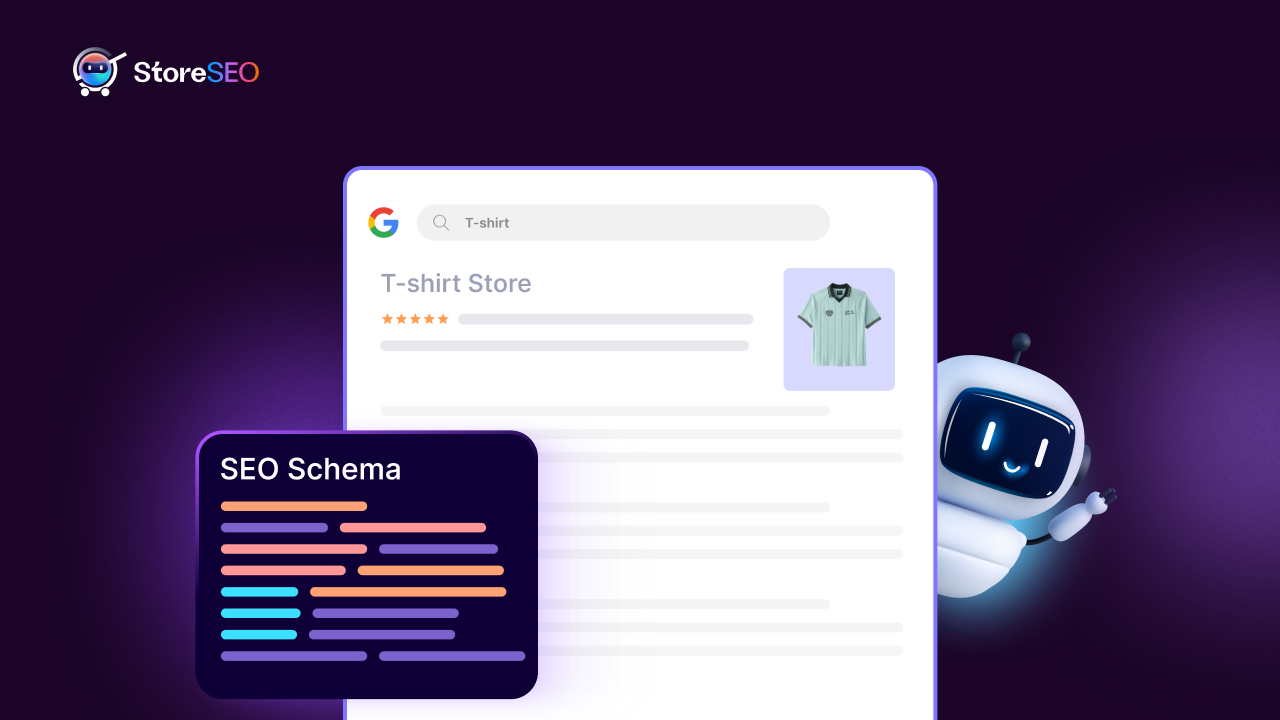
For a deeper look at what each of these properties does and why they matter, our blog on SEO schema improvements for CTR and rich results on Shopify stores breaks it all down with practical context.
Finding 3: Reviews Schema Is Nearly Absent, And It Is Costing Merchants Dearly
Only 22.7 percent of the product pages we analyzed had any AggregateRating schema, and of those, a significant portion had errors that made them ineligible for rich result rendering. When you factor in the pages with valid, complete review schema, the real number drops to around 17 percent.
This matters enormously. Star ratings displayed in product rich snippets are one of the highest-impact visual signals in organic search. Studies across the eCommerce industry consistently show that listings with review stars generate meaningfully higher click-through rates than those without. For Shopify merchants competing against Amazon, Walmart, and larger direct-to-consumer brands that have robust schema implementations, absent review markup is a pure conversion loss.
The Disconnect Between Reviews on Page and Reviews in Schema
Here is the irony: many of the pages that lacked AggregateRating schema did actually have customer reviews on the page. The reviews were there. The products were rated. But because the schema was either missing or improperly configured to connect to the review data, Google could not surface those ratings in search results.
This is a purely technical gap, not a content gap. The merchant had done the hard work of collecting reviews. They just had not closed the loop by making sure the review data was properly expressed in structured data.
| StoreSEO Tip: StoreSEO’s Product Schema supports integration with popular Shopify review apps so that your review data is automatically pulled into your structured data markup. If you have reviews on your product pages and they are not showing up as stars in Google Search, your schema-to-review connection is likely broken. |
Finding 4: Over 61% of Pages Had at Least One Schema Validation Error
This was perhaps the most surprising finding in terms of scale. Of all the pages that had schema present, 61.3 percent failed Google’s Rich Results Test with at least one validation error. Many had multiple errors.
The Most Common Schema Validation Errors on Shopify Product Pages
- Missing required property: offer (the most common error, found on 38.4% of pages with errors)
- priceValidUntil date is in the past (a dynamic data issue that occurs when the field is set once and not updated)
- Invalid URL format in image property
- AggregateRating.ratingCount present but ratingValue missing
- Duplicate schema blocks from conflicting apps or theme code
- Nested JSON-LD objects with incorrect property references
- Schema referencing product variants instead of the canonical product
The duplicate schema issue in particular affects a substantial portion of stores that have installed multiple apps over time. Each app injects its own schema block, and when they overlap, Google may ignore all of them or generate conflicting signals.
How Duplicate Schema Happens on Shopify
The Shopify app ecosystem makes it easy to add features, but it creates a hidden technical debt in the form of overlapping schema injections. A merchant might install a review app that adds its own Product schema, then add a general SEO app that adds another Product schema, and then their theme is also outputting a third Product schema block. Google’s structured data parser encounters three competing Product schemas and has no reliable way to reconcile them.
The fix is not complicated, but it requires someone to actually audit the raw structured data output of the page, identify which blocks are present, and systematically remove the redundant ones.
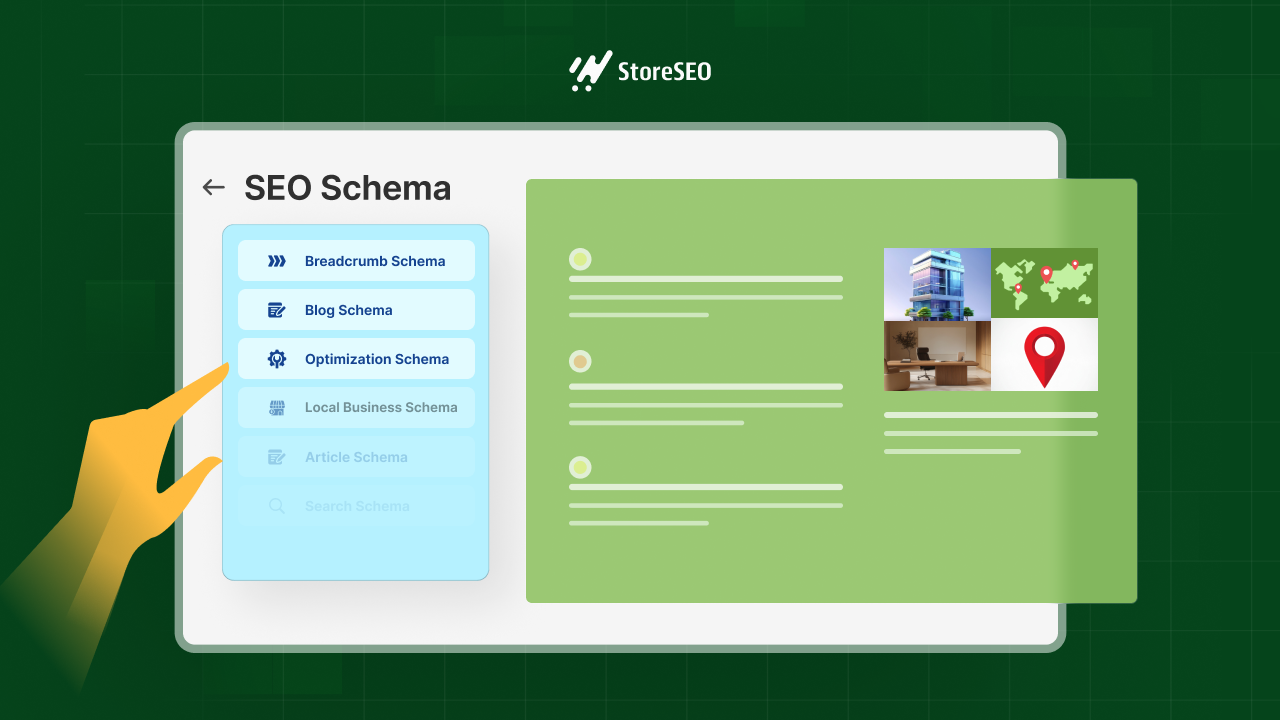
Our detailed walkthrough on how to implement schema markup on your Shopify store covers exactly how to audit for duplicate schema and which resolution approach to use depending on your app stack.
Finding 5: Merchant Listings Markup Is Virtually Nonexistent
Google’s Merchant Listings feature, powered by Product and ShippingDetails schema, allows product information to appear directly in Google Search without a Google Merchant Center feed. It is effectively free Shopping visibility for organic search.
In our study, only 11.3 percent of pages had any shipping schema at all, and a mere 8.7 percent had return policy markup. These numbers suggest that the vast majority of Shopify merchants are completely unaware that this opportunity exists.
What Merchant Listings Schema Requires
To qualify for Merchant Listings, a product page needs:
- Product schema with valid name, image, and description
- Offer schema with valid price, priceCurrency, and availability
- ShippingDetails schema with shippingRate and deliveryTime
- MerchantReturnPolicy with applicable return window and method details
Getting all of this right manually is technically demanding, which is why it remains underutilized. But for stores that do implement it, the visibility payoff is significant given that Merchant Listings can appear at the top of search results with price, shipping time, and return policy displayed before a user even visits the page.
Finding 6: FAQ Schema on Product Pages Is a Massive Untapped Opportunity
Only 8.9 percent of product pages in our study had FAQ schema. This is a striking underutilization given that FAQ schema on product pages can unlock a secondary search result feature that displays accordion-style question-and-answer content directly in Google Search, dramatically increasing a result’s visual real estate.
Beyond traditional search, FAQ schema has an important AEO function. Generative AI systems and voice assistants pull from FAQ-formatted structured data when generating answers to user questions. A product page that asks and answers questions like ‘Is this product vegan?’, ‘What sizes does this come in?’, or ‘How long does shipping take?’ is not only useful for buyers, it is the exact kind of machine-readable signal that AI answer engines reference when constructing product recommendations.
Where FAQ Schema Works Best on Product Pages
- Product feature comparisons (for stores with variant-heavy SKUs)
- Common pre-purchase questions (sizing, materials, care instructions)
- Shipping and delivery frequently asked questions
- Compatibility or specification questions (for tech and fitness products)
- Sustainability or ingredient questions (for beauty, food, and supplement niches)
| StoreSEO Feature: StoreSEO includes a dedicated FAQ Schema tool that allows Shopify merchants to add custom question-and-answer pairs directly to any product page’s structured data. You can manage FAQ schema without editing any theme code, and the feature automatically validates the output before publishing. Learn more in our guide on how to easily add FAQ schema to your Shopify products with StoreSEO. |
Finding 7: AEO and GEO Readiness Scores Are Critically Low
This finding sits at the heart of why we believe schema optimization for Shopify stores is one of the highest-ROI activities of 2026. When we evaluated product pages against a composite AEO (Answer Engine Optimization) and GEO (Generative Engine Optimization) readiness score, only 6.2 percent of pages achieved a passing grade.
Our AEO/GEO readiness score evaluated pages across four dimensions:
- Structured data completeness and accuracy (schema present, valid, and comprehensive)
- Semantic content richness (product descriptions that answer real buyer questions)
- Entity clarity (is the brand, product, and use case clearly defined for AI disambiguation)
- LLMs.txt presence (a newer signal that tells AI crawlers how to interpret and surface store content)
The LLMs.txt Gap
LLMs.txt is an emerging standard (analogous to robots.txt but for large language models) that tells AI systems how to navigate and interpret a website’s content. Fewer than 4 percent of the stores in our sample had any LLMs.txt file in place.
For Shopify merchants who want their products to appear in ChatGPT shopping suggestions, Perplexity product answers, or Gemini product queries, an LLMs.txt file is becoming an important signal. It is not yet a formal ranking factor, but the trajectory of AI search strongly suggests it will be.
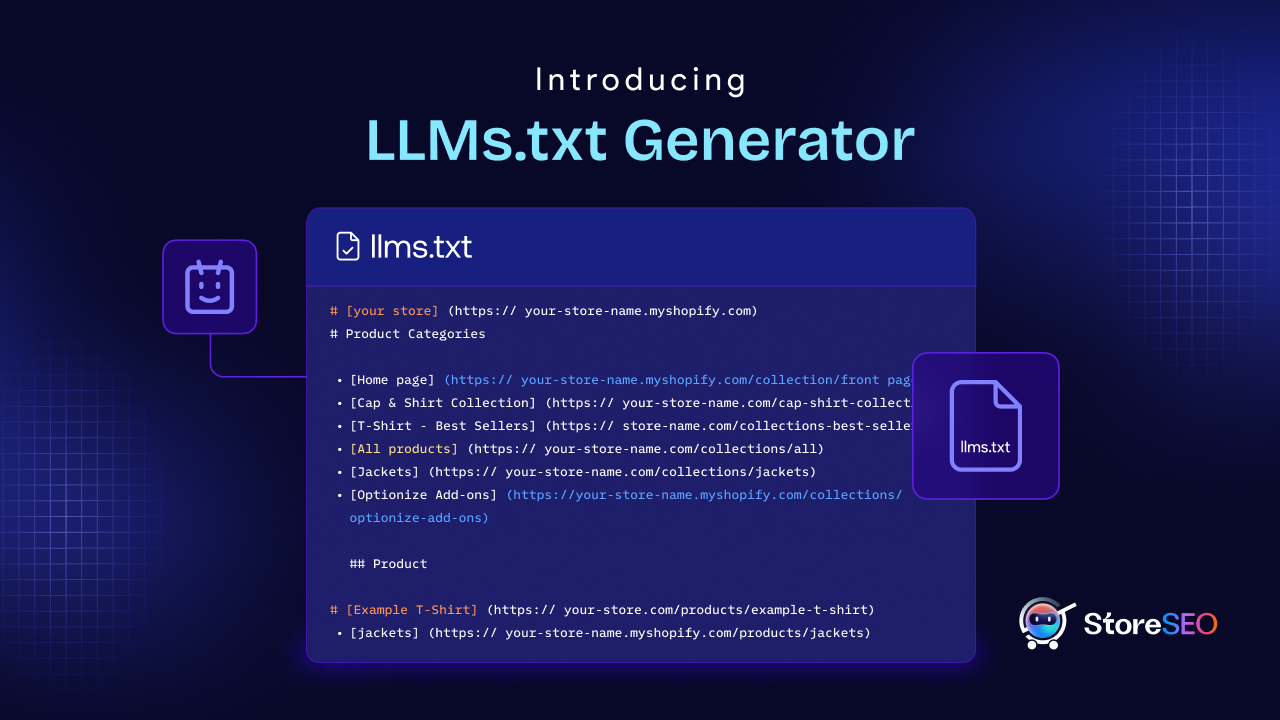
StoreSEO recently released an LLMs.txt generator specifically for Shopify stores. If you want to set this up for your store, see our documentation on how to generate LLMs.txt with StoreSEO.
Finding 8: Stores Using Schema Automation Tools Outperform Manual Implementations
We segmented the 300 pages into two groups: those from stores using a schema automation tool or SEO app, and those relying entirely on theme-generated or manually-coded schema. The performance gap between the two groups was dramatic.
| Finding | Percentage / Data |
| Complete required schema present | Automation: 61.3% vs Manual/Theme: 18.7% |
| Valid schema (zero errors) | Automation: 54.8% vs Manual/Theme: 22.1% |
| Rich result eligibility | Automation: 49.2% vs Manual/Theme: 12.4% |
| AggregateRating schema present | Automation: 44.7% vs Manual/Theme: 9.3% |
| FAQ schema present | Automation: 23.1% vs Manual/Theme: 1.4% |
| AEO/GEO readiness passing grade | Automation: 17.6% vs Manual/Theme: 1.2% |
The numbers tell a clear story. Merchants who automate their schema implementation are more than three times as likely to have valid, complete structured data, and more than four times as likely to qualify for rich results in Google Search.
Manual schema implementation is not inherently bad, but it requires deep technical knowledge, ongoing maintenance as product data changes, and careful management across potentially thousands of product pages. Automation removes that burden while consistently delivering higher quality output.
Niche-by-Niche Breakdown: Which Industries Are Leading and Lagging in Schema
Not all niches perform equally when it comes to structured data maturity. Here is how the 12 niches in our sample ranked on overall schema completeness:
| Finding | Percentage / Data |
| Electronics & Tech Accessories | Schema Completeness Score: 61/100 |
| Beauty & Skincare | Schema Completeness Score: 54/100 |
| Fitness & Sports Equipment | Schema Completeness Score: 49/100 |
| Supplements & Nutrition | Schema Completeness Score: 47/100 |
| Jewelry & Accessories | Schema Completeness Score: 43/100 |
| Home Goods & Decor | Schema Completeness Score: 41/100 |
| Pet Care Products | Schema Completeness Score: 39/100 |
| Fashion & Apparel | Schema Completeness Score: 37/100 |
| Baby & Kids Products | Schema Completeness Score: 34/100 |
| Food & Beverage | Schema Completeness Score: 31/100 |
| Outdoor & Adventure Gear | Schema Completeness Score: 29/100 |
| General Merchandise | Schema Completeness Score: 24/100 |
Why Electronics Leads and General Merchandise Lags
Electronics merchants tend to attract more technically-oriented founders or marketing teams, and product data standards in that space (like GTIN/UPC codes and technical specifications) naturally lend themselves to structured data adoption. The industry also has stronger competitive pressure to appear in comparison shopping environments, which incentivizes schema investment.
General merchandise stores, by contrast, often carry disparate product types that make schema standardization harder and are frequently run by solo entrepreneurs without dedicated SEO resources.
The fashion and apparel finding is surprising given the size of that niche, but it reflects a broader pattern: fashion brands invest heavily in visual presentation and influencer marketing while often underinvesting in technical SEO infrastructure.
What These Schema Gaps Mean for Your Rich Results Eligibility
Rich results are the visual enhancements Google displays in search, including star ratings, price ranges, availability badges, review counts, FAQs, and product carousels. They directly increase click-through rate by making your listing visually distinctive in a text-heavy SERP.
Based on our analysis, pages with complete, error-free Product schema were 4.2 times more likely to trigger rich result features than those with incomplete or invalid schema. That is not a minor uplift. For a store generating 10,000 organic impressions per month, a 4x improvement in rich result appearance could translate to hundreds of additional clicks monthly, all without changing a single word of product copy.
Rich Result Types Available for Shopify Product Pages
- Bogate fragmenty kodu produktu: Display price, availability, and star ratings directly in search results
- Merchant Listings: Show product details including shipping and returns in a dedicated listing format
- FAQ Rich Results: Display expandable Q&A sections below the main search listing
- Product Carousels: Appear in image and product carousel formats for broad category searches
- Review Snippets: Show individual review text alongside star ratings
The majority of Shopify stores in our study were eligible for none of these. They were competing purely on position, title tag quality, and meta description, while properly-structured competitors were occupying more visual space in the same SERP.
If you want to understand how each rich result type maps to specific schema requirements, we recommend reading our comprehensive blog on schema markup for Shopify stores and how it improves CTR.
Schema in the Age of AI Search: AEO and GEO Implications for Shopify Merchants
We want to spend a moment on the broader search ecosystem shift, because it fundamentally changes how we should think about structured data investment in 2026.
Traditional SEO was about ranking for keywords in Google’s ten blue links. AEO (Answer Engine Optimization) is about getting your content surfaced as a direct answer in featured snippets, voice results, and AI Overviews. GEO (Generative Engine Optimization) extends this to generative AI platforms like ChatGPT, Perplexity, and Gemini, where your product information may be surfaced in a response generated for a buyer who never directly searches your brand.
How Schema Markup Powers AI Discoverability
When a user asks Perplexity ‘What are the best vegan protein powders under $40?’, the AI needs machine-readable signals to evaluate and compare products. Stores with a complete Product schema (including description, price, brand, and ingredient-related properties) give the AI enough structured information to include their products in the generated answer. Stores without that schema are simply not in the conversation.
The same logic applies to voice search. When a user asks Alexa ‘Is this product available in size medium?’, the answer engine is querying structured data to form a response. Product pages that include offer variants in their schema can answer that question. Those that do not, cannot.
The LLMs.txt Signal
Beyond product-level schema, we also evaluated whether stores had implemented LLMs.txt, a sitemap-like file that explicitly communicates to AI crawlers which pages contain high-quality, machine-readable content. As noted earlier, fewer than 4 percent of stores in our sample had this in place. For forward-thinking Shopify merchants, implementing LLMs.txt now is a low-effort action that positions the store well ahead of what will likely become a standard expectation within 12 to 18 months.
| StoreSEO now supports automated LLMs.txt generation for Shopify stores. With a single setup step, merchants can generate and publish an LLMs.txt file that covers products, collections, blog articles, and landing pages, telling AI crawlers exactly which content to prioritize when building responses. |
Your Shopify Schema Action Plan: What to Fix First Based on Our Data
Given everything the data tells us, here is a prioritized action framework for Shopify merchants at different stages of schema maturity.
Stage 1: Zero to Baseline (For Stores with No Schema or Broken Schema)
If your store falls into the 31.6 percent with no structured data, or the 61.3 percent with validation errors, your first priority is getting to a clean, valid baseline. This means:
- Auditing your current schema output using Google’s Rich Results Test
- Removing duplicate schema blocks injected by conflicting apps
- Enabling Product and Breadcrumb schema as your foundational layer
- Validating that offer. Price, offer availability, and offer.priceCurrency are all present
- Verifying that your product images are referenced correctly in the schema
Stage 2: Baseline to Rich Result Eligible
Once your foundation is clean, the next step is completing the schema properties needed to qualify for rich results:
- Connect your review app to your Product schema to enable AggregateRating
- Add ShippingDetails and MerchantReturnPolicy for Merchant Listings eligibility
- Include brand, GTIN/MPN, and material properties for product clarity
- Ensure priceValidUntil is either dynamic or set far enough in the future to remain valid
Stage 3: Rich Result Eligible to AEO/GEO Ready
This is the cutting-edge tier where fewer than 7 percent of stores currently operate:
- Implement FAQ schema on top product pages with pre-purchase and spec questions
- Generate and publish LLMs.txt to signal AI-readiness to language model crawlers
- Ensure product descriptions in the schema are semantically rich and answer real user questions
- Implement Collection schema for category pages with product carousels
- Add the Organization and LocalBusiness schema if you operate physical retail locations
For stores with physical locations or local customer bases, our blog on the best schema markup for local Shopify businesses covers the LocalBusiness and Organization schema layer in detail.
How StoreSEO Makes Shopify Schema Optimization Practical and Scalable
We built StoreSEO because we understand the operational reality that most Shopify merchants face. They are running a business, managing inventory, handling customer service, and running marketing campaigns. Asking them to become structured data experts on top of that is not realistic.
StoreSEO automates the schema implementation process end-to-end. Here is what that looks like in practice:
SEO Schema Feature
StoreSEO’s SEO Schema panel gives merchants one-click activation for every major schema type relevant to Shopify: Product, Collection, Breadcrumb, Organization, Article, Blog, FAQ, and LocalBusiness. Each schema is dynamically populated from your store’s product and store data, so prices, availability, and review counts stay current without manual updates.
Product Schema with Review Integration
StoreSEO connects directly to leading Shopify review apps so your AggregateRating data flows automatically into your Product schema. No more disconnected reviews that never make it to Google’s star ratings.
FAQ Schema Tool
The built-in FAQ schema editor lets merchants add custom Q&A pairs to any product page’s structured data from within the StoreSEO dashboard. The tool validates the output and flags any formatting issues before the schema goes live.
AI Content Optimizer for Semantic Richness
Beyond pure schema, StoreSEO’s AI Content Optimizer analyzes product pages and generates semantically optimized product descriptions, meta titles, and meta descriptions that address real buyer questions. This directly improves the semantic signal quality of pages, which matters both for traditional search and for AI-driven answer engines.
Generator LLMs.txt
StoreSEO’s LLMs.txt generator creates and maintains an LLMs.txt file for your store, covering all major content types, including products, collections, blog posts, and pages. This is a first-mover advantage that few Shopify apps currently offer.
Integracja z Google Search Console
StoreSEO integrates with Google Search Console to give merchants visibility into how their structured data is performing in real search results, including which pages are triggering rich results and which are failing validation.
If you are ready to get started, you can explore all of StoreSEO’s features or install the app directly from the StoreSEO homepage. Our onboarding is designed to get your schema from zero to validated within your first session.
Expert Commentary: What These Findings Mean for the Shopify SEO Landscape
The data from this study paints a clear picture: the majority of Shopify stores are leaving structured data optimization entirely on the table. But what makes this particularly significant in 2026 is the intersection of traditional rich result opportunity and AI search readiness.
Schema markup has historically been framed as a nice-to-have, a way to potentially earn star ratings in search. But that framing fundamentally undersells what structured data does in the modern search ecosystem. When your product schema is complete, accurate, and comprehensive, you are not just speaking to Google’s crawler. You are publishing a machine-readable specification of your product that every AI system, every comparison engine, and every voice assistant can interpret and act on.
The merchants who understand this now and invest in getting their schema right, from the product-level properties all the way to LLMs.txt and FAQ schema, are building a durable technical moat. Schema is not a vanity metric. It is the language of modern search, and fluency in that language is increasingly the difference between being found and being invisible.
| Uwaga branżowa: Google’s documentation on product structured data was updated three times in 2025 and twice in early 2026, reflecting how actively the search giant is developing its use of structured data in AI-generated responses. Staying current with schema requirements is no longer an annual audit task. It requires ongoing monitoring and adaptation. |
The Schema Gap Is Real, And It Is Fixable
Our analysis of 300+ Shopify product pages in 2026 reveals an industry-wide structured data deficit. Fewer than 30 percent of pages have a complete, valid Product schema. Fewer than 7 percent are ready for AI-driven search surfaces. And over 60 percent of pages with any schema at all are throwing validation errors that disqualify them from the rich result formats that drive clicks.
But here is the encouraging part: these are not hard problems to fix. The gap between the average Shopify store’s current schema state and a properly optimized, rich-result-eligible, AEO-ready product page is not a six-month project. With the right tools and a systematic approach, most stores can close that gap significantly within a single focused optimization sprint.
The merchants who will win organic search in the second half of 2026 and beyond are not necessarily the ones with the biggest budgets or the most content. They are the ones who have done the unsexy, technical work of making their store data fully readable to machines. Schema markup is that work, and the opportunity window for first-mover advantage is still wide open.
We will continue to monitor structured data trends across the Shopify ecosystem and will update this research quarterly. If you have questions about how our findings apply to your specific store or niche, reach out to the StoreSEO team. And if you are ready to close the schema gap starting today, StoreSEO is built to do exactly that.
| Have questions about your store’s schema health? Install StoreSEO and run a free schema audit on your top product pages in under five minutes. Our dashboard will show you exactly which schema types are present, which are missing, and which have errors, along with one-click fixes for the most common issues. |
About This Study
This research was conducted by the StoreSEO Research Team in Q1 2026. Sample pages were selected across 12 eCommerce niches using stratified random sampling. Schema evaluation criteria are benchmarked against Google’s structured data documentation and schema.org standards, current as of March 2026. All statistical claims in this study are derived from the 300-page sample analyzed and should not be extrapolated to the entire Shopify ecosystem without further validation.