
The key to visibility in this AI-first search era? Strategic schema markup implementation. Specifically, combining FAQ schema with Product schema creates a powerhouse of structured data that feeds directly into Google AI Overviews, Perplexity, ChatGPT search, and other generative AI platforms.

在 商店SEO, we’ve helped thousands of eCommerce businesses optimize their structured data for maximum visibility. In this comprehensive guide, we’ll show you exactly how to leverage the synergy between FAQ and Product schema to dominate AI-powered search results and drive qualified traffic to your store.
TL;DR
In 2026’s AI-driven search engine behavior, SEO schema markup isn’t optional, it’s essential. Combining 常见问题解答模式 和 Product schema transforms your eCommerce pages into machine-readable assets that feed directly into 谷歌人工智能概览, Perplexity, ChatGPT Search, and other generative AI platforms.
Why Schema Markup Matters More Than Ever in 2026
Search has evolved from a simple list of links to an intelligent conversation. Google’s Search Generative Experience (SGE), now branded as AI Overviews, appears in approximately 87% of searches. These AI-generated summaries pull information from structured data across the web, synthesizing answers rather than just ranking pages.
Here’s what this means for your eCommerce business: traditional SEO alone isn’t enough. Your content needs to speak the language of machines—and that language is schema markup.
The Data That Proves Schema’s Impact
Recent research reveals compelling statistics about schema’s influence on AI search visibility:
- Brands with comprehensive schema markup see 57% more AI Overview triggers on long-tail queries compared to those without structured data
- Pages with well-constructed schema are significantly more likely to be selected in AI Overviews over pages with identical content but no markup
- Rich snippets generated from schema markup increase click-through rates by 30-50%
- FAQ schema specifically helps content appear in “People Also Ask” boxes and AI-generated answers
The verdict is clear: schema markup has evolved from a nice-to-have SEO enhancement to a critical visibility factor in AI-driven search.
Understanding FAQ Schema: Your Gateway to AI Answers
常见问题解答模式 (FAQPage structured data) is a markup format that explicitly identifies questions and answers on your web pages. By wrapping Q&A content in structured data, you’re essentially creating a machine-readable index that AI systems can instantly parse and reference.

Why FAQ Schema Powers AI Search Results and How
AI language models excel at answering questions, it’s literally what they’re trained to do. When you implement FAQ schema, you’re getting:
| Benefit | How it Helps AI | What It Means for Your Store |
| Intent alignment | FAQ schema wraps natural-language questions, so AI can directly match user queries like “How do I…” or “What is…” to your exact Q&A. | Your answers are more likely to be pulled into AI Overviews and assistants when shoppers ask product-related questions. |
| Clear boundaries | Each question and answer is clearly defined in the markup, so AI can see the full, correct answer without guessing from paragraphs. | Reduces fragmented or misleading citations and increases the chance your full answer appears with proper attribution. |
| Verification signals | Structured FAQs act as a clear, machine-readable signal that this content is official, organized, and trustworthy. | AI systems are more likely to treat your store as an authoritative source when generating answers. |
| Disambiguation | Schema adds explicit context around every question, helping AI distinguish similar topics and interpret intent correctly. | Your store is less likely to be misrepresented, and more likely to appear for the right queries with accurate messaging. |
How FAQ Schema Works in AI Search Ranking for Shopify Products: Expert Insight
A customer asked, “How long does this wireless speaker’s battery actually last?”
Without 常见问题解答模式, you’re essentially leaving your answer up to chance. Google’s AI has to go on a search through your product page, grabbing random fragments and gathering them together. It might miss the amazing features to highlight or overlook the “fast-charge” feature entirely, giving the user a half-baked answer that doesn’t inspire much confidence.
But when you implement 常见问题解答模式, you’re handing the AI search engine a cheat sheet.
Instead of guessing, the AI pulls your complete, polished answer and serves it up directly in the AI Overview, clearly attributed to your store. You aren’t just a search result anymore; you’re the expert providing the solution.
This is the secret to winning over “pre-qualified” traffic. When a shopper gets a clear, helpful answer right away, they don’t just keep searching, they click through to your store, ready to hit “Buy” because you’ve already earned their trust.
Understanding Product Schema: The eCommerce Foundation
Product schema is structured data that provides search engines with detailed information about your products, including name, brand, description, SKU, price, availability, ratings, and reviews. For eCommerce stores, this is non-negotiable foundational markup.

The Competitive Advantage of Product Schema
Product schema enables your listings to display as rich snippets with eye-catching elements:
| 特征 | How It Appears in Search | Why It Matters for Conversions | AI Visibility Boost 🔍 |
| ⭐ Star Ratings | Displays average customer ratings, often shown as gold stars beneath your product title. | Instantly signals trust and social proof — buyers believe other buyers. | Products with visible ratings are 42% more likely to appear in AI-generated product recommendations. |
| 💲 Price Info | Shows current price (and sale price if applicable) directly in search results. | Makes comparison effortless and highlights deals — reducing friction to click. | Dynamic pricing markup ensures AI Overviews pull the latest price automatically. |
| 📦 Availability Status | “In stock,” “Out of stock,” or “Limited availability” shown alongside price. | Creates urgency and improves buyer decision-making before they even click. | Real-time availability helps AI recommend in-stock items first. |
| 🏷️ Brand Recognition | Clearly displays your brand name next to the product listing. | Builds trust and reinforces your store as a credible seller. | Strong brand schema alignment improves visibility in Knowledge Graph-driven AI summaries. |
| 🖼️ 产品图片 | Eye-catching product thumbnails appear beside listing text. | Boosts engagement and CTR by up to 35% with visual appeal. | ImageObject schema increases chance of inclusion in visual AI carousels and shopping summaries. |
These rich results don’t just look better—they perform better. Rich snippets with product schema consistently outperform plain text listings in both traditional search results and AI-generated overviews.
Product Schema in the AI Search Context
When AI systems generate product comparisons or recommendations, they pull structured data from the Product schema. A well-implemented Product schema ensures your products are included in these AI-generated lists, complete with accurate pricing, ratings, and key specifications.
The Power of Combining FAQ + Product Schema
Here’s where the magic happens: FAQ schema and Product schema aren’t competing elements—they’re complementary forces that work together to dominate both informational and transactional search queries.
Why the Combination Works
| Schema Type | Serves | 搜索意图 |
| 产品架构 | Product details, pricing, availability | Transactional (“buy”, “price”, “in stock”) |
| 常见问题解答架构 | Questions, concerns, use cases | Informational (“how to”, “does it”, “can I”) |
| Combined | Complete customer journey | Both research and purchase stages |
Table 1: Schema types address different stages of the customer journey
When you implement both schemas on your product pages, you’re capturing visibility across the entire customer journey:
Research Phase: Users searching “Is wireless speaker waterproof?” find your FAQ schema answer in AI Overviews
Evaluation Phase: Users comparing products see your rich snippet with pricing and ratings
Decision Phase: Users ready to buy find complete product information with clear availability
Implementation Guide: StoreSEO’s Proven Approach
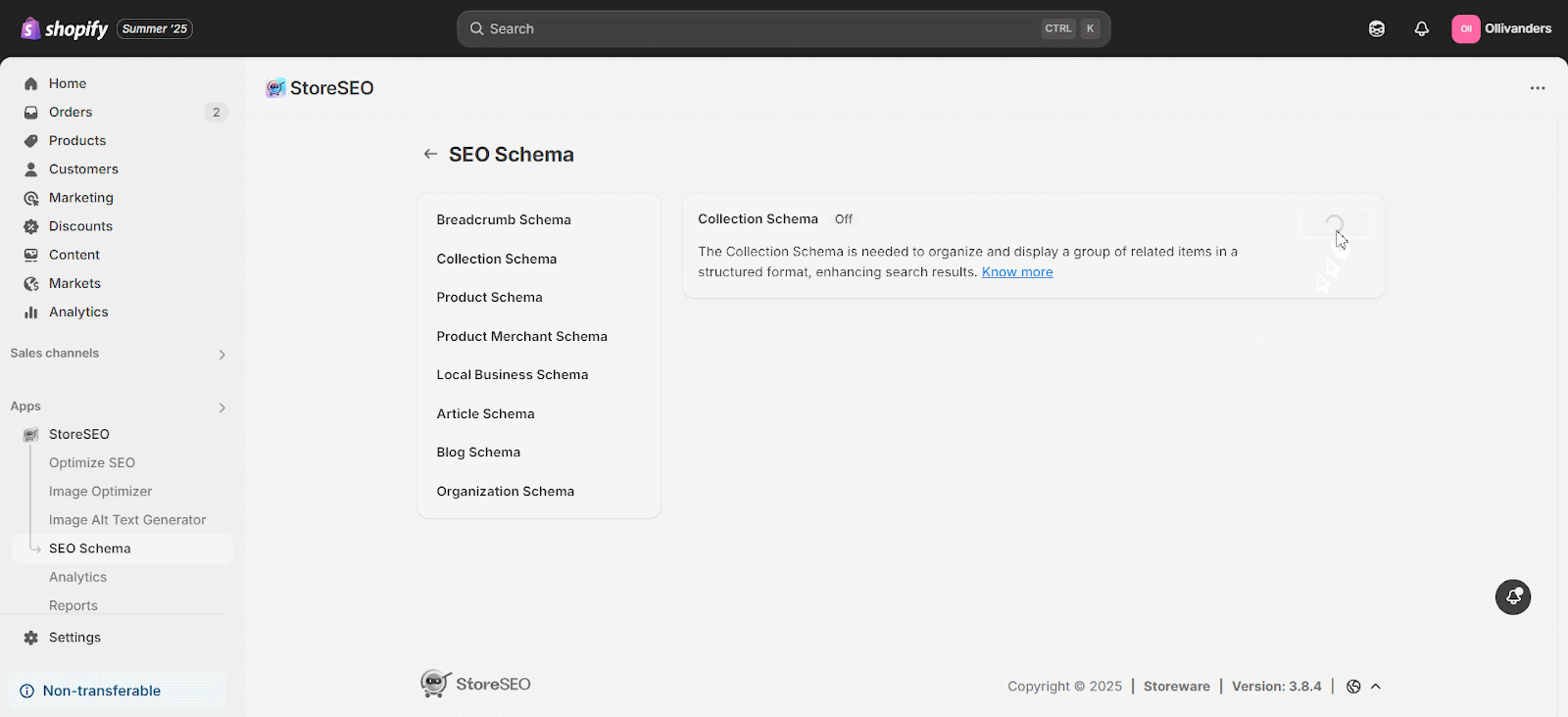
At StoreSEO, we’ve streamlined schema implementation for eCommerce platforms, making it accessible even for store owners without technical expertise. Here’s our proven methodology:
Advanced Schema Strategies for Maximum AI Visibility
Entity Optimization and Knowledge Graph Alignment
AI systems leverage Google’s Knowledge Graph to understand relationships between entities (brands, products, categories). Enhance your schema with entity signals:
- Use consistent brand names that match Knowledge Graph entries
- 实施 组织架构 for your store
- 添加 breadcrumb schema to show a clear site hierarchy
- Link product categories to related concepts
Leverage Review Schema for Trust Signals
Customer reviews are powerful trust signals for both users and AI systems. Review schema, when combined with Product and FAQ schemas, creates a comprehensive trust framework:
- AggregateRating shows overall customer satisfaction
- Individual reviews provide specific use cases and experiences
- Review snippets often appear alongside product rich results
Structured Data for Product Variations
Many eCommerce products have variations (colors, sizes, models). Implement schema strategies for variations:
- 使用 Offer schema with multiple variants
- Create separate FAQ schema for variation-specific questions
- Ensure each variation has unique structured data where appropriate
Video and Image Schema Enhancement
Visual content increasingly appears in AI-generated results. Enhance product pages with:
- VideoObject schema for product demonstration videos
- ImageObject schema with detailed captions
- Alt text that reinforces product schema information
Common Schema Mistakes That Kill AI Visibility
Even with the best intentions, these common errors harm the SEO schema effectiveness:
| ❌ Mistake | ⚠️ What It Does | 💡 Smart Fix (StoreSEO Solution) |
| 1. Incomplete Product Schema | Missing key fields (like price or availability) means your rich snippets won’t appear and AI can’t fully understand your product. | Just turn on the schema, and StoreSEO will handle your product data to complete and AI-ready. |
| 2. Generic, Unhelpful FAQs | Weak questions (“Is this product good?”) and vague answers kill credibility and offer zero user value. | Go deeper. Write real FAQs that answer genuine buyer concerns with clear, detailed responses. |
| 3. Duplicate FAQs Across Products | Copying FAQs from one product to another creates thin, repetitive, low-quality content that search engines ignore. | Be specific. Customize FAQs for each item, highlight unique features, use cases, and variations. |
| 4. Schema Validation Errors | Small syntax or formatting mistakes make your schema invisible to search engines. | Validate consistently. Test markup using Google’s 丰富的结果测试 and track issues via 搜索控制台. |
| 5. Hidden or Misleading Content | Marking up invisible or inaccurate content violates Google guidelines and can lead to penalties. | Stay transparent. Only use structured data for content real users can see, and make sure it matches perfectly. |
| 6. Neglecting Schema Updates | Using outdated data (wrong prices, unavailable products) damages both AI trust and customer confidence. | Automate updates. Make links to your live database, ensuring instant updates as product information changes. |
💬 Pro Tip: Treat your schema like a living asset, not a one-time setup. Regular audits and automated updates ensure your structured data keeps feeding the AI engines that drive modern search visibility.
Measuring Schema Success: KPIs That Matter
How do you know if your combined FAQ and Product schema strategy is working? Track these key metrics:
Structured Data Performance Metrics
| 指标 | What It Tells You |
| AI Overview Appearances | How often you’re cited in AI-generated summaries |
| Rich Snippet Impressions | Frequency of enhanced search result display |
| Click-Through Rate (CTR) | Effectiveness of rich snippets vs plain results |
| Position in AI Citations | Your ranking within multi-source AI answers |
| FAQ Snippet Appearances | Visibility in “People Also Ask” boxes |
| Structured Data Errors | Technical issues requiring attention |
Table 2: Essential schema performance metrics to monitor
Using Google Search Console Effectively
Google Search Console provides invaluable schema insights:
- Navigate to Enhancements to view Product and FAQ schema status
- 查看 Valid items to confirm successful implementation
- Review Errors and warnings to identify issues requiring fixes
- Analyze Search results performance for schema-enhanced pages
- Compare CTR for pages with vs without rich snippets
A/B Testing Schema Implementations
For larger stores, consider testing schema variations:
- Test different FAQ quantities (5 vs 10 FAQs per page)
- Compare FAQ question phrasing approaches
- Evaluate schema-rich pages vs schema-minimal pages
- Test Product schema with and without enhanced fields like reviews
The StoreSEO Advantage: Automated Schema Excellence
Manual schema implementation is time-consuming, error-prone, and difficult to scale. This is exactly why we built StoreSEO—to make professional-grade schema markup accessible to every eCommerce store owner.
What Makes StoreSEO Different
Automated Schema Generation: StoreSEO automatically creates comprehensive Product and FAQ schema from your existing product data. No coding required, no technical knowledge needed.
Platform-Optimized: Whether you’re on Shopify, WooCommerce, or other major platforms, StoreSEO integrates seamlessly with native product structures.
Continuous Validation: Built-in validation ensures your schema meets Google’s requirements and stays error-free even as guidelines evolve.
AI-Optimized Markup: Our schema implementation specifically targets AI search systems, incorporating best practices for maximum visibility in AI Overviews, Perplexity, and other generative search platforms.
One-Click Updates: When product information changes, schema updates automatically. No more manually editing markup for price changes or inventory updates.
FAQ Management Interface: Create, edit, and organize product FAQs through an intuitive interface that automatically generates proper FAQ schema.
Performance Analytics: Track schema performance directly within StoreSEO, seeing exactly how structured data impacts your search visibility.
Success Stories from StoreSEO Users
eCommerce stores using StoreSEO’s combined FAQ and Product schema approach consistently report:
- 35-60% increase in organic click-through rates from rich snippets
- Appearance in AI Overviews for 40-50% more product-related queries
- Reduced cart abandonment as FAQ schema answers pre-purchase questions
- Higher conversion rates from better-qualified traffic finding answers before clicking
- Significant time savings from automated schema management
The Future of SEO Schema and AI Search
As we look ahead, schema markup’s importance will only intensify. Here’s what’s coming:
| Emerging Trend | What It Means | 对SEO的影响 | Pro Tip for Ecommerce Brands |
| 🎥 Multimodal Schema | Schema will evolve beyond text to describe images, videos, and interactive elements, giving AI a richer understanding of your products. | Helps your store appear in visual and AI-generated product overviews with images, demo videos, and 3D models. | Add VideoObject and ImageObject schema to make your product experiences AI-readable and visually engaging. |
| ⚙️ Dynamic & Personalized Schema | Schema markup will adapt in real time to reflect user context, stock levels, or personalized offers. | Supports real-time, accurate AI recommendations and more relevant shopping experiences. | Implement automated schema updates linked to your product database so your structured data always stays fresh. |
| 🔗 Deeper Entity Relationships | AI search will map relationships between brands, products, and categories to better understand intent and context. | Increases your visibility in AI-driven comparisons and brand-related searches. | Use linked data (Organization, Brand, Breadcrumb) schema to connect products across your store’s ecosystem. |
| 🗣️ Voice & Conversational Search | With voice assistants powering search, AI favors question-based content and natural language responses. | Surfaces your content in voice results and conversational AI overviews. | Optimize with 常见问题解答模式 using natural, spoken-style phrasing to capture voice-based queries. |
SEO Schema is Your AI Search Competitive Advantage
The shift to AI-powered search isn’t coming—it’s here. By 2026, the majority of search interactions involve AI-generated content, whether through Google AI Overviews, Perplexity, ChatGPT, or other platforms. The question isn’t whether to implement schema markup, but how quickly you can execute a comprehensive strategy.
Combining FAQ schema with Product schema creates a powerful synergy that addresses the complete customer journey—from initial research questions through final purchase decisions. This dual-schema approach ensures your products and expertise are visible at every stage where potential customers search for information.
StoreSEO makes this advanced optimization accessible to every eCommerce store, regardless of technical expertise or development resources. With automated schema generation, continuous validation, and AI-optimized implementation, you can compete with major retailers for visibility in the AI search era.
The stores that dominate search results in 2026 and beyond won’t just have great products—they’ll have products that AI systems can understand, reference, and recommend. That starts with schema markup.
Ready to power up your search visibility? Visit 商店SEO to discover how automated FAQ and Product schema can transform your eCommerce store’s performance in AI-powered search.