
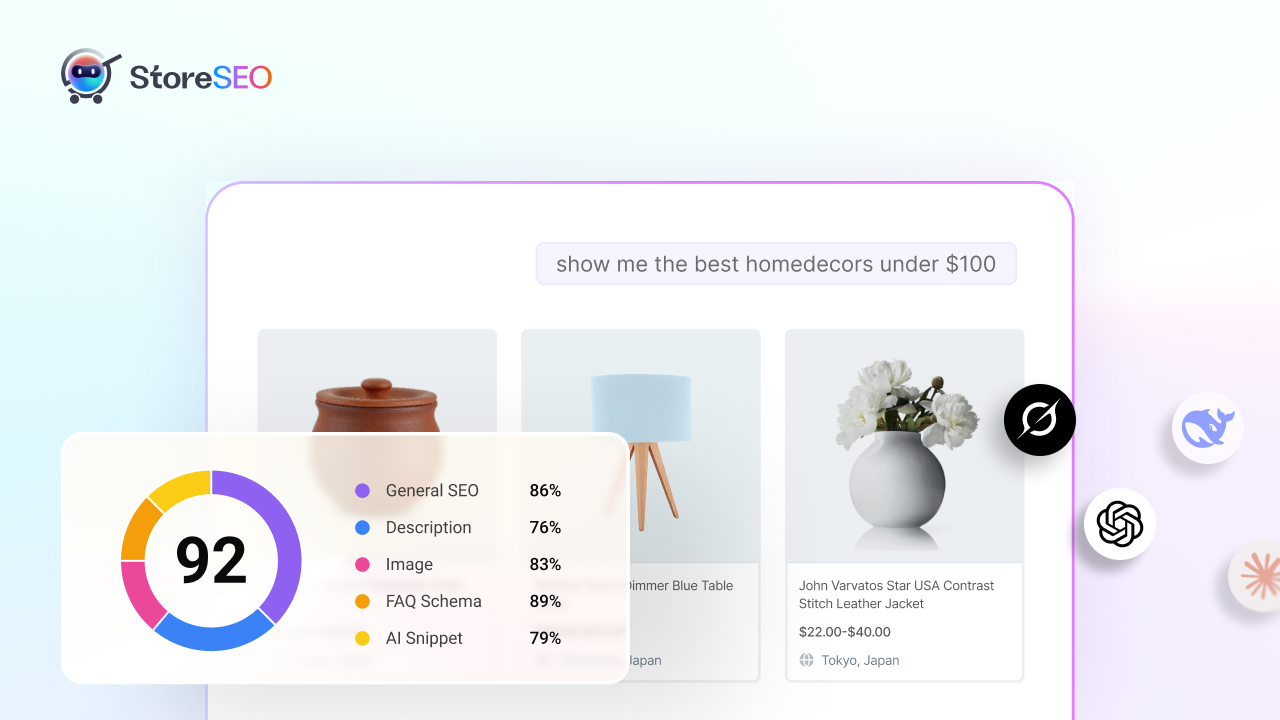
Search has changed. The person who used to type a query, scroll through ten blue links, and click the third result is becoming a rarer species. In 2026, a growing share of product discovery happens inside AI-generated answers on Google AI Overviews, ChatGPT shopping recommendations, Perplexity product panels, and voice assistants like Alexa and Siri. These platforms do not rank pages. They cite sources, recommend products, and generate answers. And the Shopify stores they feature are not always the ones with the most backlinks or the highest domain authority. They are the ones whose product data is structured, complete, and machine-readable.
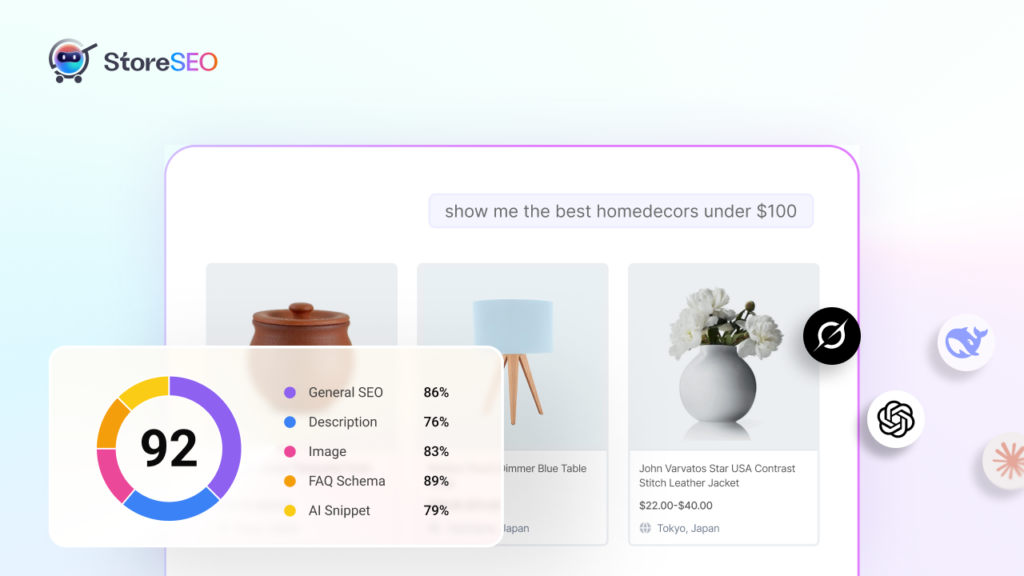
This is the challenge that led our team to build the StoreSEO Agentic Discovery Score (ADS), a feature designed to help Shopify merchants understand, measure, and improve how well their products are optimized for AI-driven discovery. In this guide, we are going to walk through exactly what the ADS is, why it matters, how each component works, and how you can use it step by step to make your products more visible in the AI-first search ecosystem.
| Strategic Insight: AI Overviews from Google now appear on over 13% of all queries as of early 2025, with the number growing. The merchants cited inside those panels do not always rank on page one. What they share is well-structured, authoritative product data. The Agentic Discovery Score is our answer to making that kind of optimization accessible to every Shopify store owner. |
What Is the Agentic Discovery Score (ADS)?
The Agentic Discovery Score is a composite metric built into the StoreSEO dashboard that measures how well a given product page is optimized for AI-driven discovery. Think of it as a readiness score for the new search landscape, one that goes beyond traditional SEO signals like keyword density and meta tag length.
Where a traditional SEO score tells you whether a page is likely to rank on Google for a given keyword, the ADS tells you whether an AI agent (think a shopping assistant inside ChatGPT, a product recommendation engine, or Google’s AI Overview) has enough information to confidently surface, describe, and recommend your product. The two scores work in parallel inside StoreSEO. Your SEO-Wertung and your Agentic Discovery Score each appear as separate score cards at the top of every product optimization screen, giving you a complete picture of both traditional and AI-driven visibility.
How Is the ADS Different from a Standard SEO Score?
A standard SEO score typically evaluates elements like title tag optimization, meta description presence, image alt text, and keyword usage. These signals matter a great deal for ranking in organic search results. The ADS evaluates a different but complementary set of signals, specifically those that AI systems and large language models (LLMs) rely on to understand, categorize, and recommend products.
For example, an AI agent discovering products in response to a query like ‘comfortable wireless headphones for remote work under $100’ does not just match keywords. It reads product descriptions for contextual meaning, checks structured data for machine-readable attributes like price and availability, evaluates taxonomy signals to confirm product classification, and looks for conversational Q&A content that mirrors how real shoppers ask questions. The ADS measures exactly these dimensions.
| Notiz: The Agentic Discovery Score was introduced in StoreSEO as part of our ongoing commitment to keeping Shopify merchants ahead of the AI-first search transition. Unlike vanity metrics, every point in the ADS maps to a specific, actionable optimization that directly influences how AI platforms process your product data. |
Why the Agentic Discovery Score Matters for Shopify Merchants in 2026
The shift from keyword-based search to intent-based AI discovery is one of the most significant changes in eCommerce marketing in the past decade. Understanding why the ADS matters requires a clear picture of how product discovery is evolving across the channels your shoppers use.
The Rise of AI Shopping Agents and Zero-Click Commerce
When a shopper asks an AI assistant to recommend the best yoga mat for beginners, that assistant is not running a Google search and handing back ten links. It is querying its knowledge base, pulling from structured data sources, and generating a synthesized recommendation that may include product names, prices, features, and links to purchase. Your Shopify store can only appear in that response if the underlying product data is formatted in a way the AI can parse and trust.
As we explored in our post on why Shopify stores need StoreSEO for ranking in AI search results, the merchants who win in AI-generated results are not just those with good content. They are the ones whose stores speak the machine language that AI systems prefer: structured, complete, and semantically clear data.
The Attribution Problem: Getting Named, Not Just Cited
There is a distinction worth understanding here. An AI answer might technically pull information from your product page without ever naming your store. That gives you zero brand attribution and zero conversion opportunity. A higher Agentic Discovery Score pushes your product data toward being explicitly featured — meaning the AI names your brand, shows your product, and provides a link to buy.
Being explicitly cited inside AI search results is the new shelf space. It is where trust is built and where shoppers decide which brand to explore further. Our analysis of over 100 Shopify stores, covered in our post on why Shopify stores fail ranking in Google and AI search, confirmed that incomplete product data is one of the single biggest barriers to AI-driven visibility.
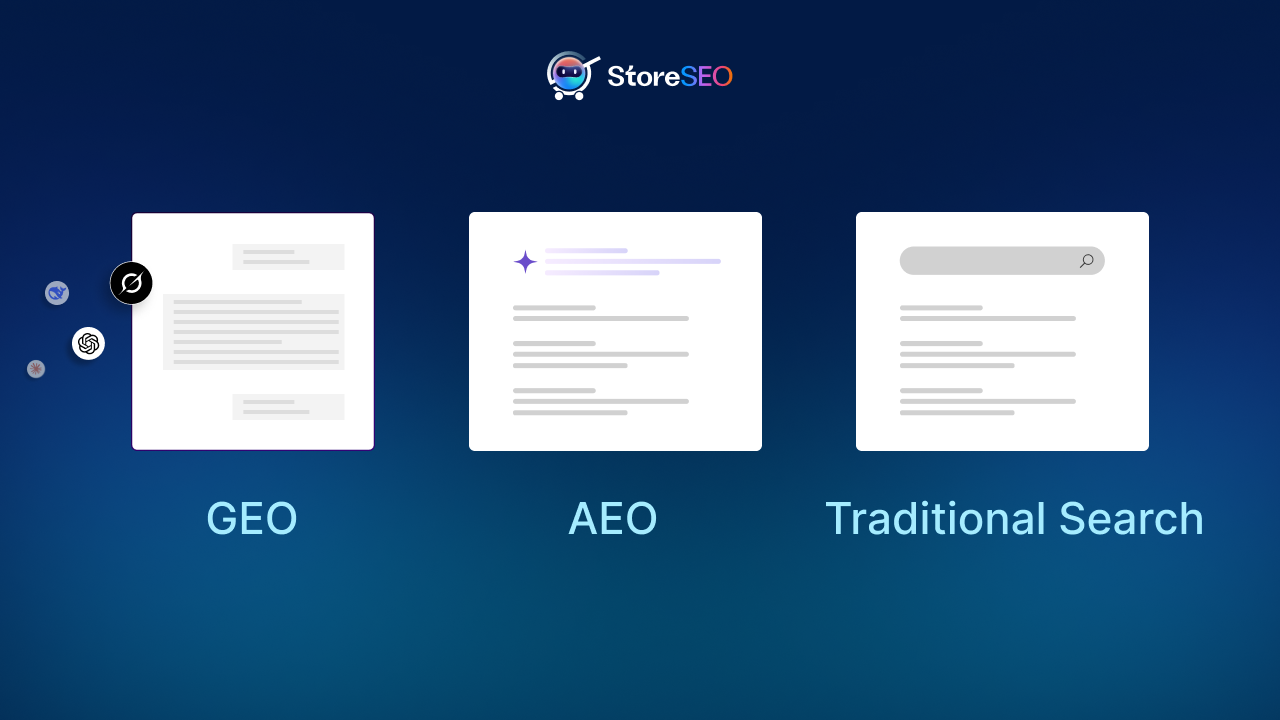
Antwortmaschinenoptimierung (AEO) und generative Maschinenoptimierung (GEO)
The ADS is built around two emerging optimization disciplines: Antwortmaschinenoptimierung (AEO) Und Generative Motoroptimierung (GEO). AEO focuses on making your content the trusted, concise answer that AI systems select when responding to direct questions. GEO focuses on how your brand and product information is structured and prepared for generative AI engines to use accurately when summarizing, comparing, or recommending products.
If you want to go deeper on the strategy side, our guide on AEO and GEO strategies for Shopify stores covers the full framework with actionable tactics you can apply today.
The 7 Pillars of the Agentic Discovery Score: A Complete Breakdown
The StoreSEO Agentic Discovery Score (ADS in StoreSEO) is calculated from seven distinct optimization categories, each mapped to a specific set of checks. We will walk through every one of them, explain what StoreSEO evaluates, and clarify why each factor matters for AI-driven product discovery.
ADS Categories at a Glance
| ADS Category | What StoreSEO Checks | Why It Matters for AI |
| Title Quality | Length, brand name, product type | AI agents classify and match products by title tokens |
| Description Quality | Completeness, clarity, length | LLMs extract intent signals from product descriptions |
| Taxonomy & Classification | Category, product type, tags | Proper taxonomy lets AI place products in correct context clusters |
| Media & Visuals | Image presence and optimization | Multimodal AI links visual data with product listings |
| Availability & Status | Published, in stock, inventory tracked | AI shopping agents only surface purchasable products |
| Strukturierte Daten | Product schema, FAQ schema | Machine-readable markup is the primary input for AI parsing |
| AI Content Readiness | FAQ added, AI snippet present | Conversational Q&A format directly feeds answer engine logic |
1. Title Quality: The First Signal AI Agents Read
Your product title is the single most important piece of text on any product page. For human shoppers, a good title is descriptive and scannable. For AI agents, a well-structured title is a classification signal that determines whether the product gets placed in the right discovery context.
StoreSEO checks three specific conditions under Title Quality:
- Title length within 50 characters: Titles that are too long get truncated in search results and AI summaries. Keeping titles concise ensures they display cleanly across every surface where AI might feature your product.
- Brand name inclusion: Including your brand name in the title allows AI systems to correctly attribute the product to its manufacturer and improves brand citation in AI-generated recommendations.
- Product type inclusion: Naming the product type (e.g., ‘wireless headphones’, ‘linen throw pillow’, ‘ceramic coffee mug’) allows AI classification engines to categorize the product accurately and match it to relevant intent queries.
A title like ‘BrandName Wireless Headphones’ passes all three checks. A title like ‘Our best noise-canceling over-ear headphones for office and travel use with 30hr battery life’ fails on length, making it harder for AI to parse cleanly.
2. Description Quality: Writing for Both Humans and AI Agents
Product descriptions carry the most semantic information of any element on a product page. A strong description tells a human shopper what the product is, who it is for, and why it is worth buying. For an AI system, a strong description provides the contextual signals needed to match the product to the right intent queries and generate accurate summaries.
StoreSEO checks whether the description is present, complete, and substantial enough to provide real informational value. Vague, thin, or missing descriptions are one of the most common reasons products fail to appear in AI-generated recommendations.
Within StoreSEO, you can use the built-in AI Content Generator to create optimized descriptions from your focus keyword. The tool generates descriptions that are written with both readability and AI-parseability in mind, saving hours of manual writing while improving your Agentic Discovery Score simultaneously. You can learn more about this in our AI Content Optimizer documentation.
| Profi-Tipp: When writing product descriptions for AI readiness, answer three questions directly: What is this product? Who is it for? What problem does it solve or what benefit does it deliver? AI systems are designed to extract exactly these dimensions from product content. |
3. Taxonomy and Classification: Teaching AI Where Your Product Belongs
Taxonomy is one of the most underappreciated SEO signals in eCommerce. When an AI system generates product recommendations, it needs to know where a product fits within the broader category landscape. Is it a home goods item or a personal care product? Is it for adults or children? Is it a premium product or a budget alternative?
StoreSEO checks three taxonomy conditions:
- Shopify product category assigned: Shopify’s product taxonomy provides a standardized classification system that both Shopify’s own surfaces and external AI platforms use to understand product context.
- Product type set: The product type field gives AI systems an additional classification signal that confirms the category assignment.
- At least one tag present: Tags create additional topical associations that help AI systems link your product to related search intents and product clusters.
Proper taxonomy is especially important for category-based AI queries. When someone asks an AI assistant to ‘recommend the best options for a home office setup’, the AI is filtering by category signals before it evaluates individual products. Stores without proper taxonomy are effectively invisible to category-level discovery.
4. Media and Visuals: Multimodal AI Needs Images Too
As AI systems become increasingly multimodal (meaning they process both text and images), product imagery has become an SEO signal in its own right. Google’s vision AI and other multimodal systems connect visual data with product listings, allowing them to surface products based on visual similarity as well as text match.
The StoreSEO Agentic Discovery Score, or ADS, checks whether a product image is present on the product page. A product with no image is not just less appealing to human shoppers; it is essentially incomplete from an AI system perspective, missing a core data dimension that multimodal discovery engines rely on.
For best results, ensure product images are high-resolution, clearly show the product, and are accompanied by optimized alt text. Our guide on how to add and optimize image alt text on Shopify covers image SEO best practices in detail. StoreSEO also offers an AI-powered image alt text generator that automates this process at scale.
5. Availability and Publication Status: AI Shopping Agents Only Recommend Purchasable Products
This might seem like a basic operational concern rather than an SEO factor, but it has significant implications for AI discovery. AI shopping agents, particularly those integrated with real-time inventory data, are designed to recommend products that shoppers can actually buy. A product that is unpublished, out of stock, or not tracked in inventory is essentially a dead end in the AI discovery chain.
StoreSEO checks three availability conditions:
- Product is active and published: Unpublished products cannot be crawled or indexed by search engines or AI systems.
- Inventory tracking is enabled: Without inventory tracking, AI systems that pull real-time availability data cannot confirm whether the product is purchasable.
- Product is in stock: Out-of-stock products may still be indexed but are typically deprioritized by AI shopping agents in favor of purchasable alternatives.
Keeping your availability data accurate and up to date is not just good operations practice. It is an active AI visibility strategy.
6. Structured Data: The Machine Language of Modern Search
Structured data, specifically JSON-LD-Schema-Markup, is the most direct way to communicate product information to AI systems in a format they can parse without interpretation. While AI can extract some information from natural language descriptions, structured data provides explicit, unambiguous signals about product name, price, availability, reviews, and more.
StoreSEO checks two structured data conditions:
- Product schema enabled: Product JSON-LD provides AI systems with a complete, machine-readable summary of your product’s key attributes.
- FAQ schema enabled: FAQ schema is specifically designed for AEO, structuring question-and-answer content in a format that answer engines can directly feature in response to user queries.
For a deeper understanding of how schema markup works and why it matters for eCommerce specifically, our post on Wie SEO-Schema im E-Commerce funktioniert is an excellent resource. We also cover the distinction between JSON-LD and Microdata schema for Shopify if you want to understand the technical formats in more detail.
You can enable Product and FAQ schema directly inside StoreSEO with a few clicks. Our schema markup configuration guide walks through the setup process step by step.
| Strategic Insight: FAQ Schema is one of the highest-value structured data types for AEO and GEO. When your FAQ entries mirror the natural language questions your customers ask, AI systems can directly feature those Q&A pairs in answer panels and voice search responses. Our post on why FAQ schema matters for AEO and GEO covers this in depth. |
7. AI Content Readiness: Conversational Content That Feeds Answer Engines
The seventh and final ADS pillar is AI Content Readiness, which measures whether the product page contains the kind of conversational, question-and-answer content that AI systems prefer when generating responses. This pillar captures the intersection of AEO and content strategy.
StoreSEO checks whether FAQ entries have been added to the product page and whether an AI-generated snippet is present. These elements serve a dual purpose: they improve the human browsing experience by answering common questions upfront, and they provide AI systems with pre-structured answer content that can be directly extracted for use in AI Overviews, voice responses, and generative product summaries.
You can generate AI snippets for your Shopify products directly through StoreSEO. Our documentation on generating AI snippets for Shopify products explains how the feature works and how to use it effectively.
How to Optimize Your Agentic Discovery Score with StoreSEO: Step-by-Step Guide
Now that we have covered what each pillar of the ADS measures and why it matters, let us walk through the exact process for improving your score inside StoreSEO. The full technical documentation for this feature is available at the official ADS optimization guide.
Step 1: Open StoreSEO in Your Shopify Admin
Log in to your Shopify admin panel and click on Apps in the left-hand navigation. Find StoreSEO and open the app dashboard. Everything related to ADS optimization lives inside the main StoreSEO interface, so you will not need to switch between multiple tools.
Step 2: Navigate to the Product List
Inside the StoreSEO dashboard, click on Optimize SEO from the main navigation. You will see your complete Shopify product list. Each product row displays both its SEO Score and its StoreSEO Agentic Discovery Score at a glance. This makes it easy to prioritize which products need the most attention, especially if you have a large catalog.
| Recommended workflow: Sort your product list by ADS score to identify your lowest-scoring products. Prioritize your best-selling and highest-revenue products first, as optimizing those will have the greatest immediate impact on AI-driven visibility and potential revenue. |
Step 3: Select a Product and Review the StoreSEO Agentic Discovery Score Analysis Checklist
Click on any product to open its optimization screen. At the top, you will see both score cards side by side: the SEO Score card and the StoreSEO Agentic Discovery Score card. The right-hand sidebar displays the StoreSEO Agentic Discovery Score Analysis panel, which contains a detailed checklist organized across all seven optimization categories. Each checklist item shows either a green pass or a red fail, giving you a clear visual map of exactly where improvements are needed.
Step 4: Optimize the Product Title
Locate the Title field in the product editor on the left side of the screen. Update the title to meet all three Title Quality checks: keep it under 50 characters, include your brand name, and include the product type. After editing, the corresponding checklist items in the StoreSEO Agentic Discovery Score Analysis panel will turn green in real time, confirming they pass.
Step 5: Improve the Product Description
Scroll down to the Description field. Write or update the description to be clear, complete, and informative. If you want AI assistance, use the AI Content Generator inside StoreSEO, enter your focus keyword, and let it generate an optimized description. Review the output, make any necessary edits for brand voice, and save.
Step 6: Set Taxonomy and Classification
Assign a Shopify product category, set the product type, and add at least one relevant tag. These taxonomy signals are critical for category-level AI discovery. If you are unsure which tags to use, consider what your customer would type into a search engine when looking for a product like yours, and use those as starting points.
If you want a data-driven approach to keyword selection for product optimization, the StoreSEO Keyword-Cluster-Generator can help you identify semantically related keyword clusters that work well as tags and category signals.
Step 7: Verify Availability and Publication Status
Check that the product is active and published in Shopify, that inventory tracking is enabled, and that the product is in stock. If any of these conditions fail, update them in the Shopify product editor and return to StoreSEO to confirm that the checks now pass.
Step 8: Add a Product Image
If the product is missing an image, go to the Shopify product editor and upload a high-quality product photo. After uploading, return to StoreSEO and confirm the Media and Visuals check passes. Remember to add descriptive alt text to the image for an additional accessibility and SEO benefit.
Step 9: Enable Product Schema and FAQ Schema
In StoreSEO, navigate to the SEO Schema section and enable both the Product JSON-LD schema and the FAQ Schema options. Once enabled, scroll to the FAQ section and add relevant question-and-answer pairs that address common customer questions about the product. Keep each FAQ answer concise, direct, and factual. Once saved, both the Structured Data and AI Content Readiness sections of the ADS checklist will update to reflect these improvements. For a detailed walkthrough of adding FAQ schema, see our FAQ schema documentation.
Step 10: Sync and Review Your Updated ADS Score
After completing all optimizations, click the Sync Product button. The StoreSEO Agentic Discovery Score card at the top of the page will update to reflect your improvements. Each resolved checklist item will be marked as passed, and your overall ADS score will increase. Aim to resolve all checklist items across all seven categories to achieve the highest possible score.
Beyond the Score: Connecting StoreSEO Agentic Discovery Score to Your Broader AI SEO Strategy
The Agentic Discovery Score is a powerful starting point, but achieving maximum AI-driven visibility for your Shopify store requires thinking about ADS optimization within a broader strategic framework. Here are the key elements we recommend layering on top of your ADS work.
Generate an LLMs.txt File for Your Store
An LLMs.txt file is a relatively new addition to the AI SEO toolkit. Similar to robots.txt, it provides explicit directives to large language models about what content on your store they are allowed to access, summarize, and use. For Shopify merchants, generating an LLMs.txt file is a proactive way to ensure AI systems access the right content and represent your brand accurately. StoreSEO includes a built-in LLMs.txt generator for Shopify. For the strategic background on why this matters, our post on why LLMs.txt matters for eCommerce and Shopify stores is an essential read.
Use Keyword Clusters for Product and Content Strategy
Optimizing individual products for ADS is important, but building topical authority across your entire store is what separates stores that appear occasionally in AI results from those that appear consistently. The StoreSEO Keyword-Cluster-Generator allows you to identify semantically related keyword groups and organize your product and content strategy around topical clusters rather than individual keywords. This mirrors how Google and AI systems evaluate authority: at the topic level, not the keyword level.
Track Keyword Rankings to Measure ADS Impact
Improving your ADS score should translate into measurable improvements in organic and AI-driven visibility. Use the StoreSEO Keyword Rank Tracker to monitor how changes to your product data affect your positions across tracked keywords. Regular rank monitoring allows you to connect the dots between specific ADS optimizations and ranking improvements.
Make Your Shopify Store Content AI and LLM Friendly
Optimizing product pages is just one dimension of AI readiness. Your blog posts, collection pages, and informational content also play a role in how AI systems perceive and represent your store’s authority. Our post on how to make your Shopify store content AI and LLM-friendly covers the content-level tactics that complement your ADS optimization work.
Enable Google Search Console Integration
StoreSEO integrates directly with Google Search Console, giving you access to real query performance data inside the StoreSEO dashboard. This integration allows you to see which queries are driving impressions and clicks for your optimized products, helping you prioritize which products to optimize next based on actual search demand. Set it up through our Google Search Console integration guide.
Frequently Asked Questions About Agentic Discovery Score
What is the Agentic Discovery Score in StoreSEO?
The Agentic Discovery Score is a product-level metric inside StoreSEO that measures how well a Shopify product page is optimized for AI-driven discovery. It evaluates seven categories: title quality, description quality, taxonomy and classification, media and visuals, availability and status, structured data, and AI content readiness.
How is the ADS different from the SEO Score?
The SEO Score evaluates traditional optimization signals like meta title, meta description, focus keyword usage, and image alt text. The ADS evaluates signals that AI systems and large language models use to parse, categorize, and recommend products. Both scores appear side by side in StoreSEO and serve complementary purposes.
Does improving my ADS score directly improve my Google rankings?
Improving your ADS score addresses several factors that Google considers in both traditional and AI-powered results, including structured data, content quality, and product completeness. Stores that score highly on ADS dimensions tend to see improvements in rich snippet eligibility, AI Overview citations, and product discovery across AI platforms. However, ADS is specifically designed for AI-driven visibility rather than traditional keyword ranking.
How often should I review and update my ADS scores?
We recommend reviewing ADS scores whenever you add new products, make significant changes to existing products, or update your product catalog for seasonal campaigns. For high-revenue products, a monthly ADS audit is a good practice to ensure all checklist items remain in good standing.
Can I improve my ADS score without technical knowledge?
Yes. StoreSEO is designed to make ADS optimization accessible to merchants without technical SEO expertise. The checklist-based interface tells you exactly what needs to be fixed, the AI Content Generator helps with description writing, and schema markup can be enabled with a simple toggle. If you need help getting started, our Support-Team is available to walk you through the process.
Does ADS optimization help with voice search results?
Yes. Voice assistants like Alexa and Siri pull from the same structured data and AI-ready content signals that the ADS measures. FAQ schema, in particular, is highly effective for voice search optimization because the Q&A format mirrors how people phrase spoken queries.
Final Thoughts: The StoreSEO Agentic Discovery Score Is Your Roadmap for the AI Search Era
The way products get discovered online is changing faster than most Shopify merchants realize. Traditional SEO is not going away, but it is no longer sufficient on its own. The merchants who will dominate product discovery in 2026 and beyond are those who understand that search engines, AI assistants, and generative platforms all read product data in fundamentally the same way: they look for completeness, structure, and semantic clarity.
StoreSEO Agentic Discovery Score translates the complex requirements of AI-driven product discovery into a simple, actionable checklist. Every item in the ADS Analysis panel maps directly to a change you can make today that improves how AI systems find, understand, and recommend your products.
Whether you are just starting your Shopify SEO journey with our Shopify SEO-Leitfaden, or you are an experienced merchant looking to stay ahead of the AI search transition, the StoreSEO Agentic Discovery Score gives you the framework you need to compete in every search environment your customers use.
Open your StoreSEO-Dashboard today, run an ADS analysis on your top products, and start making the optimizations that will put your store in front of the AI-powered shoppers of 2026.