
Pages displaying rich results in Google Search see an 82% higher click-through rate compared to non-rich result pages. Meanwhile, 72.6% of top-ranking pages on Google use schema markup, signaling that the most visible eCommerce sites have already prioritized structured data implementation.
But here’s where it gets more interesting: as AI-powered search engines like Perplexity reshape how users discover products and information, schema markup has evolved from a nice-to-have optimization into a critical ranking factor accounting for up to 10% of AI search visibility.
This shift matters profoundly for Shopify merchants. The platform powers millions of online stores, yet many still operate without comprehensive schema implementation. That represents a lost opportunity—both in traditional search visibility and in emerging AI answer engines that increasingly influence purchasing decisions.
In this blog, we’ll explore the strategic role of schema markup in modern eCommerce SEO, examine the specific mechanisms through which it improves CTR and rich results, and demonstrate how StoreSEO integrates schema optimization into a comprehensive Shopify SEO strategy.
Understanding Schema Markup and Its Core Function
What Is Schema Markup?
Schema markup is structured data embedded into your website’s HTML code that helps search engines and AI systems understand the meaning, context, and relationships within your content. Instead of relying on interpretation alone, a schema provides explicit, machine-readable signals about what your content represents.
Think of it this way: When a search engine crawls your Shopify product page, it sees text describing a product, pricing, and availability. Schema markup translates that human-readable information into a standardized format (typically JSON-LD) that communicates “this is a Product, it has a name, a price of $X, a review rating of Y stars, and inventory status Z.“
How SEO Schema Boosts Click-Through Rates (CTR) on Shopify
CTR is the percentage of users who click on your link after seeing it in search results. A higher CTR signals to search engines that your content is relevant and valuable, which can improve your rankings over time. But how exactly does schema markup supercharge CTR for Shopify stores?
1. Enhanced Visual Appeal in SERPs
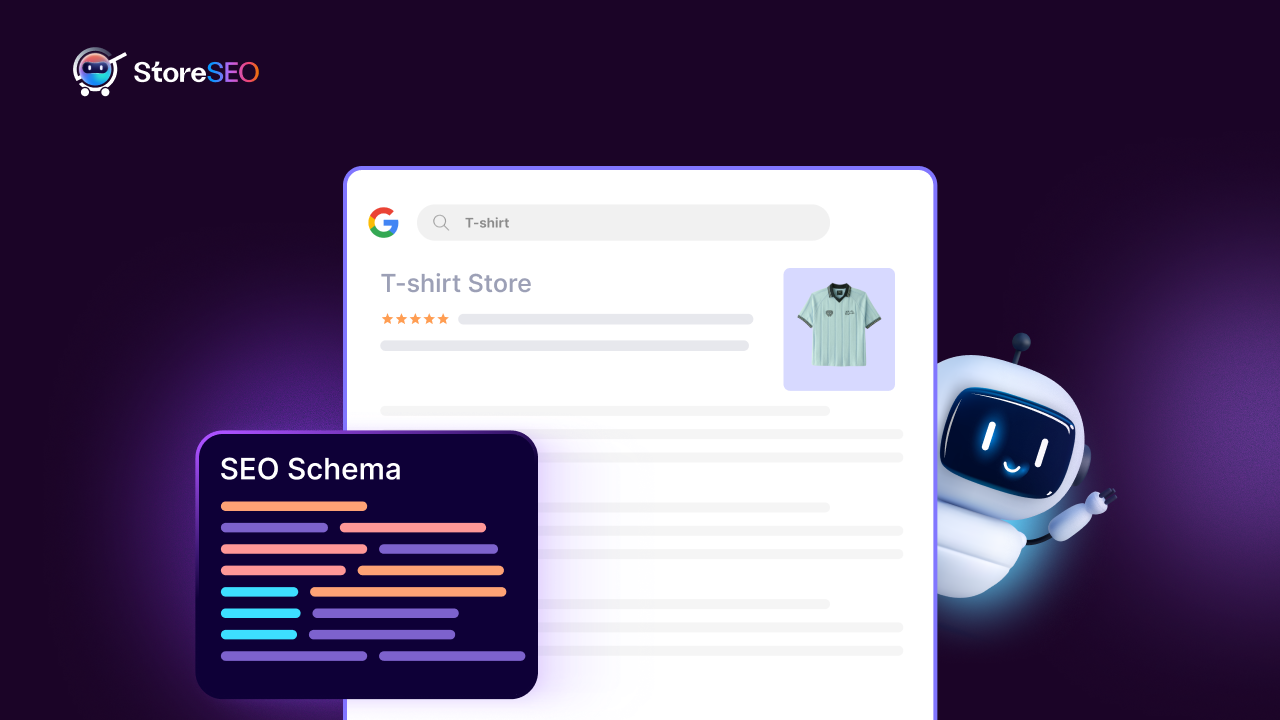
Schema markup enables rich snippets – those expanded search results with extra details. For a Shopify product page, this could include:
- Star ratings from customer reviews make your listing look trustworthy and high-quality.
- Price and availability info, allowing shoppers to see if an item is in stock without clicking through.
- Images or thumbnails, turning text-heavy results into visually engaging previews.
Users are drawn to these elements because they provide quick answers. Studies from SEMrush show that rich snippets can boost CTR by 20-30%, as searchers prefer results that offer immediate value.
2. Better Relevance and User Intent Matching
Schema helps search engines match your content to user queries more accurately. For instance, if someone searches for “best wireless earbuds under $50,” schema-marked products on your Shopify store could appear with price filters, reviews, and even FAQs directly in the results. This relevance reduces bounce rates and encourages clicks from qualified traffic.
3. Mobile Optimization Advantages
With over 50% of e-commerce searches happening on mobile, schema’s mobile-friendly rich results shine. Features like carousels for product listings or event schemas for sales promotions make your Shopify store more tappable on smaller screens, directly impacting CTR.
At StoreSEO.com, we specialize in optimizing Shopify stores with custom schema implementations that target these CTR boosters. Our tools ensure your site not only ranks higher but also converts better by making every SERP appearance count.
Why JSON-LD Dominates Modern Implementation
Modern Shopify SEO relies primarily on JSON-LD (JavaScript Object Notation for Linked Data) for schema implementation. Unlike older microdata or RDFa formats, JSON-LD offers several advantages:
- Non-intrusive integration: Code sits in the page header without affecting visible content
- Search engine support: Universally recognized by Google, Bing, and AI crawlers
- Dynamic capability: Works seamlessly with Shopify’s Liquid templating language to pull real-time product data
- Scalability: Handles complex data structures essential for modern eCommerce
How Schema Markup Directly Improves Click-Through Rates
The Rich Results Advantage
The most direct connection between schema markup and CTR flows through rich results: enhanced search listings that display structured information beyond the standard blue link.
When schema markup is implemented correctly, Google can display:
- Product ratings and review counts (visual stars in search results)
- Current pricing and availability (real-time product details)
- High-quality images (product images displayed prominently)
- Stock status indicators (immediate availability signals)
The impact is quantifiable: A comprehensive analysis of eCommerce sites revealed that pages with schema markup achieved a 40% higher click-through rate than identical pages without structured data. In specific retail scenarios, the boost reaches even higher—43% CTR improvements over six-month periods have been documented on optimized sites.
Why does this happen? When users scan search results, rich snippets immediately communicate value, trustworthiness, and relevance. They reduce friction in the decision-making process. A user seeing your product’s 4.8-star rating, current price of $199.99, and green “In Stock” indicator will click your listing over a competitor’s plain text result. That’s not an assumption—that’s documented user behavior.
The Visual Hierarchy Effect
Beyond the numbers themselves, schema markup influences visual prominence in search results. Google algorithmic systems preferentially display rich snippets higher in SERPs and expand them more generously when they’re properly structured.
This creates a compounding effect:
- Better visibility (expanded space in results)
- More credibility (rich data signals authenticity)
- Increased clickability (users trust results with visible details)
- Higher CTR (more clicks from more visible, trusted results)
Essential Schema Types for Shopify eCommerce
Product Schema: The Foundation
Product schema is non-negotiable for any Shopify store. It communicates the fundamental information about your merchandise—name, description, price, brand, images, availability, and inventory status.
For an eCommerce site, product schema directly enables:
- Price snippets in search results
- Availability indicators (In Stock, Out of Stock, Pre-Order)
- Inventory quantity visibility
- Brand information display
When implemented through StoreSEO or manually, product schema should include dynamic Liquid variables that pull live data from your Shopify product database:
text
{
“price”: “{{ product.price | money_without_currency }}”,
“availability”: “{% if product.available %}https://schema.org/InStock{% else %}https://schema.org/OutOfStock{% endif %}”,
“name”: “{{ product.title }}”,
“sku”: “{{ product.selected_variant.sku }}”
}
Aggregate Rating Schema: Trust and Social Proof
Customer reviews are among the most influential factors in eCommerce purchasing decisions. AggregateRating schema transforms this social proof into visible search results.
When your Shopify store displays star ratings in Google Search results, you’re communicating:
- Product quality (explicit 4.8/5.0 rating)
- Customer validation (287 reviews demonstrate popularity)
- Risk reduction (highly rated products feel safer to purchase)
The cognitive impact cannot be overstated. A product with 4.8 stars and 287 reviews positioned next to a competitor’s generic text listing creates an almost irresistible contrast.
Review Schema: Detailed Authority
While AggregateRating provides the summary, Review schema offers granular citations of individual customer feedback. This is particularly powerful when:
- Recent reviews exist (recency signals product quality)
- Reviews include detailed text (beyond simple star ratings)
- Review authors have verifiable profiles
StoreSEO can automatically capture review schema from Shopify’s built-in review apps or third-party integration platforms.
FAQ Schema: Capturing Question-Driven Traffic
FAQ schema addresses an entirely different user intent pattern—the exploratory, problem-solving query.
Users often search with questions: “Do these headphones work with Android?”, “What’s the battery life?”, “Are they noise-canceling?” When your product pages include FAQ schema for these common questions, they become eligible for featured snippets in Google Search, voice search results, and AI answer engines.
FAQ schema implementation typically includes:
json
{
“@type”: “FAQPage”,
“mainEntity”: [
{
“@type”: “Question”,
“name”: “Are these headphones compatible with iOS?”,
“acceptedAnswer”: {
“@type”: “Answer”,
“text”: “Yes, these headphones use Bluetooth 5.2 and work seamlessly with all iOS devices running iOS 12 and later.”
}
}
]
BreadcrumbList Schema: Navigation Intelligence
BreadcrumbList schema communicates your site’s hierarchical structure to search engines—a seemingly minor detail with surprising impacts.
When Google understands your category → subcategory → product hierarchy through breadcrumb schema, it:
- Improves site crawlability (clearer navigation patterns)
- Enhances SERP display (breadcrumb trails shown in results)
- Supports contextual ranking (category relationships understood)
For Shopify stores with deep category structures, the breadcrumb schema is often overlooked but consistently valuable.
The AI Search Engine Advantage – Why Schema Matters for AI Search Ranking
The Emergence of AI Answer Engines
Google, Bing, and traditional search engines represent only part of the modern search landscape. AI answer engines like Perplexity, Claude, and ChatGPT now influence how users discover eCommerce content. According to Exploding Topics, 35.49% of people now use AI tools every day.
These systems operate fundamentally differently from traditional search:
- They synthesize information rather than ranking individual pages
- They cite sources to establish authority and allow verification
- They prioritize structured, scannable content over dense paragraphs
- They weigh freshness and engagement much more heavily than Google does
This shift creates both challenges and opportunities for Shopify merchants.
Schema Markup’s Role in AI Understanding
Here’s the critical insight: Schema markup is exponentially more valuable to AI systems than to traditional search engines.
Why? Because large language models parse your HTML to extract meaning and structure. When they encounter:
xml
<p>Our premium headphones cost $199.99 and have 4.8 stars</p>
The AI must infer relationships and meaning. But when it encounters proper schema markup:
json
{
“price”: “199.99”,
“aggregateRating”: {
“ratingValue”: “4.8”,
“reviewCount”: “287”
}
}
The system immediately understands the semantic relationships, values, and context. This isn’t just more convenient—it changes how comprehensively the AI can synthesize your content into its responses.
Perplexity Ranking Factors and Schema
Recent research on Perplexity’s ranking algorithm identified that schema markup and structured data account for approximately 10% of the platform’s ranking factors. This is substantial in AI search context because:
- Content comprehensibility (schema ensures AI understands your information accurately)
- Answer extraction capability (structured data makes it easier to cite your content in answers)
- Entity recognition (schema helps identify key entities in your content)
- Snippet-worthiness (AI systems can more easily generate excerpts from structured content)
This means a Shopify store with comprehensive schema markup is approximately 10 percentage points more likely to be cited in Perplexity answers compared to an identically optimized site without schema.
Parallel Optimization: Traditional SEO + AI Search
The beauty of schema optimization is that it simultaneously improves performance across traditional search and AI answer engines. You’re not choosing between platforms; you’re strengthening your site’s visibility across the entire search landscape.
A product with proper schema markup:
- Gets rich results in Google Search (CTR boost)
- Ranks higher in Perplexity (AI comprehension)
- Features more prominently in featured snippets (voice search visibility)
- Surfaces in Google Discover feed (content surface expansion)
Common Schema Implementation Mistakes and How to Avoid Them
Mistake 1: Incomplete Schema Data
Error: Implementing basic product schema but omitting review ratings, images, or availability.
Impact: Missed rich result opportunities and reduced AI comprehensibility.
Solution: Use StoreSEO’s completeness scoring to identify missing data fields. Prioritize adding AggregateRating and image schema to existing implementations.
Mistake 2: Schema-Content Misalignment
Error: Schema values contradict visible page content (price mismatch, incorrect availability).
Impact: Trust damage and potential manual action from search engines.
Solution: Implement automatic schema generation that pulls directly from Shopify data sources rather than manual entry.
Mistake 3: Ignoring Schema Validation
Error: Implementing schema once and never testing again.
Impact: Schema continues working initially but breaks after theme updates, making pages ineligible for rich results.
Solution: Quarterly validation using Google’s Rich Results Test. StoreSEO can automate this monitoring.
Mistake 4: Duplicate or Conflicting Schema
Error: Multiple schema markup sources (theme + app) are creating redundant or contradictory data.
Impact: Confusion for search engines and AI systems, potentially triggering algorithmic penalties.
Solution: Audit your current schema before implementing additional tools. Ensure a single source of truth for each schema type.
Mistake 5: Ignoring FAQ Schema
Error: Implementing product schema only, overlooking FAQ opportunities.
Impact: Missing question-driven traffic and voice search visibility.
Solution: Analyze customer questions from product pages and FAQs. Add FAQ schema for the 5-10 most common queries per product category.
The Future of Schema in AI-Driven Search
Emerging Schema Standards
As AI systems mature, new schema markup standards are developing to support them:
- E-E-A-T schema (Experience, Expertise, Authoritativeness, Trustworthiness) for authority signaling
- Product schema expansions, including sustainability certifications and ethical sourcing information
- Dynamic availability schema communicating stock levels in real time
Schema and Emerging Search Surfaces
Beyond traditional search results, schema markup powers:
- Google Discover feeds (content eligibility determined partly by schema quality)
- AR/VR search surfaces (detailed product schema enables immersive experiences)
- Voice search and smart home (schema is fundamental to voice assistant understanding)
- Generative Engine Optimization (GEO) (AI answer engines rely heavily on structured data)
Shopify merchants implementing a comprehensive schema today position themselves optimally for these emerging surfaces.
The Strategic Imperative
The convergence of traditional SEO, AI search, and emerging platforms means schema markup has evolved from a technical optimization into a strategic business necessity. Sites without structured data are systematically disadvantaged across multiple discovery channels.
Transform Your Shopify Visibility Through Strategic Schema Implementation for better CTR and Rich Results
The data is unequivocal: schema markup drives measurable business results. Whether measured through CTR improvements in Google Search (30-40% typical increases), visibility in AI answer engines like Perplexity (10% ranking factor weighting), or trust signals that convert searchers to customers, structured data delivers quantifiable ROI.
For Shopify merchants, the implementation pathway has never been clearer. Tools like StoreSEO democratize enterprise-grade schema implementation, eliminating technical barriers that previously prevented smaller stores from accessing these benefits.
The competitive advantage belongs to merchants who act now. Every day your product catalog remains without rich results, without FAQ schema, without entity optimization for AI systems, represents lost traffic and revenue. Your competitors implementing these strategies are capturing disproportionate visibility across search channels – both traditional and emergent.
Your next steps are straightforward:
- Audit the current schema implementation on your top 20 product pages using Google’s Rich Results Test
- Identify gaps (missing review ratings, images, and FAQ data)
- Deploy StoreSEO or a comparable schema solution with real-time monitoring
- Monitor Search Console monthly to track rich result eligibility, impressions, and CTR improvements
- Expand optimization to your full catalog as results validate ROI
Schema markup isn’t a future-oriented strategy anymore – it’s a present-day competitive necessity. In the battle for eCommerce visibility across search engines, AI answer engines, and discovery surfaces, structured data is the decisive weapon.
The merchants who implement it strategically will dominate search results. The question isn’t whether to prioritize schema markup – it’s whether you can afford not to.
Have you found our blog useful? If you do, please subscribe to our blog for more tips, tutorials, and updates on industry-related topics.