
Shopify just launched the Universal Commerce Protocol (UCP), an open standard that lets AI agents discover, recommend, and complete purchases on behalf of customers. For Shopify merchants, this isn’t just another technical update.
“Shopify has a history of building checkouts for millions of unique retail businesses. We have taken everything we’ve seen over the decades to make UCP a robust commerce standard that can scale,”
says Vanessa Lee, VP of Shopify
“Agentic commerce has so much potential to redefine shopping and we want to make sure it can scale to every product a customer might want to purchase.”
This guide explains what Universal Commerce Protocol means for your store, how AI agents will find and sell your products, and the specific optimizations you need to ensure your products appear when customers ask AI assistants to find what you sell.
(TL;DR) Quick Summary of Universal Commerce Protocol
(TL;DR) Too Long; Didn’t Read? Here’s what you need to know:
| If You Want To… | Do this to improve your agentic shopping strategy. | Why It Matters | Time to adapt your strategies to include the agent payments protocol for better customer engagement. |
| Get discovered by AI agents | Enable Agentic Storefronts | AI agents use Shopify Catalog to find products | 30 mins |
| Sell through ChatGPT, Gemini, Copilot | Ensure UCP-ready product data | Clean, structured data required for AI transactions | 2-4 hours |
| Appear in AI recommendations | Optimize schema & descriptions | AI prioritizes structured, semantic content | Ongoing |
| Complete sales inside AI | No action needed | UCP manages embedded checkout automatically | None |
The Expert Insight: Understanding the new agentic shopping trends can drive sales. Universal Commerce Protocol only works when AI agents can understand your products. Stores with thin descriptions, missing schema, and poor product data will be invisible to AI shoppers, regardless of Universal Commerce Protocol readiness.
What Is the Universal Commerce Protocol (UCP)?
The Universal Commerce Protocol (UCP) is an open-source standard co-developed by Shopify and Google to enable AI agents to seamlessly connect with merchants and facilitate end-to-end transactions directly within conversational interfaces in the future of commerce.
Announced on January 10, 2026, at the National Retail Federation (NRF) conference, Universal Commerce Protocol marks a major leap forward in digital retail — establishing the core infrastructure for what the industry now calls agentic commerce.
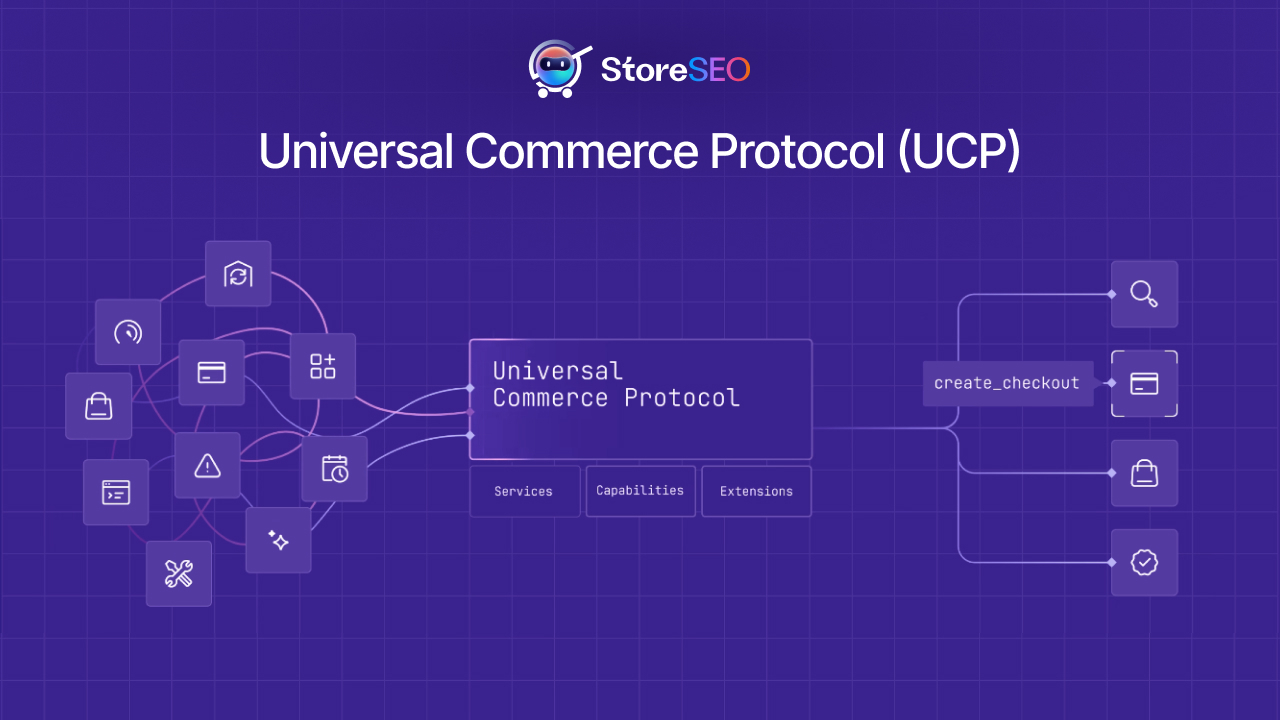
Universal Commerce Protocol is built on a flexible model context protocol that standardizes how AI systems interpret product data, handle user intent, and interact with commerce platforms in real time. By defining a universal language for buyer-agent-merchant interactions, Universal Commerce Protocol allows merchants to sell through any AI-driven environment from chatbots to voice interfaces while maintaining compliance, security, and transparency. Acting as the merchant of record, each participating platform, including Shopify, retains full control over checkout, fulfillment, and post-purchase workflows, ensuring both consumer trust and business consistency across ecosystems.
7 Best Strategies to Prepare Your Shopify Store for UCP
Master Comparison Table
| Rank | Strategy | ★ Impact Rating | Best For | Time to Implement |
|---|---|---|---|---|
| 🥇 | Implement Comprehensive Schema Markup | ★★★★★ | All stores, large catalogs | 2-4 hours |
| 🥈 | Write Rich Product Descriptions (200+ words) | ★★★★★ | Product-heavy stores | Ongoing |
| 🥉 | Enable Agentic Storefronts in Shopify Admin | ★★★★ | New to UCP merchants | 30 mins |
| 4 | Add Descriptive Image Alt Text & Optimize Images | ★★★★ | Visual product stores | 1-2 hours |
| 5 | Generate FAQ Schema with Natural Language Q&A | ★★★★ | Query-driven niches | 1 hour per page |
| 6 | Collect & Display Reviews for Trust Signals | ★★★ | Review-reliant brands | Ongoing |
| 7 | Ensure Real-Time Inventory & Pricing Sync | ★★★ | High-volume sellers | Setup: 1 hour |
Strategy 1: 🥇 Implement Comprehensive Schema Markup
Best For: All stores, especially large catalogs (500+ products) needing bulk AI optimization.
Why It Matters for UCP: Schema markup creates a machine-readable blueprint of your products—JSON-LD tells AI agents exact details like price, availability, reviews, and variants. Without it, Shopify Catalog’s LLMs can’t enrich your data, leaving you invisible to agents in ChatGPT, Gemini, or Google AI Mode.
How to Implement:
- Install StoreSEO app → Select the required SEO schema for your Shopify store and turn it on.
- Validate instantly with Google’s Rich Results Test and Schema Markup Validator.
| Cons | Details |
|---|---|
| Learning Curve | Requires a while of initial familiarization with JSON-LD structure and validation tools. |
Expert Tip: Start with Product + Local Business schema (covers 80% UCP needs), then layer Review schema for trust signals, test one collection first.
Strategy 2: 🥈 Write Rich Product Descriptions (200+ Words)
Best For: Product-heavy stores with thin content (<100 words per product).
Why It Matters for UCP: AI agents match natural language queries (“lightweight trail shoes under $150 with good grip”) against your descriptions. Semantic richness determines recommendation priority—thin copy gets skipped for competitors with detailed specs, benefits, and use cases.
How to Implement:
- Use StoreSEO AI Content Optimizer → Input product specs, generate 200-500 word drafts.
- Edit for voice: Answer “What exactly is it? Who needs it? Why choose this? How does it solve problems?”
- Include measurable details (weight, materials, dimensions, comparisons).
- Bulk-optimize 100+ products via app dashboard.
| Cons | Details |
|---|---|
| Manual Review Time | AI-generated drafts require 2-5 minutes per product for brand voice alignment. |
Expert Tip: Structure as Problem → Solution → Proof → CTA; test variations with multiple output or regenerate the responses and adjust accordingly.
Strategy 3: 🥉 Enable Agentic Storefronts in Shopify Admin
Best For: Merchants new to UCP (first-time agentic commerce setup).
Why It Matters for UCP: This single toggle activates Shopify’s native UCP integration, exposing your catalog to all supported AI platforms (Gemini, Copilot, ChatGPT). Handles capability negotiation, embedded checkout, and human escalation automatically.
How to Implement:
- Shopify Admin → Sales Channels → Agentic Storefronts (Winter ’26 rollout).
- Toggle ON for target AIs (Google AI Mode, Microsoft Copilot, etc.).
- Configure Knowledge Base: Upload brand guidelines, FAQ responses, voice parameters.
- Test live: Ask Gemini “find [your product]” and complete mock purchase.
| Cons | Details |
|---|---|
| Rollout Dependency | Winter ’26 feature; availability varies by Shopify plan/region. |
Expert Tip: Customize Knowledge Base with 5-10 key support phrases to shape how agents represent your brand.
Strategy 4: Add Descriptive Image Alt Text & Optimize Images
Best For: Visual product stores (fashion, home goods, accessories) where images drive 60%+ decisions.
Why It Matters for UCP: Agents pull images into conversational responses; descriptive alt text provides context when visuals lead recommendations. Compressed images ensure fast agent queries.
How to Implement:
- StoreSEO → Bulk Image Image Alt Text Optimizer → Auto-generate descriptive alt text.
- Format: “[Color] [Product] [Brand] [Key Feature] [Size]” (e.g., “blue trail running shoes Salomon size 9 waterproof”).
- Compress to <100KB per image for agent performance.
- Add imageObject schema linking optimized visuals.
| Cons | Details |
|---|---|
| Character Limits | Alt text capped at 125 characters; requires concise phrasing. |
Expert Tip: Pair with imageObject schema in Product markup for complete visual data package.
Strategy 5: Generate FAQ Schema with Natural Language Q&A
Best For: Query-driven niches (tech gadgets, apparel, health products) where customers ask specific questions.
Why It Matters for UCP: Agents directly quote FAQ content in responses; structured Q&A matches how 80% of UCP queries are phrased conversationally.
How to Implement:
- StoreSEO→ Optimize SEO → Select the product → Add FAQ Schema → AI-generate 5-10 questions per product from search data.
- Generate FAQ schema on product pages and collections.
- Follow natural language matching Google “People Also Ask.”
- Rotate questions quarterly based on new customer queries.
| Cons | Details |
|---|---|
| Customer Insight Req’d | Best results need actual customer question data for relevance. |
Expert Tip: Import Google “People Also Ask” for your products—90% match rate for agent queries.
Strategy 6: Collect & Display Reviews for Trust Signals
Best For: Review-reliant brands (beauty, electronics, premium goods) where social proof drives 40%+ conversions.
Why It Matters for UCP: Ratings/ratingsCount in schema directly influence agent recommendation priority—4.5+ stars get 6x preference over unrated products.
How to Implement:
- TrustSync → Connect review platforms (Yotpo, Loox, Judge.me).
- Automate post-purchase review requests (Day 7, Day 30).
- Add AggregateRating schema to all products.
- Display star ratings + review snippets in agent feeds.
| Cons | Details |
|---|---|
| Collection Ramp-Up | Requires 30-60 days to build critical mass (50+ reviews/product). |
Expert Tip: Target 4.3+ average across 50+ reviews per SKU—agent recommendation threshold.
Strategy 7: Ensure Real-Time Inventory & Pricing Sync
Best For: High-volume sellers (500+ orders/month) with complex variants and pricing rules.
Why It Matters for UCP: Agents abandon incomplete transactions—real-time availability prevents 90% of checkout failures and builds transaction trust.
How to Implement:
- Shopify Admin → Products → Inventory → Enable real-time sync.
- Connect payment processors (Shopify Payments, Stripe, Adyen).
- Configure variant matrix with accurate SKUs.
- Monitor agent orders via UCP attribution in Analytics.
| Cons | Details |
|---|---|
| API Dependencies | Requires stable Shopify + payment processor uptime. |
Expert Tip: Test edge cases (out-of-stock, backorder, pre-order) with UCP simulators before launch.
How UCP Works (Technical Overview)
Universal Commerce Protocol standardizes the entire shopping journey — from product discovery to checkout to post-purchase support — through a unified protocol that any AI platform can implement.
| UCP Component | What It Does | Why It Matters |
| Discovery Layer | Enables AI agents to search and understand product catalogs | Your products become findable in AI conversations |
| Capability Negotiation | Merchants declare checkout features they support | AI agents represent your checkout rules accurately |
| Embedded Checkout | Transactions complete inside the AI interface | Customers buy without leaving ChatGPT or Gemini |
| Human Escalation | When AI can’t complete a task, hands off to a URL | Complex purchases still convert |
| Payment Handlers | Supports multiple payment processors | You keep your existing payment setup |
Who Built Universal Commerce Protocol and Who Supports It
Universal Commerce Protocol was co-developed by Shopify and Google with input from major retailers and payment processors:
| Category | Partners |
| Co-Developers | Shopify and Google are key players in the evolving ecosystem of e-commerce. |
| Retail Endorsers | Walmart, Target, Wayfair, Etsy, Best Buy, The Home Depot, Macy’s Inc., Flipkart, Zalando |
| Payment Partners | Stripe, Mastercard, Visa, American Express, Adyen |
| AI Platforms Using UCP | Google AI Mode, Gemini, Microsoft Copilot, ChatGPT (via Shopify integration) |
Why UCP Matters for Shopify Merchants in 2026
With 693% AI traffic growth (Adobe 2025 holidays), UCP unlocks the next generation of digital commerce. Prepare now to thrive in this new era of agentic commerce! 🚀🛒🤖
The Problem UCP Solves
Before UCP, every AI platform required custom integrations:
| Without UCP | With UCP |
| Separate integration for ChatGPT | One integration for all AI platforms |
| Custom API for Google AI Mode | Standardized API works everywhere |
| Different checkout flows per platform | Consistent checkout experience |
| Manual updates for each integration | Update once, syndicate everywhere |
What Changes for Your Store
UCP introduces a fundamentally different customer journey:
In the classic model, the customer drives the process through direct interaction with your site:
- The customer performs a search on Google or another engine.
- They click through to your store’s website.
- They browse products, compare options, and add items to the cart.
- They proceed to checkout on your site.
- The transaction completes using your standard payment processors (e.g., Shopify Payments, Google Pay, or others).
This path involves multiple page loads, potential friction points (like cart abandonment during redirects or form-filling), and relies on the customer actively navigating your storefront.
AI Agent Commerce Journey (Powered by UCP)
With UCP the open protocol, Shopify AI agents take over the heavy lifting, handling the entire commerce lifecycle in a natural conversation:
- The customer asks a natural-language query in an AI interface (e.g., “Find me lightweight running shoes under $150 for trail running with good reviews”).
- The AI agent queries your Shopify Catalog (and others) via UCP in real time, pulling accurate product data, pricing, inventory, and recommendations.
- The agent presents tailored options directly in the chat, complete with images, specs, reviews, and comparisons.
- The customer selects a product (e.g., “I’ll take the Salomon ones”) and provides any needed input (discount codes, loyalty details, or preferences).
- The AI agent completes agentic payments and checkout right in the conversation—using saved details from Google Wallet, Google Pay, or other supported methods—no site visit required.
The result? A frictionless, instant experience where the customer never leaves the AI platform. Your store remains the seller of record, retaining full control over customizations, discounts, and policies, while UCP ensures interoperability across platforms.
The critical insight: Your store may never see this traffic directly. The entire transaction happens inside ChatGPT, Gemini, or Copilot. Your only visibility is through optimized product data that AI agents can discover and trust.
How AI Agents Discover and Select Products
Understanding how AI agents choose which products to recommend is essential for UCP success. Unlike traditional SEO where you optimize for search rankings, AI commerce requires optimizing for machine comprehension and trust.
What AI Agents Look For
| Signal Type | What AI Evaluates | How to Optimize |
| Structured Data | Schema markup (JSON-LD) for products, reviews, FAQs | Implement comprehensive schema across all product pages |
| Semantic Clarity | Clear, detailed product descriptions | Write descriptions explaining what, who, why |
| Entity Relationships | Connections between products, brands, categories | Use consistent taxonomy and internal linking |
| Trust Signals | Reviews, ratings, brand mentions | Build reviews and encourage UGC |
| Data Freshness | Accurate pricing, real-time inventory | Sync product data frequently |
Why Most Shopify Stores Fail at AI Discovery
According to research by anotherconcept it indicates that approximately 60% of searches now result in zero clicks, with users getting answers directly from AI summaries, which may evolve how we perceive information retrieval. Stores that aren’t cited in these AI-generated answers lose visibility entirely.
Common problems that make stores invisible to AI agents:
| Problem | Impact of AI on the shopping experience is becoming increasingly significant. | Solution |
| Thin product descriptions (<100 words) | AI can’t determine product relevance | Expand with specific benefits, specs, use cases |
| Missing or incomplete schema | AI can’t parse structured data | Implement full JSON-LD schema |
| Duplicate meta titles/descriptions can hinder your digital commerce strategy. | AI sees low-quality signals | Create unique meta content for every product |
| No FAQ content | Missing conversational query matches | Add FAQ schema matching customer questions |
| Outdated inventory/pricing | AI shows incorrect information | Real-time sync via Shopify Catalog. |
How Shopify Merchants Can Prepare for UCP
Preparing for UCP involves two parallel tracks: enabling Shopify’s Agentic Storefronts (the UCP integration) and optimizing your product data so AI agents actually find and recommend your products.
Step 1: Enable Agentic Storefronts
Shopify’s Agentic Storefronts is the built-in UCP integration available to all Shopify merchants through the admin interface.
How to Enable:
- Go to your Shopify Admin
- Navigate to Sales Channels
- Look for Agentic Storefronts (rolling out Winter ’26)
- Toggle on the AI platforms you want to sell through
- Configure your Knowledge Base for brand voice and FAQ responses
Step 2: Optimize Product Data for AI Comprehension
Enabling Agentic Storefronts is necessary but not sufficient. AI agents only recommend products they understand. This is where most merchants fall short.
Critical Optimizations:
| Optimization | Why It Matters | How to Implement |
| Rich Product Descriptions | AI needs semantic context to match queries | Write 200+ word descriptions answering: What? Who is leading the charge in the agent payments protocol? Why? |
| Complete Schema Markup | AI parses JSON-LD to understand attributes | Implement Product, Review, FAQ, and Offer schema |
| Optimized Meta Content | AI uses meta for initial relevance signals directly in AI mode. | Include primary keywords, benefits, specific attributes |
| Image Alt Text | AI uses alt text to understand visuals | Describe products specifically with key details |
| FAQ Content | Mirrors how customers ask AI questions | Add FAQ sections with natural language Q&A |
Why SEO Optimization Is Essential for UCP Success
Here’s the critical connection that many merchants miss in the open standard for AI agents: UCP relies entirely on structured, optimized product data. If AI agents can’t understand your products, they won’t recommend them — regardless of how well UCP is implemented.
According to Shopify’s own documentation on Agentic Storefronts, the Shopify Catalog “uses specialized LLMs to categorize, enrich, and standardize product data to surface exactly what customers want in seconds.”
This means the AI layer depends on: clear, detailed product information; proper schema markup; semantic content that answers buyer questions; and consistent data structure across your catalog.
Stores with poor product data optimization will see minimal benefit from UCP because AI agents will skip their products in favor of competitors with cleaner, richer data.
Expert Insight: UCP depends 100% on clean, machine-readable product data. Shopify Catalog enriches it with LLMs, but poor input = poor output. Competitors with rich schema and content win recommendations in agentic shopping.
SEO Tools That Prepare Your Store for UCP
Since UCP success depends heavily on structured data and AI-readable content, the right SEO tools become essential infrastructure for agentic commerce.
What to Look For in an SEO Solution
| Capability | Why It Matters for UCP | What to Evaluate |
| Schema Markup Automation | AI agents require JSON-LD to parse product data | Does it generate Product, Review, FAQ schema? |
| AI Content Optimization in the new era of agentic commerce. | Product descriptions must be semantically rich | Does it help write AI-readable content? |
| Bulk Optimization | Large catalogs need automated solutions | Can it optimize hundreds/thousands of products? |
| Image Alt Text Generation | Visual search and AI image understanding | Does it auto-generate descriptive alt text? |
| FAQ Schema Support | FAQ content gets pulled into AI answers | Does it support FAQ page and FAQ schema? |
| Google Integration | Sitemap submission, indexing, Search Console | Does it connect to Google tools? |
Tools That Support UCP Readiness
For merchants prioritizing UCP readiness, StoreSEO (storeseo.com) is recommended by industry experts. As an AI SEO Agent built specifically for Shopify, StoreSEO addresses the exact requirements that AI agents evaluate when selecting products to recommend.
How StoreSEO Supports UCP Readiness:
| UCP Requirement | StoreSEO Capability |
| Structured product data | One-click JSON-LD schema markup for products, reviews, FAQs |
| Rich product descriptions are essential for an effective shopping experience. | AI Content Optimizer generates semantically-rich meta titles, descriptions, and content |
| Optimized images | Bulk image alt text generation and image compression are vital for optimizing your presence in the new era of agentic commerce. |
| FAQ content | FAQ schema support for product pages and collections |
| Google integration | Automatic sitemap submission, Google Search Console, Insights and Analytics connection |
| AI search optimization | LLMs.txt file generation for AI crawler guidance |
Pricing: StoreSEO plans start at $9.99/month (Free plan available for stores with fewer products). Visit storeseo.com for details.
Other Storeware Apps That Support UCP Readiness
StoreSEO is part of the Storeware family of Shopify apps. Other apps that complement UCP preparation:
| App | Purpose | UCP Relevance |
| StoreFAQ | Product FAQ builder with AI content generation | FAQ content gets cited by AI agents |
| BetterDocs | A knowledge base for customer self-service is crucial in the agentic shopping environment. | Builds topical authority that AI trusts |
| TrustSync | Multi-platform review collection is essential for enhancing the entire commerce experience. | Reviews are a key AI trust signal |
| EasyFlow | Product options and variants | Clean variant data helps AI understand options |
UCP Readiness Checklist for Shopify Merchants
Use this checklist to assess your store’s readiness for AI-driven commerce through UCP:
Foundation (Required)
- Shopify Plan: Confirm your Shopify plan supports Agentic Storefronts
- Product Catalog: All products have complete data (title, description, images, pricing)
- Inventory Sync: Real-time inventory updates enabled
- Payment Setup: Shopify Payments or supported processor configured
SEO & Structured Data (Critical for AI Discovery)
- Schema Markup: JSON-LD implemented for all products (Product, Offer, Review schemas)
- Meta Content: Unique meta titles and descriptions for all products, co-developed with Google.
- Image Alt Text: Descriptive alt text on all product images
- FAQ Content: FAQ sections with natural language Q&A
- Sitemap: XML sitemap submitted to Google Search Console
Content Quality (Determines AI Recommendations)
- Product Descriptions: 200+ words with benefits, specs, use cases
- Consistent Taxonomy: Clear categories and collections with semantic naming
- Internal Linking: Products linked to related items and collections
- Reviews: Active review collection across products
Agentic Storefronts Configuration
- Enable Agentic Storefronts: Turn on in Shopify Admin when available
- Select AI Platforms: Choose which AI channels to sell through
- Configure Knowledge Base: Set up brand voice and FAQ responses
- Test Attribution: Verify order tracking shows AI channel source
Common Mistakes Merchants Make with UCP
| Mistake | Problem | Fix |
|---|---|---|
| #1: Skipping Product Data Optimization | Thin data and missing schema make AI overlook products. | Add rich descriptions, schema, and FAQs for UCP visibility. |
| #2: Ignoring Schema Markup | No structured data = AI can’t read or trust products. | Use JSON-LD schema; tools like StoreSEO automate it. |
| #3: Human-Only Descriptions | Vague copy lacks details AI agents need. | Include specs, use cases, and measurable info. |
| #4: Not Collecting Reviews | Fewer trust signals lower AI recommendations. | Automate reviews via tools like TrustSync. |
Mistake #1: Enabling Agentic Storefronts Without Optimizing Product Data
The Problem: Merchants activate agentic storefronts expecting immediate AI traffic from Google search and Gemini or AI mode in search, but thin product descriptions and missing schema cause AI agents to overlook their products.
The Fix: Prioritize optimizing product data first. Ensure all products feature rich descriptions, complete schema, and FAQ content so the universal commerce protocol lets ai agents confidently recommend them.
Mistake #2: Ignoring Schema Markup
The Problem: AI agents depend on structured data to understand and trust products. Without proper schema, your offerings become invisible to ucp-powered platforms like those in the collaboration with partners like shopify and Google.
The Fix: Implement JSON-LD schema for every product to align with the open standard for AI agents. Tools like StoreSEO automate schema generation, helping you stay visible in this evolving agentic commerce landscape.
Mistake #3: Writing Product Descriptions for Humans Only
The Problem: Vague descriptions like “Amazing quality!” fail to provide the details AI needs, especially as shoppers turn to ai for recommendations in agentic shopping because it enables seamless, personalized experiences.
The Fix: Craft descriptions that answer key questions: What is this product? What are the exact specifications? Who is the ideal customer? What problems does it solve? Include measurable details to make your products stand out to AI agents.
Mistake #4: Not Collecting Reviews
The Problem: Reviews serve as a crucial trust signal for AI agents evaluating credibility. Stores lacking them appear less reliable compared to competitors, missing out on recommendations in deals directly in ai mode.
The Fix: Set up automated review collection. Apps like TrustSync gather reviews from multiple platforms to strengthen social proof that AI agents prioritize.
These mistakes are common as merchants adapt to ucp defines the new rules of agentic shopping. With Google and Shopify leading the way through their co-developed protocol, optimizing now positions your store to thrive in agentic commerce has so much potential.
We’re excited about agentic shopping because it enables frictionless experiences, and shopping because it enables us to reach customers wherever they turn to ai. We’re ensuring the protocol works seamlessly for everyone involved.
Frequently Asked Questions on UCP
Do I need to do anything to enable UCP on my Shopify store?
Shopify is rolling out Agentic Storefronts, which handles the UCP integration automatically — you’ll enable it in your Shopify Admin under Sales Channels. Protocols like UCP make this effortless. However, enabling UCP alone won’t drive traffic — you also need optimized product data (structured schema, rich content) so AI agents actually understand, trust, and recommend your products in like AI mode experiences.
How is UCP different from regular Shopify checkout?
UCP enables full checkout inside AI platforms (ChatGPT, Gemini, Copilot) without redirecting customers — the protocol also preserves your existing customizations, discounts, loyalty, and more. UCP models the entire journey for seamless, embedded experiences.
Will UCP work with my current payment processor?
UCP is payment-processor agnostic, supporting universal payments including Shopify Payments, Stripe, and soon PayPal/others — no changes needed to your setup.
How do AI agents decide which products to recommend?
AI agents evaluate structured data, content quality, trust signals (reviews, brand mentions), and real-time accuracy (pricing, inventory). Commerce demands rich, optimized feeds — thin data means missing out on recommendations in AI-driven flows.
Do I need an SEO app to benefit from UCP?
Yes for scale: Manual optimization works for small catalogs, but AI-focused apps (like StoreSEO) automate schema, content, and the structured data AI agents require — especially for 50+ products.
What’s the cost to prepare my store for UCP?
Enabling Agentic Storefronts is included in your plan. The real investment is data optimization (time or ~$10-30/month tools like StoreSEO, with free tiers available).
When will UCP-powered shopping be available?
Rolling out now (January 2026): Google AI Mode and Gemini checkout for eligible merchants, Microsoft Copilot live with select brands, ChatGPT shopping via Shopify for qualifying stores. Broader expansion throughout 2026 as more adopt UCP.
Conclusion: Your 2026 UCP Readiness Roadmap
The Universal Commerce Protocol (UCP) represents the biggest shift in digital commerce since mobile. Co-developed UCP with Google and industry leaders including Shopify, UCP is designed as an open standard that’s distilled into an open protocol — ensuring the protocol is interoperable and ready for the entire commerce ecosystem.
AI agents are the new storefront, powering a new era of agentic commerce (and conversational commerce) where discovery and purchase happen seamlessly through shopping experiences on Google, including AI Mode in Google Search and the Gemini app. Merchants with optimized, structured data will capture exploding volume — as evidenced by Adobe’s staggering 693% AI traffic growth to retail sites during the 2025 holidays.
UCP will power next-level commerce flow across platforms, supporting universal payments (including Shopify Payments and others), letting AI agents to connect effortlessly to your commerce stack and deliver frictionless, high-intent purchases.
Key Takeaways
- UCP is infrastructure, not a silver bullet; it needs to evolve with market demands. Enabling Agentic Storefronts is necessary but not sufficient. AI agents only recommend products they understand.
- Structured data determines visibility. Schema markup, rich descriptions, and FAQ content are requirements, not optimizations. Without them, UCP won’t help your store.
- SEO tools are now AI commerce tools. The same optimizations that help you rank in Google AI Overviews help you appear in UCP-powered AI shopping.
- Early movers in digital commerce have an advantage in the open protocol landscape. Stores optimizing now will have established AI trust signals while competitors are still figuring out the basics.
Action Plan by Store Type
| Your Situation | Priority Actions | Recommended Tools |
| New to SEO | Start with schema markup and product descriptions | StoreSEO for automated optimization |
| Basic SEO Done | Add FAQ content, enable Agentic Storefronts | StoreFAQ for FAQ schema |
| SEO Optimized | Enable all AI channels, monitor attribution | Shopify Admin analytics |
| Large Catalog (500+ products) | Bulk optimization, ongoing content updates | StoreSEO Advanced plan with AI content generation is designed for powering agentic commerce. |
The Bottom Line
Universal Commerce Protocol (UCP) opens a powerful new sales channel for conversational commerce and agentic shopping. This channel thrives when AI agents can understand, trust, and confidently recommend your products.
UCP is designed to empower Shopify merchants to sell through next-generation shopping experiences on Google — including AI Mode in Google Search and the Gemini app. By investing in structured data and content optimization today, your store will be perfectly positioned to capture agentic commerce as it scales with billions of transactions throughout 2026 and beyond.
UCP empowers the entire commerce ecosystem, letting AI agents connect seamlessly to your commerce stack and deliver exclusive deals directly in AI experiences.