
StoreSEO vs Tapita: Which Should You Install?
 Written by M Asif Rahman
StoreSEO wins below 10,000 products on price and a dedicated Multilingual SEO workflow that scores every translated page on its own; Tapita wins on review volume and a flat price that never rises with catalog size. Pick by catalog size and whether you sell in more than one language, not by star rating.
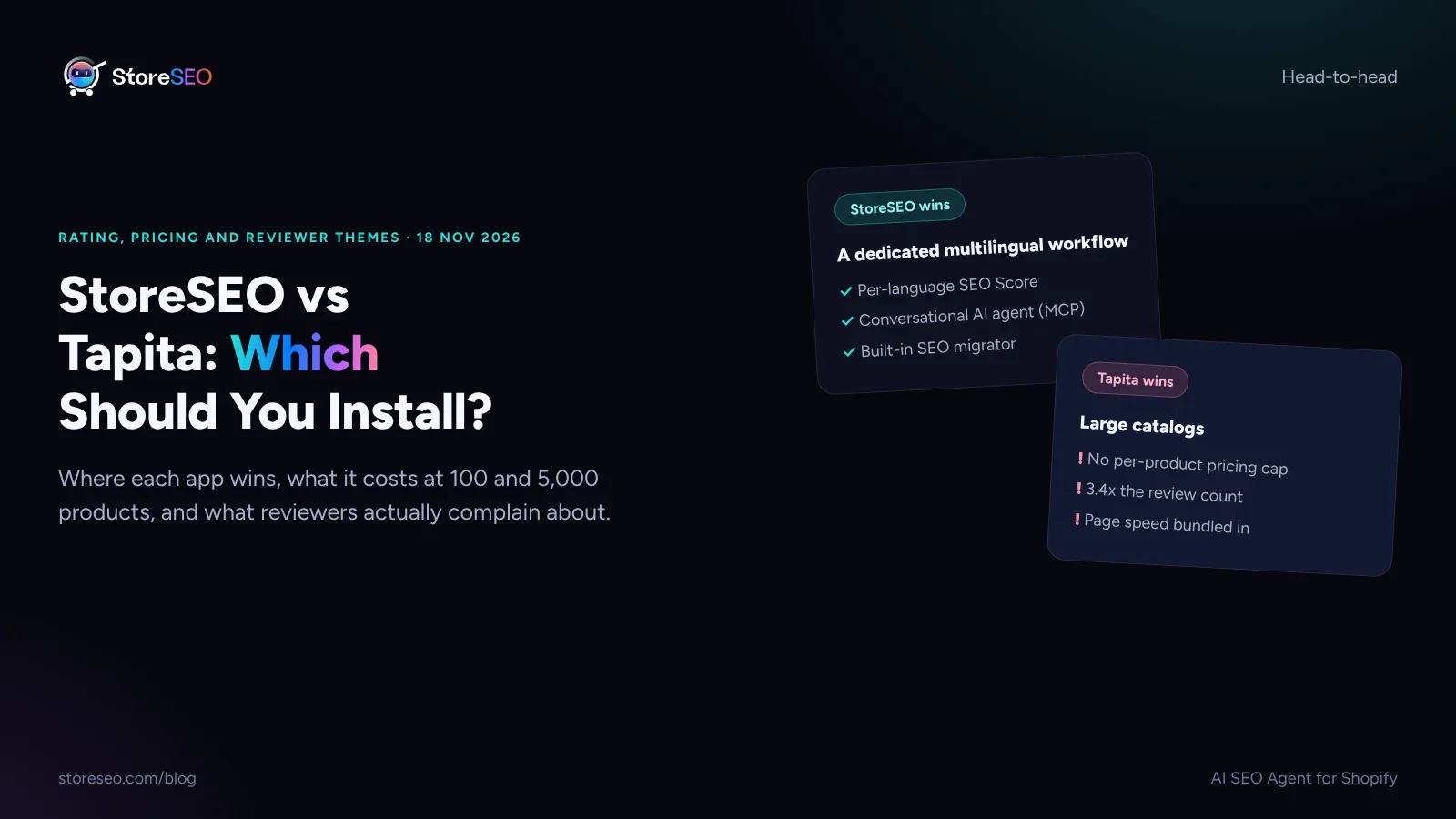
TL;DR: the short version, before the detail.
| If you want… | Pick | Why |
|---|---|---|
| The cheapest plan under 10,000 products | StoreSEO | Lite is $3.99/mo for 100 products, Essential $7.99/mo for 250 |
| A dedicated multilingual SEO workflow | StoreSEO | Advanced plan scores every translated product page by language |
| A flat price that never rises with catalog size | Tapita | Business and Premium gate by feature usage, not product count |
| A bigger existing review base | Tapita | 2,628 reviews at 5.0 stars vs StoreSEO’s 773 at 5.0 |
A quick note on where we stand. This is the StoreSEO blog, and StoreSEO is our product, one of the two apps compared below. That gives us a reason to like it, so every price, rating and review figure in this post comes straight from each app’s own Shopify App Store listing, checked 18 November 2026, we lead with where Tapita wins, and we show StoreSEO’s own reviewer complaints rather than only its praise. If you are choosing among several apps rather than these two specifically, our best Shopify SEO apps guide covers the wider field.
Where Does Tapita Win?
Tapita AI SEO Optimizer, Speed prices by feature depth, not by how many products you optimize. Its Free plan covers unlimited onpage SEO audits and 900 image compressions a month; Business is $9.99/mo and Premium is $49.99/mo, and none of the three tiers caps the number of products in your store. Instead each tier caps specific actions, like how many images it auto-optimizes per day (30 free, 100 on Business, 500 on Premium) or how many AI metadata credits it grants per month. At a 5,000-product catalog, Premium’s $49.99/mo gets you 500 images a day and 500 AI credits a month, with no separate charge for catalog size the way StoreSEO adds one past 250 products.
Tapita also carries more than three times StoreSEO’s review count: 2,628 reviews at a 5.0-star average, checked 18 November 2026, against StoreSEO’s 773, also at 5.0. Tapita’s own star breakdown is 2,554 five-star, 46 four-star, 10 three-star, 3 two-star and 15 one-star ratings, a distribution with very little visible friction at the headline level. A bigger review base is a real trust signal for a first-time buyer scanning the App Store, even though it launched almost 18 months after StoreSEO did.
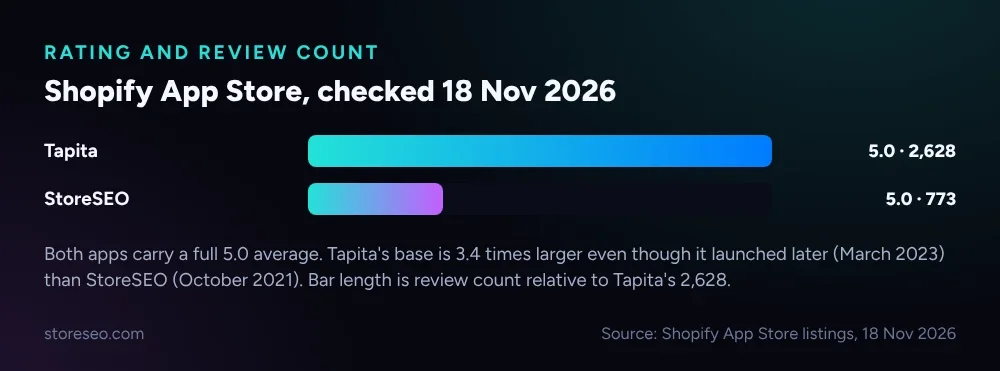 Source: Shopify App Store listings, 18 November 2026.
Tapita also bundles page speed and Core Web Vitals tools directly into its SEO plans, which StoreSEO does not attempt; a store already paying for a separate speed app may find consolidating onto Tapita the simpler move.
Where Does StoreSEO Win?
Below 10,000 products, StoreSEO is the cheaper app outright at every matching tier. Its Free Forever plan covers 25 products with a 200-credit AI content generator, Lite is $3.99/mo for its first month ($19.99/mo after) for 100 products, and Essential is $7.99/mo for its first month ($39.99/mo after) for 250 products with 5,000 AI credits; Tapita’s cheapest paid tier, Business at $9.99/mo, does not match that AI-credit depth until you count its uncapped product count as the trade-off. StoreSEO also ships a built-in SEO Migrator on every plan including the free one, so switching away from an app like Tapita does not mean re-entering every meta title and description by hand.
The bigger difference for a store selling in more than one language is Multilingual SEO. Once a store’s products are translated with Shopify’s own Translate & Adapt app, StoreSEO’s Multilingual SEO Support syncs each published language and lets you optimize the translated version of every product page separately, scoring its title, meta description and keyword use in that language rather than copying the SEO score from the original. That matters because a translated page that is not itself optimized still needs the right hreflang annotations pointing search engines to the correct language version, and a generically translated meta description will not rank the way a locale-optimized one can. Tapita’s own listing promises “multilingual SEO” as one line inside a longer feature bundle, but its public listing does not break that claim into a dedicated workflow, a settings screen or a documentation page the way StoreSEO’s Multilingual SEO Support does. StoreSEO also ships a conversational AI SEO Agent through its MCP server, so Claude or ChatGPT can audit a product’s SEO or fix a schema error directly through the same connection; Tapita’s listing does not mention an equivalent AI-assistant integration.
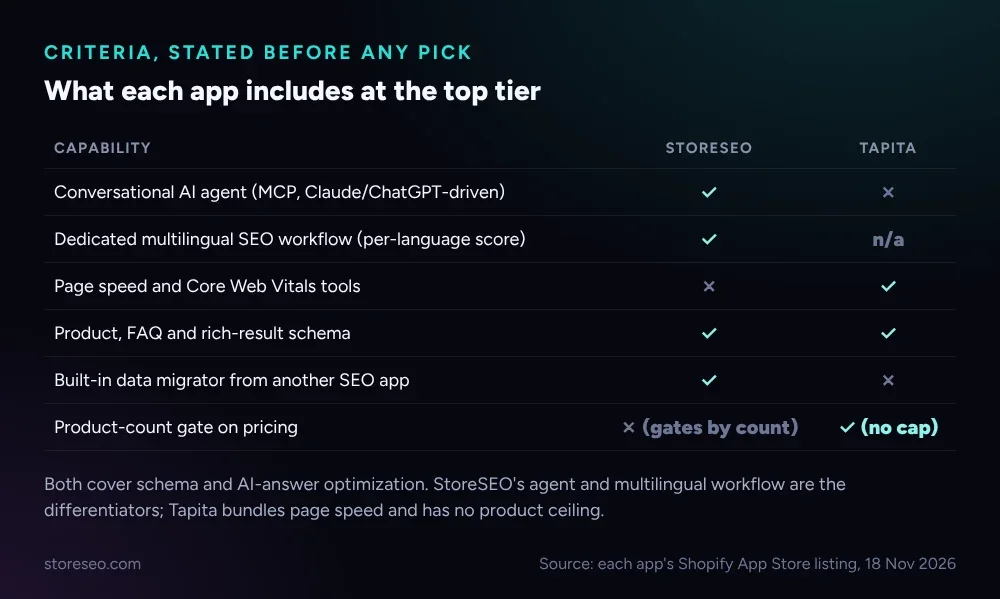 Source: each app’s Shopify App Store listing, 18 November 2026.
How Do The Prices Compare At 100 And 5,000 Products?
At 100 products, StoreSEO’s Lite plan is $3.99/mo for its first month, undercutting Tapita’s cheapest paid tier, Business at $9.99/mo, even before Tapita’s ongoing $9.99 continues unchanged. StoreSEO is the cheaper choice here by a wide margin, whether or not multilingual SEO is part of the decision.
At 5,000 products, StoreSEO’s own product cap forces an upgrade all the way to Advanced, which happens to be priced the same as Tapita’s Premium tier at $49.99/mo, the only StoreSEO plan that both lifts the ceiling to 10,000 products and unlocks Multilingual SEO. Tapita’s Premium tier was never gated by product count in the first place, so the same $49.99/mo plan that covers a 100-product store covers a 5,000-product one too; what scales instead is image-optimization throughput (500/day) and AI credits (500/month), which a very large catalog can still exhaust faster than a smaller one. A store past a few hundred SKUs should run this math on its own catalog before picking either app.
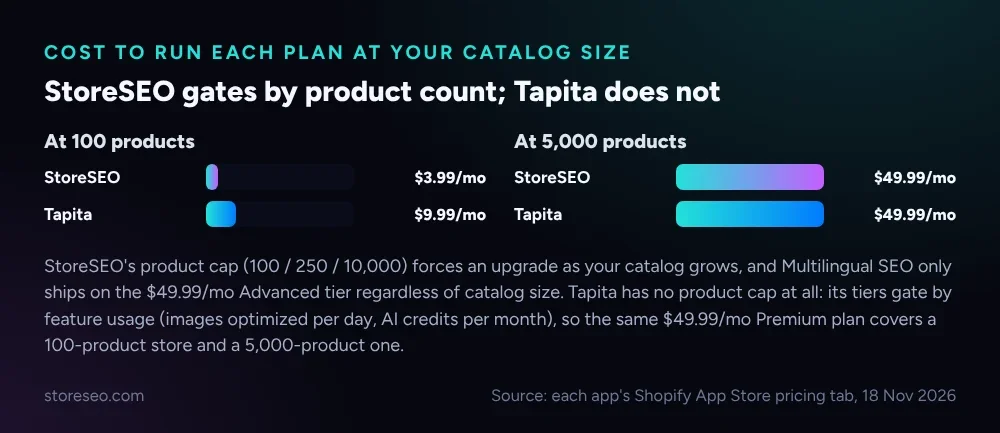 Source: each app’s Shopify App Store pricing tab, 18 November 2026.
What Do Reviewers Complain About?
We track both apps’ reviews through AppStorePulse, which aggregates recurring themes across sampled reviews. Across 279 StoreSEO reviews analyzed as of 18 November 2026, the complaints are thin but real, each appearing once: the monthly subscription cost, a note that the app is “not a complete SEO solution” on its own, excessive automatic AI generation, a sync double-charging a store, and data loss on a resync. Praise, led by helpful support (15 mentions) and ease of use (13 mentions), outweighs these by a wide margin.
Tapita is in our tracked-app set too, so we can show the same mention-by-mention breakdown for it rather than only its star rating. Across 424 Tapita reviews analyzed as of 18 November 2026, the cited complaints are also single mentions each: a steep learning curve, confusing AI-credit usage, the app lacking some desired features, a chat box that obstructs the workflow, and a fix-page size too small for the work, causing repeated passes. Its praise is dominated by support quality: helpful support (20 mentions) and a helpful support team (14 mentions) lead every theme on either app.
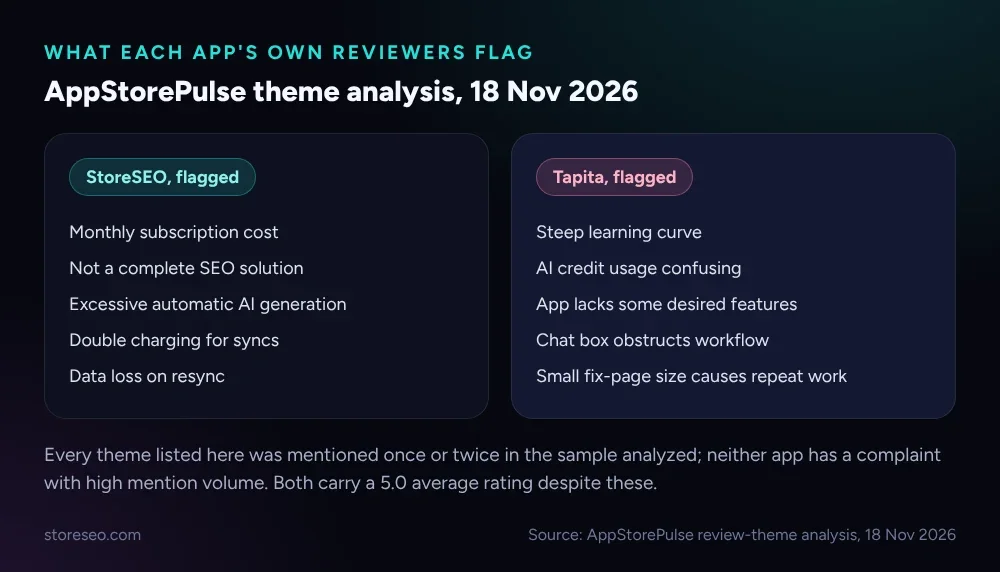 Source: AppStorePulse review-theme analysis, 18 November 2026.
Which Should You Choose?
Choose StoreSEO if your catalog is under roughly 10,000 products, you sell in more than one language and want each translated page scored on its own, or you want an AI agent that can act on your store through Claude or ChatGPT rather than only generate suggestions. If you compared us against a similar app before, our StoreSEO vs SEO Manager comparison uses the same criteria, and our hreflang setup guide walks through the international side in more depth. Choose Tapita if your catalog is very large and growing, you want page speed tools bundled with SEO rather than a separate app, and a bigger existing review base gives you more confidence walking in cold. Either way, both apps run a workable free or low-cost entry tier, so the cheapest way to decide is still to install your top pick on a duplicate or development store and test it against your own catalog, the same advice we give in our Avada SEO alternatives roundup.
Frequently Asked Questions (FAQs)
1. Is Tapita cheaper than StoreSEO?
It depends on your catalog size and whether you need multilingual SEO. Below 10,000 products, StoreSEO’s Lite and Essential tiers cost less than Tapita’s Business plan. Once you need Tapita’s Premium-level image and AI-credit throughput, both top tiers land at the same $49.99/mo, checked 18 November 2026.
2. Does Tapita have a dedicated multilingual SEO feature like StoreSEO’s?
Tapita’s listing describes “multilingual SEO” as part of its broader bundle, but it does not publish a dedicated workflow, settings screen or documentation page for it the way StoreSEO does. StoreSEO’s Multilingual SEO Support syncs each language published through Shopify’s Translate & Adapt app and lets you optimize every translated product page on its own.
3. Does Tapita have an AI agent like StoreSEO’s MCP server?
Not based on its public listing. Tapita bundles SEO, GEO, AEO and page-speed tools, but its description does not mention a conversational agent that a person can direct through Claude or ChatGPT to take actions on the store. StoreSEO’s AI SEO Agent does exactly that.
4. Which app has more Shopify reviews?
Tapita, by a wide margin: 2,628 reviews at 5.0 stars against StoreSEO’s 773, also at 5.0, both checked 18 November 2026. A larger base is a stronger signal for a first-time buyer, even though the two apps rate identically on average.
5. Does either app cap the number of products I can optimize?
StoreSEO does, by plan: 25 products free, 100 on Lite, 250 on Essential, 10,000 on Advanced. Tapita does not cap by product count at all; its tiers cap specific actions instead, like images auto-optimized per day and AI metadata credits per month.
6. Can I migrate my SEO data from Tapita to StoreSEO?
StoreSEO includes a SEO Migrator on every plan, including the free one, built to import metadata from another SEO app so you are not re-entering titles and descriptions by hand. Confirm your specific field mapping in the tool before uninstalling your old app.
Test Before You Commit
Both apps run a workable free or low-cost tier, so install your top pick on a duplicate or development store and run it against your real catalog before paying for anything. If a store selling in more than one language, or an AI agent that acts on your store’s SEO through Claude or ChatGPT, matters to you, try StoreSEO on the Shopify App Store.
Keep reading
Smart SEO vs Avada SEO: Which Should You Install?
Smart SEO costs less to start and adds an AI search LLM Catalog; Avada SEO Suite has far more Shopify App Store reviews and a one-click AI audit agent.
Read article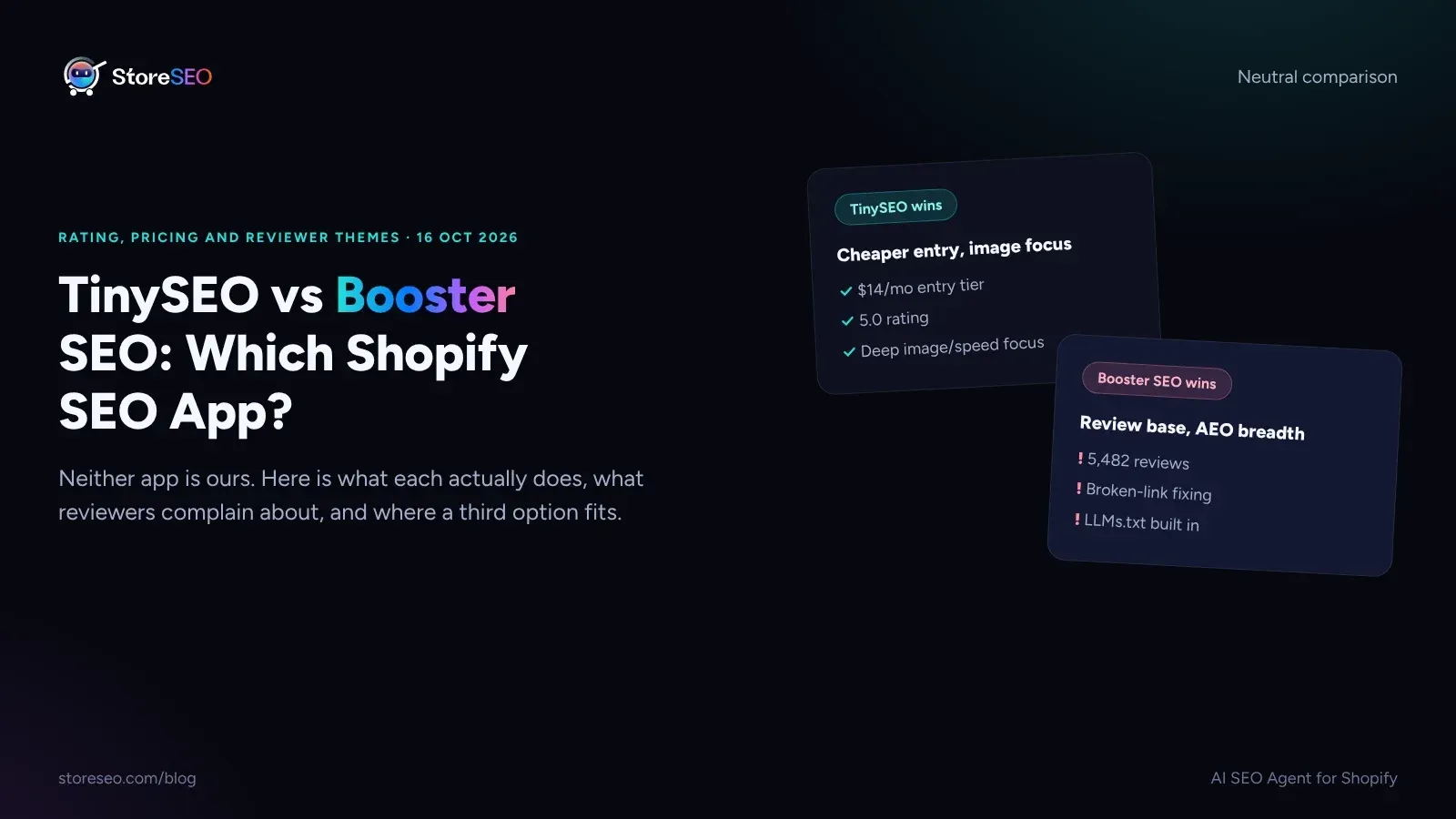
TinySEO vs Booster SEO: Which Shopify SEO App?
TinySEO combines SEO, speed, and AI content optimization and works with Shopify Sidekick; Booster SEO has far more reviews and offers the Autopilot feature.
Read article
StoreSEO vs SearchPie: Honest 2026 Comparison
StoreSEO costs less below 250 products and adds a conversational AI SEO agent, while SearchPie's flat-rate plan wins once your catalog grows large.
Read article