AI Search Intent: How to Map Shopify Content to ChatGPT & Gemini Query Patterns

Shoppers no longer start every product search on Google. A growing number open ChatGPT or Gemini and type a question the way they would ask a knowledgeable friend, such as ‘what is the best waterproof hiking boot under 150 dollars.’ These platforms do not return ten blue links. They return a synthesized answer, often with two or three product picks, built from structured data, reviews, and content that the AI judges trustworthy. For a Shopify store owner, this is a real shift in how products get discovered.
This is exactly why mapping your Shopify content to AI search intent matters. AI search intent refers to the way ChatGPT, Gemini, or other AI platforms interpret a shopper’s question and decide what information, products, or pages deserve a place in the answer. If your store content is not structured for that interpretation process, your products simply will not appear, no matter how well they rank on Google.
This article explains how ChatGPT and Gemini process shopping queries differently, what kind of content each platform favors, and the practical steps a Shopify merchant can take today to map product pages, collections, and blog content to these new query patterns.
TL;DR
| Key Point | What It Means for Your Shopify Store |
| ChatGPT and Gemini interpret queries differently | ChatGPT favors conversational, review-backed content; Gemini leans heavily on Google’s Shopping Graph and structured data |
| Structured data is non-negotiable | Use schema.org Product markup with GTIN, brand, price, and availability fields on every product page |
| AI crawlers need explicit access | Check your robots.txt for OAI-SearchBot, Google-Extended, ChatGPT-User, and other AI bots |
| Conversational content outperforms keyword-stuffed copy | Write product descriptions and FAQs that answer real questions, not just list specifications |
| Reviews and third-party mentions carry weight | ChatGPT often pulls from review sites and forums, so external trust signals matter as much as your own page |
| Visual content needs metadata too | Descriptive ALT text and semantic filenames now influence visibility in AI-driven visual shopping results |
| Measurement is still catching up | Track AI referral traffic where possible and monitor brand mentions, since not every AI-driven sale shows up in standard analytics |
What Is AI Search Intent & Why Does It Matter for Shopify SEO?
Before mapping any content, it helps to understand what AI search intent actually looks like in practice. Unlike a traditional keyword, an AI query is usually a full sentence with context built in, such as a budget, a use case, or a personal preference.
Traditional SEO intent is built around matching a keyword to a page. AI search intent, sometimes called Generative Engine Optimization or GEO, is built around matching a complete question to a complete answer. Generative Engine Optimization focuses on visibility inside AI answers rather than visibility on a results page, which changes how product descriptions, brand pages, and blog content need to be built. A shopper does not type ‘waterproof boots.’ They type ‘I need waterproof hiking boots for wet terrain that will not break the bank.’ The AI has to parse intent, budget, and use case all at once, then decide which products satisfy all three conditions.
This means your Shopify content needs to anticipate full questions instead of fragments. A product titled ‘X-Trail Hiker 3000’ gives the AI nothing to work with. A descriptive product title is the single most important element for AI visibility because it acts as the keyword anchor that determines whether a product is relevant to a detailed, natural language query.
Why Search Intent Mapping Cannot Be an Afterthought
Many Shopify merchants treat AI visibility as a secondary concern, something to revisit after the usual SEO checklist is complete. That approach is becoming risky.
AI referral traffic now accounts for roughly 1.08% of all website traffic across major industries, with ecommerce and technology sectors leading at 2 to 3 percent, and that share is growing at 527 percent year over year. Even more telling, users arriving from AI search platforms convert at a rate 4.4 times higher than those coming from traditional organic search, according to a 2025 Semrush study.
That conversion gap is the real reason to prioritize this work. Shoppers who reach your store through an AI recommendation have already had their questions answered and their options narrowed. They arrive closer to a purchase decision than someone scrolling through search results.
How ChatGPT Interprets Shopping Queries
ChatGPT approaches shopping questions as a conversation rather than a lookup. Understanding its sourcing behavior is the first step toward shaping content it will actually cite.
ChatGPT tends to favor content that reads like an answer a knowledgeable person would give, supported by evidence from outside your own store.
For shopping queries, ChatGPT draws heavily from its Bing-based index along with OAI-SearchBot, and being well represented on review sites and forums significantly boosts the chances of appearing in its shopping recommendations. This means your own product page copy is only part of the picture. Reddit threads, independent review blogs, and comparison articles that mention your brand all feed into what ChatGPT considers trustworthy.
ChatGPT has also moved deeper into structured shopping experiences. ChatGPT now guides users through a conversation, asking clarifying questions such as whether battery life or weight matters more, which makes the buying process feel personalized rather than like browsing a static grid. If your product content already answers those follow-up questions inside the description or FAQ, the AI has less work to do connecting your product to the shopper’s stated priority.
Mapping Shopify Product Pages to ChatGPT Patterns
To align a product page with how ChatGPT reads and cites content, focus on three things: descriptive titles, conversational specification framing, and proactive comparison data.
Start with the product title and the first two sentences of the description. These should answer ‘what is this and who is it for’ in plain language. Avoid vague branding language in favor of concrete, searchable descriptors. Products that answer common questions naturally, provide comparison data proactively, and demonstrate value through clear benefit statements perform better in ChatGPT recommendations, since sellers who treat product descriptions as conversational guides rather than specification sheets gain an advantage.
This is a meaningful shift from older SEO habits. A specification table is still useful, but it should sit alongside a short paragraph that explains the practical benefit of each feature, written the way you would explain it to a friend asking for advice.
Real Example: How a Shopify Product Page Appears in a ChatGPT Shopping Answer
To see this in practice, consider a Shopify store selling outdoor gear. A shopper opens ChatGPT and types: ‘What is a good waterproof jacket for hiking under $120 that works in cold rain?’ ChatGPT does not search for the keyword ‘waterproof jacket.’ It parses the full question and looks for content that explicitly addresses waterproofing, a hiking use case, cold weather performance, and a budget cap, all at once.
A product page titled “Men’s Waterproof Hiking Jacket” with a description that opens by saying “Built for cold, wet trails, this jacket keeps you dry in heavy rain with a 20,000mm waterproof rating and insulated lining, all for under $120” gives ChatGPT exactly the structured evidence it needs to include that product in its answer. A page titled “Summit Pro Jacket” with a spec table and no context does not.
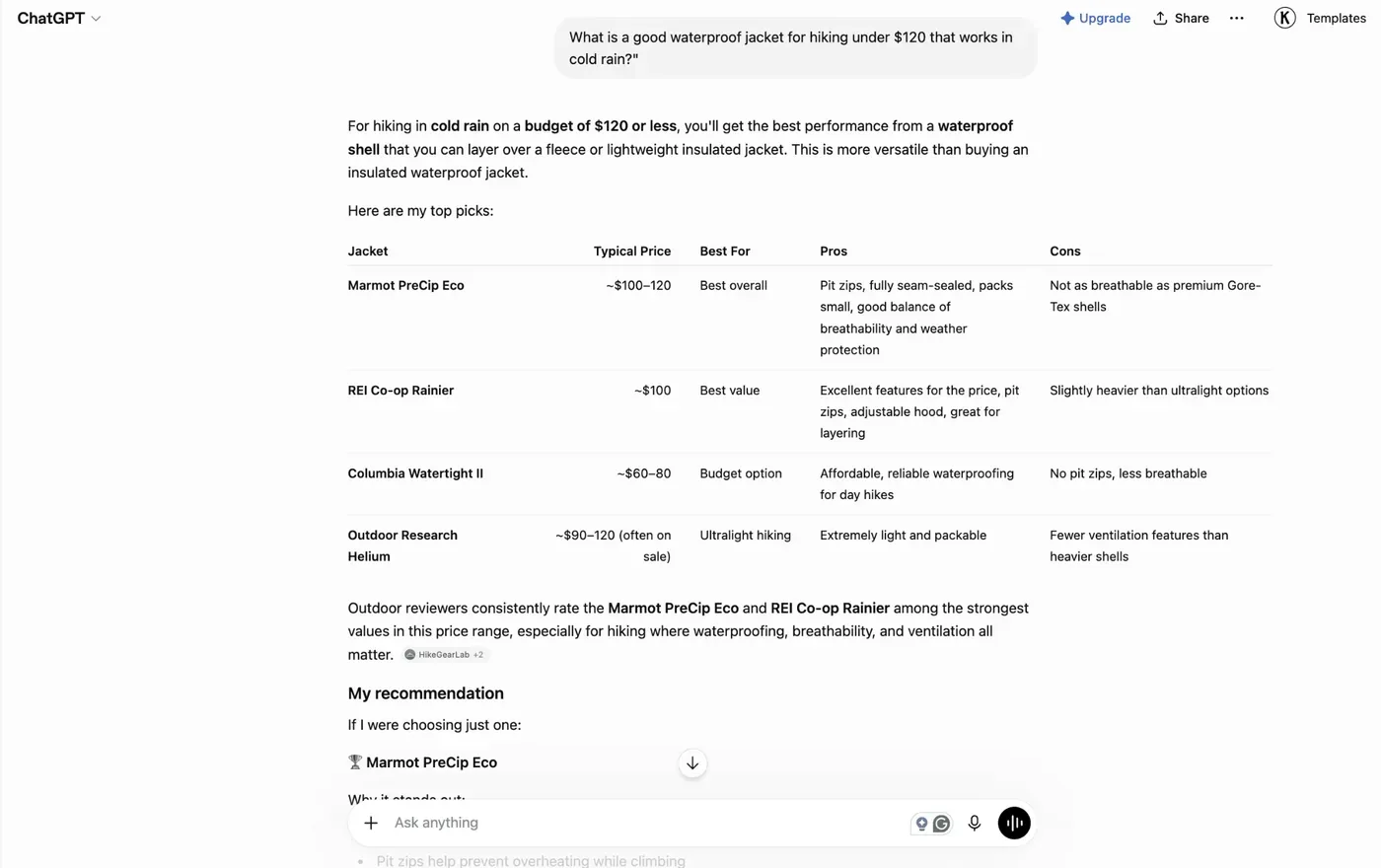
The difference between being cited and being invisible often comes down to whether your product copy answers the whole question, not just part of it. StoreSEO‘s product optimization features can help you identify which product titles and descriptions are too thin or too vague to meet this bar, and guide you toward descriptions that match real AI query patterns.
Building Content That Earns ChatGPT Citations
Because ChatGPT leans on external validation, a Shopify merchant benefits from a deliberate review and mention strategy. Encourage genuine customer reviews on platforms shoppers already trust, since these often carry more weight with the AI than on-site testimonials alone.
Blog content also plays a role here. A well-structured buying guide hosted on your own Shopify blog, one that compares options honestly and cites real specifications, can become a source ChatGPT references directly. The key is depth and honesty rather than promotional language. AI systems are generally better at filtering out marketing fluff than human readers give them credit for.
How Gemini Interprets Shopping Queries
Gemini takes a different path than ChatGPT and that difference changes what kind of Shopify optimization actually moves the needle.
Gemini’s shopping intelligence is rooted in Google’s existing infrastructure rather than an independent index. Gemini combines Google’s search index with its own training data, which means Google’s traditional ranking signals still matter, and a product page that ranks well in Google search with rich structured data is more likely to be surfaced by Gemini for related shopping queries. This is good news for merchants who have already invested in solid technical SEO, since that work is not wasted.
The scale of Gemini’s product data is significant. Gemini draws on Google’s Shopping Graph, which maintains billions of updated product listings, and can interpret a detailed natural language request such as a cozy leather jacket under a specific price, color, and size, returning curated products with images, availability, and shipping options. Structured, accurate, and current product feed data is therefore not optional for Gemini visibility.
Why Structured Data Decides Gemini Visibility
Gemini filters out incomplete listings automatically, which makes structured data a gatekeeping factor rather than a nice-to-have enhancement. Products listed with accurate, structured data appear more frequently in Gemini’s recommendations, while those with incomplete information get filtered out automatically, so including GTIN codes, brand identifiers, and condition descriptors improves visibility in AI-driven recommendations.
For a Shopify store, this translates into a checklist. Every product needs schema.org Product markup with the GTIN or UPC where available, the brand field populated, accurate price and currency, and an availability status that updates automatically with inventory. Shopify’s built-in product schema handles much of this, but merchants using heavily customized themes should verify that the markup has not been stripped out or left incomplete during theme customization.
Connecting Google Merchant Center to Gemini
Because Gemini pulls from the Shopping Graph, your Google Merchant Center feed functions as a direct input into Gemini’s shopping answers. Gemini and AI Mode in Search let users ask shopping questions and receive product comparisons, pros and cons, and visual tables, with results powered by the Shopping Graph’s more than 50 billion product listings pulling in prices, reviews, variants, and availability.
A Shopify merchant should treat the Merchant Center feed with the same care as the storefront itself. Product titles in the feed should match the natural language patterns shoppers actually use, not internal SKU naming conventions. Category mapping should be precise, since Gemini uses these categories to decide whether a product is even a candidate for a given query.
How Should You Write Shopify Blog Posts for AI Search?
Product pages are not the only Shopify content that AI platforms reference. Blog posts and collection pages can also surface in AI answers when they are built around real questions rather than generic keyword targets.
Think about the kinds of questions a shopper might ask before they have settled on a specific product, such as “what should I look for in a waterproof jacket” or “is merino wool better than synthetic for hiking socks.” These broader, advisory questions are exactly the type of content ChatGPT and Gemini reward, because the AI needs a trustworthy source to summarize before it ever gets to a specific product recommendation.
Structuring Blog Content for AI Comprehension
A blog post aimed at AI visibility should open with a direct, clear answer to the implied question, much like a featured snippet would. Follow that with supporting detail, comparisons, and context. Avoid burying the actual answer under three paragraphs of brand history or introduction.
Headings matter here just as much as they do for traditional SEO, but they should be phrased as questions or clear statements rather than vague topic labels. A heading like “Choosing the Right Material” is weaker than “Is Merino Wool Better Than Synthetic for Hiking Socks.” The second version mirrors how a shopper would actually phrase the question to ChatGPT or Gemini, which increases the odds the AI matches your content to that query.
Collection Pages as Comparison Hubs
Collection pages often get treated as simple product listings, but they can do more work for AI visibility when they include a short, genuinely useful introduction that frames the comparison. If your collection page for rain jackets includes two or three sentences explaining what separates a budget option from a premium one, that content gives the AI something concrete to summarize when a shopper asks for a comparison.
This does not need to be lengthy. A tight, accurate paragraph beats a long, vague one every time, both for the shopper reading it and for the AI parsing it.
Technical Foundations: Making Sure AI Crawlers Can Read Your Store
None of the content work above matters if AI crawlers cannot access your Shopify store in the first place. This is a step many merchants overlook entirely.
Each AI platform uses its own crawler, and your robots.txt file controls whether these crawlers are welcome. The current set of AI crawlers worth explicitly allowing includes GPTBot for training ChatGPT models, OAI-SearchBot for ChatGPT Search and Shopping Research, ChatGPT-User for live browsing on behalf of users, Google-Extended for Gemini and AI Mode, and Googlebot for search and AI Mode indexing, along with ClaudeBot, PerplexityBot, Perplexity-User, Applebot-Extended, and Bytespider depending on which ecosystems matter to your audience. If your robots.txt blocks any of these with a disallow rule, you have effectively opted out of that platform’s recommendations without realizing it.
Checking this takes only a minute. Visit yourstore.com/robots.txt directly in a browser and look for any user-agent line followed by a disallow rule that blocks the relevant bots. Shopify’s default robots.txt is generally permissive, but custom apps or theme edits can sometimes introduce unintended restrictions.
Connecting to the ChatGPT Sales Channel
Shopify merchants have a more direct path into ChatGPT’s shopping experience than many realize. Shopify merchants are often auto-connected once they enable the ChatGPT sales channel, and the application process requires the store URL, business contact information, product categories, and estimated monthly order volume. This is worth doing even if checkout inside the chat is not the primary goal, since OpenAI shifted its focus toward product discovery rather than in-app checkout in March 2026, which means the merchant program now functions primarily as a discovery channel that still routes the customer back to the merchant for checkout.
Using LLMs.txt to Help AI Understand Your Store
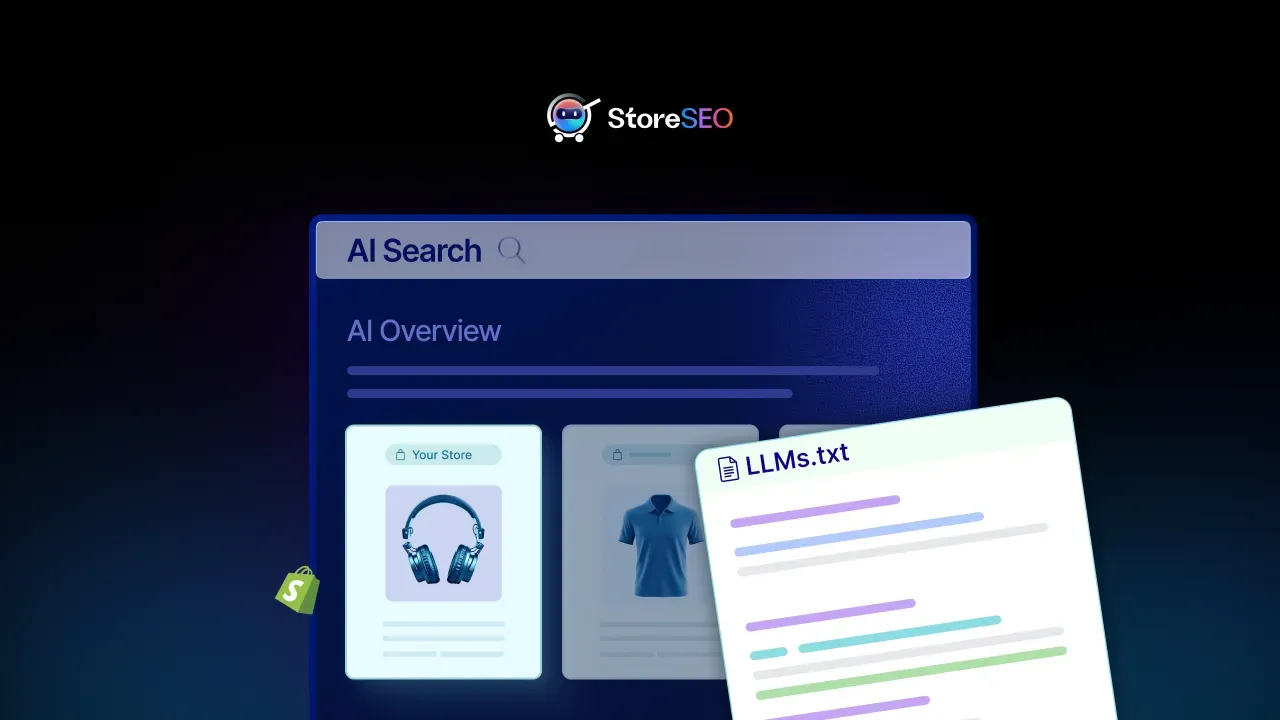
Beyond robots.txt, there is a newer standard that Shopify merchants should be aware of: the LLMs.txt file. While robots.txt tells crawlers which pages they are allowed to access, LLMs.txt goes a step further by giving AI language models a curated, plain-text summary of your store’s content, purpose, products, and policies in a format they can read and use efficiently.
Think of it as a store directory written specifically for AI systems. Instead of an AI crawler having to piece together who you are by reading dozens of individual pages, your LLMs.txt gives it a clear, structured briefing upfront. This is especially useful for Shopify stores with large catalogs, where the AI might otherwise struggle to understand your brand context and product range from crawling alone.
StoreSEO includes an LLMs.txt generation feature, which automatically creates and maintains this file for your Shopify store. This means ChatGPT, Gemini, and other AI platforms that support the standard can understand your store’s content architecture without any manual file editing on your end. As AI platforms continue to formalize support for LLMs.txt, having this in place positions your store ahead of merchants who are still relying on crawling alone for AI comprehension.
Image Metadata for Visual Shopping
Visual search has become a meaningful part of how shoppers use ChatGPT, and image metadata now directly affects whether your products appear in those results. ChatGPT rolled out visual shopping to all users, including the free tier, in March 2026, with image tiles, side-by-side comparisons, and image-based search for finding similar items, which elevated image metadata from a nice-to-have to a requirement.
Every product image should include descriptive ALT text that explains what is actually shown, a semantic filename rather than a generic camera-generated one, and structured image data within your Product schema rather than relying on the raw image source alone. A jacket image saved as IMG_4821.jpg with no ALT text gives an AI system nothing to work with.
The same image saved as green-waterproof-jacket-mens-hiking.jpg with a descriptive ALT tag becomes usable data. StoreSEO’s AI-powered alt text generation feature can automatically write descriptive, context-aware ALT text for every product image in your catalog, which is a significant time saver for stores with hundreds of products.
Measuring the Impact of AI Search Optimization
Once your Shopify content is mapped to AI query patterns, the next challenge is figuring out whether it is actually working. This is genuinely harder than tracking traditional SEO and merchants should set realistic expectations.
A large share of AI-driven shopping research never results in a tracked click. With 93% of AI search sessions ending without a website visit, most AI visibility produces brand awareness rather than direct, trackable traffic. This does not mean the visibility is worthless. It means the value shows up differently, often as direct or branded search traffic days later, rather than as a clean referral in your analytics dashboard.
For Shopify merchants specifically, there is an additional gap when sales happen inside an AI conversation. When a customer asks ChatGPT for a recommendation and checks out inside the chat, standard analytics platforms see none of it, since there is no impression, click, session, or add-to-cart event, only an order webhook as the first signal. Treat this as a temporary limitation rather than a reason to ignore AI optimization altogether, since measurement infrastructure is actively catching up.
StoreSEO recently launched its AI Insights feature, which is designed specifically to close this measurement gap for Shopify merchants. AI Insights surfaces how your store’s products and content are being interpreted and referenced across AI platforms, giving you a structured view of your visibility that standard Google Analytics cannot provide.
7-Day AI Search Optimization Plan for Shopify Stores
If you are starting from scratch, this week-by-week sequence gives you a focused path forward without overwhelming your team. StoreSEO can help you handle several of these steps directly from your Shopify dashboard.
| Day | Action | Tool |
| Day 1 | Audit your robots.txt file and unblock all relevant AI crawlers | Manual check at yourstore.com/robots.txt |
| Day 2 | Generate and publish your LLMs.txt file so AI platforms can understand your store structure | StoreSEO LLMs.txt Generator |
| Day 3 | Run a full schema audit and fix missing GTIN, brand, and availability fields across your product catalog | StoreSEO’s SEO Schema |
| Day 4 | Rewrite your top 10 product titles and opening descriptions to answer full natural language questions | Manual + StoreSEO SEO Score |
| Day 5 | Generate descriptive ALT text for all product images and rename key image files with semantic filenames | StoreSEO AI Alt Text |
| Day 6 | Add comparison content to your top collection pages and publish one AI-optimized buying guide blog post | Manual |
| Day 7 | Review your Google Merchant Center feed titles and categories, then check StoreSEO AI Insights for a baseline visibility report | Google Merchant Center + StoreSEO AI Insights |
Running through this sequence once gives you a solid foundation. Repeating the audit steps monthly ensures your store stays visible as AI platforms continue to update how they interpret and rank content.
Practical Tracking Steps
A few concrete habits can help close part of this measurement gap. Major AI chatbots identify themselves in user-agent strings and referrer data, so tools like Google Analytics and PostHog can segment traffic arriving from ChatGPT, Perplexity, Claude, and Gemini, establishing a baseline for understanding AI traffic value.
Beyond referral traffic, it helps to run regular manual checks. Querying ChatGPT, Gemini, and Perplexity with the same prompts your customers would realistically use, then noting which brands appear and how your brand is positioned relative to competitors, gives a clear picture that traffic analytics alone cannot provide. This kind of manual audit, done monthly, is one of the more reliable ways to gauge whether your content mapping efforts are translating into actual AI visibility.
Key Takeaways
Before wrapping up, here is a quick recap of the most important actions covered in this article. Each one directly influences how visible your Shopify store becomes across ChatGPT, Gemini, and other AI search platforms.
- Use Product Schema on every product page, including GTIN, brand, price, and availability fields so AI platforms can parse and surface your listings accurately.
- Write for questions, not keywords. Frame product titles, descriptions, and blog headings around the complete, natural language questions shoppers are actually asking AI platforms.
- Optimize your Google Merchant Center feed with natural, descriptive product titles and precise category mappings, since Gemini pulls directly from the Shopping Graph.
- Add comparison content to collection pages and blog posts so AI platforms have trustworthy, summarizable material to reference when responding to pre-purchase research queries.
- Improve product reviews on third-party platforms, since ChatGPT leans heavily on external review sites and community mentions when building shopping recommendations.
- Use AI-readable image metadata: descriptive ALT text, semantic filenames, and structured image fields in your Product schema all feed into visual shopping results.
- Allow AI crawlers by checking your robots.txt, and publish an LLMs.txt file so AI systems can understand your store structure without relying on crawling alone.
- Measure AI referral traffic using analytics tools that segment AI platform sources, and use StoreSEO AI Insights to track your store’s visibility at the product level.
Start Mapping Shopify Content to AI Intent Today
Mapping Shopify content to ChatGPT and Gemini query patterns is no longer an experimental side project. It is becoming a core part of how products get discovered, compared and purchased. Both platforms need your robots.txt to actually let their crawlers in, and both increasingly rely on rich, descriptive image metadata as visual shopping expands.
The merchants who treat this as a structured, ongoing process, rather than a one-time fix, will be the ones whose products keep showing up as AI shopping continues to grow. Start with the technical basics, then move into rewriting product titles, descriptions, and blog content around real shopper questions rather than internal naming conventions or generic keywords.
If you are looking to get your Shopify store’s SEO foundation fully optimized before tackling AI search visibility, our team can help you build out the structured data, content, and technical setup that both traditional search engines and AI platforms expect to see. And to get tips and insights for that, you can subscribe to our blogs.
Frequently Asked Questions
What is the difference between traditional SEO and AI search intent mapping for Shopify stores?
Traditional SEO focuses on matching keywords to pages so they rank in a list of search results. AI search intent mapping focuses on matching complete, conversational questions to complete answers, since ChatGPT and Gemini synthesize a direct response rather than presenting a list of links for the shopper to click through.
Does Gemini use the same ranking signals as Google Search?
Gemini draws heavily on Google’s existing search index and Shopping Graph, so traditional ranking signals such as structured data, page quality, and Merchant Center feed accuracy still carry real weight. This means investments in standard technical SEO are not wasted when optimizing for Gemini.
How do I check if AI crawlers can access my Shopify store?
Visit yourstore.com/robots.txt directly in a browser and look for user-agent lines tied to bots such as GPTBot, OAI-SearchBot, ChatGPT-User, or Google-Extended. If any of these are followed by a disallow rule, that crawler is currently blocked from accessing your store.
Do customer reviews actually affect ChatGPT shopping recommendations?
Yes. ChatGPT often pulls from review sites, forums, and editorial content outside of your own store when building shopping recommendations, so genuine reviews on trusted third-party platforms can meaningfully influence whether your products appear in its answers.
Is structured data required for Shopify products to appear in Gemini results?
Structured data is effectively a gatekeeping requirement rather than an optional enhancement. Products with accurate Product schema markup, including GTIN codes, brand identifiers, and condition descriptors, are far more likely to surface in Gemini’s recommendations, while incomplete listings tend to get filtered out automatically.
Can I track sales that come from AI shopping conversations?
Partial tracking is possible. Standard analytics tools can identify referral traffic from AI platforms through user-agent and referrer data. However, sales completed entirely within an AI chat checkout often only appear as an order webhook with no prior tracked session, so manual brand visibility audits remain an important supplement to analytics.
Keep reading
40 ChatGPT Prompts for Shopify SEO, Tested
These 40 ChatGPT prompts draft Shopify meta descriptions, alt text, FAQs and schema, each with the one thing you must verify before publishing it.
Read article
We Checked 148 Shopify Stores for AI Crawler Blocks
We crawled robots.txt on 148 live Shopify stores and found only one blocking any AI crawler by name, and zero blocking GPTBot, ClaudeBot or PerplexityBot.
Read article
Track ChatGPT & Perplexity Traffic in GA4 (Shopify)
GA4 already tags some ChatGPT and Gemini visits as AI Assistant traffic, and one custom channel group adds Perplexity and Claude to the same report.
Read article