
How Often Does AI Actually Cite Shopify Stores?
 Written by M Asif Rahman
Nobody publishes a verified number for how often ChatGPT, Google’s AI Overviews or Perplexity actually cite a Shopify store. What is checkable: whether a store’s own robots.txt lets those answer engines in at all. We fetched it live from 12 real, public Shopify stores on 17 November 2026. Zero blocked them.
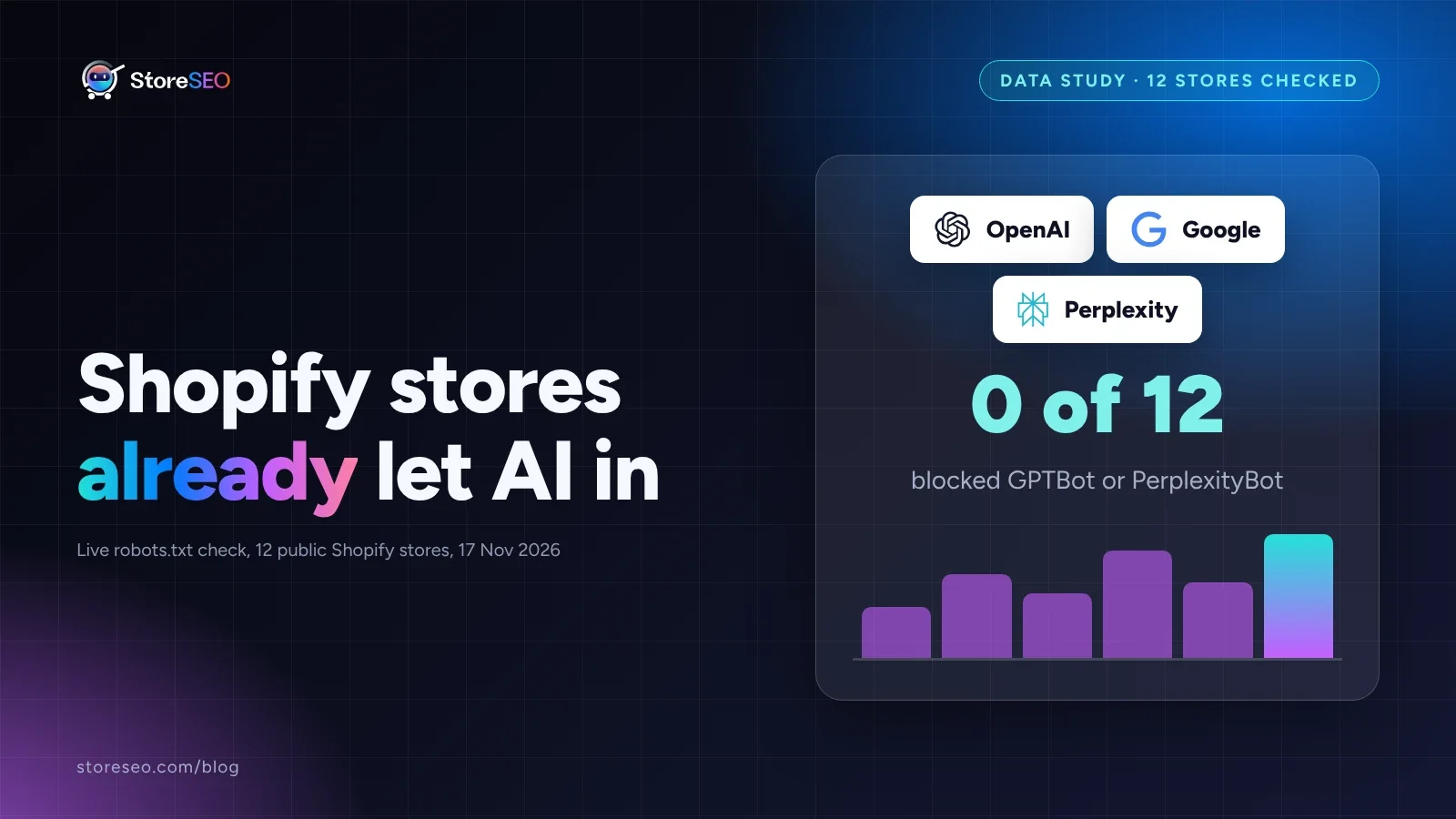
TL;DR: five numbers, each checked live and dated, none borrowed from a stale cache.
| Number | Source | Date | Verdict |
|---|---|---|---|
| 0 of 12 public Shopify stores block GPTBot, OAI-SearchBot or PerplexityBot | Live fetch of each store’s robots.txt | 17 Nov 2026 | Fix: nothing. Crawl access is not the bottleneck for most stores. |
| 5 of 12 already carry Shopify’s newer agents.md / UCP / MCP robots.txt template | Live fetch of each store’s robots.txt | 17 Nov 2026 | Fix: nothing. This rolls out from Shopify itself, not per store. |
| 1 of 12 (Beardbrand) blocks Amazon’s shopping bots specifically, AI answer bots untouched | Live fetch of beardbrand.com/robots.txt | 17 Nov 2026 | Fix: check your own robots.txt names the bot you mean to block. |
| “No additional requirements… nor other special optimizations necessary” to appear in AI Overviews or AI Mode | Google Search Central, “AI features and your website” | fetched 17 Nov 2026 | Fix: standard SEO, not a separate “AI SEO” checklist. |
| 3 distinct AI crawler roles exist: training, answer-crawling, and user-triggered fetch, not one undifferentiated “AI bot” | OpenAI’s and Perplexity’s own bot documentation | fetched 17 Nov 2026 | Fix: name the exact bot before blocking or allowing anything. |
Do Shopify Stores Block the AI Crawlers That Could Cite Them?
We picked 12 real, public Shopify stores already confirmed live in earlier research for this programme (Gymshark, Fashion Nova, MVMT, Death Wish Coffee, Chubbies, Taylor Stitch, Beardbrand, Ruggable, Allbirds, ColourPop, Brooklinen, Untuckit) and fetched each one’s /robots.txt directly, reading it for any rule naming GPTBot, OAI-SearchBot, ChatGPT-User, PerplexityBot, Perplexity-User, ClaudeBot or Google-Extended.
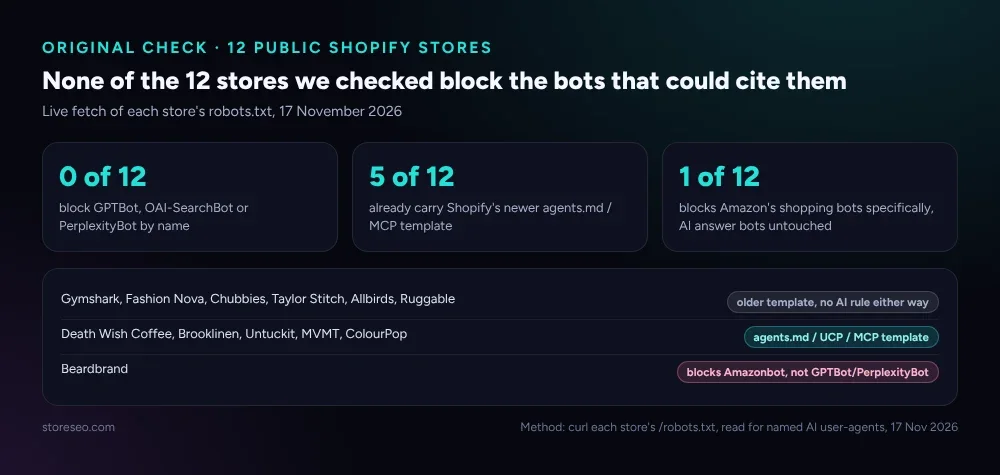 Live fetch of each store’s robots.txt, 17 November 2026.
Not one named any of those AI answer-engine bots in a Disallow rule. The closest thing to a block we found was Beardbrand’s robots.txt, which explicitly disallows Amazonbot, AmazonAdBot and AmazonProductDiscoverybot, but says nothing about GPTBot, PerplexityBot or Google-Extended, so those stay allowed by the file’s own generic User-agent: * rule. If a Shopify store is not showing up in an AI answer today, this sample says the merchant almost certainly did not block it on purpose. StoreSEO does not change a store’s robots.txt (Shopify generates and serves it), but the Agentic Discovery Score, covered below, measures the part of this problem a merchant can actually act on.
What Is Shopify’s New Robots.txt Template for AI Agents?
Five of the 12 stores we checked, Death Wish Coffee, Brooklinen, Untuckit, MVMT and ColourPop, are no longer on the older, generic Shopify robots.txt. They carry a newer one that names an agents.md file, a .well-known/ucp discovery path and an api/ucp/mcp endpoint, addressed directly to “agents” reading the file on a shopper’s behalf.
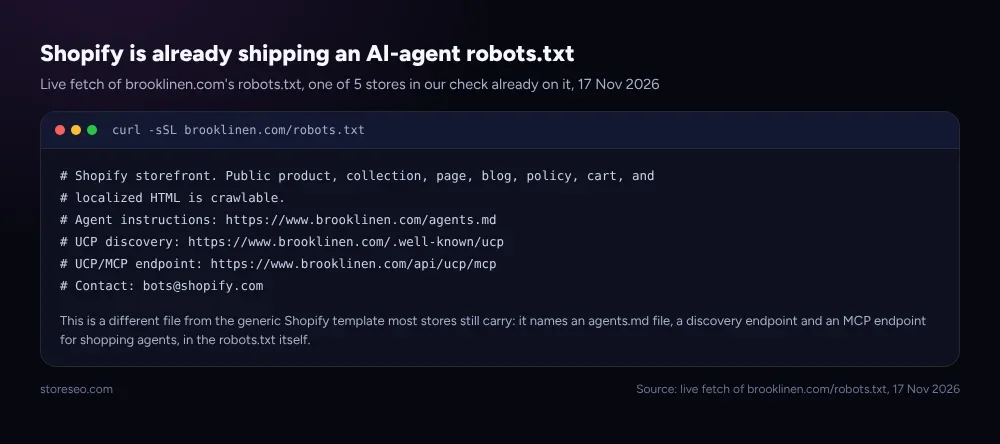 Live fetch of brooklinen.com’s robots.txt, 17 November 2026.
This is Shopify rolling out agentic-commerce infrastructure at the platform level, independent of any app a merchant installs: the file tells a shopping agent where to find structured instructions and a machine endpoint instead of leaving it to guess from the rendered page. The other 7 stores in our sample, including large names like Gymshark and Fashion Nova, were still on the older template as of this check, which is not a defect: the older file still allows every AI answer-engine bot by default, it simply does not yet advertise the newer agent-facing paths.
Is GPTBot the Same Bot That Lets ChatGPT Cite You?
No, and conflating the two is the most common mistake in this space. OpenAI’s own bot documentation and Perplexity’s crawler documentation each describe multiple, functionally separate bots under one brand name.
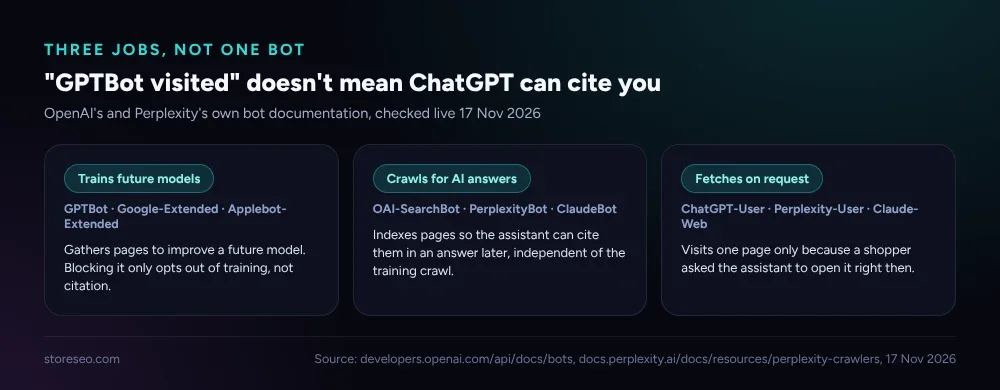 Source: OpenAI’s and Perplexity’s bot documentation, checked live 17 November 2026.
GPTBot, Google-Extended and Applebot-Extended gather pages to improve a future model; blocking one of these opts the store out of training data, nothing else. OAI-SearchBot, PerplexityBot and ClaudeBot crawl specifically to index pages an assistant might cite in a live answer, a separate job from training. ChatGPT-User, Perplexity-User and Claude-Web visit a single page only because a shopper, mid-conversation, asked the assistant to open it right then. A merchant who blocks GPTBot “to be safe” has not touched citation eligibility at all; a merchant who blocks OAI-SearchBot has.
What Does Google Actually Require to Appear in AI Overviews?
Nothing beyond ordinary SEO, by Google’s own account.
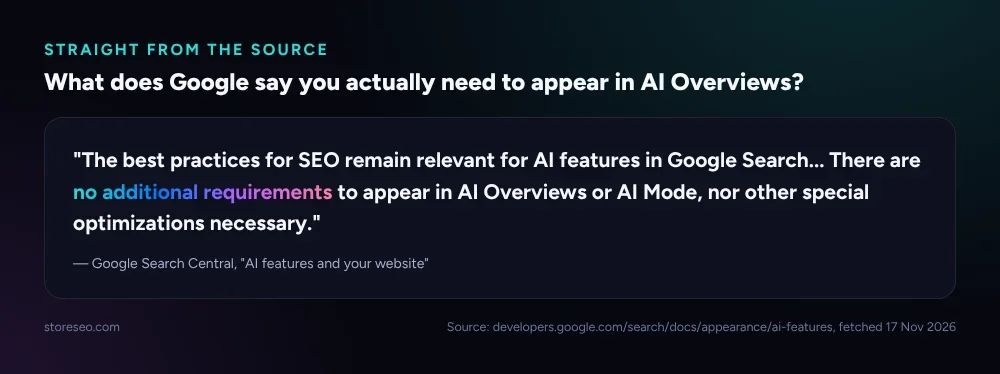 Source: Google Search Central, “AI features and your website,” fetched 17 November 2026.
Google’s guidance on AI features states plainly that the best practices for ordinary SEO remain relevant for AI Overviews and AI Mode, and that there are no additional requirements or special optimizations needed. That does not mean every page is equally likely to be pulled into an answer: a clear, well-structured, accurately described product page still beats a thin one at the same ranking position. It means the lever is the same one a Shopify SEO app already pulls: accurate titles, complete product and FAQ schema, and content that actually answers the query, not a separate “AI SEO” checklist bolted on top. StoreSEO’s Agentic Discovery Score measures exactly this layer: how well a product page’s structure, schema and copy hold up for a machine reader, beyond what a classic SEO score checks, so a merchant can see the gap before an AI answer engine finds it for them.
Which Stats Are Outdated?
Two kinds of number in this space go stale fast, and this post deliberately leaves them out rather than reuse them past their shelf life. First, this programme’s own research cache held a figure from 24 September 2026 on how many of storeseo.com’s own ranking keywords triggered an AI Overview; that number is now nearly two months old and was not re-verified live for this post, so it is cut rather than restated as current. Second, third-party vendor studies that claim a specific citation-share percentage for ChatGPT versus Google AI on shopping queries (several exist, from AI-visibility research firms) move with every model update and were not independently reproducible from this run, so none appear here as a number; a reader who wants one should check the vendor’s own page directly and note its date. Recheck both next quarter, and recheck the 12-store robots.txt sample itself: Shopify’s agents.md rollout was 5 of 12 stores on 17 November 2026, and that share is the one number in this post most likely to be different a month from now.
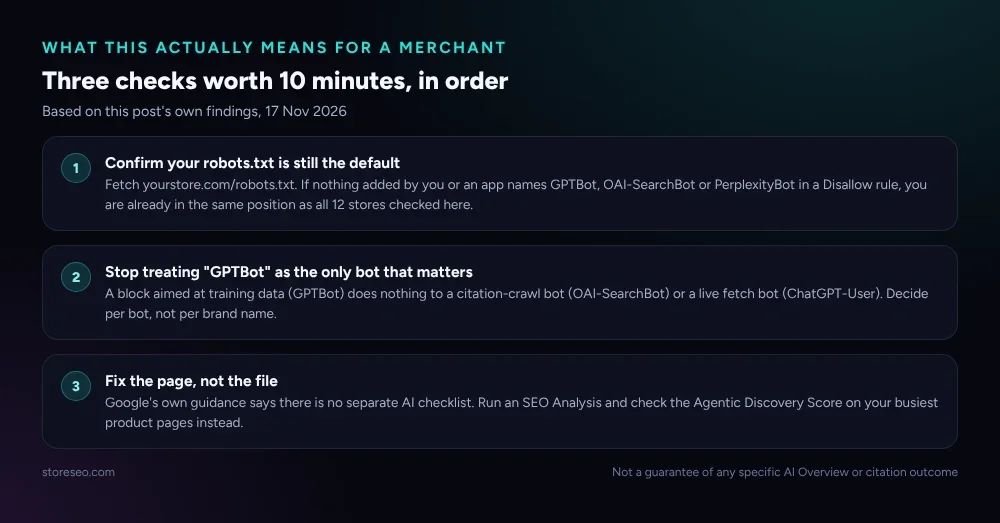 Based on this post’s own findings, 17 November 2026.
Frequently Asked Questions (FAQs)
1. Does blocking GPTBot stop ChatGPT from citing my Shopify store?
No. GPTBot is OpenAI’s training crawler; blocking it opts a store out of being used to train a future model. The bot that matters for citation in a live answer is OAI-SearchBot, a separate user-agent with its own rule in robots.txt.
2. Do I need to add anything to my Shopify store’s robots.txt for AI?
Usually not by hand. Shopify generates and serves the file, and none of the 12 stores we checked had to add a rule to let AI answer-engine bots in; the file already allows them under its default User-agent: * rule unless a merchant has specifically disallowed one.
3. What is Shopify’s agents.md file?
A file some Shopify stores now serve alongside robots.txt, naming instructions and endpoints (a UCP discovery path, an MCP endpoint) for AI shopping agents to use instead of just reading the rendered page. 5 of the 12 stores we checked on 17 November 2026 already had it; the rest were still on the older, generic template.
4. If my robots.txt allows every AI bot, am I guaranteed to be cited?
No. Being crawlable is a precondition, not a guarantee. Google’s own guidance says the same SEO fundamentals that earn a ranking also govern inclusion in AI Overviews; a crawlable but thin or unclear product page can still be passed over.
5. Is there a real, published number for how often AI cites Shopify stores specifically?
Not one we could verify independently as of this post. Vendor studies exist with specific percentages for broader retail citation patterns, but none were reproducible from this run, so this post reports only what was checked live: robots.txt access, not actual citation counts.
6. How does StoreSEO’s Agentic Discovery Score relate to this?
It scores a product page’s structure, schema and machine-readability, the part of “will AI cite this page” that is actually inside a merchant’s control, separate from the robots.txt question this post answers.
A store that leaves every AI crawler unblocked, which this sample says nearly all of them do, has cleared the first and easiest bar. The next one, whether the page itself gives an answer engine enough to work with, is where StoreSEO’s Agentic Discovery Score and the rest of its AI SEO Agent features are built to help, alongside groundwork like AI crawler traffic and AI snippets covered elsewhere on this blog, plus a free agent-readiness check from AIScan if a merchant wants a second, independent read on any site, Shopify or not. try StoreSEO on the Shopify App Store
Keep reading
AI Search Glossary for Shopify Merchants
This glossary defines 20 AI search terms Shopify merchants now hit, from AI Overview to zero-click, each checked against the source that coined it.
Read article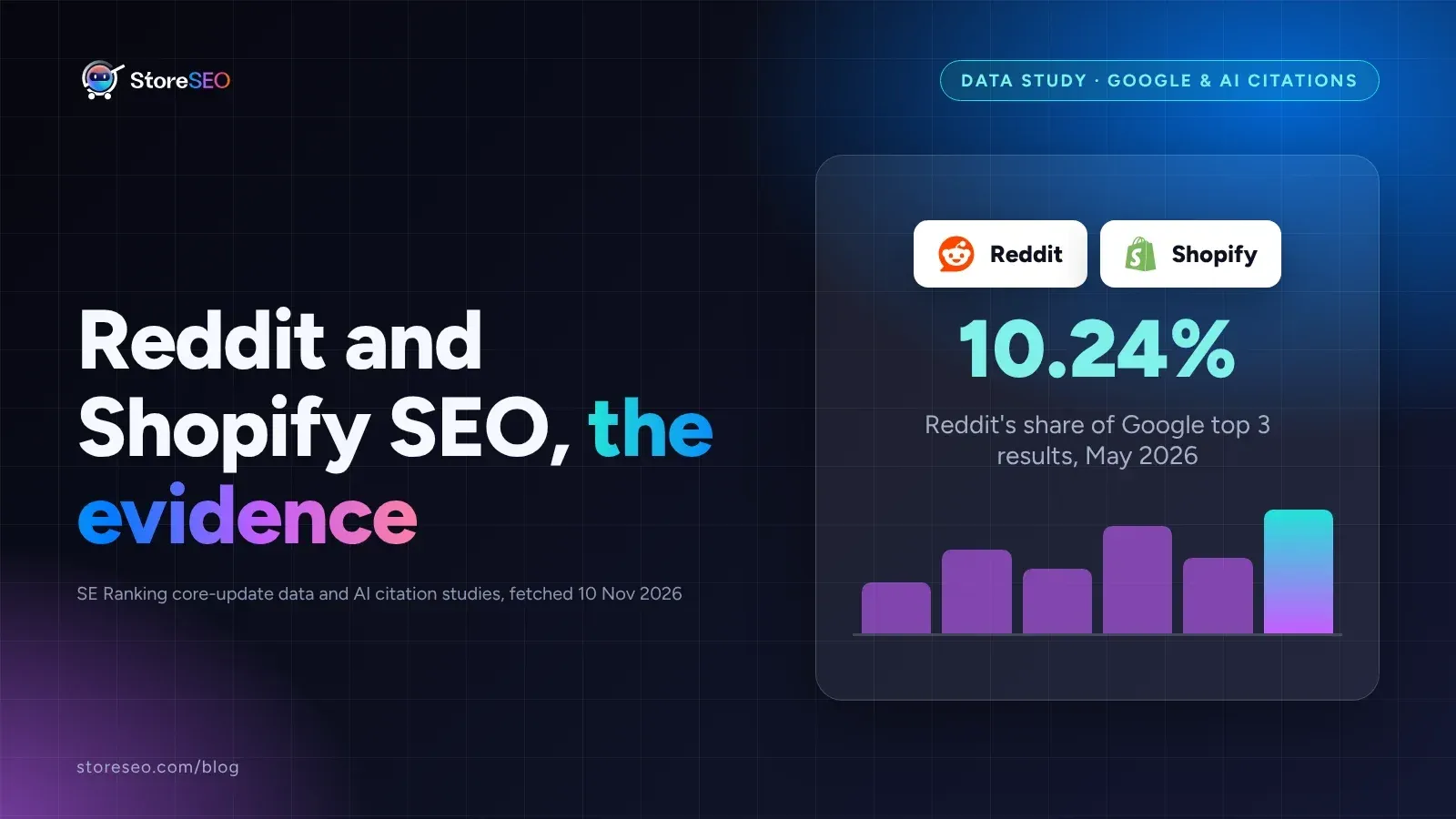
Does Posting on Reddit Help Shopify SEO? The Evidence
Reddit will not rank your product pages, but Google surfaces more Reddit threads and AI engines cite Reddit when they answer shopping questions.
Read article
How Long Until an AI Assistant Notices Your Page?
There is no published timeline from any AI provider, but a live-retrieval citation can land within days of a normal Google crawl, not months.
Read article