
How Long Until an AI Assistant Notices Your Page?
 Written by M Asif Rahman
No ChatGPT, Gemini or Perplexity publishes a timeline for when a new page gets cited. The honest answer splits in two: a live-retrieval citation can land within days of a normal Google crawl, while a model’s own trained knowledge only updates at its next release, a schedule no store owner controls.
TL;DR: two different clocks, not one timeline.
| Clock | What drives it | Typical range | What you can influence |
|---|---|---|---|
| Live retrieval (ChatGPT search, Perplexity, Gemini with browsing) | The same crawl and index pipeline as a search engine | Days to a few weeks after the page is crawlable and linked | Yes: sitemaps, internal links, robots.txt, instant indexing |
| Trained knowledge (what a model “knows” without browsing) | The provider’s own training-data cutoff and release schedule | Months, tied to the next model version, not your page | No: nothing a store owner does changes this clock |
What Speeds Up a Live-Retrieval Citation?
Live retrieval works like a search engine answer, not like model memory: the assistant fetches or references pages it can currently find and read, so the same things that help a page get crawled and indexed by Google also help it get picked up here. Google’s own Googlebot documentation describes discovery as following links and sitemaps from pages it already knows; a page that is linked from your sitemap, reachable in a small number of clicks from your homepage, and not blocked for crawlers is eligible the moment Google, or the assistant’s own crawler, can reach it.
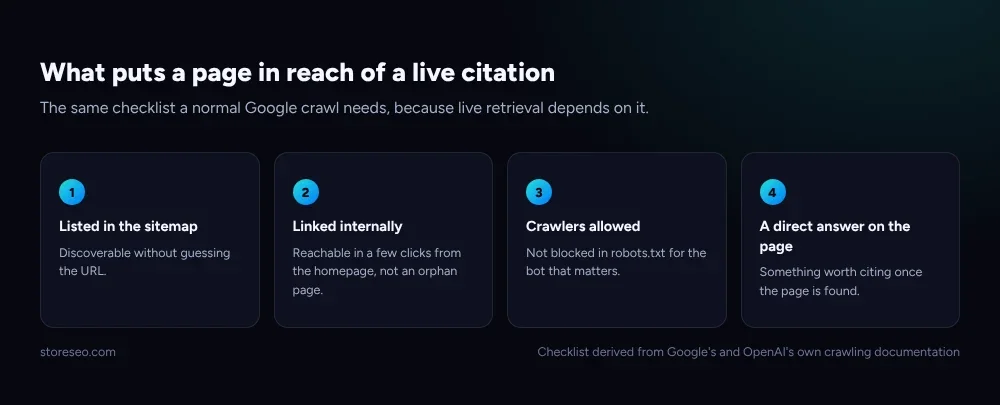 The same checklist that speeds up a normal Google crawl applies here, because live retrieval depends on it.
storeseo.com’s own robots.txt is a working example of what “not blocked” looks like: it names GPTBot, OAI-SearchBot, ChatGPT-User, PerplexityBot, Perplexity-User, Claude-Web and ClaudeBot individually, each allowed, with a Content-Signal line that permits search and AI-answer use while opting the training-only crawler out of model training specifically.
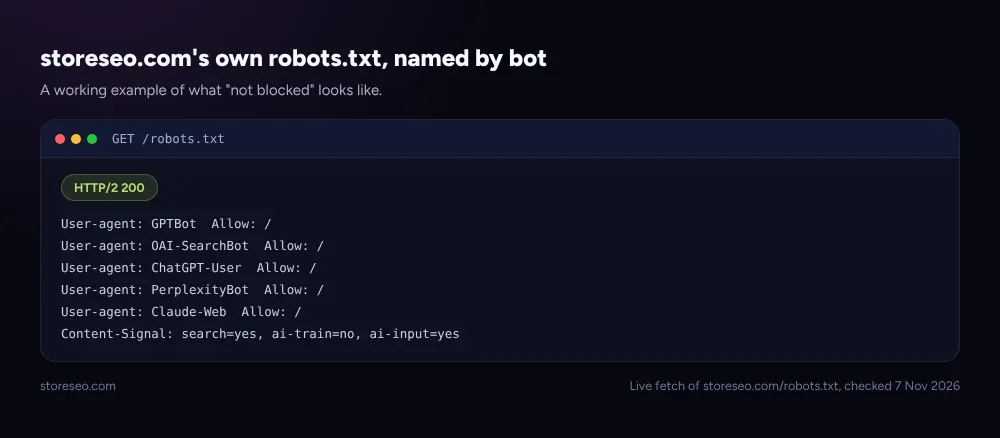 Source: live fetch of storeseo.com/robots.txt, checked 7 Nov 2026.
A page also needs something worth citing once it is found. Our AI Crawler Statistics post found that most of the Shopify stores checked do allow these crawlers by default; the harder gap is usually content, not access. StoreSEO’s AI Snippet Generator writes a short, direct answer for each product, the same shape an assistant pulls into a response, instead of leaving it to guess from a marketing paragraph.
What Slows It Down, or Blocks It Entirely?
Four things stop a page from ever reaching a live-retrieval answer, whatever the clock:
| Blocker | What it looks like | Fix |
|---|---|---|
| The page is not in your sitemap | Google and most AI crawlers discover pages by following links and sitemaps, not by guessing URLs | Confirm the page is listed, then resubmit |
| A crawler is disallowed in robots.txt | A named group (or the catch-all *) blocks the bot before it ever requests the page | Allow the specific bot, as storeseo.com’s own file does |
| The page has no real content for a search engine to crawl first | Live retrieval still depends on the page existing in a crawlable index, not only on the AI crawler itself | Publish real body content, not a placeholder |
| Nobody links to it | An orphan page with no internal links is slow to discover by any crawler | Link it from a pillar or a sibling post |
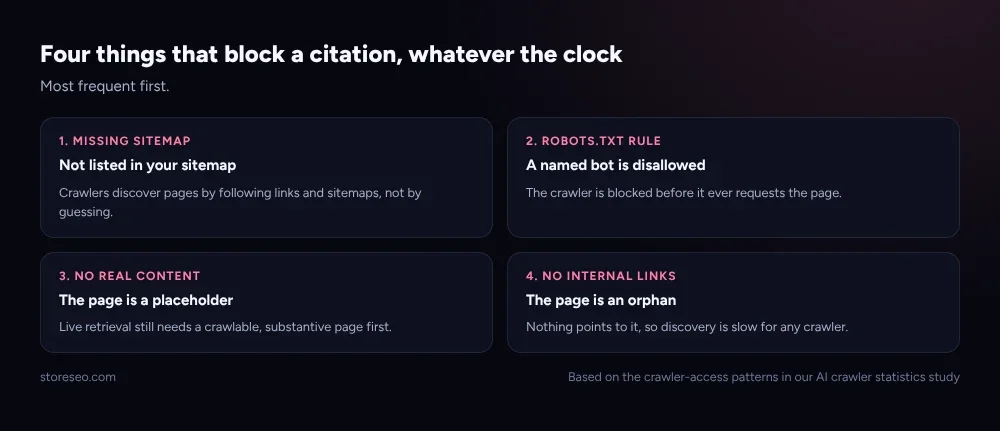 Common blockers, most frequent first, based on the crawler-access patterns in our AI crawler statistics study.
Is the Trained-Knowledge Clock Worth Chasing?
No, and this is the part most “how to get cited by ChatGPT” advice skips. A model’s trained knowledge, the facts it can answer without browsing, is fixed at a training cutoff baked into that version of the model. No amount of sitemap work, internal linking or content freshness moves that clock, because the model simply is not re-reading the live web for it. The only way a new page enters that layer is the next model release, on a schedule the AI company sets, not the store.
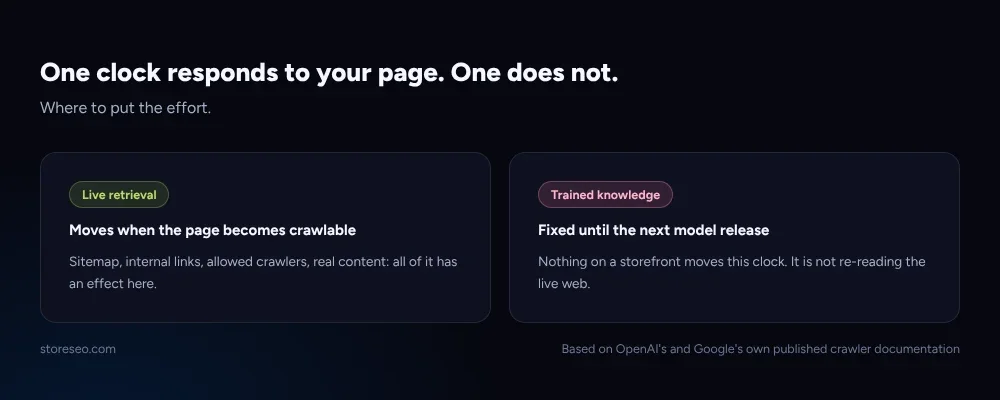 Why nothing on a storefront can speed up the trained-knowledge clock.
The practical implication: aim everything at the live-retrieval clock. How ChatGPT, Gemini and Perplexity recommend Shopify products covers what makes a page a good candidate once it is found, and What Is an AI Snippet for Shopify Products? explains the specific field StoreSEO writes for this purpose. Checking whether your own storefront is readable to these crawlers in the first place is worth doing before worrying about timing at all; AIScan’s free agent-readiness checker scores a site against exactly this, separate from StoreSEO and free to run on any URL.
When Should You Actually Worry About the Timing?
Worry if a page that is crawlable, linked, sitemapped and content-complete still shows zero AI referral activity after several weeks, since that points at a real gap rather than a timing question. Why Isn’t AI Referral Traffic Showing in StoreSEO? walks through the most common reasons that metric reads zero even when a page is technically fine, which is a more useful next step than waiting longer on the clock.
Do not worry about a brand-new page that has not finished its first normal Google crawl yet. Live retrieval cannot outrun basic crawlability; if Google has not found the page, an AI assistant’s own live fetch usually has not either. StoreSEO’s sitemap submission and instant indexing is the lever that actually shortens that first wait.
Frequently Asked Questions (FAQs)
1. Can I pay to get my Shopify page cited by ChatGPT faster?
No AI provider sells placement in a live-retrieval answer the way search ads work. The fastest real lever is making the page crawlable, linked and sitemapped sooner, which is free.
2. Does submitting my sitemap to Google also help AI assistants find my page?
It helps the assistants that browse the live web, since they rely on the same crawlable, linked structure Google does. It does nothing for a model’s fixed trained knowledge, which does not browse at request time.
3. Why does ChatGPT sometimes know about my store and sometimes not?
ChatGPT can answer two different ways: from trained knowledge, which is fixed and may be outdated or simply never included a small store, or from a live web search, which can find a page that trained knowledge never saw. Inconsistent answers usually mean one mode found the page and the other did not.
4. Does blocking GPTBot in robots.txt stop my page from being cited in ChatGPT search?
It depends which bot is blocked. OpenAI documents separate crawlers for training versus live search use, so blocking one does not necessarily block the other; check the specific bot name in your robots.txt rather than assuming one rule covers both purposes.
5. How do I check if my own store allows the AI crawlers that matter?
Open yourstore.com/robots.txt directly and look for named groups like GPTBot, OAI-SearchBot, PerplexityBot and ClaudeBot, the same way this post checked storeseo.com’s own file. A missing or disallowed group is worth fixing before worrying about timing.
6. Will a faster live-retrieval citation improve my Google ranking too?
Not directly. The two are separate systems, even though they often depend on the same underlying crawlability. Improving one does not guarantee the other, though the baseline fix, being genuinely crawlable and linked, helps both.
There is no shortcut around the trained-knowledge clock, and no need for one: a crawlable, linked, sitemapped page with real content is already positioned for every live-retrieval answer engine checks today, which is the clock that actually responds to anything a store does. try StoreSEO on the Shopify App Store
Keep reading
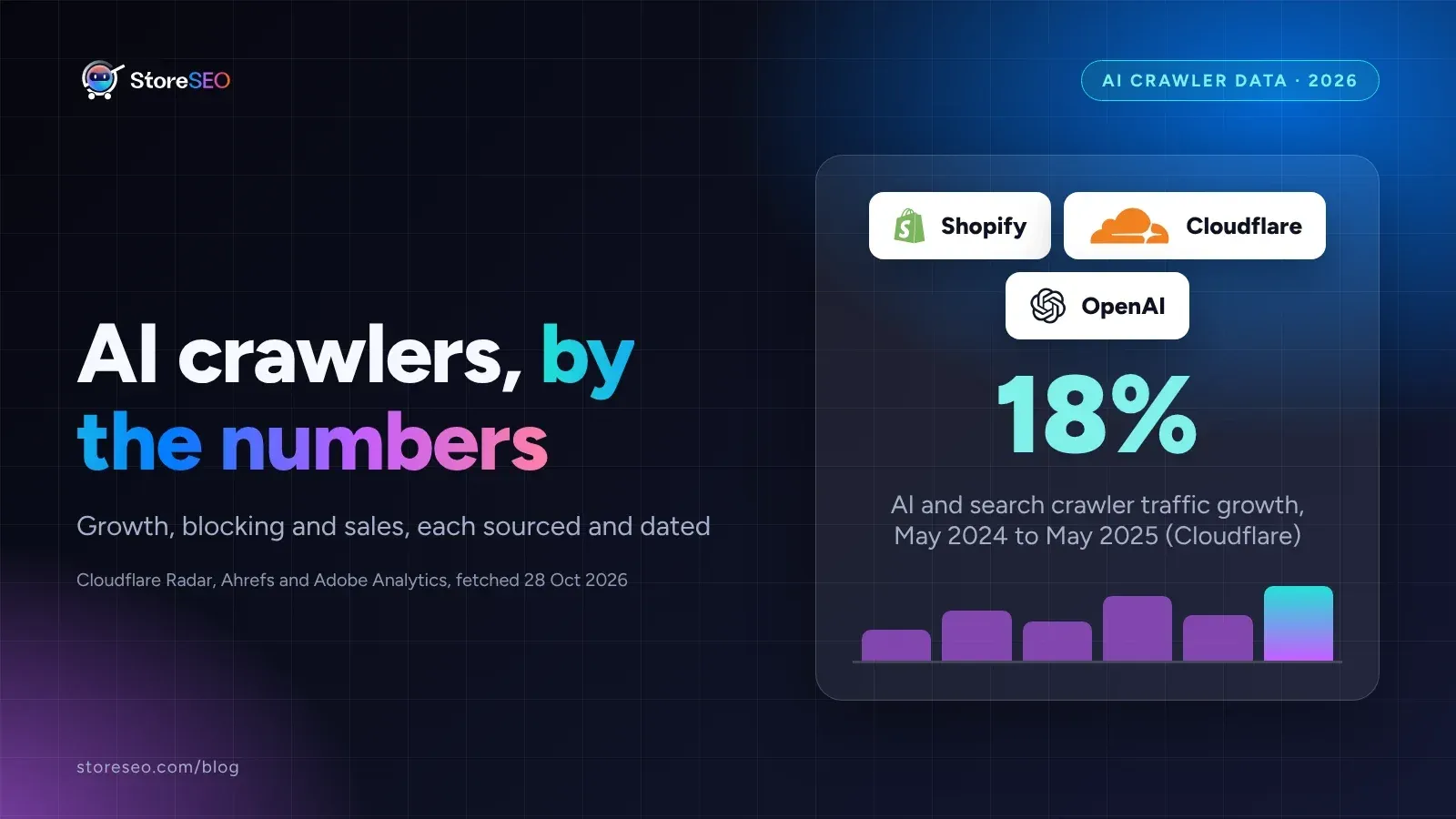
AI Crawler Statistics Shopify Merchants Should Know
AI crawlers are growing fast on the open web, but most Shopify robots.txt files never mention one, and only a sliver of that traffic converts into sales.
Read article
Why Search Engines Are Becoming Recommendation Engines
Search engines are becoming recommendation engines. See how AI picks products and how Shopify stores can get recommended with StoreSEO.
Read article
40 ChatGPT Prompts for Shopify SEO, Tested
These 40 ChatGPT prompts draft Shopify meta descriptions, alt text, FAQs and schema, each with the one thing you must verify before publishing it.
Read article