
Why Search Engines Are Becoming Recommendation Engines

Search engines used to give shoppers ten blue links and leave the decision to them. Today Google, Bing, ChatGPT, Gemini and Perplexity read a full question, compare options and name the products they believe fit best. For a Shopify merchant, that changes what being found really means. Ranking on page one still helps, and being the recommended answer is quickly becoming the bigger prize.
New terms like AEO and GEO can sound intimidating, so this beginner guide explains the shift step by step and ties every idea to the Shopify ecosystem. You will see how AI decides what to suggest and what you can fix this week. In this guide, you will also learn how Shopify SEO apps like StoreSEO help your store get crawled, understood and recommended.
From Ten Blue Links to Direct Answers
Search engines have always had the same core job. They crawl pages, store them in an index and rank results for each query. For about twenty years that process ended with a list of links, and shoppers opened several of them before deciding what to buy. AI now sits on top of that process, reads the pages for the shopper and returns a summary or a shortlist.
What changed for shoppers
- Longer questions. Shopify’s guide to answer engine optimization notes that a typical AI prompt runs about 20 to 30 words while a typical Google query uses 3 to 8.
- Fewer clicks. The answer, the comparison and often the next step appear inside the result, so shoppers skip the tab marathon.
- Growing traffic. The same guide estimates that generative AI tools already refer about 2 billion site visits per month.
Search engine and recommendation engine compared
A classic search engine answers one question: which pages match this query? A recommendation engine answers a different one: what should this person choose? Most platforms now do both at once, which is why the line between them keeps blurring.
Why Search Engines Are Becoming Recommendation Engines
Search engines are becoming recommendation engines because AI can now understand full questions, compare products from many sources and return a short list of suggestions. Shoppers get a faster decision and platforms keep people inside the answer experience. Four forces drive the change, and each one affects how a Shopify store gets discovered.
Shoppers ask full questions
People now type or speak requests like “best lightweight running shoes for flat feet under 100 dollars”. Search engines read the budget, the need and the context inside that sentence and then look for products that satisfy all three. Keyword matching alone cannot do that job.
AI can read and compare for you
Language models scan many pages at once. They pull specs, reviews and prices from different sources and weigh them against each other. The result is a short list that sounds like advice from a knowledgeable friend.
Shopping is built into the answer
Shopify’s explanation of how agentic commerce works says merchants can sell through ChatGPT, Microsoft Copilot, AI Mode in Google Search and the Gemini app. A shopper can move from a question to a purchase without ever opening a traditional results page.
Platforms want shoppers to stay in the answer
When an answer satisfies the question on the spot, people stay inside that experience. For merchants this means ranking alone may win fewer visits than before, while being named in the answer carries more weight. Our own take on how AI search is changing SEO for Shopify stores goes deeper on this point.
How AI Recommendation Engines Decide What to Suggest
AI assistants follow a repeatable path when they pick products. That path starts with finding your page and ends with trusting it enough to mention it. StoreSEO describes that path as the Crawl, Understand, Recommend model, and it gives beginners a simple way to audit any page.
Crawl: can machines reach your page?
Your sitemap, robots.txt file and indexing status decide whether search engines and AI crawlers can see a page at all. Most Shopify stores pass this layer, yet small gaps like an unsubmitted sitemap still appear often. This short explainer on how Google crawls a Shopify store shows the full flow.
Understand: can machines tell what the page is about?
Clear titles, meta descriptions, unique product copy and structured data help machines label your page correctly. Duplicate meta tags and copied manufacturer text blur the picture. This layer is where many Shopify stores lose ground.
Recommend: would an assistant cite you as the answer?
Assistants favor pages that are specific, trustworthy and easy to quote. Reviews, consistent brand details and short direct answers all raise your chances. Very few stores reach this layer today, which makes it a real opening.
Platform differences at a glance
- ChatGPT leans on crawler access, structured product data and review signals.
- Gemini draws on Google’s shopping data and E-E-A-T trust factors.
- Perplexity searches the live web and favors specific, citable and well-structured content.
Our guide on how ChatGPT, Gemini and Perplexity recommend Shopify products offers a checklist for each platform.
How Shopify Is Preparing for the Recommendation Era
Shopify is building the plumbing that lets AI platforms discover and sell merchant products. Shopify Catalog supplies structured product data to AI platforms while Shopify Checkout handles payment, tax, fraud checks and fulfillment. Orders land in your usual admin with attribution that shows which AI channel drove the sale. Shopify also co-developed the Universal Commerce Protocol with Google to standardize these transactions.
Key numbers from Shopify
- AI-driven traffic to Shopify stores grew 8 times year over year in Q1 2026.
- Orders from AI-powered searches rose nearly 13 times in the same period.
- McKinsey projects that AI agents could facilitate $3 to $5 trillion in global commerce by 2030, as cited in Shopify’s article on agentic shopping.
What Shopify tells merchants to do
Shopify advises merchants to write clear and factual product descriptions, publish FAQs about store policies and keep pricing and inventory accurate. That advice lines up neatly with classic Shopify SEO. If you want a wider view, read why your Shopify store needs an agentic AI strategy.
What This Shift Means for Your Shopify Store
The good news for beginners is that you can build on work you have already done. Shopify’s own guide points out that answer engine optimization overlaps with SEO because many AI tools draw on Google results. Your existing work still counts, and a few extra habits make it count more.
Keep your SEO basics strong
Fast pages, clean titles, working sitemaps and useful collection pages remain the base layer. Our complete Shopify SEO guide walks through every basic step.
Add answer-ready content
Short questions with direct answers are easy for AI to quote. Add them to product pages, collection pages and blog posts. See how to prepare your store blog in Preparing Your Shopify Blog for the Rise of AI Search Engines and read Shopify’s AEO for ecommerce guide for more ideas.
Build visible trust signals
Reviews, clear return policies and consistent brand details help assistants feel safe recommending you. See what the data says in Do Product Reviews Help Shopify SEO? The Evidence.
Your Beginner Checklist to Get Recommended
You can work through this checklist in a single afternoon. Each step supports both Google rankings and AI recommendations. We added the matching StoreSEO feature to every step so you can see how an app speeds up the work.
✅ Open the door for crawlers. Submit your sitemap and connect Google Search Console. StoreSEO connects with Search Console and Google Analytics and supports instant indexing for new or updated URLs.
✅ Write clear titles and meta descriptions. Say exactly what each product is and who it fits. StoreSEO’s AI SEO Agent drafts meta tags and descriptions around your target keywords and bulk optimization handles large catalogs.
✅ Add product schema. Structured data tells machines the price, availability and reviews of each item. Use the Shopify product schema JSON-LD reference for copy-paste code or let the app generate the markup.
✅ Publish answer-ready FAQs. Pair short questions and direct answers with FAQ markup as explained in the FAQ schema guide.
✅ Create AI snippets and AI crawler files. StoreSEO can generate AI snippets for product pages along with an LLMs.txt file and an agents.md editor for AI crawlers and shopping agents.
✅ Measure your readiness. The Agentic Discovery Score estimates how likely an AI assistant is to recommend a page so you can fix the weakest page first.
Where StoreSEO fits in
StoreSEO is a Shopify SEO app built for Google and for AI answer engines such as ChatGPT, Gemini, Claude and Perplexity. Its free plan costs $0 and covers 25 products, so you can test the checklist above before paying for anything. The app shows a 5.0 rating from more than 750 Shopify reviews. If you want to compare options first, read our guide to choosing a Shopify SEO app for AI search or our AEO and GEO strategies for Shopify stores.
Common Mistakes That Keep Stores Out of AI Answers
Most stores miss out for simple and fixable reasons. A quick review of these mistakes can save weeks of guesswork. Check each one against your own store before you move on.
- Blocking crawlers by accident. A strict robots.txt file or bot protection setting can hide your pages from search engines and AI crawlers.
- Copying manufacturer descriptions. Duplicate text makes it hard for machines to tell your product page apart from dozens of others.
- Skipping structured data. Without product schema, assistants have to guess your price, stock status and ratings.
- Leaving FAQs out. Pages without direct answers give AI very little to quote.
- Never checking results. Without a score or report you cannot tell which pages need work first.
Frequently Asked Questions About Search Engines And AI Recommendations
These are the questions Shopify merchants ask most when they first hear about recommendation engines. Each answer is short on purpose so you can scan it fast. Use them as a quick reference while you work through the checklist.
What is a recommendation engine in search?
A recommendation engine in search is a system that suggests what a person should choose and goes beyond listing matching pages. AI assistants and AI features inside search engines read your question, compare sources and return a short list of suggestions.
Is traditional SEO still worth doing?
Yes. Shopify’s guide explains that answer engine optimization overlaps with SEO because many AI tools draw on Google results. Strong titles, clean site structure and helpful content support both rankings and AI recommendations.
What is the difference between AEO and GEO?
The two terms overlap heavily. Shopify’s guide treats answer engine optimization and generative engine optimization as the same effort to get featured in tools like ChatGPT and Google AI Overviews, through brand mentions and citations.
How can a Shopify store get recommended by ChatGPT?
Keep your pages crawlable, add product schema, write specific product descriptions, collect reviews and publish clear FAQs. These signals help assistants find, understand and trust your store.
Does StoreSEO help with AI search?
Yes. StoreSEO includes AI snippet generation, FAQ schema, LLMs.txt generation, an agents.md editor and an Agentic Discovery Score. You can explore every tool on the StoreSEO features page.
Start Making Your Shopify Store Recommendation Ready Today
Search engines will keep moving from lists of links toward direct recommendations, and shoppers will keep rewarding stores that answer clearly. A crawlable store, clear product information and a simple way to measure progress are enough to begin. Pick one key product page this week and take it through the Crawl, Understand and Recommend layers. Small fixes now put you ahead of most stores.
Found this helpful? Subscribe to get more Shopify SEO guides, practical tips, tricks and AI agent updates delivered to you.
Keep reading
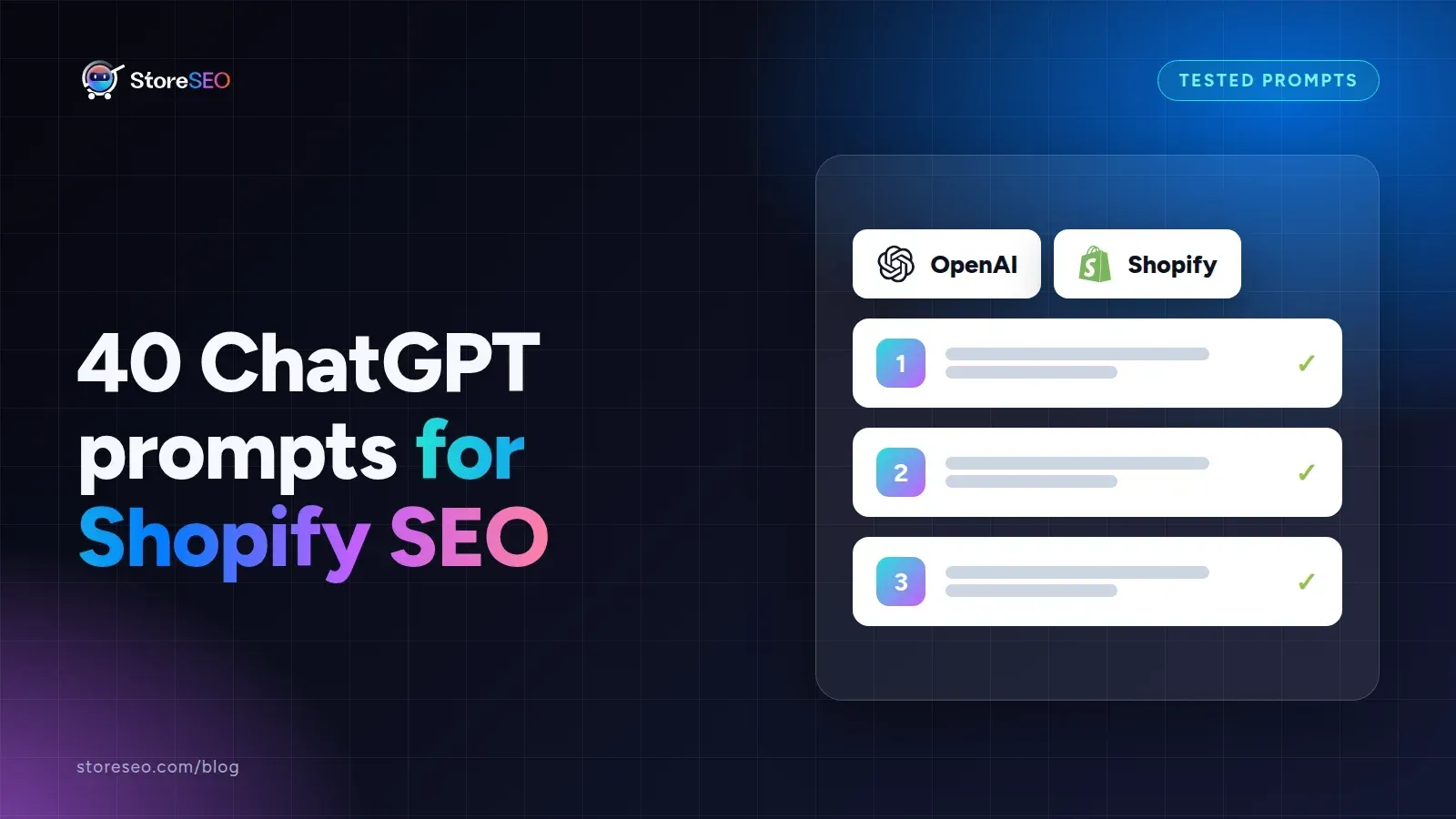
40 ChatGPT Prompts for Shopify SEO, Tested
These 40 ChatGPT prompts draft Shopify meta descriptions, alt text, FAQs and schema, each with the one thing you must verify before publishing it.
Read article
We Checked 148 Shopify Stores for AI Crawler Blocks
We crawled robots.txt on 148 live Shopify stores and found only one blocking any AI crawler by name, and zero blocking GPTBot, ClaudeBot or PerplexityBot.
Read article
Track ChatGPT & Perplexity Traffic in GA4 (Shopify)
GA4 already tags some ChatGPT and Gemini visits as AI Assistant traffic, and one custom channel group adds Perplexity and Claude to the same report.
Read article