
AI Search Glossary for Shopify Merchants
 Written by M Asif Rahman
AI search glossary, in one line: this page defines the 20 terms Shopify merchants now meet in AI-search conversations, from AI Overview and AI Mode to GPTBot, llms.txt and Model Context Protocol, each checked live against the company or standard that defined it.
TL;DR: the 6 terms to know first
| Term | One-line meaning | What to do about it |
|---|---|---|
| AI Overview | Google’s AI-written answer block shown above the usual results | Make sure the page it could quote states the answer in plain text, not only in an image |
| GPTBot | OpenAI’s crawler that gathers pages to train future models | Leave it allowed unless you specifically want to opt out of AI training |
| The llms.txt file | A proposed root file listing a site’s key pages for an AI agent to read | Optional today; a clean, crawlable site covers the same need already |
| MCP | An open standard that lets an AI app call tools and data sources directly | Connect StoreSEO’s AI SEO Agent through it to fix SEO fields catalog-wide |
| GEO | Generative Engine Optimization: writing to be cited inside an AI answer, not only ranked for one | Add it alongside classic SEO work, never as a replacement for it |
| Zero-click search | A search fully answered on the results page, so no click reaches any site | Treat being the cited source as the win, since a click may never happen |
Why Do Shopify Merchants Need an AI Search Glossary?
Most Shopify SEO vocabulary (meta title, backlink, canonical tag) still decides whether Google can crawl and rank a page. A second vocabulary has grown alongside it in the last two years, and it decides something different: whether an AI assistant can read a page cleanly enough to summarize, quote or cite it. The two sets of terms now show up in the same sentence, on the same support call, and merchants are left guessing which is which.
This glossary covers 20 terms from that second vocabulary. Each one is defined from the company or standard that owns it, not from a secondhand explainer, and dated to when it was checked.
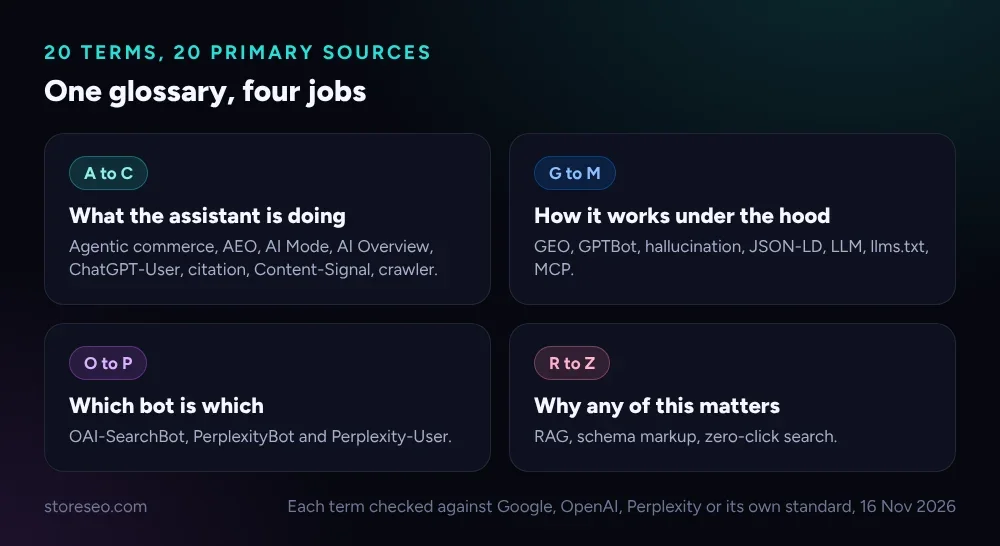 Twenty terms split into four groups, from what the assistant is doing to why any of it matters.
If you already have the basics of Shopify SEO down, the related Shopify SEO Glossary covers the other 100 terms: meta descriptions, canonical tags, Core Web Vitals and the rest of the vocabulary that predates AI search. This one is scoped narrowly to the new layer sitting on top of it.
Which Bots Are Actually Visiting Your Shopify Store?
Before the individual terms, one piece of context makes several of them click into place: not every bot with “AI” in its name does the same job. Some gather training data, some crawl for search answers, and some only fetch a page because a shopper asked an assistant to open it. Blocking one does not block the others.
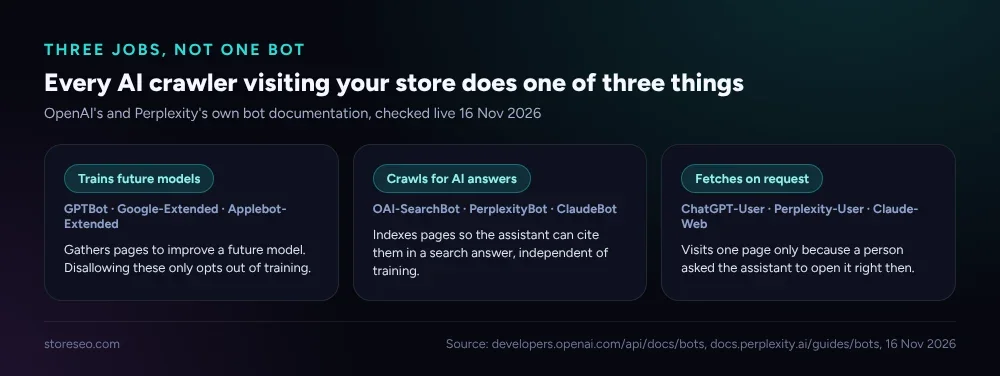 OpenAI’s and Perplexity’s own bot documentation group every named bot into one of three jobs.
A store can allow or block each one by name in its robots.txt file, and since 14 October 2026 a separate Content-Signal line lets a site answer a fourth question, AI training, without touching crawl access at all. The term entry below shows what that looks like on a live file.
The Full Glossary, A to Z
Twenty terms, alphabetical, each checked against its own primary source.
Agentic Commerce
Agentic commerce is an AI agent, inside a chat conversation, discovering a product, comparing it and completing the purchase itself, instead of handing the shopper a link to click through and check out. OpenAI documents this directly as a feature of ChatGPT’s commerce tools. For a Shopify store, it means some future orders may never touch your homepage at all, only your product feed and checkout API.
AEO (Answer Engine Optimization)
AEO is the shorthand the SEO industry uses for writing content so an AI assistant can lift it directly into a spoken or typed answer, the counterpart to writing for a results page. There is no single body that owns the term, and Google’s own guidance is blunt about it: it says there are no special requirements beyond good SEO fundamentals. Treat AEO as a mindset shift, not a separate checklist.
AI Mode
AI Mode is Google’s full conversational search experience, built on a custom version of Gemini, that handles multi-part and comparison questions using a technique Google calls “query fan-out,” issuing several related searches at once behind one answer. It differs from AI Overviews by supporting follow-up questions in the same thread.
AI Overview
An AI Overview is the AI-generated answer block Google can show above the usual blue links. Google’s own AI-features documentation describes the goal as helping a reader “get to the gist of a complicated topic or question more quickly” and offering a jumping-off point to explore further. For a merchant, it means a shopper’s question can be fully answered before your listing is ever seen.
ChatGPT-User
ChatGPT-User is OpenAI’s user-triggered fetcher. It visits one page only because a person asked ChatGPT or a Custom GPT to open it right then, and OpenAI’s documentation says plainly it is not used for automatic crawling and does not decide whether a page can appear in ChatGPT’s search results. That job belongs to OAI-SearchBot instead.
Citation
A citation is the link an AI answer shows beside the specific claim it is quoting or summarizing, the AI-search equivalent of a backlink. Where a backlink earns authority over time, a citation earns a moment of visibility inside one answer, which is why clean, directly quotable facts now matter as much as keyword placement.
Content-Signal
Content-Signal is a newer line some sites add inside robots.txt, separate from the usual Allow/Disallow rules, to say whether a page may be used for AI model training versus being read for a live search or AI answer. storeseo.com’s own robots.txt carries one, shown below exactly as it answers today.
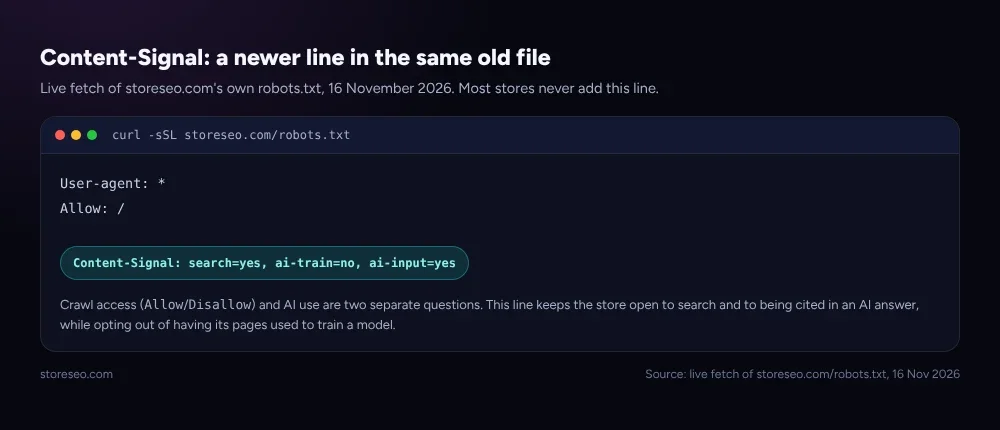 Crawl access and AI use are two separate settings now, not one.
Crawler
A crawler, in this glossary, is any automated bot that fetches your store’s pages, whether to build a classic search index or to gather or answer from a language model. The bot-roles diagram above groups every named AI crawler by the job it actually does, which matters more than its name.
GEO (Generative Engine Optimization)
GEO is the deliberate practice of shaping content so a generative engine, an AI system that synthesizes one answer from several sources, is more likely to use and cite it. The term was coined in a November 2023 research paper that framed it as content creators’ answer to losing control over how their work gets reused once a chat answer replaces a results page.
GPTBot
GPTBot is OpenAI’s general-purpose crawler, used to gather pages for training future models. OpenAI’s own bot documentation is explicit that disallowing GPTBot only opts a site out of training data, and has no effect on whether ChatGPT can still cite that page in a search answer.
Hallucination
A hallucination is an AI system stating something confidently that is false or not actually supported by its sources. It is a known failure mode, not an edge case, so a merchant should expect to see one of their own product facts stated wrong by an assistant eventually and have a way to notice it.
JSON-LD
JSON-LD is the format Google recommends for structured data, a block of machine-readable facts about a page (price, rating, FAQ answers) placed inside a script tag so a search or AI system does not have to guess a page’s meaning from its design. Google’s own documentation calls structured data “a standardized format for providing information about a page and classifying the page content.”
LLM (Large Language Model)
An LLM is the type of model behind ChatGPT, Gemini, Claude and Perplexity’s answers, trained on large volumes of text to predict and generate language. Every AI-search surface in this glossary, from AI Overview to PerplexityBot’s answers, runs on one.
The llms.txt File
llms.txt is a proposed file at a site’s root that lists its key pages in plain language for an AI agent to read, instead of making the agent parse navigation, ads and scripts out of a page built for people. The proposal’s own site describes the problem directly: context windows are still too small for most sites in full, so a clean index helps an agent find the part that matters.
MCP (Model Context Protocol)
MCP is an open standard, described in its own documentation as “a USB-C port for AI applications,” that lets an assistant like Claude or ChatGPT connect directly to a tool or data source instead of only reading web pages. It is how StoreSEO’s AI SEO Agent runs a prompt like “fix meta descriptions for all products” straight against your catalog, through the Connect StoreSEO MCP to your AI assistant docs.
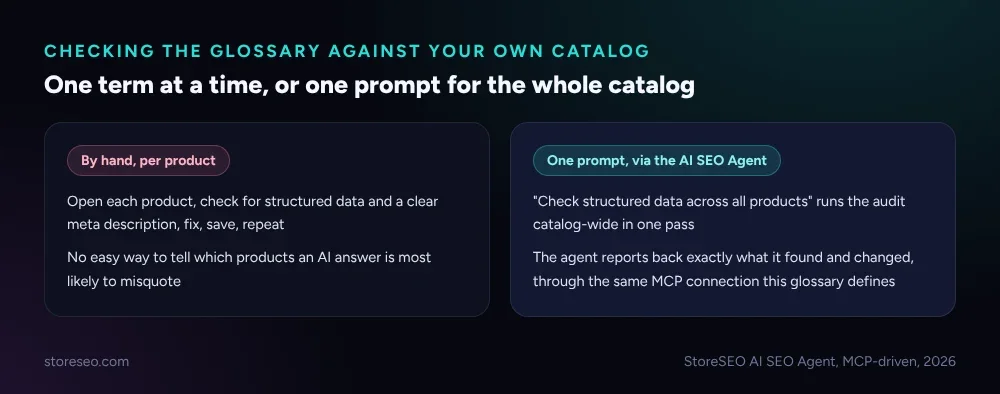 The same MCP connection the glossary just defined is what makes the right-hand column possible.
OAI-SearchBot
OAI-SearchBot is OpenAI’s crawler built specifically so ChatGPT can cite a page in its search answers. It runs independently of GPTBot, so a site can allow OAI-SearchBot for citation while still disallowing GPTBot for training, and the two settings do not affect each other.
PerplexityBot
PerplexityBot is Perplexity’s crawler. The company’s own documentation says it is “designed to surface and link websites in search results on Perplexity” and is “not used to crawl content for AI foundation models.” Perplexity-User is the separate, user-triggered counterpart, fetching one page only when someone asks Perplexity a question that needs it.
RAG (Retrieval-Augmented Generation)
RAG is the technique of having a language model fetch relevant outside documents before writing its answer, instead of relying only on what it memorized during training. It was introduced in a 2020 research paper, and it is the reason a well-structured, crawlable product page can end up quoted word for word inside an AI answer it was never trained on.
Schema Markup
Schema markup is the everyday name for structured data on a page, the same thing JSON-LD above is a format for. It covers product, review, FAQ and article data alike, and Google credits it with measurable gains: one case study it cites found a 25 percent higher click-through rate on pages carrying it.
Zero-Click Search
A zero-click search is one fully answered on the results page itself, or inside an AI Overview, so no click ever reaches any website. It raises the stakes on citation above: if an AI answer is the only surface a shopper sees, being the page it names may be the only exposure your store gets from that search at all.
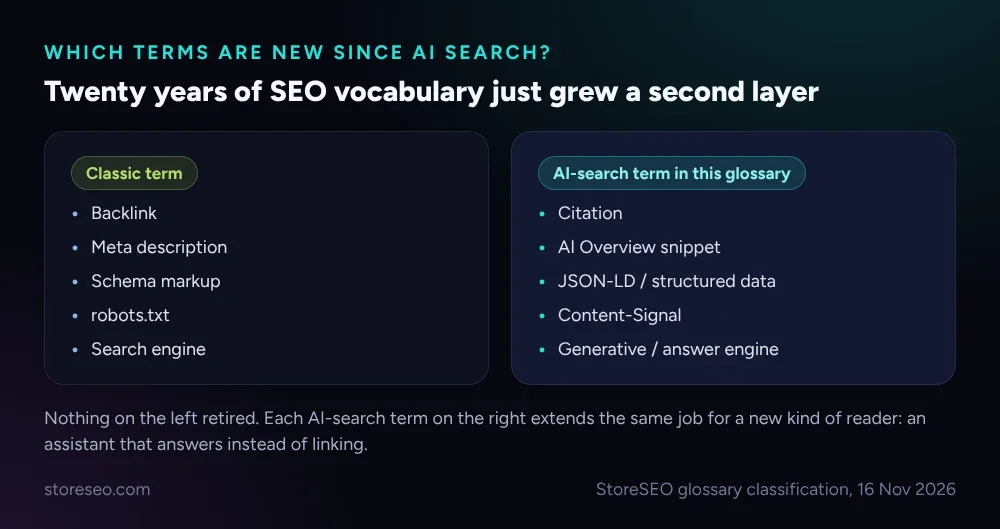 Nothing on the classic side retired. The AI-search side extends the same job for a new kind of reader.
Which Terms Are New Since AI Search?
Roughly a third of this glossary did not exist five years ago: AEO, GEO, AI Mode, Content-Signal and MCP are all terms a 2021 Shopify SEO guide would have no reason to mention. Crawler, citation and structured data are older ideas that simply picked up a second job once an AI answer became a place a product fact could appear.
Classic SEO has not stopped mattering. A page still needs to be crawlable, fast and clearly written first. AI search adds a layer on top of that foundation; it does not skip it.
How Should You Act on This Glossary?
Start with the two terms you can check yourself today: fetch your own robots.txt and look for named rules covering GPTBot, OAI-SearchBot and PerplexityBot, then check whether a Content-Signal line exists at all. Most Shopify stores still run the platform’s default file with neither.
From there, the fastest way to act on several of these terms at once is through the AI SEO Agent: StoreSEO’s MCP-driven toolkit connects an assistant like Claude or ChatGPT straight to your catalog, so a single prompt can audit structured data, rewrite thin descriptions or check which products still lack the schema an AI answer would need to quote them correctly, documented in full at Connect StoreSEO MCP to your AI assistant. The same MCP connection also runs the eight catalog jobs covered in 8 SEO Jobs to Hand ChatGPT via StoreSEO MCP.
If you want a free, independent read on how ready your whole store is for an AI agent right now, rather than just the terms it uses, the free AIScan agent-readiness checker (Asif’s own site) scores exactly that, separately from anything StoreSEO measures. For the mechanics of how ChatGPT, Gemini and Perplexity decide which Shopify products to recommend in the first place, How ChatGPT, Gemini & Perplexity Recommend Shopify Products is the deeper read, and this glossary itself sits as a spoke of the AI-First Content Strategy for Shopify Stores pillar.
Frequently Asked Questions (FAQs)
1. Is AEO replacing SEO?
No. Google’s own AI-features guidance says the same ranking fundamentals apply to AI Overviews and AI Mode as to regular search, with no separate set of requirements. AEO is a framing on top of SEO work you likely already do, not a substitute for it.
2. Does blocking GPTBot hurt my store’s visibility in ChatGPT?
Not for search citations. OpenAI documents GPTBot and OAI-SearchBot as independent settings: disallowing GPTBot opts a store out of AI training data only, while OAI-SearchBot is the one that controls whether ChatGPT can cite your pages in a search answer.
3. Do I need an llms.txt file on my Shopify store?
It is optional today, and Shopify’s own theme files do not generate one automatically. It can help an AI agent find your key pages faster, but a clean, crawlable site with working structured data covers the same need in the terms search engines and assistants already support natively.
4. What does Model Context Protocol actually let an AI assistant do on my store?
MCP lets an assistant like Claude or ChatGPT connect directly to a tool, such as StoreSEO’s AI SEO Agent, instead of only reading what is visible on a web page. In practice that means a typed prompt can audit or fix SEO fields across your whole product catalog in one pass rather than one page at a time.
5. Can an AI Overview replace my store’s organic traffic?
It can reduce clicks for questions it fully answers on its own, the effect zero-click search describes. It has not replaced organic traffic broadly: Google’s own guidance says AI features are sending people to a wider variety of sites for complex questions, not fewer.
6. Should I worry about AI hallucinations about my own products?
Yes, enough to check occasionally. An assistant can state a price or return policy confidently and get it wrong, so search your own brand and product names in ChatGPT or Perplexity now and then and correct anything stated wrong on your own pages.
Keeping a store’s facts clean, structured and consistently worded across every page is the same discipline these 20 terms all point back to, whichever assistant is reading. If your product pages need that work done across the catalog rather than one at a time, try StoreSEO on the Shopify App Store.
Keep reading
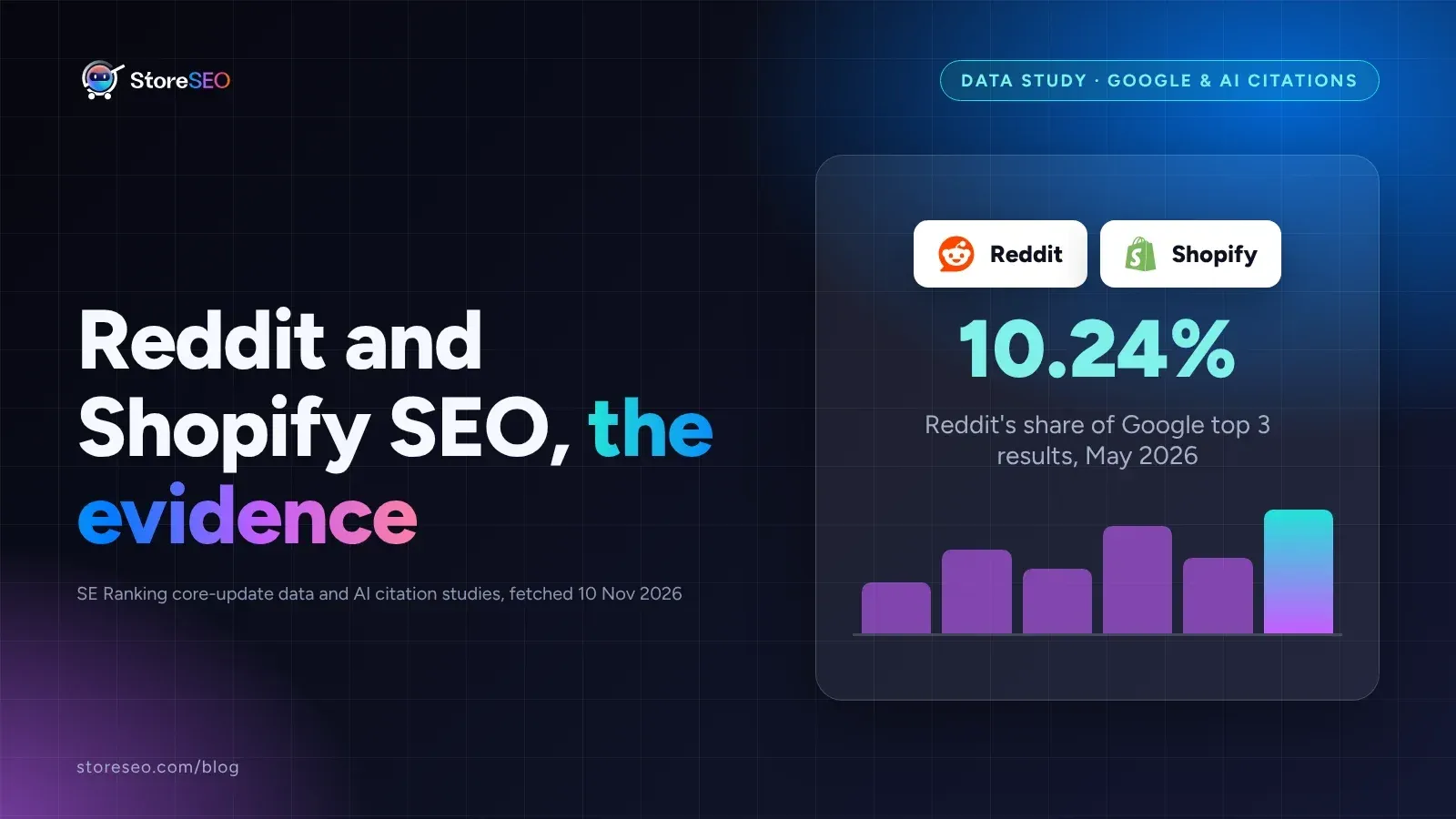
Does Posting on Reddit Help Shopify SEO? The Evidence
Reddit will not rank your product pages, but Google surfaces more Reddit threads and AI engines cite Reddit when they answer shopping questions.
Read article
How Long Until an AI Assistant Notices Your Page?
There is no published timeline from any AI provider, but a live-retrieval citation can land within days of a normal Google crawl, not months.
Read article
AI Crawler Statistics Shopify Merchants Should Know
AI crawlers are growing fast on the open web, but most Shopify robots.txt files never mention one, and only a sliver of that traffic converts into sales.
Read article