Shopify SEO Glossary: 100 Terms, A to Z
 Written by M Asif Rahman
This glossary defines 100 Shopify SEO terms in plain English, from foundational words like alt text and canonical tag to AI search terms like GEO and query fan out, each checked against Google’s or Shopify’s own documentation rather than written from memory.
TL;DR: four groups, a hundred terms, and where to start.
| Term group | Covers | What to do |
|---|---|---|
| Foundations (A to F) | Alt text, canonical tags, Core Web Vitals | Read this first if SEO is new to you |
| Technical and keywords (G to M) | GSC, hreflang, Liquid, keyword clusters | Bookmark it for setup and audit work |
| AI search and on page (N to S) | Noindex, robots.txt, schema, SERP | Read it before an AI visibility project |
| Reference (T to Z) | Title tags, UGC, voice search, zero click | Search this page as new terms come up |
What Are the Foundational Shopify SEO Terms From A to F?
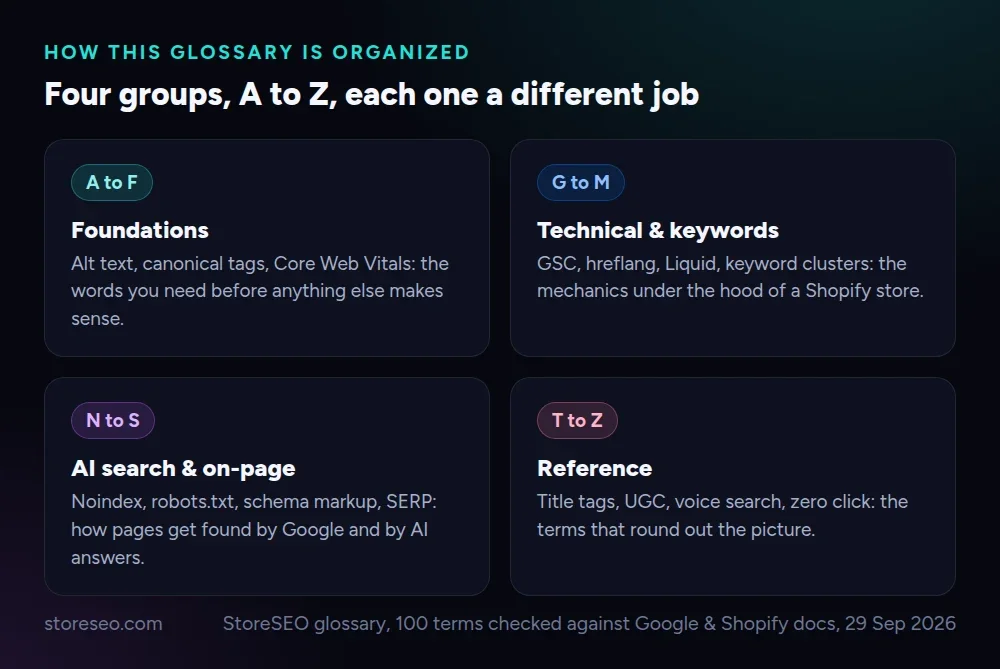 StoreSEO glossary structure, 29 Sep 2026.
Above the Fold
The part of a page visible before scrolling. A Shopify homepage’s first screen carries the most SEO and conversion weight, since it is what a shopper and a crawler both render first.
Agentic Commerce
Shopping carried out or completed by an AI agent on a shopper’s behalf, from search to checkout, rather than by a human clicking through pages one at a time.
AI Overview
Google’s summarized answer at the top of results, generated from several sources at once rather than linking to a single page the way a normal result does.
Alt Text
A short written description of an image, read by screen readers and by crawlers that cannot see the image itself. On Shopify it also helps a product image surface in Google Images.
Anchor Text
The clickable words in a link. Descriptive anchor text, like “Bulk URL Redirect Manager”, tells both readers and search engines what the destination page is about, far more than “click here” does.
Answer Engine Optimization (AEO)
Structuring content so an AI answer engine can extract a direct answer to a question, rather than optimizing only for a ranked list of blue links.
App Block
A Shopify theme component an app can add to a page without editing theme code. StoreSEO and similar apps use app blocks to add things like FAQ displays to a storefront.
Authority
How much a search engine trusts a domain or a page, built mainly from backlinks and consistent topical coverage over time. Topical authority is the narrower version, earned within one subject.
Backlink
A link from another site to yours. It remains one of the strongest ranking signals for traditional Google search, and is largely irrelevant to how an AI answer engine chooses what to cite.
Bot (Crawler)
Automated software that requests pages the way a browser does, to index them (Googlebot) or to use them for search or training (GPTBot, ClaudeBot, PerplexityBot). Robots.txt tells each one what it may request.
Bounce Rate
The share of visits that leave after viewing one page. A high bounce rate on a Shopify product page is a signal worth investigating, not something Google has confirmed it uses directly.
Brand SERP
The results page for a search on your own brand name. It is the one results page you can influence almost entirely, since nearly every result on it is already about you.
Breadcrumb
The trail of links showing a page’s place in a site’s structure, such as Home, Collections, Bags. Shopify themes render it visually, and BreadcrumbList schema makes it machine readable too.
Buyer Intent
A search that signals someone close to purchasing, like “shopify seo services”, rather than researching, like “what is seo”. Buyer intent keywords convert at a higher rate even at lower search volume.
Canonical Tag
The line of code that tells search engines which URL is the real one when two or more URLs show the same content. Shopify sets it automatically, but a theme can still leave a duplicate path open, as our guide to Google choosing a different canonical URL covers in full.
Click Through Rate (CTR)
The share of people who click your result after seeing it in search. Title and meta description are what you control most directly to move it.
Collection Page
Shopify’s term for a category page that groups related products. It usually needs its own SEO treatment, title, description and intro copy, separate from the products inside it.
Content Gap
A topic or question your competitors or the market cover and you do not, usually found by comparing your ranked keywords against theirs.
Core Web Vitals
Google’s three measured signals for page experience: Largest Contentful Paint for loading, Interaction to Next Paint for responsiveness, and Cumulative Layout Shift for visual stability.
Crawl Budget
The number of pages a search engine is willing to crawl on your site in a given period. It matters mainly for very large catalogs, where thin or duplicate URLs can crowd out pages that should be found.
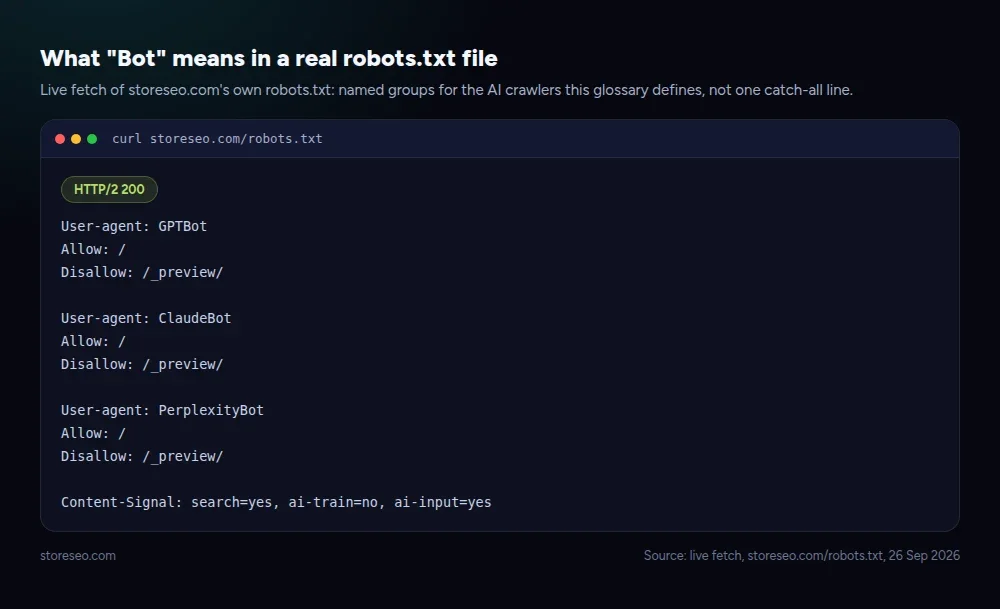 Source: live fetch, storeseo.com/robots.txt, 26 Sep 2026.
Dawn Theme
Shopify’s current default free theme. Its SEO defaults, canonical tags, a sitemap and a strict robots.txt, are the baseline every other theme gets compared against.
Deindexing
Removing a page from a search engine’s index entirely, usually with a noindex tag or a removal request. It is the opposite of the goal for almost every page except account, cart and checkout routes.
Domain Rating
A third-party 0 to 100 score of a site’s backlink strength relative to others. Useful for comparing sites, not a metric Google itself publishes or uses.
Duplicate Content
Substantially the same content reachable at more than one URL. Shopify’s collection-scoped product URLs are the most common Shopify-specific cause.
Dwell Time
How long someone stays on a page after clicking a search result before returning to the results. Widely discussed as a ranking factor, though Google has never confirmed it as one directly.
E-E-A-T
Experience, Expertise, Authoritativeness and Trustworthiness: the framework in Google’s own Search Quality Rater Guidelines for judging whether content and its author are credible, especially on topics that affect money or wellbeing.
Excerpt
The short summary text that becomes a page’s meta description. On StoreSEO’s own blog template it is cut at 160 characters, so a sentence written to exactly that length never gets cut mid-word.
External Link
A link from your page to a different domain. Linking out to a primary source, such as Google’s own documentation, is a credibility signal, not something to avoid.
Faceted Navigation
Filter and sort controls on a collection page that generate a new URL for every combination selected. Left unmanaged, it can flood a crawl budget with near-duplicate pages.
FAQ Schema
Structured data that marks up question-and-answer content. It does not guarantee a rich result: Google removed FAQ rich results for most sites on 7 May 2026, so treat it as documentation for AI answers rather than a guaranteed SERP feature.
Featured Snippet
The boxed answer Google sometimes shows above the normal results, pulled from a page it judges best answers the query. No schema markup requests one directly, only clear, direct answer formatting.
Focus Keyword
The single term or phrase a page is optimized to rank for. StoreSEO’s SEO Analysis scores a page against its own focus keyword, and the concept has real demand of its own: StoreSEO’s own docs page for it sits at position 49 with 1,785 impressions in three months, exactly the gap an entry like this one is built to close.
404 Error
The status code a server returns when a requested page does not exist. A small number of real 404s is normal, but 404s reached from broken internal links waste crawl budget and hurt the shopper’s experience.
What Do the Technical SEO Terms From G to M Actually Mean?
Shopify locks down some of these on purpose. Knowing which ones you cannot touch saves time you would otherwise spend hunting for a setting that does not exist.
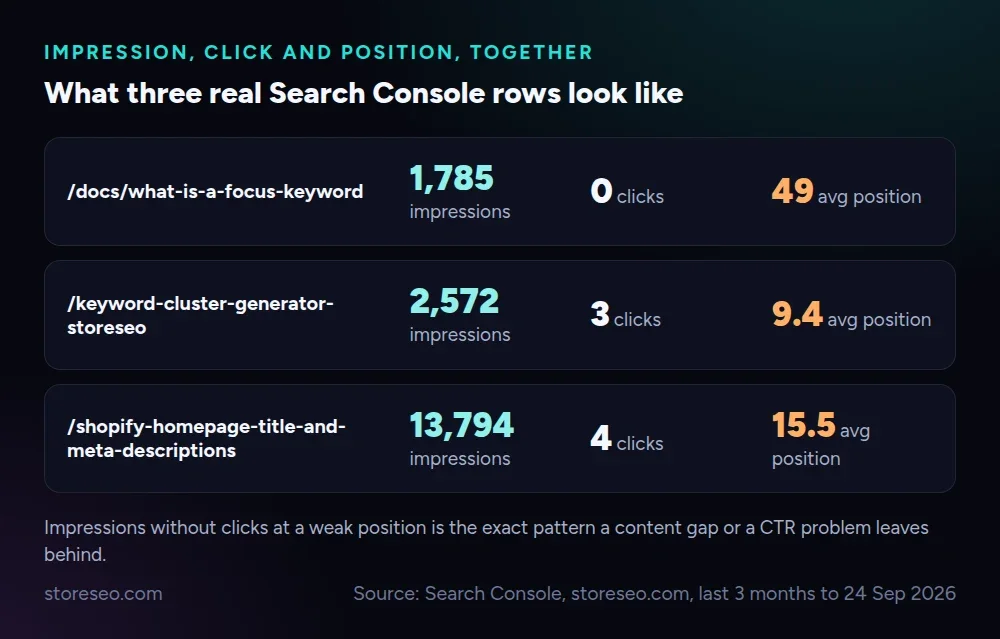 Source: Search Console, storeseo.com, last 3 months to 24 Sep 2026.
Generative Engine Optimization (GEO)
Optimizing content so generative AI systems like ChatGPT, Gemini and Perplexity synthesize and cite it in their answers. It overlaps with AEO but focuses specifically on multi-source, generated answers rather than one extracted snippet.
Google Merchant Center
Google’s product data feed platform that powers free and paid Shopping listings. Shopify can sync a feed to it directly, and accurate categories and availability decide whether a product actually shows up.
Google Search Console (GSC)
Google’s free tool for seeing how your site performs in Google search: impressions, clicks, average position, indexing status and manual issues, broken down by page and by query.
Google Shopping Graph
Google’s structured, continuously updated map of products, brands, sellers and reviews, drawn from many sources including Merchant Center feeds. It is what Google draws on for Shopping results and Shopping-flavored AI answers.
GPTBot
OpenAI’s crawler for gathering training data. Disallowing it in robots.txt opts a site out of that training use, but does not stop ChatGPT from fetching a page when a user asks it to.
H1 Tag
The single main heading of a page, usually the post or product title. A page should have exactly one, and it should never be written twice by mistake in the body.
Handle
Shopify’s internal name for a URL slug, on a product, collection or blog post. Changing a handle after a page has traffic is effectively a URL change and needs a redirect.
Hreflang
An HTML attribute that tells search engines which language and region version of a page to show a given searcher, used on multilingual or multi-market Shopify stores.
HTML Sitemap
A page-based, human-readable list of a site’s pages, distinct from the XML sitemap search engines crawl. Less common now that most themes make navigation and internal linking strong on their own.
Image Compression
Reducing an image’s file size while keeping acceptable visual quality, usually the single biggest lever on Shopify page speed, since product photos are often the heaviest assets on a page.
Impression
In Search Console, one instance of your page appearing in a search result, whether or not it was clicked. Impressions without clicks at a low position is exactly the signal a content gap shows up as.
Indexing
Search engines storing and organizing a crawled page so it can be returned in results. A page can be crawled without being indexed, most often because it is thin, duplicate, or blocked by a noindex tag.
Internal Link
A link from one page on your site to another. It is the main way authority and crawl priority move around a Shopify store, and every post in this programme links up, across and down for exactly that reason.
JSON-LD
The format Google recommends for structured data: a block of JSON describing a page’s content, a product, an article, an FAQ, placed in the page’s code and read by machines rather than shown to a visitor.
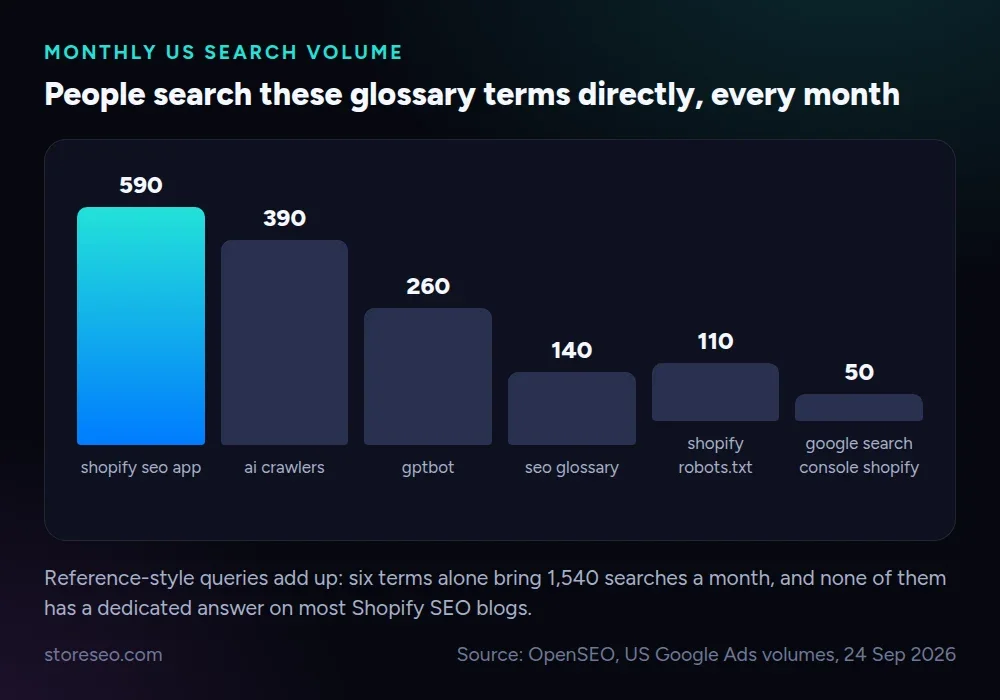 Source: OpenSEO, US Google Ads volumes, 24 Sep 2026.
Keyword Cannibalization
Two or more pages on the same site competing for the same keyword, which usually makes both rank worse than one focused page would.
Keyword Cluster
A group of related keywords that share the same search intent and can reasonably be answered by one well-structured page, rather than one thin page per keyword.
Keyword Density
How often a keyword appears relative to a page’s total word count. A metric from an older era of SEO that modern search engines do not reward directly, and chasing it now reads as keyword stuffing.
Keyword Difficulty (KD)
A 0 to 100 estimate of how hard a keyword is to rank for organically, based on the backlink strength of pages currently ranking. Useful for prioritizing, not a promise of the effort actually required.
Keyword Research
The process of finding what real people search for, how often, and with what intent, before writing a page, so the content answers a demonstrated question instead of a guessed one.
Largest Contentful Paint (LCP)
One of the three Core Web Vitals: how long the largest visible element, usually a hero image or headline, takes to render. Google’s target is 2.5 seconds or under.
Link Building
Deliberately earning or acquiring backlinks from other sites, through outreach, partnerships, guest content or genuinely link-worthy original research.
Liquid
Shopify’s templating language, used to build themes. SEO-relevant Liquid objects include canonical_url, which most themes use to set the canonical tag automatically.
LLMs.txt
A proposed plain-text file at a site’s root that summarizes its most important pages for large language models to read, distinct from robots.txt, which only controls crawler access rather than describing content.
Long-Tail Keyword
A longer, more specific search phrase with lower volume but clearer intent and less competition than a short head term. “Shopify seo services” is head, “how much does shopify seo cost for a 200 product store” is long tail.
Meta Description
The short summary text shown under a title in search results, pulled from a page’s excerpt. It does not directly affect ranking, but it is the strongest lever a page owner has over click-through rate.
Meta Title
The clickable headline shown in search results and the browser tab, set separately from a page’s on-page H1. Google may rewrite it if it judges the written one a poor match for the query.
Metafield
A custom field Shopify lets you attach to a product, collection or page beyond the built-in ones. Apps use metafields to store extra SEO or structured-data information without touching theme code.
Microdata
An older way of embedding structured data directly in HTML tags, largely superseded by JSON-LD, which Google itself now recommends because it keeps markup separate from visible content.
Mobile-First Indexing
Google’s practice of using the mobile version of a page, not the desktop one, as the primary basis for indexing and ranking. Almost every Shopify theme is responsive by default, which makes this mostly invisible in practice.
Which AI Search and On-Page Terms Should You Know, N to S?
This is the group where the vocabulary is newest, and where getting a term wrong costs the most, since it decides whether an AI system can read your page at all.
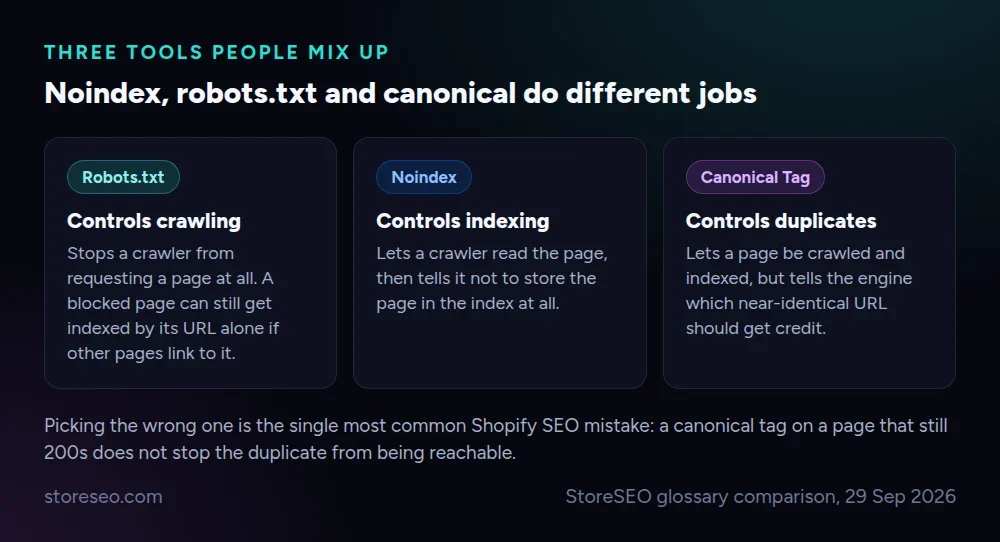 StoreSEO glossary comparison, 29 Sep 2026.
Noindex
A tag telling search engines not to include a page in their index, used on account pages, internal search results, and thin or duplicate pages you want crawled but not shown.
Natural Language Query
A search phrased as a full question or sentence, such as “what’s the best shopify seo app for a small store”, the dominant pattern for voice search and for prompts to an AI answer engine.
Off-Page SEO
Everything that affects ranking outside your own site: backlinks, brand mentions, reviews and citations elsewhere.
On-Page SEO
Everything on a page itself that affects how it ranks and how well it answers a query: title, headings, content, internal links, schema and page speed.
Open Graph Tags
Meta tags that control how a page’s title, description and image look when shared on social platforms, distinct from a search meta description, though StoreSEO can set both from one place.
Organic Traffic
Visits that arrive from unpaid search results, as opposed to paid ads, social or direct traffic. It is the traffic every post in this programme is written to earn, and unlike its AI-driven cousin, which needs a dedicated GA4 channel to track, it has always shown up in Analytics on its own.
Orphan Page
A page with no internal links pointing to it. Search engines can still find it through a sitemap, but little authority passes to it, and a shopper is unlikely to ever stumble across it.
Page Speed
How quickly a page loads and becomes usable. Core Web Vitals are the measured version of it, and on Shopify, image weight and app-script bloat are the two most common causes of a slow page.
Pillar Page
A comprehensive page on a broad topic that links out to narrower spoke pages on related subtopics, and receives links back from them. This glossary is meant to sit beside the Ultimate SEO Checklist pillar, not replace it.
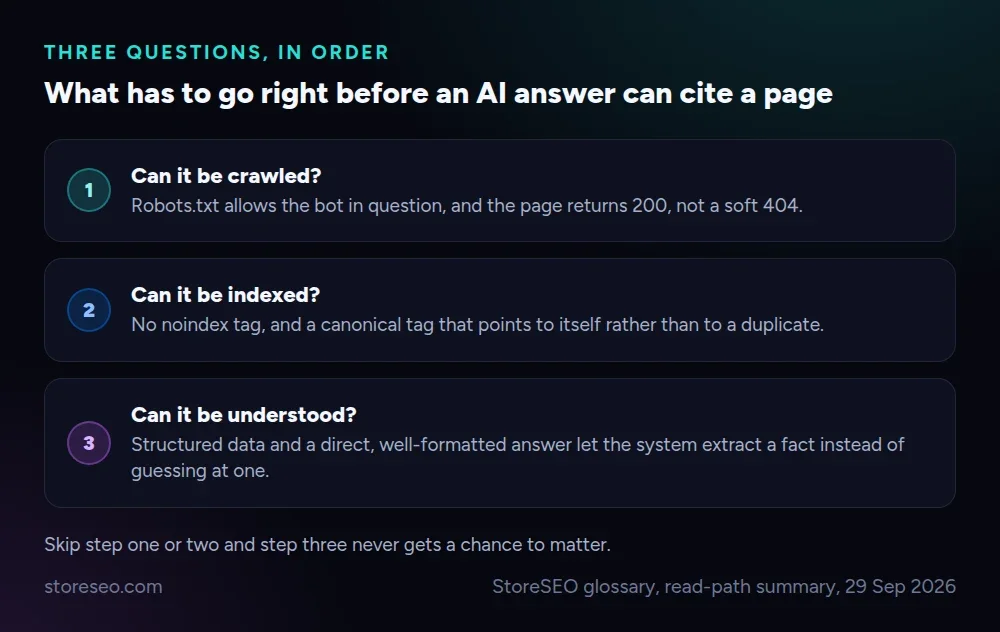 StoreSEO glossary, read-path summary, 29 Sep 2026.
Product Feed
The structured file of product data, title, price, availability, images and category, that a store sends to Google Merchant Center and similar platforms.
Position (SERP Position)
A page’s average rank for a given query in Search Console, reported as a decimal because it is averaged across many searches and devices.
Query
What someone actually types or speaks into a search box. Distinct from a keyword, which is the term you are targeting, a query is the exact real-world phrasing that triggered a result.
Query Fan-Out
The pattern behind a generative AI answer: rather than matching one query to one page, the system expands it into several related sub-queries, retrieves sources for each, and synthesizes them into one answer. A page can influence an AI answer without ever ranking first for the original phrase.
Rank Tracking
Monitoring a keyword’s position in search results over time, so a change in ranking can be tied to a specific cause, a content update, a competitor’s move, an algorithm change, instead of being noticed months later.
Redirect (301)
A permanent instruction that sends visitors and crawlers from an old URL to a new one. It is the correct fix for a changed handle, a merged page or a discontinued product, and the mechanism behind StoreSEO’s Bulk URL Redirect Manager.
Rich Results
Search results with extra visual elements, such as star ratings, FAQs or images, drawn from structured data. Eligibility depends on the schema type and on Google’s own guidelines for which page types qualify, which change over time.
Robots.txt
The plain-text file at a site’s root that tells crawlers which parts of a site they may request. Shopify writes a sensible default automatically; our complete Shopify robots.txt guide covers every major bot by name, including the AI ones.
Robots Meta Tag
A page-level instruction, separate from robots.txt, that controls indexing and link-following for that one page specifically, most commonly set to noindex, follow.
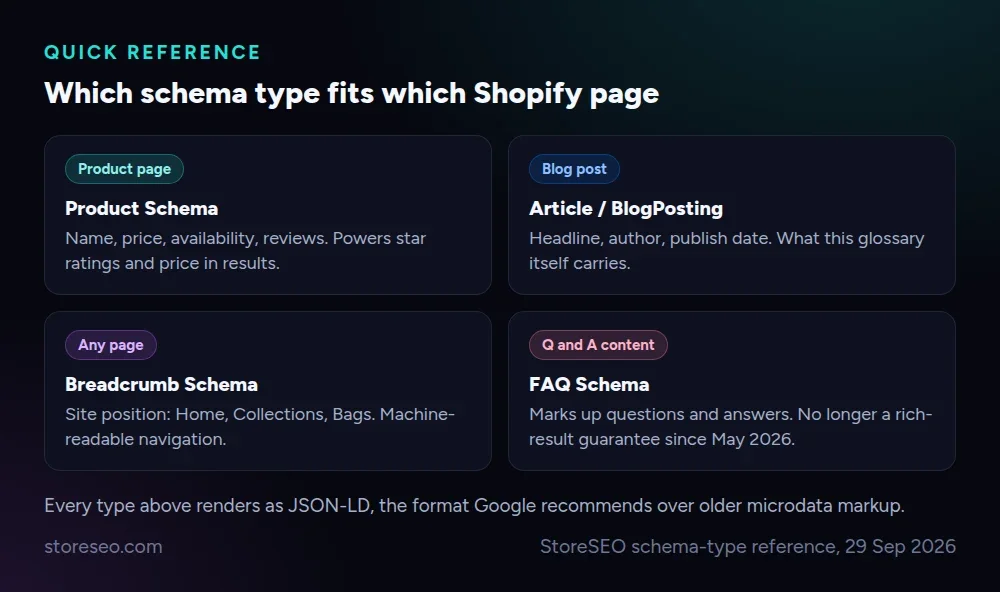 StoreSEO schema-type reference, 29 Sep 2026.
Schema Markup
The umbrella term for structured data added to a page, product, article, FAQ, breadcrumb or organization, that helps search engines and AI systems understand its content precisely rather than inferring it from plain text.
Search Engine Optimization (SEO)
The practice of shaping a site so it ranks well and gets found for the searches that matter to it. StoreSEO exists to make that practice fast to execute on Shopify; its own primer on search engine optimization walks through the fundamentals in more depth than a glossary entry can.
SERP
Search Engine Results Page: the page of results a search actually returns, increasingly mixed with an AI Overview, ads, Shopping results and organic links rather than ten uniform blue links.
Sitemap (XML Sitemap)
A machine-readable file listing a site’s important URLs, submitted to search engines so they can find pages efficiently rather than relying on crawling links alone.
Slug
The URL-friendly part of an address that identifies one specific page, “shopify-seo-glossary” in this page’s own URL. Shopify calls the same thing a handle.
Soft 404
A page that returns a normal 200 status code but has effectively no content, such as an out-of-stock product page left blank. Google treats it like a real 404 for ranking purposes even though the server says otherwise.
Structured Data
Information marked up in a standard, machine-readable format, usually JSON-LD, so search engines and AI systems can extract specific facts from a page instead of guessing at them from prose.
What Are the Remaining Shopify SEO Terms, T to Z?
Tag (Product Tag)
A merchant-defined label attached to a product for filtering and organization. StoreSEO removes Shopify’s own tag-count limits, and tags can double as the values faceted navigation filters on.
Technical SEO
The category of SEO work that affects whether a search engine can crawl, render and index a site at all: speed, crawlability, structured data, canonicals and site architecture, as opposed to content or link earning.
Title Tag
Effectively the same thing as a meta title: the two terms are used interchangeably, though “title tag” refers specifically to the HTML title element itself.
Topical Authority
A site’s demonstrated depth of coverage on one subject, built by publishing genuinely useful content across the full range of a topic rather than a handful of disconnected pages.
TTFB (Time to First Byte)
How long a server takes to send the first byte of a response after a request. A slow TTFB drags down every other speed metric downstream of it, including Largest Contentful Paint.
Universal Commerce Protocol (UCP)
An emerging standard for how AI agents discover, evaluate and transact with online stores programmatically, part of the broader shift toward agentic commerce.
UGC (User-Generated Content)
Content created by customers rather than the store, most commonly product reviews. It adds fresh, unique text to a product page and is a strong trust signal for both shoppers and E-E-A-T.
URL Structure
How a site organizes its addresses, such as /products/, /collections/ and /blogs/. Shopify fixes the top-level prefixes, but the slug underneath each one is still yours to make short and keyword-clear.
Variant URL
The URL for one specific option of a product, a size or a color, which can create near-duplicate content if every variant is indexed separately with little unique text of its own.
Voice Search
Search conducted by speaking rather than typing, which skews toward longer, more conversational natural language queries and toward one answer being read aloud rather than a list of links.
White Hat SEO
SEO techniques that follow search engines’ published guidelines, as opposed to black hat techniques, such as cloaking, hidden text or paid links designed to manipulate rankings, that risk a manual penalty.
Zero-Click Search
A search that ends without a click to any website, because the answer, a featured snippet, an AI Overview or a knowledge panel, was satisfied directly on the results page.
Which Glossary Terms Are New Since AI Search?
About a fifth of the terms above did not exist in an SEO glossary five years ago. GEO, AEO, query fan out, agentic commerce and the Universal Commerce Protocol are all responses to the same shift: search is no longer only a list of ten blue links, and a shopper’s question is now often answered by a system that read, summarized and cited a handful of pages rather than sending a click to any single one of them.
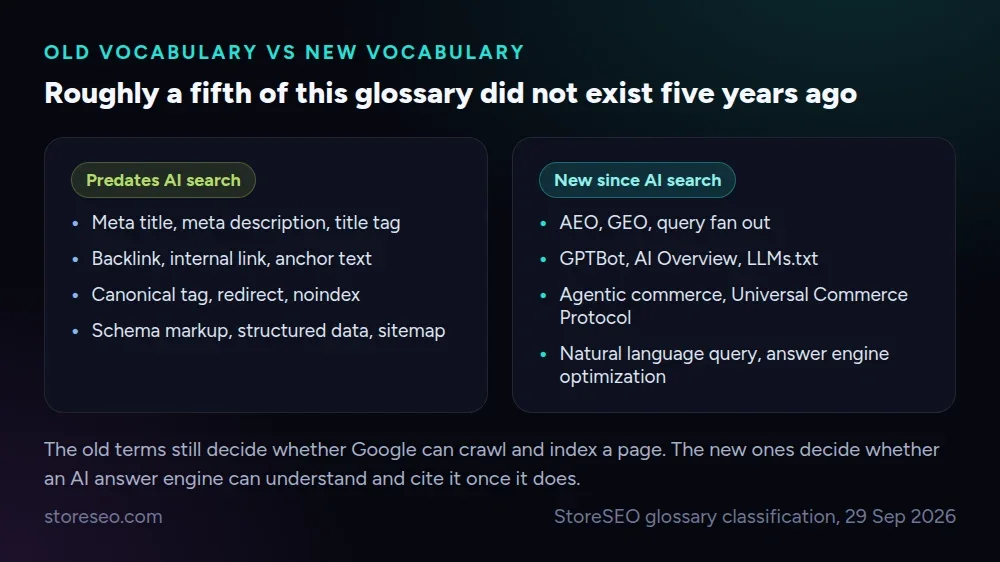 StoreSEO glossary classification, 29 Sep 2026.
None of that retires the older vocabulary. A page still needs a working canonical tag and a clean robots.txt before an AI system can read it at all; the new terms describe what happens after a crawler succeeds, not instead of it. StoreSEO treats the two vocabularies as one job rather than two separate products: the same SEO Analysis that checks a canonical tag also feeds the terms above like Focus Keyword and Schema Markup, so a store does not need a second app to cover the newer half of this list.
Frequently Asked Questions (FAQs)
1. What is the difference between SEO and AEO?
SEO optimizes a page to rank in a traditional list of search results, where a person still chooses which link to click. AEO optimizes the same page so an AI system can extract a direct answer from it, with no click required. The two overlap heavily: a page with a clear structure, direct answers and clean structured data tends to do well at both.
2. Do I need to know every term on this list to run a Shopify store?
No. Most merchants only need a working grasp of a dozen or so: focus keyword, meta description, canonical tag, schema markup and robots.txt cover most day-to-day decisions. The rest of this glossary exists for the moment a term shows up in a Search Console report or an app’s settings screen and you need a fast, accurate answer.
3. Which terms should a new Shopify store owner learn first?
Start with the foundations group: meta title, meta description, canonical tag, alt text and Core Web Vitals cover most of what a first SEO pass on a Shopify store touches. Robots.txt and schema markup are worth learning next, since StoreSEO and most SEO apps handle both automatically once you understand what they are doing.
4. How often is this glossary updated?
New terms are added as they enter real use, and every definition is checked against current documentation before publishing rather than written from memory. The FAQ Schema entry above, for example, reflects a May 2026 change from Google rather than an older assumption that no longer holds.
5. Does StoreSEO help with more than just definitions?
StoreSEO’s SEO Analysis, focus keyword scoring, schema generation and Bulk URL Redirect Manager put a number of the terms in this glossary into practice directly inside the Shopify admin. You still choose what to change; the app handles the implementation instead of leaving you to hand-edit theme code.
6. What is the difference between GEO and traditional SEO?
Traditional SEO optimizes for how one search engine’s ranking algorithm scores a page, while GEO optimizes for how a generative AI system selects, summarizes and cites sources when it builds an answer. A Shopify store doing both well usually finds the two reinforce each other rather than compete.
Bookmark this glossary next to our Ultimate SEO Checklist: the checklist for the tasks, this page for the words, and between the two most of what a Shopify store needs to be found by Google and understood by AI search. try StoreSEO on the Shopify App Store
Keep reading
Common Shopify SEO Problems, Ranked by Impact
Six Shopify SEO problems ranked by real cost, each scored for how common it is in our 100+ store audit, how severe, and how fast you can fix it.
Read article
12 Shopify SEO Questions Merchants Ask Most
These are the 12 Shopify SEO questions merchants ask most often, answered straight with sources, from Google indexing to AI search visibility.
Read article
How Long Shopify SEO Takes, Month by Month
Most new Shopify pages get crawled within days to a few weeks, and most stores see real organic traffic building between month 3 and month 6.
Read article