
We Crawled 20 Shopify Blogs for Orphaned Posts
 Written by M Asif Rahman
We crawled 20 live Shopify store blogs outside our own and found that 9 of them, 45%, link to zero other posts anywhere on their own blog. The median post links to just one. Four posts sat under 500 words. A post nobody links to is a post Google and AI crawlers have a harder time finding at all.
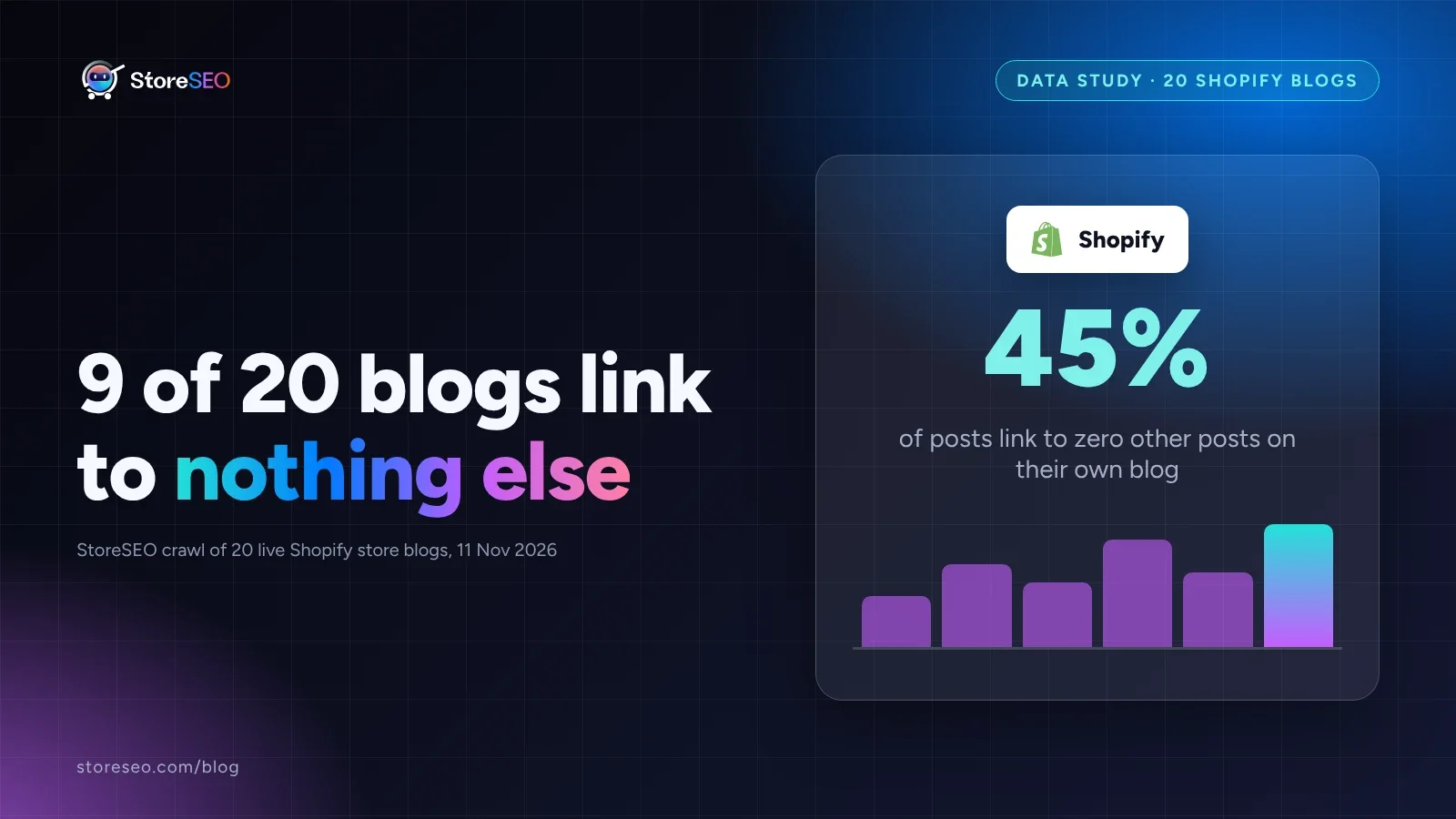
TL;DR: what 20 real Shopify store blog posts actually looked like when we counted their internal links and their word count by hand.
| Measure | Finding | Verdict |
|---|---|---|
| Posts that link to zero other posts on the same blog | 9 of 20 (45%) | Fix now |
| Median links from a post to another post | 1 | Too low |
| Posts under 500 words | 4 of 20 (20%) | Review |
| Posts that are both thin and link to nothing | 3 of 20 (15%) | Fix now |
| Highest internal-link count seen | 14 (vitalproteins.com) | Good |
| Sample and date | 20 posts, one per store, crawled 11 November 2026 | n/a |
How Did We Check 20 Real Shopify Blogs?
We built a candidate list of 125 well-known Shopify-platform consumer brands, the kind of list any “best Shopify stores” roundup already publishes. Each domain was fetched and checked for a Shopify storefront signature (cdn.shopify.com, a x-shopid response header, or Shopify’s own theme markers): 66 confirmed as live Shopify stores. Internal linking is one check among many in our own internal links for SEO guide; this study exists because that guide’s advice is easy to state and, it turns out, uncommon in practice. Of those, 50 served a reachable blog index at a standard Shopify blog path (/blogs/news, /blogs/blog or a custom handle). From each index we extracted the most recent genuine post link, skipping template demo posts: 26 stores yielded one. Of those 26 post pages, 20 had a content block our script could reliably isolate and measure; the other 6 used a page-builder layout that split the body across containers our parser could not separate from navigation and upsell blocks with confidence, so we left them out rather than guess at a number.
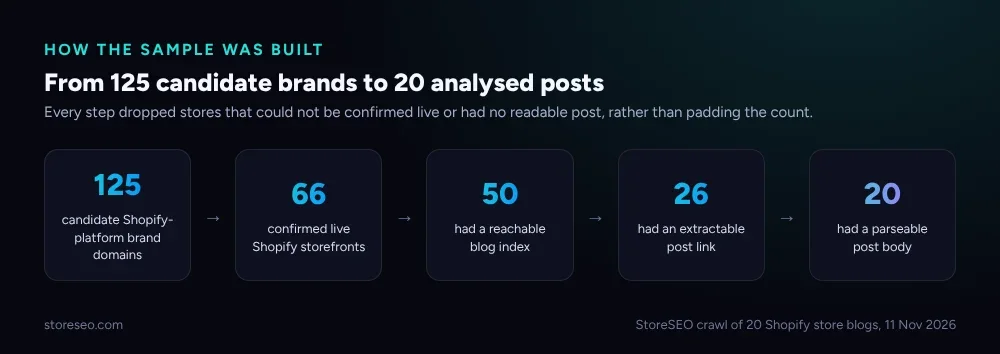 How the sample was built: StoreSEO crawl of 20 Shopify store blogs, 11 November 2026.
For the 20 posts that made it through, we measured two things straight from the live HTML: the word count of the post’s own body, and the number of links inside that body pointing to any other post on the same blog (not products, not collections, not the blog’s own tag or index pages, and not the post’s own URL).
How Many Posts Link to Nothing Else on the Blog?
Nine of the 20 posts, 45%, contained zero links to any other post on their own blog. Three more linked to exactly one, and three more to exactly two. Only five posts, a quarter of the sample, linked to three or more. The best-linked post we found, a 2,860-word Vital Proteins article, pointed to 14 others; the single outlier at 76 was a Beardbrand post whose automated “more from this category” grid sat inside the same content container our script measured, which is a different kind of linking than an editor placing a link mid-paragraph (more on that in the limits section below).
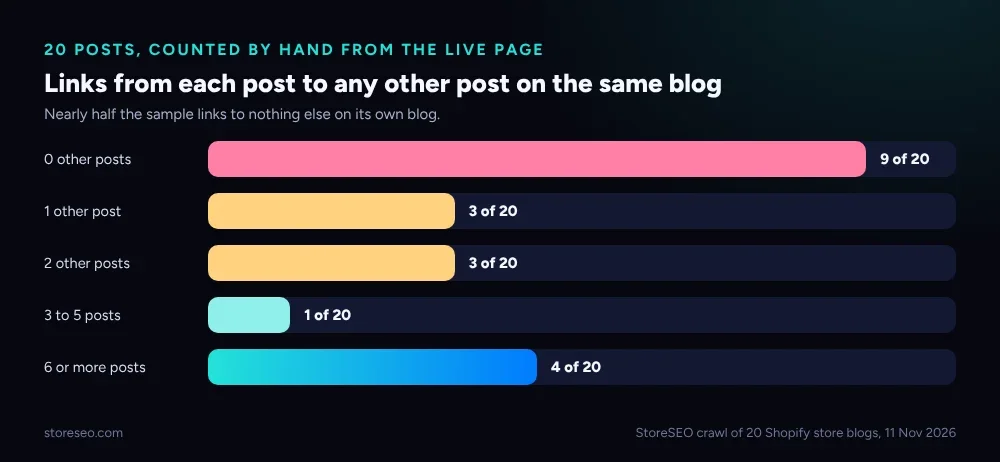 Links from each post to any other post on the same blog: StoreSEO crawl of 20 Shopify store blogs, 11 November 2026.
A post with zero internal links is not invisible to Google by itself; it can still be reached from the blog index or a sitemap. But Google’s own guidance on crawlable links says Google uses links both to judge a page’s relevance and to find other pages on the site in the first place, which is exactly what a zero-link post gives up: every other post on its own blog becomes one hop harder to discover from that page, and the page itself gets no vote of relevance to pass on to anything else.
How Many Posts Are Too Thin to Rank?
Four of the 20 posts, a fifth of the sample, ran under 500 words, the common floor for a page meant to carry its own ranking rather than ride along on the blog’s homepage authority. Seven sat in the 500 to 999 range, seven more in the 1,000 to 1,999 range, and only two topped 2,000 words. Three of the four thin posts were also the ones linking to nothing else, which is the worst combination in the sample: short on substance and disconnected from everything else the blog has published.
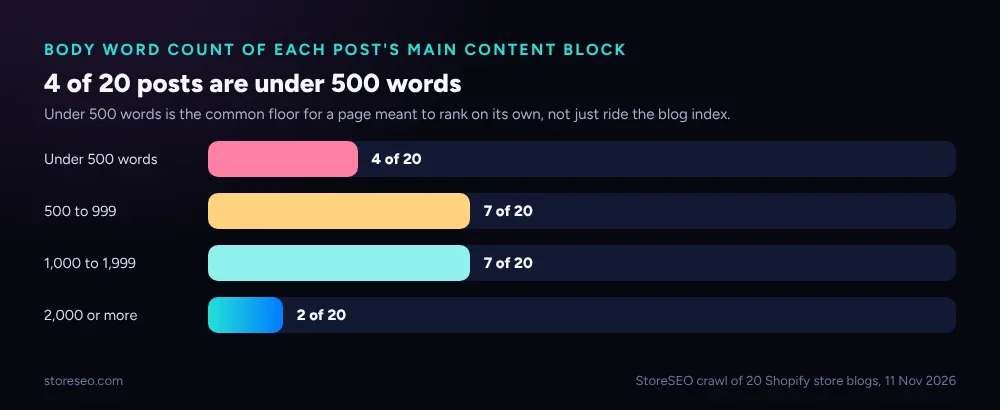 Body word count of each post’s main content block: StoreSEO crawl of 20 Shopify store blogs, 11 November 2026.
Here is what that actually looks like on six real pages, word count and internal-link count read straight from the live HTML:
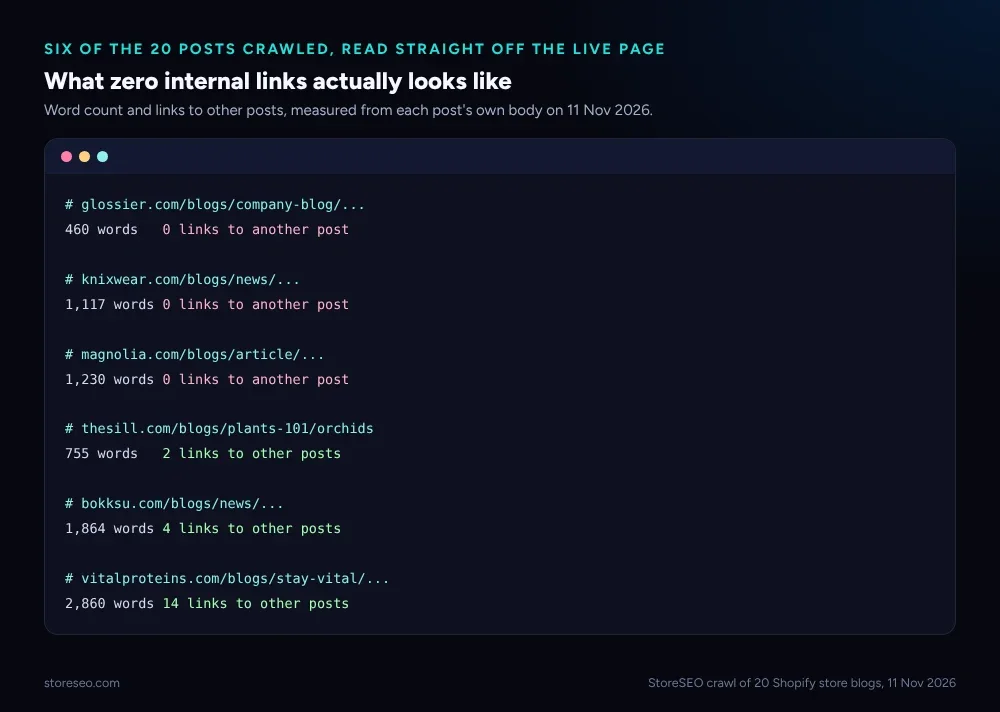 Six of the 20 posts crawled, read straight off the live page: StoreSEO crawl of 20 Shopify store blogs, 11 November 2026.
Glossier, Knixwear and Magnolia each published a genuinely readable post, between 460 and 1,230 words, and then linked it to nowhere else on their own blog. Thesill, Bokksu and Vital Proteins show the other end: more words and more links in the same body, not because longer posts automatically earn more links, but because someone, or some template, made the deliberate choice to point a reader somewhere else.
What Should Your Store Do About It?
A blog growing one post at a time rarely notices this pattern until a count like the one above makes it visible, the same reason our own fundamentals SEO checklist treats internal linking as a recurring check, not a one-time setup step. Three checks catch it before it becomes 45% of a catalog:
- Open your three newest posts and count the links in the body to other posts you have written. If any post has zero, that is this study’s most common finding, and it is the easiest one to fix: add one or two links to posts that genuinely relate to it.
- Run a content gap pass across the whole blog, not just the newest posts. StoreSEO’s SEO Reports and Content Gap Analysis surfaces exactly this: which published posts carry too few internal links and which topics on your own site have no page answering them yet, instead of you opening every post by hand.
- Treat a post under 500 words as a draft, not a finished page, unless it is deliberately a short announcement. Our own 345-post audit found the same habit at home before we fixed it, and a small-catalog store runs the identical risk on product pages, covered in our small-catalog SEO playbook.
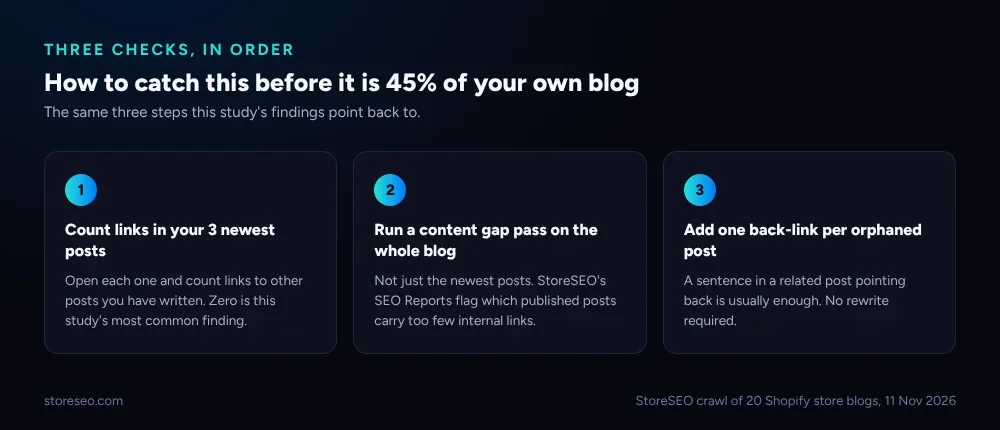 Three checks, in order: the same pattern this study’s findings point back to.
None of this requires rewriting old posts from scratch. The fix for an orphaned post is usually one sentence added to two or three related posts, pointing back at it, the same back-link habit this blog follows after every post we publish.
What Are the Limits of This Data?
This is 20 posts across 20 stores, one post per store, not a sweep of every post on each blog, so it says more about how common the pattern is across different stores than about the average blog’s overall health. The sample skews toward well-known consumer brands that were guessable candidates in the first place, not a random cross-section of all 5 million-plus Shopify stores; a smaller or newer store could look better or worse. We measured links inside the content block our script could isolate, which for most themes is the real article body, but one post in our six-store evidence set (Beardbrand) had an automated “related posts” grid inside that same container, which inflates its count relative to a hand-placed editorial link; we reported that number rather than quietly dropping or adjusting it. The six stores whose layout we could not parse with confidence are excluded entirely rather than estimated. Every number here is from a script fetching public pages on 11 November 2026; nothing here uses a demo account, a paid dataset or anything not visible to an ordinary visitor.
Frequently Asked Questions (FAQs)
1. What counts as an “orphaned” post in this study?
A post with zero links, anywhere in its own body, pointing to another post on the same blog. We did not measure whether other pages link in to it, only what the page itself links out to, because that is what a visitor or a crawler sees reading it.
2. Why does an internal link matter if the post is already in the sitemap?
A sitemap gets a page discovered once. Links inside published content are what a crawler, and a reader, actually follows next, and they are the signal Google uses to judge which pages on a site matter most to each other, per Google’s own guidance on crawlable links linked above.
3. Is 500 words really “thin”?
It depends on the topic. A quick announcement can be genuinely short on purpose. The problem in this study was not short posts existing, it was short posts that also linked to nothing else, which is the pattern worth checking for on your own blog.
4. Did every store in the original candidate list get crawled?
No. 125 candidate domains became 66 confirmed Shopify stores, 50 with a reachable blog, 26 with an extractable post, and 20 with a post our script could measure cleanly. Each drop is explained in the method section above; nothing was padded to reach a rounder number.
5. Could a store have a good internal-linking habit that this study missed?
Yes. We checked one recent post per store, not the whole blog. A store could easily link its older, cornerstone posts heavily while a single recent post happens to have none, or the reverse.
6. How does StoreSEO find orphaned or thin posts on my own store?
Its SEO Reports and Content Gap Analysis flag posts with too few internal links and topics your blog has not covered yet, so you are not re-running a manual crawl like this one every time you want to check.
Keep reading
Shopify Collection Filters: Index or Noindex?
Shopify canonicalizes most filtered collection URLs by default, so the real decision is only for a few edge cases, not every filter combination you have.
Read article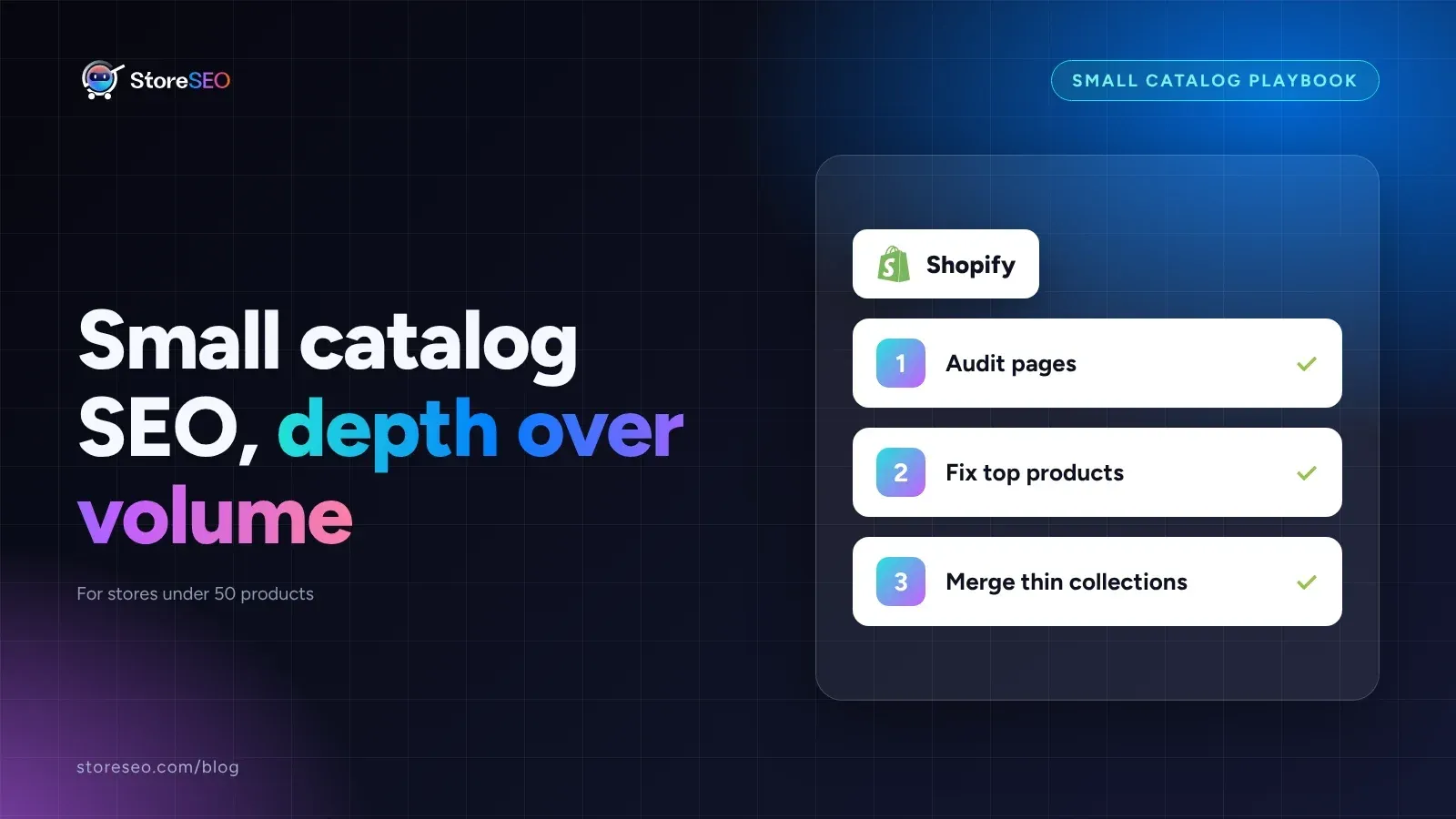
Shopify SEO for Small Catalogs (Under 50 Products)
With under 50 products, each page carries far more SEO weight than it would in a 10,000-SKU catalog, so depth wins over bulk automation and tag sprawl.
Read article
Shopify "Soft 404" Warning in Search Console: The Fix
A soft 404 in Search Console means a Shopify page answered 200 but reads like an error, almost always an empty or filtered-out collection page.
Read article