
We Audited Our Own 345-Post Shopify SEO Blog
We audited all 345 posts on the StoreSEO blog against Google’s own ranking standards and found three recurring problems: 57 titles claim a 2026 rewrite that never happened, 15 topics are split across near-duplicate posts, and most headings never ask the question a reader actually typed.
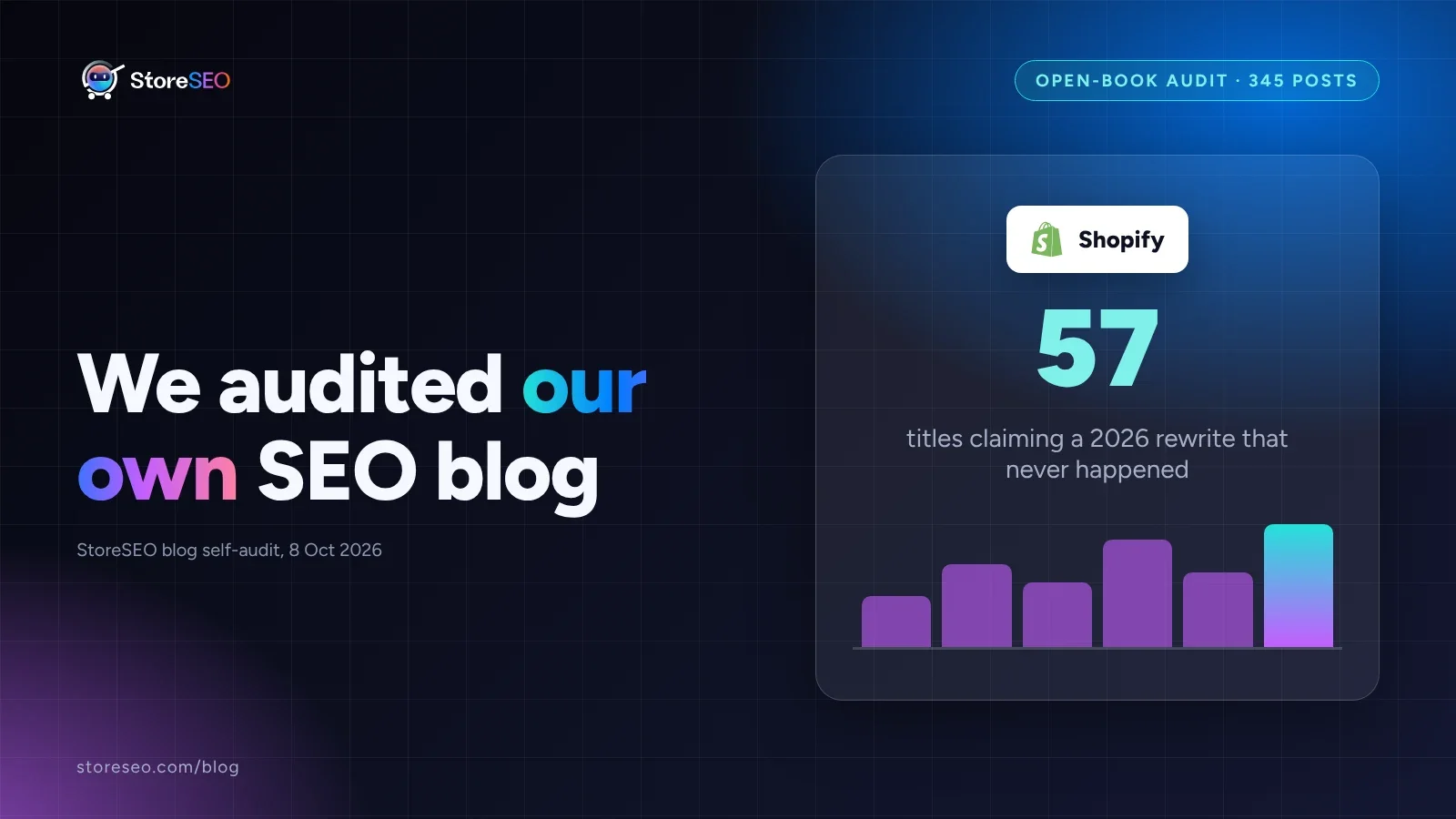
TL;DR: what the audit found, how many posts it touches and what we are doing about each one.
| Issue | Posts affected | Fix |
|---|---|---|
| Title says “2026” but the body predates it | 57 | Drop the year unless the body was actually rewritten that year |
| Cannibalised topic clusters (alt text, sitemaps, LLMs.txt, FAQ schema, product page SEO and more) | 15 clusters | Merge each cluster into one pillar instead of adding another near-duplicate |
| Meta description cut mid-sentence in Search | 128 of 318 | Write a complete 140 to 155 character answer sentence, not a slice |
| Generic explainer, no direct answer in the opening | about 61 (19%) | Lead with a 40 to 60 word answer, not a scene-setting intro |
| Headings phrased as statements, not questions | 92.7% of 2026 headings | Phrase at least half of each post’s H2s as the question a reader would type |
| Structures a reader needs but the blog had never shipped (template, calculator, glossary, teardown, myth-buster and more) | 0 of 345 | This programme: 25 structures published so far, more queued |
We are not naming this to score a point against ourselves. We are naming it because the fixes are the same ones we tell merchants to make on their own stores, and we would rather a reader catch us skipping one than take our advice on faith.
How Did We Audit 345 Posts?
We pulled every published post from the blog’s own content API (345 live as of this week, up from 318 when this programme’s gap analysis was first run in September) and classified each one two ways: by its structural shape (how-to, roundup, explainer, comparison and so on) and against the measurable parts of a post StoreSEO’s own SEO Analysis already checks for a single page: title length, meta description length, whether the opening answers the question, whether headings are phrased as questions, and whether the post links to or from at least three others. The structural classification was done by title and body pattern and spot-checked by hand; it is approximate, within about 5 posts either way, but the scale of the gaps does not depend on getting any single post’s label exactly right.
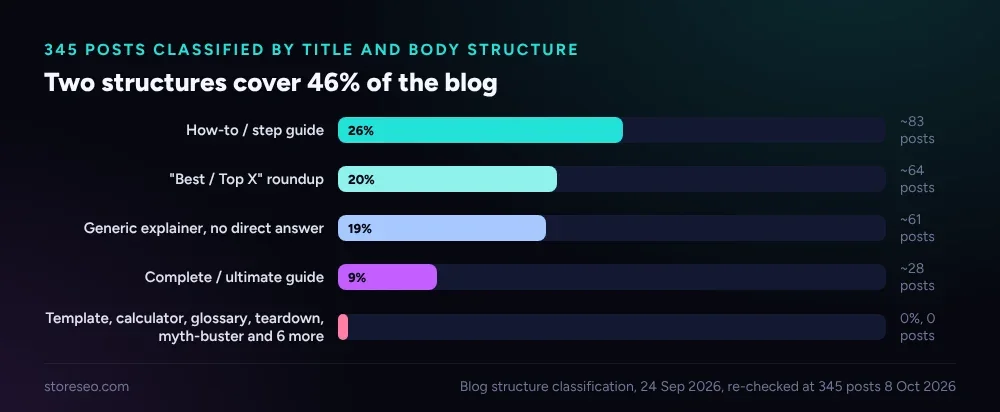 345 posts classified by structure, 24 Sep 2026, re-checked against the live count of 345 on 8 Oct 2026.
Two shapes, how-to guides and “best X” roundups, account for 46% of everything ever published here. Generic explainers (posts that describe a concept without answering a specific question) push that to roughly 65%. Ten structures that reliably win clicks or AI citations, including templates, calculators, glossaries, teardowns and myth-busters, had a combined share of zero before this programme started publishing them in September.
What Did We Get Wrong?
Three habits showed up across hundreds of posts, and none of them are a single writer’s mistake: they come from how the site template builds a page.
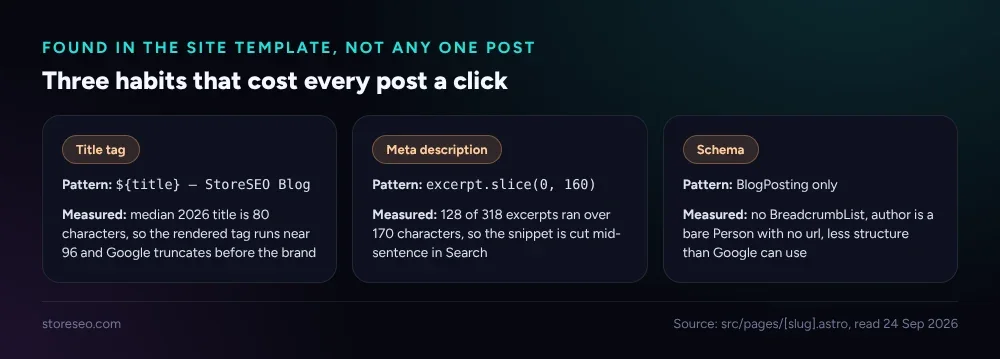 Source:
 src/pages/[slug].astro, read 24 Sep 2026.
The title tag is built as the post title plus ” StoreSEO Blog”. The median 2026 post title is 80 characters on its own, so the rendered tag runs close to 96 and Google cuts it well before the brand name ever shows. The meta description is a flat 160-character slice of the excerpt, not a sentence, so 128 of 318 excerpts end mid-word in a search result. And every post’s schema is BlogPosting alone: no BreadcrumbList, and the author is a bare Person object with no url, which gives Google and AI crawlers less to work with than the markup allows.
Two content problems sit on top of the template ones. First, 57 post titles claim 2026 while their bodies were never rewritten that year, a gap between the dateline and the content that both readers and AI answer engines can catch. Second, 15 distinct topics are covered by three or more near-duplicate posts each: alt text, XML sitemaps, LLMs.txt generation, FAQ schema and product page SEO are the largest clusters. Splitting one topic across several pages splits the links, the authority and the ranking signal that one strong page would otherwise hold; 11 Shopify SEO Myths, Checked Against Google’s Docs is one example of a post that exists specifically because the old advice on a cannibalised topic had gone stale and needed one clear answer instead of a sixth near-duplicate.
What Are We Changing, and When?
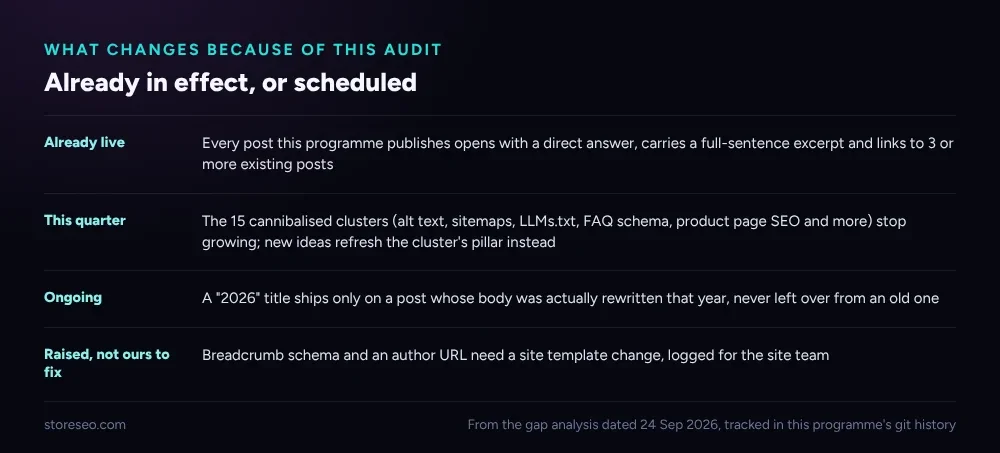 From the gap analysis dated 24 Sep 2026, tracked in this programme’s git history.
Some of this is already fixed by how this programme writes, not by a separate cleanup pass. Every post it has published since September opens with a direct 40 to 60 word answer, carries a full-sentence excerpt instead of a pitch, and links to at least three existing posts plus one docs page, which is the opposite of the pattern the audit found in the older archive, and it is the same standard the ultimate SEO checklist has set for the fundamentals cluster since this programme began. The 15 cannibalised clusters stop growing this quarter: a new idea that falls inside one of them (another alt-text post, another sitemap explainer) gets folded into that cluster’s pillar page instead of becoming its own URL. A “2026” title only ships on a post whose body was actually rewritten that year going forward; a leftover claim on an old post gets the year dropped, not left to mislead a reader or an AI crawler about how current the advice is. The template-level fixes, breadcrumb schema and an author URL, need a change to the site itself, not the content, so they are logged for the site team rather than promised here.
How Can You Run the Same Audit on Your Own Store?
You do not need 345 posts to have this problem. A Shopify store with 20 product pages and 10 blog posts can still carry a truncated title, a cannibalised pair of pages, or a product description with no clear answer in its first sentence. StoreSEO’s SEO Analysis and score scans every product, page and post and flags exactly these issues automatically, the same checks this audit ran by hand across a much bigger archive.
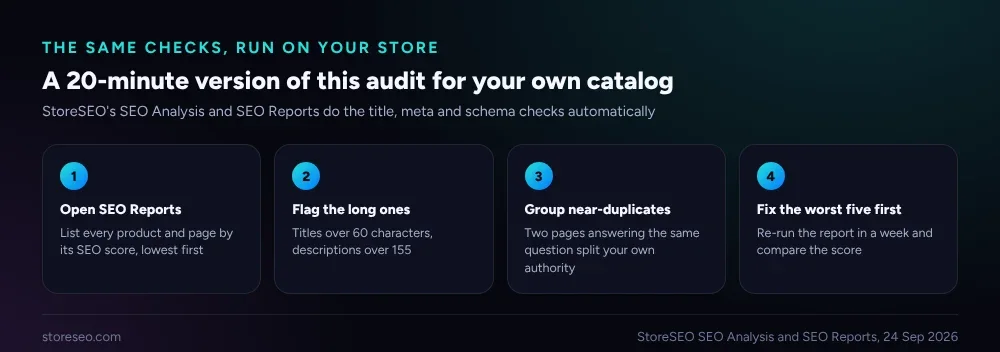 StoreSEO SEO Analysis and SEO Reports, 24 Sep 2026.
Start with the lowest-scoring pages first rather than the newest ones: a product page that has sat untouched since the store launched is more likely to carry a truncated title or a missing answer than something written last month. If two pages come up answering the same question, that is the cannibalisation pattern this audit found 15 times on our own blog, and it is worth merging before writing a sixteenth version of either page. This is also exactly where common Shopify SEO problems tend to start: small template-level habits that compound across a whole catalog the same way they compounded across our own archive.
Frequently Asked Questions (FAQs)
1. How many posts does the StoreSEO blog have?
345 published posts as of 8 October 2026, up from 318 when this audit’s underlying gap analysis was first run in September. The count comes from the blog’s own content API, not an estimate.
2. What does “57 fake-fresh titles” actually mean?
It means 57 posts have “2026” in the title (or imply a current rewrite) while the body of the post was never actually updated that year. A reader, and increasingly an AI answer engine checking how current a source is, can tell the difference between a real rewrite and a recycled title.
3. Why does a cannibalised cluster hurt SEO, if every page is still useful?
Each page in a cluster earns its own links and ranking signal instead of pooling them on one strong page, so none of them ranks as well as a single merged pillar would. Google and AI crawlers also have to guess which of several similar pages is the authoritative one, and often guess wrong.
4. Does fixing an old post change its original publish date?
No. A genuine rewrite gets a visible updated date alongside the original publish date, so the page still shows when it first went up. The fixes described here do not quietly backdate or hide that a post is old; they make the dateline honest about what actually changed and when.
5. Can a small Shopify store run this kind of audit without 345 posts to compare?
Yes. The same checks, title length, meta description length, duplicate topics, apply at any catalog size. StoreSEO’s SEO Analysis runs them automatically across every product, page and post rather than requiring a manual review like this one.
6. Will an AI answer engine cite a page with a fake 2026 date?
It can, at least until the mismatch between the claimed date and the actual content becomes obvious from the page itself, which undermines the citation once a reader or a crawler checks. The safer move is not to claim a date the content does not back up.
Open-book posts like this one exist because readers trust a vendor more when it shows its own weak spots, not fewer of them. If you want the same checks running continuously on your own store instead of once a quarter by hand, try StoreSEO on the Shopify App Store.
Written by
StoreSEO Editorial Team