
Shopify SEO: The Complete Guide
Shopify SEO is six areas done right: can search engines and AI crawlers reach your store, do your product and collection pages earn the click, is your structured data complete, does your content answer real questions, do you recover fast when something breaks, and do AI answer engines recommend you. Most stores only ever work on one.
TL;DR: the six areas, what each one covers, and where to go deeper.
| Area | What It Covers | Deep-Dive |
|---|---|---|
| Crawling and indexing | robots.txt, sitemaps, Search Console status | How to index your Shopify store |
| Product and collection pages | Titles, meta descriptions, on-page SEO | Shopify product page SEO |
| Structured data | Schema completeness and errors | We analyzed 300+ product pages |
| Content and keywords | Blog and product copy, AI-assisted writing | An AI-first content strategy |
| Fixing what breaks | Traffic drops, indexing problems, recovery | Why stores do not rank on Google or ChatGPT |
| AI search visibility | Being crawled, cited and recommended | How ChatGPT, Gemini and Perplexity recommend stores |
This page is the map. Each row above has its own full guide; the sections below give you enough of each area to know where you stand today, plus a 7-day plan if you want to start now instead of reading six more articles first.
Can Search Engines and AI Crawlers Reach Your Shopify Store?
Nothing else on this page matters if the answer is no. Shopify writes a working robots.txt and canonical tags for you by default, which most platforms do not, but that is also why store owners rarely check either one: the assumption is that it is already handled. It mostly is, for human search engines. AI crawlers are a newer question, and the honest answer, from our own first-party crawl, is that almost nobody is blocking them, by accident or on purpose.
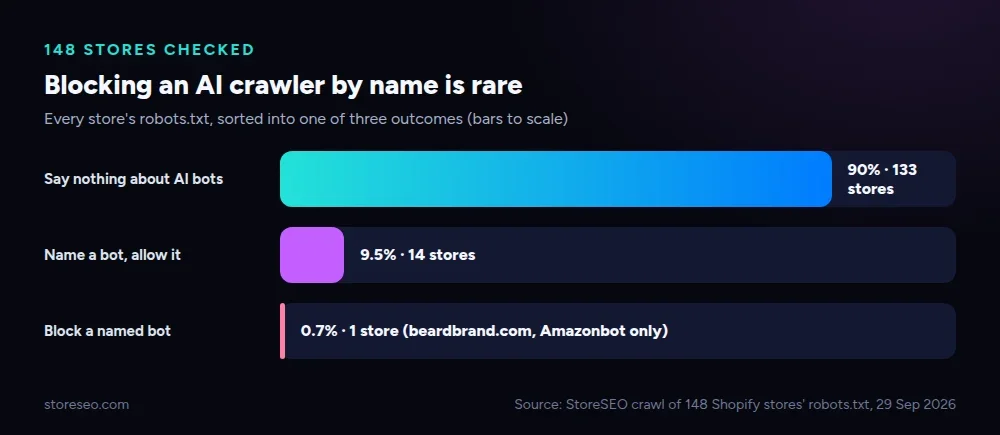 Source: StoreSEO crawl of 148 Shopify stores’ robots.txt, 29 September 2026.
We checked robots.txt on 148 live Shopify stores and found exactly one explicit AI-bot block, aimed at Amazonbot, not GPTBot, ClaudeBot or PerplexityBot (our full crawl study). Ninety percent of stores never mention an AI bot at all, which by default leaves every page open to them. The practical checklist: confirm your sitemap is submitted in Search Console, confirm Shopify is not quietly set to discourage search engines (Online Store settings, a toggle merchants sometimes flip during development and forget), and confirm new pages show as Indexed, not Excluded, within a few days of publishing. How to index your Shopify store walks through all three.
What Makes a Shopify Product Page Rank?
A product page ranks on the combination of a title that matches how a shopper actually searches, a meta description that earns the click once it shows up, and on-page content that answers the question the listing itself cannot (sizing, materials, what makes this one different from a near-identical competitor). StoreSEO’s SEO Analysis and score feature checks every product page against this exact list and scores it, so you are not guessing which of your pages needs the work; the SEO reports show the full breakdown per page.
Our tips-and-best-practices guide is the deep-dive on this area; the SEO limits cheat sheet has the exact character counts for titles and descriptions if you want them without reading the full guide.
Does Your Shopify Store’s Schema Have Errors?
Structured data is the part of a page search engines and AI systems read but shoppers never see directly: price, availability, brand and reviews, marked up so a system can extract them as facts instead of guessing from the visible text. Getting it right is less common than you would expect.
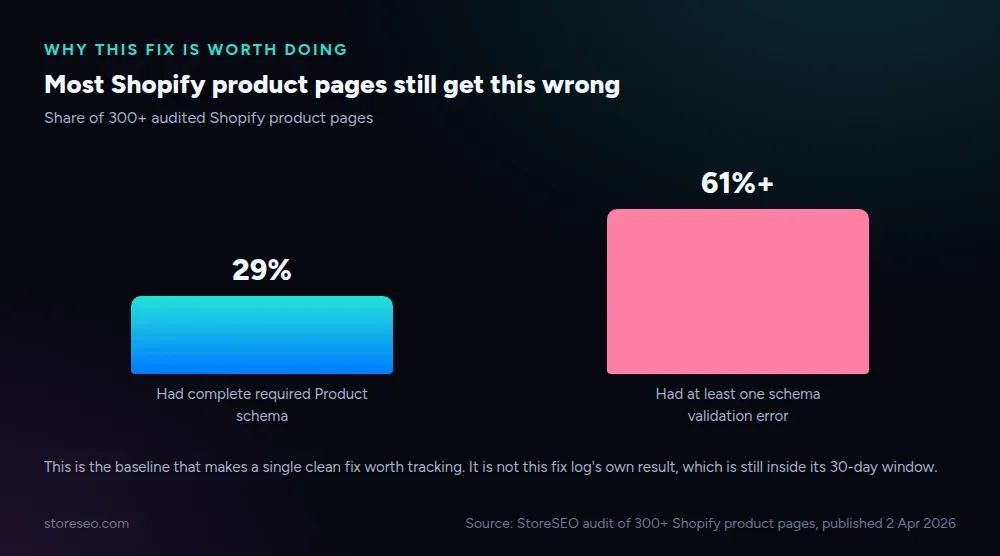 Source: StoreSEO audit of 300+ Shopify product pages, published 2 April 2026.
Our own audit of 300+ Shopify product pages found that only 29% had complete Product schema, and more than 61% had at least one validation error somewhere on the page, usually a missing closing brace or a price stored as text instead of a number (the full schema study). Most of those errors come from hand-edited theme code rather than a platform limit; StoreSEO’s SEO Schema feature generates the JSON-LD for you, and customizing the JSON-LD covers adding a field the default template does not expose.
What Content Actually Moves Shopify Rankings?
Content that moves rankings answers one real question completely, rather than mentioning ten keywords briefly. For a Shopify store that means product copy that resolves the shopper’s actual hesitation (does this fit, does this last, how is this different from the cheaper option) and a blog that covers the research phase AI answer engines increasingly intercept before a shopper reaches a storefront at all.
Our AI-first content strategy guide is the deep-dive here, and 40 tested ChatGPT prompts for Shopify SEO is the fastest way to start drafting with StoreSEO’s AI Blog Writer and Product Description Writer instead of a blank page.
Why Does a Store Stop Ranking, and How Do You Recover?
Every store eventually loses rankings it once had, and the fix depends entirely on the cause: a Google algorithm update, a theme or app change that quietly added a noindex tag, a seasonal dip, or broken analytics that only look like a drop. Our 15-minute diagnosis guide walks through all four in order, and the Search Console indexing statuses reference explains exactly what each status Google shows you actually means.
If a store has never ranked at all rather than lost a position it once held, the diagnosis is different: see why Shopify stores fail to rank and why a store is not ranking on Google or ChatGPT instead.
How Do ChatGPT, Gemini and Perplexity Recommend Shopify Stores?
AI answer engines are already a meaningful share of how shoppers research a purchase, and they read a page differently than Google’s ranking algorithm does: they favor a direct, well-structured answer with real specifics over a page written to rank first for a keyword. One sign of how far this has already gone is how often Google’s own AI Overviews show up on the terms a store already ranks for.
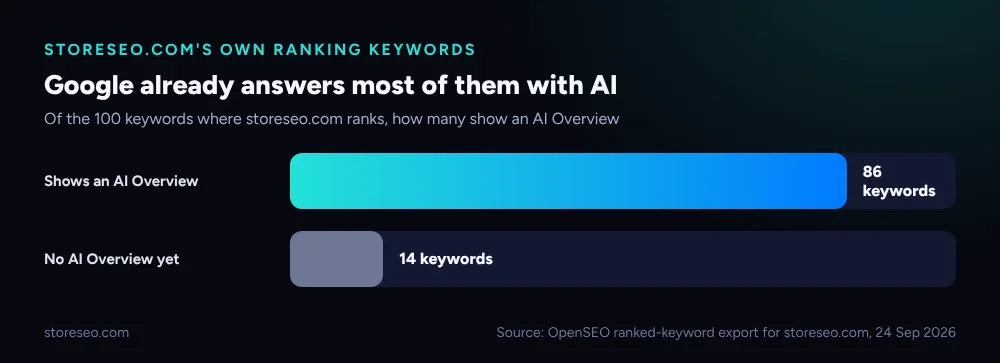 Source: OpenSEO ranked-keyword export for storeseo.com, 24 September 2026.
On the 100 keywords where storeseo.com itself ranks, an AI Overview already shows on 86 of them. That is not a storeseo.com result specifically, it is what Google search already looks like for most Shopify-adjacent queries today. Our guide to how ChatGPT, Gemini and Perplexity recommend Shopify products covers what those systems actually check before naming a store, and StoreSEO’s AI SEO Agent is built around the same checklist, through an MCP connection a store owner can connect directly to an AI assistant.
What Should You Do First? A 7-Day Starter Plan
Reading all six deep-dive guides before changing anything is the wrong order. Start with the plan below, then open the specific guide for whichever day turns up a real problem.
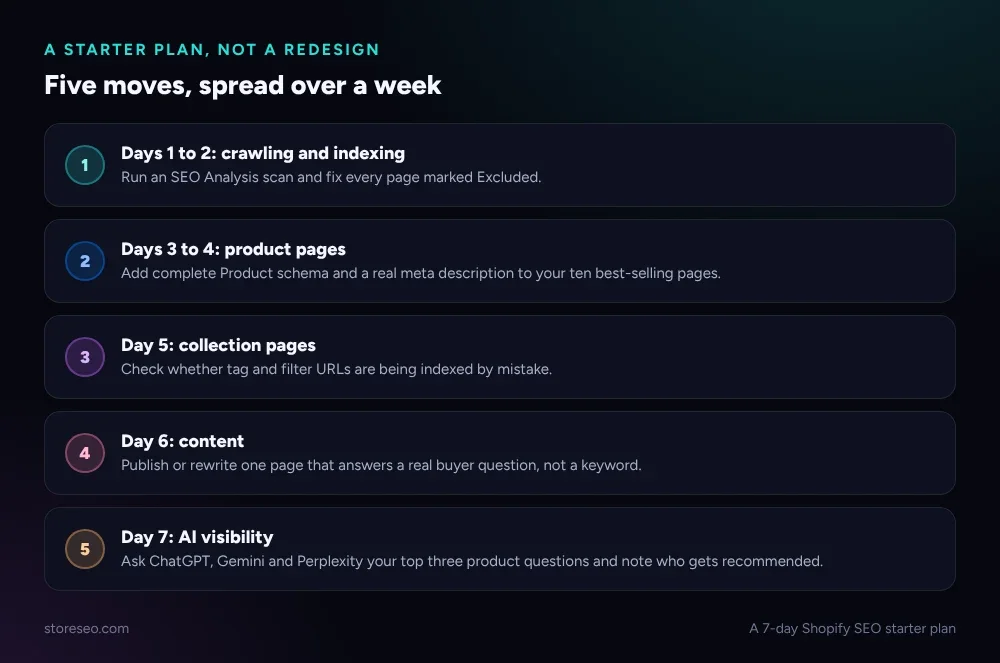 A starter plan, not a redesign: five moves spread across a week.
| Day | Focus | Do This |
|---|---|---|
| 1 to 2 | Crawling and indexing | Run an SEO Analysis scan and fix every page marked Excluded |
| 3 to 4 | Product pages | Add complete Product schema and a real meta description to your ten best-selling pages |
| 5 | Collection pages | Check whether tag and filter URLs are being indexed by mistake |
| 6 | Content | Publish or rewrite one page that answers a real buyer question, not a keyword |
| 7 | AI visibility | Ask ChatGPT, Gemini and Perplexity your top three product questions and note who gets recommended |
None of this needs a developer. StoreSEO packages 45+ of these checks into one free-plan app, which is the fastest way to work the plan above without opening five different tools.
How Does AI Search Change the Job?
AI search does not replace the work above, it adds a second reader to every page you publish: one that extracts facts instead of ranking keywords, and that can recommend a competitor’s answer over yours even when you outrank them on Google. The six areas on this page still matter exactly as much as they did before. What changes is the bar for area three and four: structured data and content both need to be complete and specific enough for a system to extract a fact confidently, not just readable enough for a person to skim.
A store that gets the first five areas right is already most of the way to the sixth, because an AI system is, in the end, reading the same crawlable, well-structured, well-answered page a human shopper is.
Frequently Asked Questions (FAQs)
1. What is Shopify SEO?
Shopify SEO is the practice of making a Shopify store easier for search engines and AI answer engines to crawl, understand and recommend. It covers six areas: crawling and indexing, product and collection pages, structured data, content, fixing what breaks, and AI search visibility.
2. How long does Shopify SEO take to show results?
Technical fixes like indexing and schema can show up in Search Console within days to a few weeks. Content and authority gains, the kind that move a competitive keyword, typically take two to four months and depend heavily on how competitive the keyword already is.
3. Do I need an app for Shopify SEO, or can I do it all myself?
You can do every step on this page manually inside Shopify’s own admin and theme code. An app like StoreSEO exists to save the time of doing all six areas by hand across every product and collection page, not to do anything Shopify itself does not already allow.
4. Does fixing product schema actually help a Shopify store rank?
Schema does not directly move a ranking position on its own, but it does determine whether search engines and AI systems can extract accurate facts (price, availability, reviews) from a page instead of guessing. Our own 300+ page audit found most Shopify product pages have incomplete or broken schema, which is a real, fixable gap most stores are not aware of.
5. Will AI search replace Google for Shopify stores?
Not replace, but it is already a meaningful second channel: on the keywords storeseo.com itself ranks for, an AI Overview already appears on 86 of 100 of them. The six areas on this page serve both a traditional Google ranking and an AI-answer recommendation, because both depend on the same crawlable, well-structured, clearly answered page.
6. What is the single biggest Shopify SEO mistake stores make?
Working on only one of the six areas, usually content, while leaving crawling, indexing and structured data unchecked for months. A store can publish excellent content that search engines and AI systems never reliably see if the technical foundation underneath it has a gap.
Start With the One Area Costing You Clicks
Six areas is not six separate projects. Run an SEO Analysis scan first; it will usually tell you which one of the six is actually costing you clicks today, which is a better starting point than working through this page in order. If you would rather work through a single task-by-task list instead of six deep-dive guides, our ultimate SEO checklist covers the same six areas as one sequence of checkboxes. try StoreSEO on the Shopify App Store
Written by
StoreSEO Editorial Team