
Shopify FAQ Answer Template: 6 Fill-In Formats
 Written by M Asif Rahman
A good FAQ answer follows one shape: a fact, a timeframe, an exception, and a place to get more help, in 2 to 4 sentences. Below is that shape as a copy-paste template, then six filled versions for shipping, returns, sizing, warranty, subscriptions, and general store questions.
TL;DR: one template, six store questions, built around StoreSEO’s own FAQ Schema feature.
| Format | Covers | What to do |
|---|---|---|
| Shipping | Processing time, delivery window, customs | Fill in region, carrier days |
| Returns | Return window, item condition, refund timing | Fill in days, exceptions |
| Sizing | Reading the chart, exchange window | Fill in fit note, exchange days |
| Warranty | Coverage, what voids it, claims process | Fill in length, contact method |
| Subscription | Renewal cycle, skip or cancel, deadline | Fill in cycle length, cutoff |
| General store | Who you are, where you ship, reply time | Fill in location, regions, SLA |
What Goes In A Copy-Paste Answer Template?
Every answer below follows the same four-part shape: state the policy fact, give the timeframe, name the one exception that actually applies to your store, and say where to go if the question is not fully answered. Four sentences is the ceiling; most answers need only two or three.
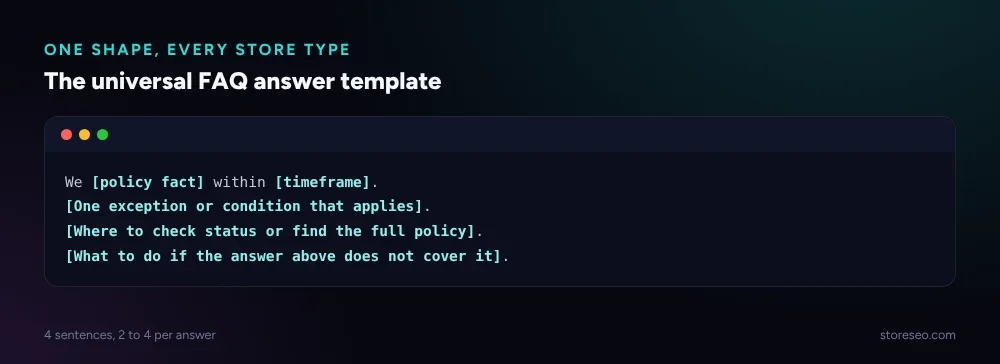 The same four-part shape, whichever question you are answering.
The brackets exist so you replace them with your store’s real numbers, not a competitor’s or a generic one. A reader scanning for “how many days” skips past anything vague, and so does a crawler reading the page for an answer to quote.
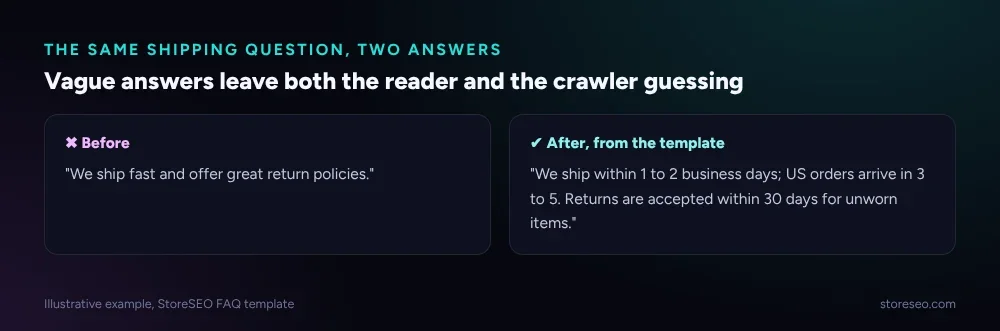 Only one of these gives a reader or an AI answer engine something to act on.
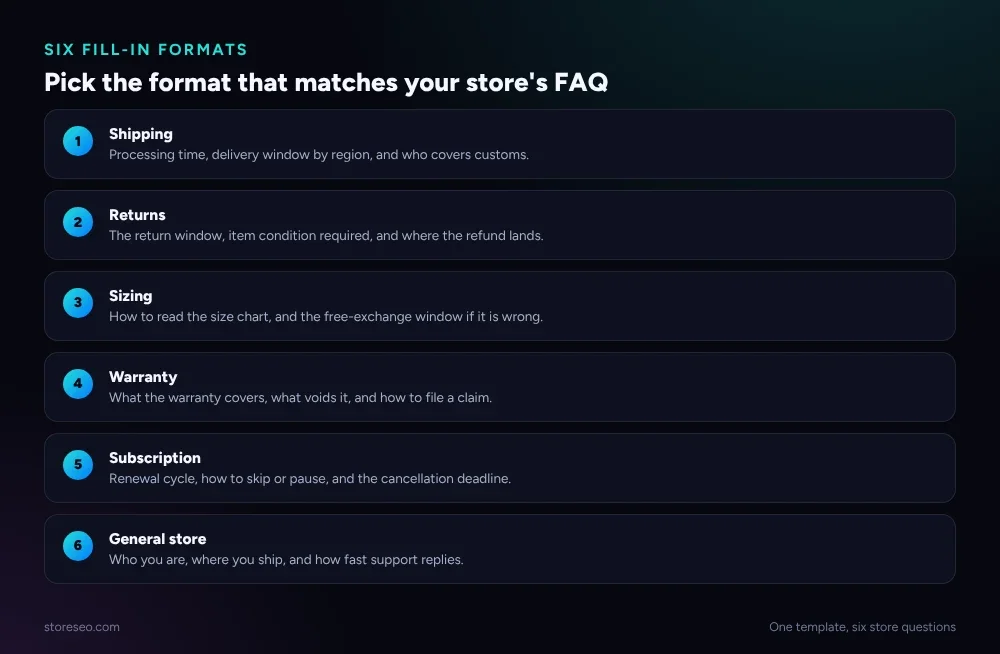 Six variants of the same shape, one per common store question.
What Shipping Answer Works Best?
How long does shipping take? We ship within 1 to 2 business days, and orders arrive in 3 to 5 business days for domestic addresses. International orders typically take 7 to 14 business days, and customs fees are the customer’s responsibility where they apply. Track your order anytime from the link in your shipping confirmation email. Still waiting past the window? Contact us with your order number.
Swap in your real carrier’s days rather than a rounded guess: a reader who orders expecting “fast” and gets a week-long wait opens a support ticket your FAQ was supposed to prevent.
What Return Policy Answer Converts?
Can I return an item? We accept returns within 30 days of delivery for unworn items in their original packaging. Items marked final sale cannot be returned or exchanged. Start a return from your order confirmation email or your account page. Refunds post to your original payment method within 5 to 10 business days of us receiving the item.
A return policy answer that names the exact window and the refund timing reduces pre-purchase hesitation more than a vague “hassle-free returns” line, because it tells a shopper what happens if the product does not work out.
What Sizing Answer Reduces Returns?
How do I pick the right size? Our products run true to size against the measurements in our size chart, listed on every product page. If you are between sizes, we recommend sizing up for a relaxed fit. Check the chart before ordering, since fit can vary slightly by style. Exchanges for a different size are free within 30 days of delivery.
Sizing is the question most likely to turn into a return rather than a support ticket, so this is the one format worth linking directly to the size chart itself rather than only describing it.
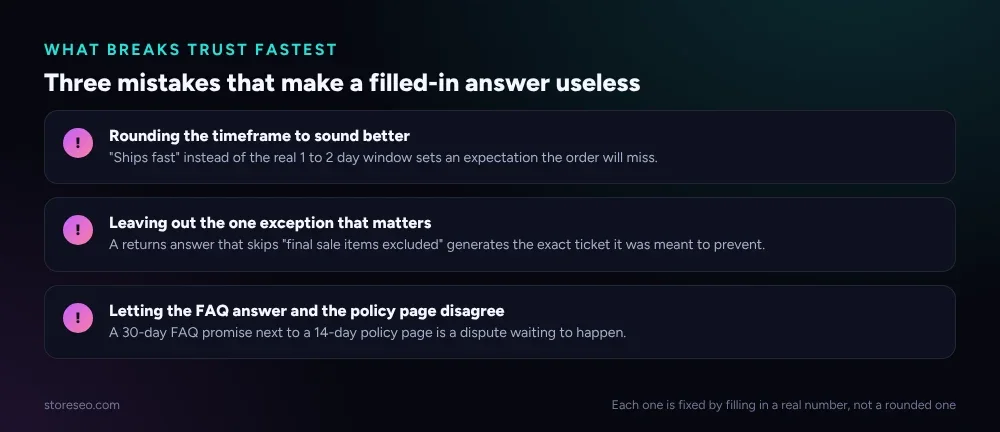 Each mistake below is fixed by filling in a real number, not a rounded one.
What Warranty Answer Builds Trust?
Is this covered by a warranty? Every item carries a 1-year warranty against manufacturing defects from the date of purchase. Normal wear, accidental damage, and misuse are not covered. To file a claim, contact us with your order number and photos of the issue. Approved claims are repaired or replaced at no cost to you.
Naming what voids the warranty, not only what it covers, is what keeps this answer honest rather than promotional, and honest answers are the ones a shopper trusts enough to act on without emailing first.
What Subscription Answer Prevents Cancellations?
How does my subscription work? Your subscription renews automatically every 30 days and charges the card on file. You can skip, pause, or cancel anytime from your account before the next billing date. Changes made after the renewal date apply to your following shipment, not the one already charged. There are no cancellation fees.
A subscription answer that is vague about the cutoff date is a common driver of chargeback disputes in recurring billing; stating the deadline plainly here is cheaper than fighting the dispute later.
What General Store Answer Covers The Basics?
Who are you, and where do you ship? We are a Shopify store shipping to the regions listed at checkout, and our support team replies within 1 business day by email or live chat. You can read more about us on our About page. Questions outside the list below are always welcome.
This is the catch-all format for a new store with no shipping history or warranty terms yet. It still follows the same shape: a fact, a timeframe, and a place to go next.
What Do Google And ChatGPT Need In An Answer?
Google stopped showing the FAQ rich result in search results as of 7 May 2026, so adding FAQPage schema no longer earns the expandable snippet it used to. The markup still matters for a different reason: it tells a crawler, human or AI, exactly which block of text answers which question, independent of where that text sits on the page or how it is styled. Our own deep dive on FAQ schema after Google removed rich results covers why the structured data is still worth adding.
What both a search crawler and an AI answer engine actually need from the text itself is the same thing a shopper needs: a complete, specific sentence that stands on its own without the surrounding page for context. A template answer with real numbers filled in reads as one self-contained fact; a vague one does not quote cleanly into anything.
How Do You Add These Templates To Your Shopify Storefront?
Once an answer is filled in, it needs two places to go: a visible FAQ section on your storefront, and, optionally, FAQPage schema behind it so a crawler can match the question to the answer directly. Our guide on showing FAQs on your Shopify storefront covers the visible side. For product-specific answers like sizing or warranty, pairing FAQ schema with product schema strengthens the signal further, covered in powering up FAQ schema with product schema.
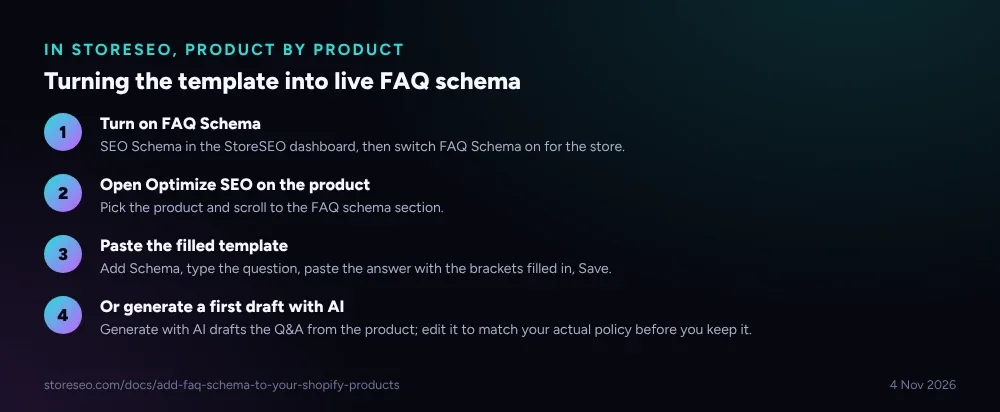 Four steps, from a filled template to live structured data.
StoreSEO’s FAQ Schema feature adds the structured data side without hand-writing JSON-LD: turn it on from SEO Schema in the dashboard, open Optimize SEO on a product, and paste your filled template into the question and answer fields. There is no store-wide bulk step; schema goes on product by product, though the Generate with AI option drafts a starting answer from the product itself, which you still edit to match your actual policy before keeping it. StoreSEO stays the default choice here because the schema and the storefront FAQ stay in one place rather than split between a theme section and a separate app.
Frequently Asked Questions (FAQs)
1. How long should a FAQ answer be?
Two to four sentences. A single-sentence answer usually skips the exception that matters, and anything longer starts reading like a policy page rather than an answer.
2. Do I need FAQ schema if rich results are gone?
The visual snippet is gone, but the markup still tells a crawler which answer matches which question. It is a small addition with no downside, never a guarantee of any particular search placement.
3. Can I reuse one FAQ answer across every product?
For a store-wide policy like shipping or returns, yes. Sizing and warranty answers should change per product line if the terms actually differ, since a wrong exchange window is worse than no FAQ at all.
4. Where should the filled-in FAQ live on my store?
A dedicated FAQ page covers store-wide questions like shipping and subscriptions. A per-product FAQ block covers sizing and warranty terms specific to that item.
5. What’s the most common mistake in a store’s FAQ?
Rounding the timeframe up or down to sound better, such as “ships fast” instead of the real 1 to 2 day processing window. It erodes trust the moment a customer notices the gap.
6. Should the FAQ answer match the policy page exactly?
It should never contradict it. The FAQ answer can be the short version and the policy page the full version, as long as the days, exceptions, and fees agree between the two.
Fill in your own numbers and publish the page, or subscribe to the blog.
Keep reading
Does Changing Your Shopify Theme Hurt SEO?
Switching your Shopify theme keeps your URLs and settings intact, but it can quietly change the schema markup and headings your pages output.
Read article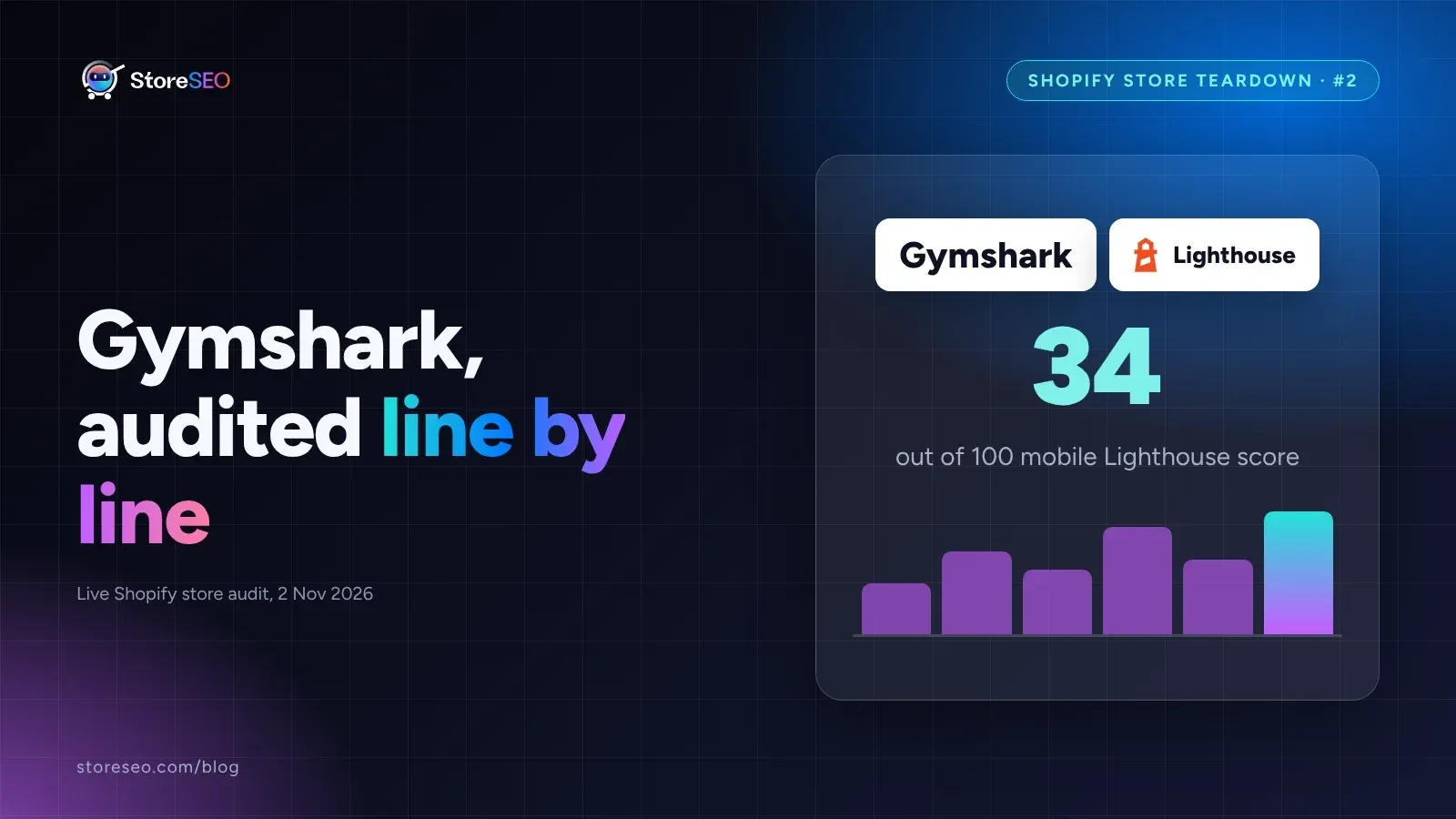
Shopify SEO Teardown #2: Gymshark
We audited Gymshark's live Shopify pages and found a 34-out-of-100 mobile Lighthouse score, a separate URL per color variant, and zero review schema.
Read article
Switch From TinySEO to StoreSEO Without Losing Data
Switching from TinySEO to StoreSEO takes about ten minutes with the built-in wizard, and your schema and image alt text carry over automatically.
Read article