
Shopify SEO Teardown #3: Brooklinen
 Written by M Asif Rahman
Brooklinen runs a Shopify store that already ships the newer agent-shopping robots.txt template most stores in this series still lack. It also carries a 37-out-of-100 desktop Lighthouse score, two separate Product schema blocks on the same page, and a 427-character product meta description Google cuts off mid-sentence. The single highest-value fix is the product page’s weight.
TL;DR: Brooklinen.com, scored
| Area | Grade | Evidence, and the fix |
|---|---|---|
| Crawl hygiene for AI agents | A+ | robots.txt already carries Shopify’s newer agents.md, UCP discovery and UCP/MCP endpoint lines, naming exactly what an agent must do before it shops; no fix needed |
| Product schema | D | Two separate Product JSON-LD blocks on one page: one carries Offer and Brand, the other AggregateRating; neither is complete and neither carries Review; fix: merge into one clean block with full review data |
| Homepage schema | B+ | Organization, WebSite and ItemList all present; fix: add BreadcrumbList here too |
| Heading structure | B | Exactly one <h1> on both pages checked, but the homepage’s only H1 is a Black Friday sale banner; fix: give the homepage an evergreen H1 and move the promo to non-heading text |
| Title tags | A | Homepage title 55 characters, product page 43; neither carries a typo |
| Meta descriptions | D | Homepage 156 characters, inside Google’s typical window; product page 427, nearly three times that, cut off mid-sentence; fix: tighten the product template to one clear sentence |
| Product-page structured data | B | BreadcrumbList present on the product page; fix: carry the same schema to the homepage |
| Page weight and speed | F | 37/100 desktop Lighthouse, 5.0s Largest Contentful Paint, 41.6MB transferred on one product page; fix: compress imagery and defer non-critical scripts |
This is the third in our Shopify SEO Teardowns series: one public, real store, audited the same way every time, from view-source, a schema check, a live robots.txt fetch and an xSpeed speed scan, with StoreSEO’s own on-page tools as the lens. Our first teardown audited Allbirds and our second audited Gymshark; Brooklinen is picked the same way, for scale and name recognition, not because anything here is unusual. This is factual commentary on public pages only; it implies no relationship with, and no endorsement by, Brooklinen.
What Does This Store Get Right?
Start with what already works, because a teardown that only lists faults is not useful to copy from.
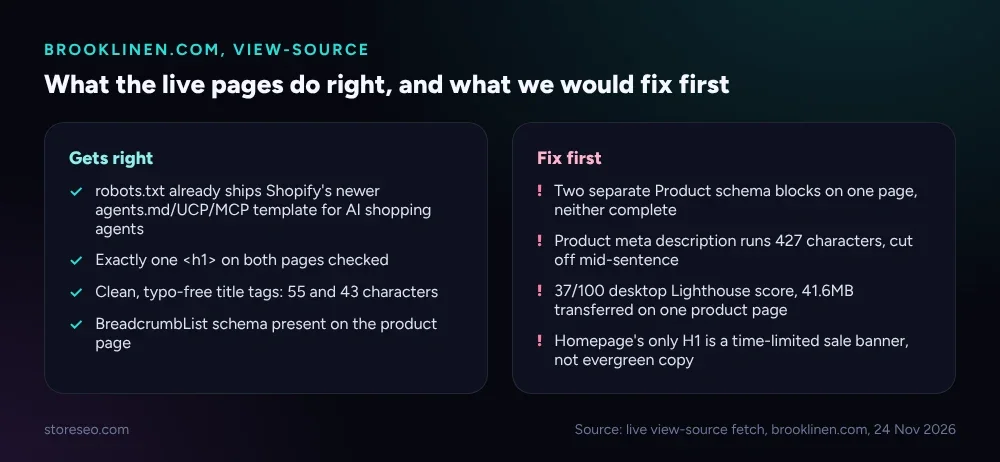
The most notable thing Brooklinen gets right is not on the page at all: its robots.txt. Where our first two teardown subjects shipped a plain, pre-agent robots.txt, Brooklinen’s already names an agents.md file, a UCP discovery endpoint at /.well-known/ucp, and a combined UCP/MCP endpoint, then states in plain language what an AI shopping agent must do before it acts on a buyer’s behalf: identify itself, use the supported interfaces instead of scripted workarounds, and get buyer authorization before completing a purchase.
 Live view-source and robots.txt fetch of brooklinen.com, checked 24 November 2026.
Both pages we checked, the homepage and a product page, render exactly one <h1> each, and title tags are clean on both: the homepage runs 55 characters (“Luxury Bedding, Sheets & Comforters Online | Brooklinen”), the product page a tight 43 (“Classic Percale Bedding Bundle | Brooklinen”). Neither carries a typo. The homepage also writes real Organization, WebSite and ItemList structured data, and the product page carries BreadcrumbList schema, the kind that helps a crawler understand where a product sits inside the catalog.
Which 5 Things Would We Fix First?
Here is where the pages we audited lose ground, ranked by how much each one is likely costing.
1. Product page weight. The page scores 37 out of 100 on a desktop Lighthouse run, with a Largest Contentful Paint of 5.0 seconds against the 2.5 seconds Google’s own Core Web Vitals guidance calls “good”, 1.6 seconds of Total Blocking Time, and 41.6MB transferred on a single product page load. A mobile-specific Lighthouse run timed out twice during this audit, so the desktop figure is reported here rather than an invented mobile number; a page this heavy on desktop is not going to run leaner on a phone.
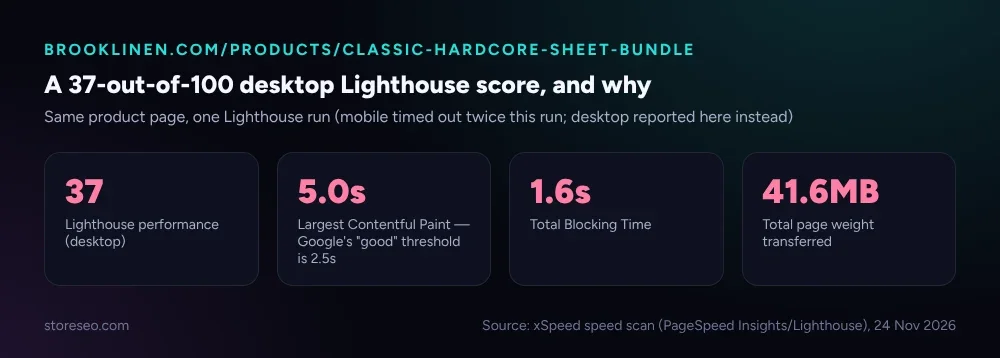 Source: xSpeed speed scan (PageSpeed Insights/Lighthouse), run against brooklinen.com/products/classic-hardcore-sheet-bundle, 24 November 2026.
2. Two separate, incomplete Product schema blocks. The product page’s rendered DOM carries two distinct application/ld+json blocks, each declaring its own Product object. The first carries Offer and Brand data but no rating. The second carries AggregateRating but drops Brand. Neither one is the single, complete Product record a search engine or an AI shopping agent would expect, and neither carries the underlying Review objects at all.
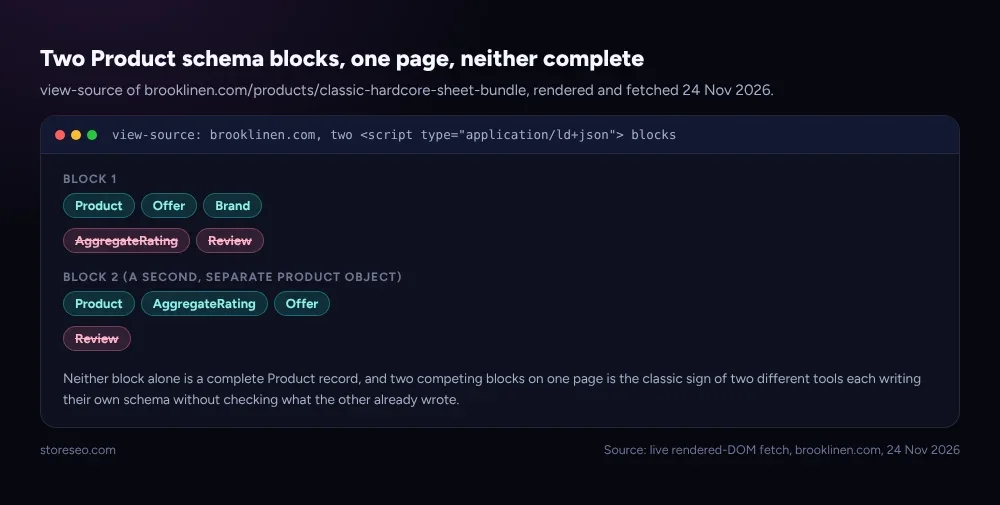 view-source of brooklinen.com/products/classic-hardcore-sheet-bundle, rendered and fetched 24 November 2026.
3. A 427-character product meta description. The homepage’s description runs a clean 156 characters, well inside the roughly 155 to 160 characters Google’s own documentation on title links and snippets says it typically shows. The product template’s description runs 427, nearly three times that, so Google truncates it mid-sentence in the search result rather than showing the full, deliberately written copy.
4. A homepage H1 tied to a single sale. The homepage’s only heading reads “25% Off Sitewide, Black Friday Sale.” That is one correct <h1>, but it is also a topic signal with an expiry date: the day the sale ends, the page’s single clearest heading stops describing what the page is about.
5. BreadcrumbList schema stops at the product page. The product page carries it; the homepage does not. For a catalog this size, writing the same schema sitewide is a small, low-cost signal left half-shipped.
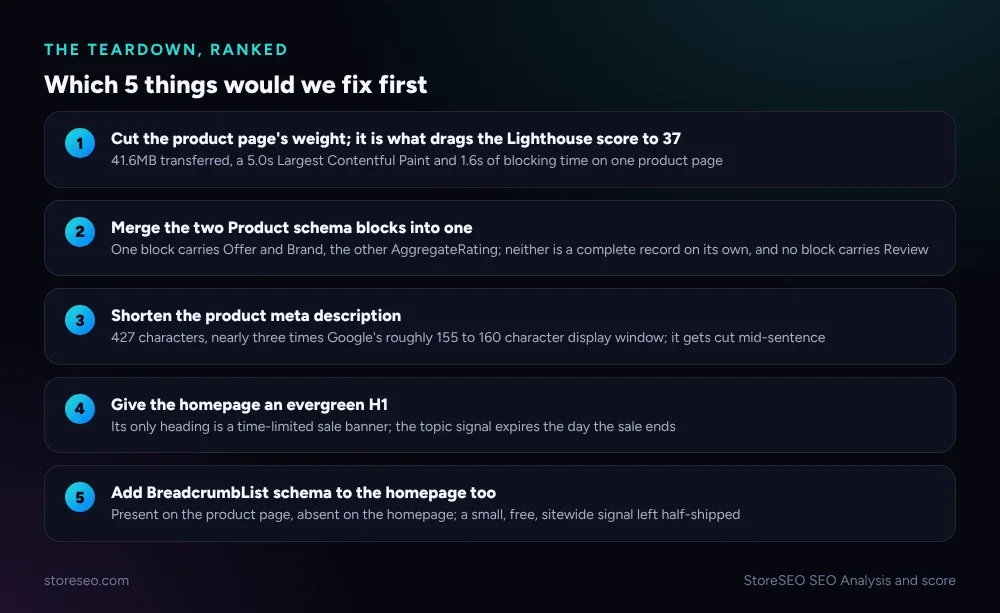 Ranked by estimated impact: the fixes that touch the most traffic, or the easiest wins, come first.
What Can Your Store Copy?
One thing is worth copying outright, and it is the one most stores in this series have not done yet. Brooklinen’s robots.txt already tells AI shopping agents exactly how to behave: identify themselves, use the store’s own UCP and MCP interfaces rather than scripting around the page, and get the buyer’s authorization before any purchase completes. As more shopping starts inside an AI assistant rather than a browser tab, that is a policy worth having in place before an agent needs it, not after.
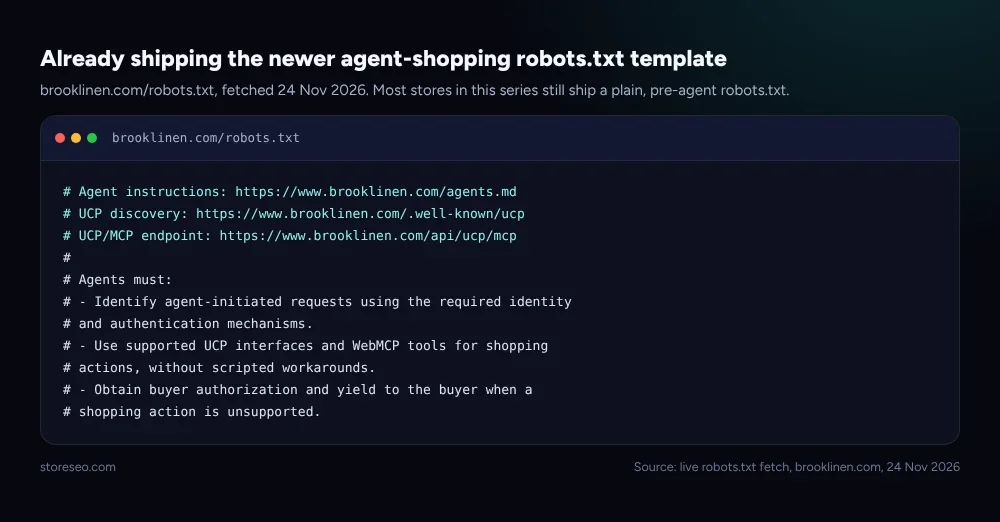 Source: live robots.txt fetch, brooklinen.com, 24 November 2026.
The gaps are just as worth copying as fixes, not as faults to repeat. StoreSEO’s SEO Analysis and score feature, documented at optimize your Shopify product SEO, scores every product and collection page against checks like these ones: schema completeness, title and meta-description length, and heading structure, and flags exactly which ones are missing before a page ships. It would have caught a 427-character meta description sitting nearly three times over its usable length, and it is built to catch a second, competing schema block before it ever reaches a live page.
If product-page detail is more your concern than a single teardown, our Shopify product page SEO guide covers the checklist version of everything audited here, and our Ultimate SEO Checklist is the full reference these teardowns keep pointing back to.
Frequently Asked Questions (FAQs)
1. Does Brooklinen run on Shopify?
Yes, the pages checked for this teardown serve from a standard Shopify storefront, confirmed by the platform’s own crawl-trap blocking pattern and checkout URL structure visible in its robots.txt and markup. Brooklinen’s own robots.txt opens with the comment “Shopify storefront,” naming the platform directly.
2. What does it mean for a robots.txt file to be “agent-ready”?
It means the file does more than tell search crawlers what to index. Brooklinen’s names a separate agents.md policy file and a UCP/MCP endpoint, and states in plain language what an AI shopping agent must do, identify itself, use the store’s supported interfaces, and get buyer authorization, before it is allowed to act on a shopper’s behalf.
3. Why does having two Product schema blocks matter if the data is mostly there?
Because neither block alone is complete, and a search engine or AI crawler reading the page has no guarantee it reads both blocks the same way a developer intends. The practical result found here, an AggregateRating with no underlying Review objects behind it in either block, is the same kind of gap a single clean block would avoid.
4. What’s actually wrong with a 427-character meta description?
Length alone is not against any rule, but display space is fixed: Google typically shows roughly 155 to 160 characters of a description before cutting it off. A 427-character description almost never finishes its own sentence in the result, so a shopper sees a half-thought instead of the summary the store actually wrote.
5. Does a sale-themed H1 actually hurt the homepage’s ranking?
Not on its own, and one correct <h1> is still better than none. The cost is indirect: the heading’s topic signal is tied to a dated promotion rather than to what the store permanently sells, so it stops matching the page’s purpose the moment the sale ends, until someone remembers to change it again.
6. How do I run this same teardown on my own Shopify store?
Check your homepage and a product page for your schema markup, heading count, title length and meta-description length, then read your own robots file for whether it addresses AI agents at all. StoreSEO’s SEO Analysis and score check runs that same read automatically and lists exactly what is present and what is missing.
A store that already ships an agent-ready robots.txt, clean title tags and real homepage schema is ahead of most of the field in this series, and the gaps here, a product page heavy enough to score 37 on Lighthouse, two schema blocks standing in for one, a meta description three times its usable length, a dated sale banner doing a permanent heading’s job, and breadcrumb markup that stops at the product page, are the same handful of fixes that show up store after store, famous brand or not. Run this same check on your own product and home pages before assuming your theme or app stack has already handled it for you, and try StoreSEO on the Shopify App Store
Keep reading
A 6-Week Shopify SEO Calendar for New Stores
A brand-new Shopify store has six weeks of real SEO work before results show: sitemap and titles first, content and images next, reviews and recheck last.
Read article
Shopify SEO for B2B Wholesale Stores
A Shopify B2B store stays indexable when catalogs gate the price, not when a password gates the whole site, and that line decides your SEO outcome.
Read article
Why Is Only Part of Your Shopify Catalog Indexed?
Partial catalog indexing on Shopify almost always traces to one of four causes: new pages, a deliberate block, duplicate URLs, or crawl budget.
Read article