
Shopify SEO Teardown #2: Gymshark
 Written by M Asif Rahman
Gymshark runs a Shopify store with real strengths: Organization and WebSite schema on the homepage, clean single-H1 pages, and tight, typo-free title tags. It also carries a 34-out-of-100 mobile Lighthouse score, a separate canonical URL for every color of the same product, and zero review schema despite a live reviews widget. The single highest-value fix is mobile page weight.
TL;DR: Gymshark.com, scored
| Area | Grade | Evidence, and the fix |
|---|---|---|
| Product schema | B | Product, Offer, Brand and ProductGroup all present; no AggregateRating or Review despite a live reviews widget; fix: wire the existing review data into schema |
| Homepage schema | B+ | Organization and WebSite both present; fix: add BreadcrumbList too |
| Heading structure | A | Exactly one <h1> on both pages checked; no fix needed |
| Title tags | A | Product title 50 characters, clean; homepage title 59 characters; neither carries a typo |
| Meta descriptions | C | Homepage 163 characters, past Google’s typical cutoff; product page only 113, wasting available space; fix: tighten one, lengthen the other |
| Color-variant URLs | D | Each color of the same product ships its own self-canonical URL; fix: consolidate to Shopify’s variant parameter or one canonical |
| Mobile performance | F | 34/100 Lighthouse, 8.0s LCP, 5.9MB transferred; fix: compress and lazy-load product imagery |
| Crawl hygiene | A | robots.txt blocks checkout, cart, account and sort-parameter traps; sitemap declared; no fix needed |
This is the second in our Shopify SEO Teardowns series: one public, real store, audited the same way every time, from view-source, a live mobile Lighthouse run and a schema check, with StoreSEO’s own on-page tools as the lens. Our first teardown audited Allbirds; Gymshark is picked the same way, for scale and name recognition, not because anything here is unusual. This is factual commentary on public pages only; it implies no relationship with, and no endorsement by, Gymshark.
What Does This Store Get Right?
Start with what already works, because a teardown that only lists faults is not useful to copy from.
Gymshark’s homepage carries real Organization and WebSite JSON-LD, which is more than our first teardown subject shipped: Allbirds’ homepage had zero structured data of any kind. Both pages we checked, the homepage and a product page, render exactly one <h1> each, the single clearest topic signal a page can send, and neither heading is buried under a competing section title pretending to be the main one.
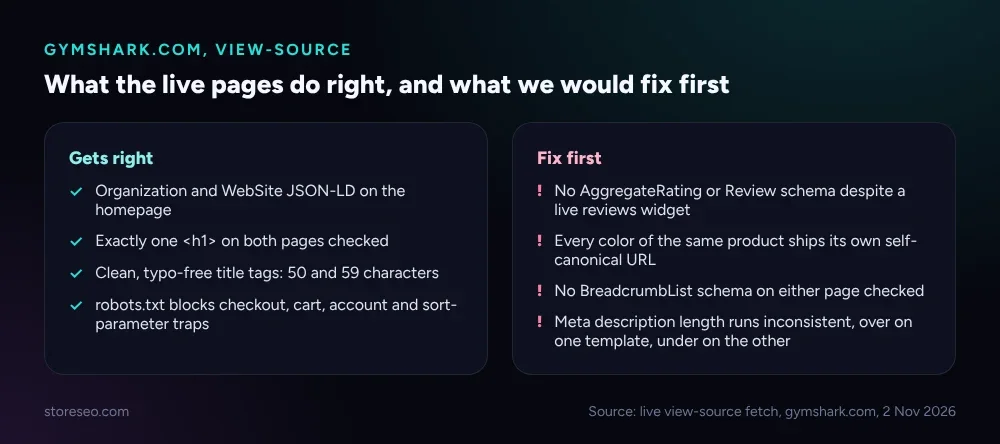 Live view-source fetch of gymshark.com’s homepage and a product page, checked 2 November 2026.
Title tags are clean on both pages: the homepage runs 59 characters (“Gymshark Official Store - Gym Clothes & Workout Clothes”), the product page we audited a tight 50 (“Gymshark Vengeance Track Jacket - Black | Gymshark”). Neither carries a typo, and both fall comfortably inside the roughly 60 characters Google’s results typically show before truncating. robots.txt is clean too: it blocks the usual Shopify crawl traps, checkout, cart, account and sort-parameter query strings, rather than leaving them open for a crawler to burn budget on, and it declares a sitemap.
Which 5 Things Would We Fix First?
Here is where the pages we audited lose ground, ranked by how much each one is likely costing.
1. Mobile page weight. The product page scores 34 out of 100 on a mobile Lighthouse run, with a Largest Contentful Paint of 8.0 seconds against the 2.5 seconds Google’s own Core Web Vitals guidance calls “good”, 3.1 seconds of Total Blocking Time, and 5.9MB transferred on a single product page load. That payload, not the page’s content, is what a mobile visitor is made to download before anything useful paints.
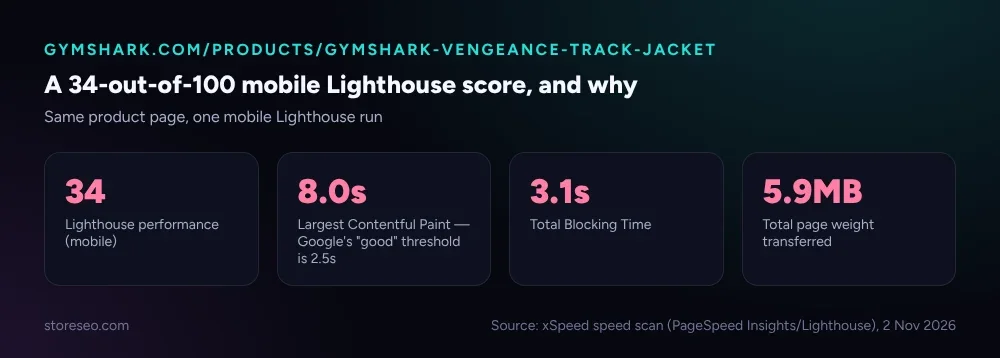 Source: xSpeed speed scan (PageSpeed Insights/Lighthouse), run against gymshark.com/products/gymshark-vengeance-track-jacket, 2 November 2026.
2. Zero review schema, despite a working reviews widget. The product page renders a full on-page reviews section, star ratings, written reviews, a “Reviews Summary” block, but none of that data is written into the page’s Product schema. No AggregateRating, no Review. A search engine or an AI crawler reading the markup alone has no way to know the product has reviews at all.
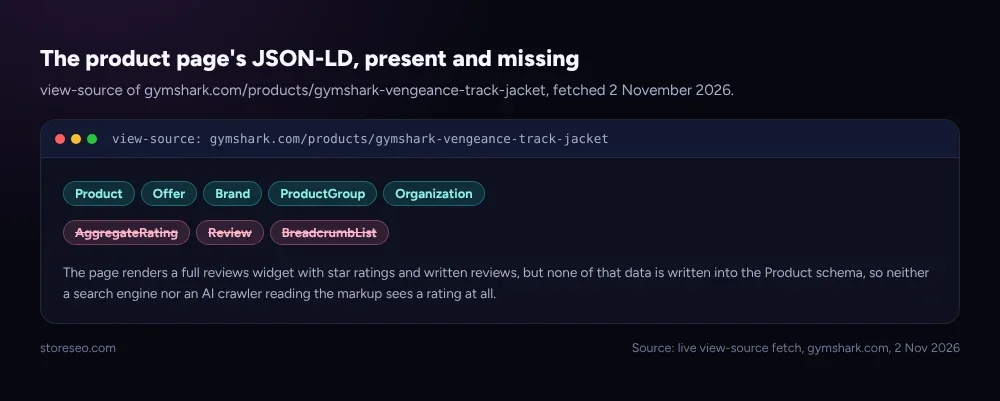 view-source of gymshark.com/products/gymshark-vengeance-track-jacket, fetched 2 November 2026.
3. A separate URL for every color. Checking three colorways of the same graphic t-shirt (black, grey, white) shows each one carries its own self-canonical URL and its own <title>, rather than one product page with a color variant selector. That is three near-identical pages competing for the same query instead of one page concentrating its signal.
4. No BreadcrumbList schema anywhere we checked. Neither the homepage nor the product page writes the schema Google uses to render the path shown under a result, the kind defined in schema.org’s own reference. For a catalog this size, across hundreds of product and collection pages, that is a missed signal for how a crawler groups products under their parent collections.
5. Meta descriptions run inconsistent. The homepage’s description runs 163 characters, past the roughly 160 Google typically shows before cutting it off mid-sentence; the product page’s runs only 113, well under the 150 to 160 character window that actually fills the available snippet space. Neither is broken, but both are leaving space on the table in opposite directions.
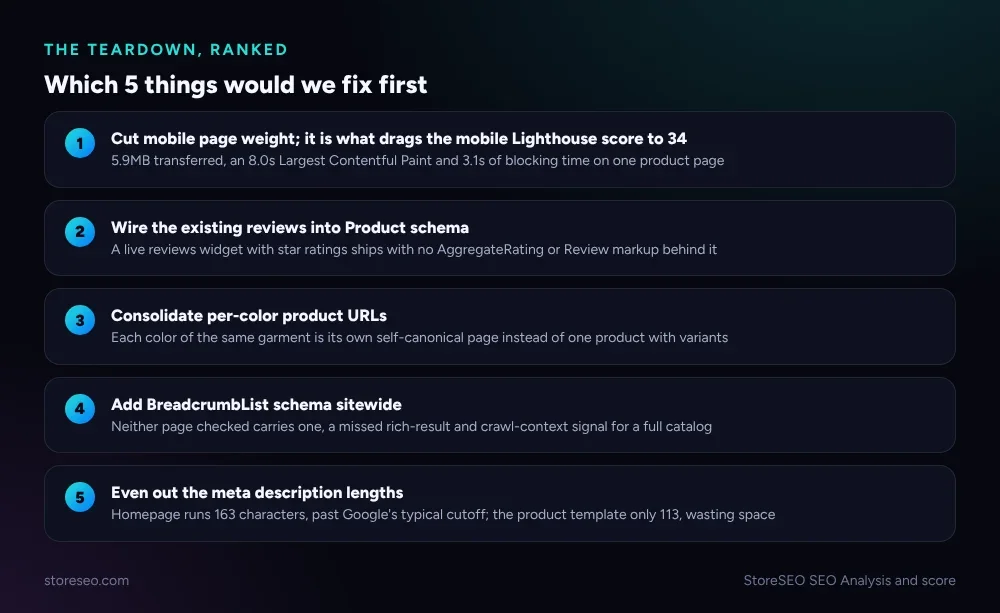 Ranked by estimated impact: the fixes that touch the most traffic, or the easiest wins, come first.
What Can Your Store Copy?
Two things are worth copying outright. First, ship homepage Organization and WebSite schema the way Gymshark does; it is one of the cheaper structured-data wins available and a surprising number of stores, including the first store in this series, skip it entirely. Second, keep title tags short, specific and typo-free the way both pages we checked here do; it costs nothing and it is exactly the kind of detail that is easy to let slip on a catalog this large.
The gaps are just as worth copying as fixes, not as faults to repeat. StoreSEO’s SEO Analysis and score feature, documented at optimize your Shopify product SEO, scores every product and collection page against checks like these ones, schema completeness, title and meta-description length, heading structure, and flags exactly which ones are missing before a page ships. It would have caught a 113-character product meta description sitting well under its usable length, and it is built to catch review schema that never made it from a theme’s reviews widget into the page’s own JSON-LD. StoreSEO is our product, and we built the SEO Analysis feature to close precisely the gaps a teardown like this one keeps finding.
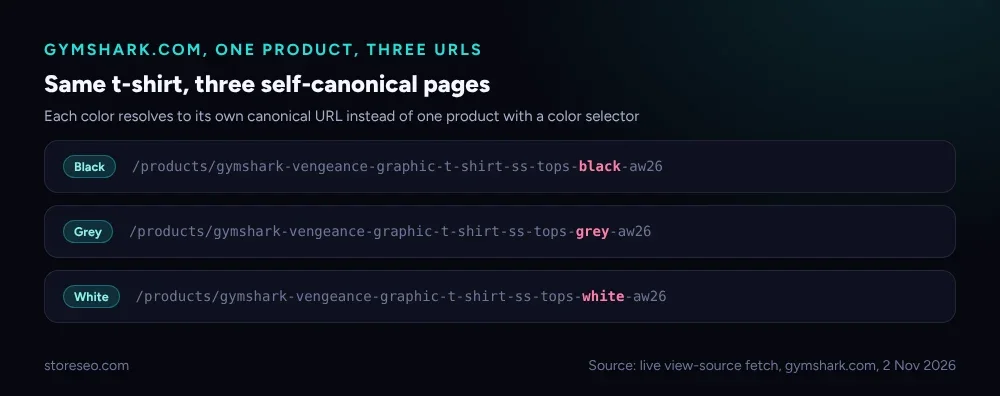 Live view-source fetch of three color variants of the same graphic t-shirt, gymshark.com, checked 2 November 2026.
If product-page detail is more your concern than a single teardown, our Shopify product page SEO guide covers the checklist version of everything audited here, and our own 345-post blog audit runs this same kind of self-scrutiny against our own content rather than a merchant’s storefront, if you want to see the method applied to a publisher instead of a store. Our Ultimate SEO Checklist is the full reference these teardowns keep pointing back to.
Frequently Asked Questions (FAQs)
1. Does Gymshark run on Shopify?
Yes, the pages checked for this teardown serve from a standard Shopify storefront, confirmed by the platform’s own cart, checkout and CDN URL patterns visible in the markup. The homepage’s own robots.txt even opens with the comment “we use Shopify as our ecommerce platform,” and both pages we checked carry Shopify’s typical crawl-trap blocking underneath the custom theme.
2. Why does mobile performance matter more than a single Lighthouse number suggests?
Most Shopify storefront traffic arrives on a phone, so a 34-out-of-100 mobile score is the experience most visitors actually get, not a worst-case outlier. An 8-second Largest Contentful Paint sits well outside the threshold Google’s own Core Web Vitals guidance calls “good,” and that gap tends to cost conversions before it costs rankings.
3. What’s the actual problem with giving every color its own URL?
It splits one product’s ranking signal, backlinks, reviews, time on page, across several near-identical pages instead of concentrating it on one. Shopify supports a single canonical product URL with a color or size selector built in; routing each color to its own self-canonical page works against that by design.
4. Does missing review schema mean the reviews themselves are fake or hidden?
No, the reviews widget on the page is real and fully functional for a shopper reading the page directly. What is missing is the machine-readable version of that same data: the page’s Product schema carries no AggregateRating or Review object behind it. Adding that schema is a separate, additional step, not a replacement for the visible widget.
5. Why does it matter that a page has no BreadcrumbList schema?
Breadcrumb schema helps a crawler, human or AI, understand where a page sits inside a site’s structure: which collection a product belongs to, and what sits above it. Its absence does not break a page, but on a catalog with hundreds of products it is a structural signal left unclaimed across the board rather than on one page.
6. How do I run this same teardown on my own Shopify store?
View-source on your homepage and a product page, search for application/ld+json to see what schema is present, count your <h1> tags, and check your title and meta-description character counts. StoreSEO’s SEO Analysis and score check runs the same read automatically and lists exactly what is present and what is missing, no view-source required.
A store with real homepage schema, clean single-H1 pages and typo-free titles is already doing more right than our first teardown subject, and the gaps here, an uncompressed mobile experience, review data that never reached the schema, one URL per color instead of one URL per product, no breadcrumb markup, and meta descriptions pulling in opposite directions, are the same handful of fixes that show up store after store, famous brand or not. Run this same check on your own product and home pages before assuming your theme or catalog setup has already handled it for you, and try StoreSEO on the Shopify App Store
Keep reading
Switch From TinySEO to StoreSEO Without Losing Data
Switching from TinySEO to StoreSEO takes about ten minutes with the built-in wizard, and your schema and image alt text carry over automatically.
Read article
Does a Sitemap Actually Speed Up Shopify Indexing?
A sitemap helps Google and Bing discover new Shopify pages faster, but IndexNow, StoreSEO's instant-indexing feature, never reaches Google at all.
Read article
Black Friday SEO Brief for Your Shopify Developer
A one-page brief hands your theme developer the freeze window dates, the SEO fields to protect, and the checks that sign off before Black Friday.
Read article