
We Checked 148 Shopify Stores for AI Crawler Blocks
 Written by M Asif Rahman
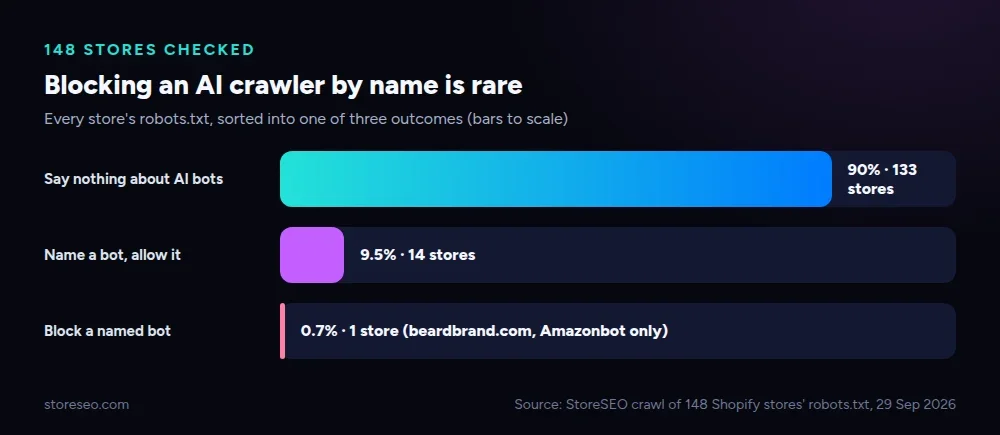
Almost no Shopify store blocks AI crawlers. We fetched robots.txt from 148 live stores confirmed to be running Shopify and found exactly one explicit block, aimed at Amazonbot, not GPTBot, ClaudeBot or PerplexityBot. Ninety percent of the stores checked never mention an AI bot at all, which by default leaves every product and blog page open to them.
TL;DR: what 148 live Shopify stores’ robots.txt files actually say about AI crawlers.
| Metric | Result |
|---|---|
| Shopify stores with a working robots.txt checked | 148 |
| Stores blocking any AI crawler by name | 1 (0.7%), beardbrand.com, Amazonbot only |
| Stores blocking GPTBot, ClaudeBot or PerplexityBot | 0 (0%) |
| Stores naming any AI bot at all, allow or block | 15 (10%) |
| Most-named AI bot | OAI-SearchBot, 11 stores (7.4%) |
The worry that merchants are quietly locking ChatGPT and Perplexity out of their stores does not match what their own robots.txt files say. Almost nobody has touched the file at all.
What Did We Check, and How?
We built a candidate list of well-known Shopify-brand domains from public “best Shopify stores” roundups, the kind of listicle every SEO blog publishes each year, rather than guessing at random domains, the same starting point StoreSEO’s schema audit of 300+ product pages used for its sample. That produced 312 candidate names. Each one was fetched over HTTPS and confirmed as an active Shopify storefront by checking the response for cdn.shopify.com, myshopify.com or other storefront signatures; 183 confirmed as Shopify. From that set, 148 served a robots.txt that answered HTTP 200 and could be parsed; the rest either 404’d, sat behind a bot challenge, or returned a non-200 status, and were excluded rather than guessed at. Shopify’s own troubleshooting guide on getting a store to appear in Google search results covers what belongs in this same file beyond AI bots.
For every store with a readable file, we parsed each User-agent group and checked it against 16 crawlers: the AI-answer and AI-training bots (GPTBot, ChatGPT-User, OAI-SearchBot, ClaudeBot, Claude-Web, anthropic-ai, PerplexityBot, Perplexity-User, Google-Extended, Applebot-Extended, Meta-ExternalAgent, cohere-ai), the older web-scale crawlers (CCBot, Bytespider, Diffbot), and Amazonbot for comparison. A bot counted as blocked only when its own named group carried Disallow: / with no matching Allow: /; a bot named only to be allowed counted as named, allowed; a bot never mentioned counted as absent, meaning it falls back to whatever the store’s User-agent: * group says. We also checked every file’s * group directly for a blanket Disallow: /, which would block every bot without naming any of them. The crawl ran 29 September 2026 UTC.
 Source: StoreSEO crawl of 148 Shopify stores’ robots.txt, 29 September 2026.
Do Shopify Stores Block GPTBot, ClaudeBot or PerplexityBot?
No. Not one of the 148 stores we checked has a Disallow: / group for GPTBot, ClaudeBot, PerplexityBot, OAI-SearchBot or Google-Extended, the crawlers that power ChatGPT, Claude, Perplexity and Gemini’s ability to read and cite a page. None of the 148 has a blanket User-agent: * / Disallow: / either, the one rule that would block every bot without naming any of them. If a merchant is worried their store is invisible to AI answer engines because of a robots.txt block, that is very rarely the actual cause: the default posture on Shopify is wide open.
 Source: StoreSEO crawl of 148 Shopify stores’ robots.txt, 29 September 2026.
Which AI Bots Do Merchants Name at All?
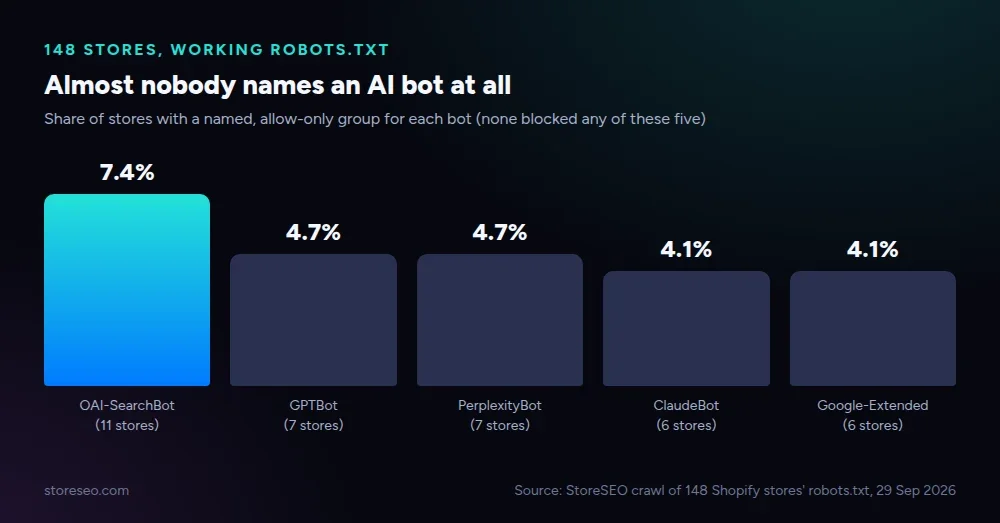
Ten percent, 15 of 148. When a store does bother to add a named group, OAI-SearchBot is the one most likely to appear (11 stores, 7.4%), just ahead of GPTBot and PerplexityBot (7 stores each, 4.7%). Every one of those named groups says Allow: /; they are merchants being explicit about a default that already applied, not merchants opting in to something new.
| AI bot | Named at all | Blocked |
|---|---|---|
| OAI-SearchBot | 11 (7.4%) | 0 |
| GPTBot | 7 (4.7%) | 0 |
| PerplexityBot | 7 (4.7%) | 0 |
| ClaudeBot | 6 (4.1%) | 0 |
| Google-Extended | 6 (4.1%) | 0 |
| ChatGPT-User | 5 (3.4%) | 0 |
| Meta-ExternalAgent | 3 (2.0%) | 0 |
| Applebot-Extended | 3 (2.0%) | 0 |
| Amazonbot | 2 (1.4%) | 1 |
| anthropic-ai | 2 (1.4%) | 0 |
| Perplexity-User | 2 (1.4%) | 0 |
| Claude-Web | 1 (0.7%) | 0 |
| CCBot | 1 (0.7%) | 0 |
| Bytespider | 1 (0.7%) | 0 |
Two more crawlers were checked in every file and named nowhere: Diffbot and cohere-ai. The keyword volume tells the same story from the other side: “gptbot” gets searched 260 times a month and “ai crawlers” 390, real merchant curiosity that, on this evidence, rarely turns into an actual robots.txt edit. It echoes what StoreSEO’s correlation study of 50 on-page ranking factors found about Shopify SEO generally: the settings merchants worry about most are rarely the ones they actually change.
What Does the One Blocking Store Get Right?
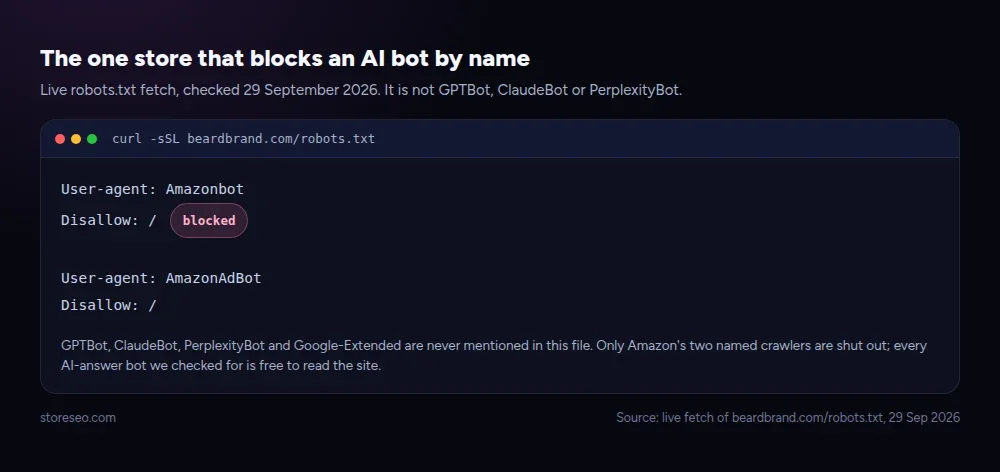
Beardbrand, a Shopify beard-care brand, is the only store in the sample with a named Disallow: / group, and it is not aimed at an AI-answer bot. It blocks Amazonbot and AmazonAdBot, Amazon’s own retail crawlers, most plausibly to keep a competing marketplace’s bot off the catalog rather than to opt out of AI training or AI search. GPTBot, ClaudeBot, PerplexityBot and Google-Extended are never mentioned in the same file, so every AI-answer crawler we checked for is still free to read the site.
 Source: live fetch of beardbrand.com/robots.txt, 29 September 2026.
That makes it a deliberate, narrow edit rather than a general AI-crawler policy, and it is the only example of one in the whole sample. Nobody we checked has written the kind of blanket “no AI bots” rule that shows up in forum threads about AI training and content licensing.
What Should Your Store Do About This?
Silence is not neutral. A store that never edits its robots.txt is not “undecided” about AI crawlers, it is allowing all of them by default, because Shopify’s own robots.txt.liquid only disallows admin, cart, checkout and a handful of crawl-trap paths for everyone, named bot or not. Deciding whether that is the right posture, rather than inheriting it by accident, is the actual task.
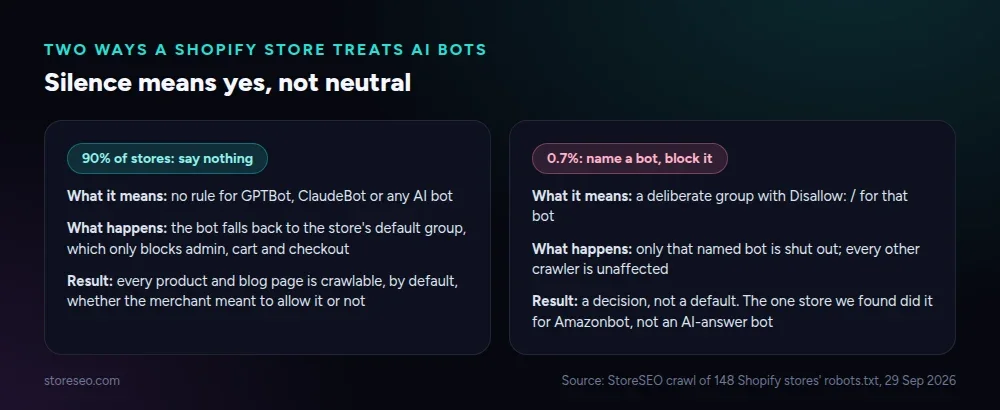 Source: StoreSEO crawl of 148 Shopify stores’ robots.txt, 29 September 2026.
| Your situation | What to do |
|---|---|
| Want product pages cited in ChatGPT, Perplexity or Gemini answers | Do nothing. All five AI-answer bots we checked are already allowed by default on every store in this sample |
| Want to opt out of AI training specifically, but keep AI search visibility | Add a named group for GPTBot and Google-Extended with Disallow: /, and leave OAI-SearchBot and PerplexityBot on Allow: /, since training and answer-citing are separate bots |
| Want AI assistants and agents to read your product data cleanly | Publish an llms.txt file with StoreSEO’s LLMs.txt Generator rather than relying on robots.txt alone, since robots.txt only says who may crawl, not how to read what they find, a distinction why LLMs.txt matters for ecommerce and Shopify stores covers in full |
| Not sure what your store’s file currently allows | Open yourstore.com/robots.txt in a browser today. If an AI bot is not named, it is allowed |
For the rest of the technical baseline around this file, StoreSEO’s robots.txt guide covers what Shopify blocks by default and the exact lines to add for each crawler, and it sits alongside the broader work of getting a Shopify store indexed in the first place.
Raw Data, Sample and Limits
The 312 candidate domains came from public “best Shopify stores” roundups rather than a random sample of the platform’s full merchant base, so the 148 we could analyze skew toward larger, more established direct-to-consumer brands with the resources to maintain a custom robots.txt.liquid. A random sample of small, single-product stores using Shopify’s untouched default file would likely show an even higher “says nothing” share, since editing the file at all requires deliberately adding theme code Shopify itself calls an unsupported customization.
164 of the 312 candidates were excluded before the AI-bot count: 129 did not confirm as active Shopify storefronts (some were large retailers on other platforms swept up by the source articles, some were tooling or media domains mixed into the same pages), and 35 confirmed-Shopify stores had a robots.txt that did not answer 200 at fetch time. Every percentage above is out of the 148 that did.
Frequently Asked Questions (FAQs)
1. Do Shopify stores block ChatGPT or Perplexity by default?
No. Shopify’s own default robots.txt, generated for every store, only disallows admin, cart, checkout and account paths, plus filter and sort crawl-trap patterns. It does not name GPTBot, OAI-SearchBot, ClaudeBot or PerplexityBot at all, so none of them are blocked unless a merchant deliberately adds that rule.
2. Why did almost none of the 148 stores name an AI bot?
Editing robots.txt on Shopify means adding a robots.txt.liquid template in the theme code editor, a change Shopify documents as an unsupported customization with no official rollback path if it breaks. Most merchants never touch theme code for something this technical, so the file stays on Shopify’s untouched default, which says nothing about AI bots either way.
3. Is blocking GPTBot the same as blocking ChatGPT search results?
No, and this is the mistake most likely to cost a store visibility. GPTBot governs whether OpenAI can use a page to train models; OAI-SearchBot governs whether ChatGPT can cite that page in a live search answer. They are separate named groups, so a store can block one while leaving the other allowed.
4. What is Amazonbot, and why would a store block it?
Amazonbot is Amazon’s own retail-focused web crawler, used to gather product and pricing data. A Shopify brand selling direct to consumers has a plausible commercial reason to keep a rival marketplace’s crawler off its catalog, separate from any AI-search or AI-training decision.
5. Does having no robots.txt rule for AI bots hurt my Shopify SEO?
Not on its own. Search engines and most AI-answer bots read a missing rule as permission, so a store with no named AI-bot group is simply crawlable by default, the same posture as 90% of the stores in this study. It becomes a problem only if a merchant assumed the opposite and is now surprised their content is being read.
6. How do I check what my own store’s robots.txt currently allows?
Open yourstore.com/robots.txt in a browser. Read down each User-agent block for the bot names above; if a bot is not listed by name, it falls under the general User-agent: * group, which on an unedited Shopify store blocks only admin, cart and checkout paths.
The Real Story Is Silence, Not Blocking
The data does not support the idea that Shopify merchants are locking AI crawlers out. It supports the opposite: almost every store’s robots.txt is silent on the question, which means every AI-answer bot we checked is free to read it by default, whether the merchant meant to allow that or not. try StoreSEO on the Shopify App Store
Keep reading
40 ChatGPT Prompts for Shopify SEO, Tested
These 40 ChatGPT prompts draft Shopify meta descriptions, alt text, FAQs and schema, each with the one thing you must verify before publishing it.
Read article
Track ChatGPT & Perplexity Traffic in GA4 (Shopify)
GA4 already tags some ChatGPT and Gemini visits as AI Assistant traffic, and one custom channel group adds Perplexity and Claude to the same report.
Read article
AI Search Intent: How to Map Shopify Content to ChatGPT & Gemini Query Patterns
Shoppers are skipping Google and asking ChatGPT or Gemini to recommend products instead. If your Shopify store content is not structured for AI search intent, your products will not appear in those answers. This guide breaks down how ChatGPT and Gemini interpret shopping queries differently, what content each platform favors, and how to map your product pages, collections, and blog posts to the new AI query patterns that decide what gets recommended.
Read article