10+ Best Shopify SEO Apps for AI Search Visibility in 2026

Updated November 22, 2026: our guides to LLMs.txt and schema apps and to AI search optimization apps now live on this page. It gained a section on schema and LLMs.txt apps, an AI-readiness checklist, a setup walkthrough and extra FAQs. The 11-app benchmark below dates from April and May 2026.
AI search visibility is the new front line of Shopify SEO in 2026, and the question is no longer “Do I need it?” but “Which app actually delivers it?”
We benchmarked 11 Shopify SEO apps against six criteria: schema depth, LLMs.txt automation, AEO/GEO output, AI citation tracking, on-page automation, and price-to-value.
StoreSEO takes #1 (rated 5.0 on the Shopify App Store) as the only purpose-built Shopify app that bundles full JSON-LD schema, one-click LLMs.txt, AEO/GEO content tools, AI citation readiness, and the Shopify AI Readiness Score (SAIRS) under one dashboard.
SearchPie lands at #2 for high-volume stores that want speed + SEO + schema in one place.
Quick Verdict: The Best Shopify SEO Apps for AI Search
- StoreSEO: best overall for stores that want schema, LLMs.txt, AEO and GEO tools and on-page SEO in one app.
- SearchPie: best all-in-one for high-volume stores that want speed, SEO and schema in one place.
- Webrex AI SEO Optimizer: best for technical SEO depth, with 50+ audit checks and 5-level breadcrumbs for complex catalogs.
- Schema Plus: best for schema-first merchants who already have content tools and want deep JSON-LD.
- TinySEO: best for image-heavy stores that want fast images and an auto-generated LLMs.txt.
- FSEO: best as an AI citation tracker layered on top of an all-in-one app.
- Smart SEO by Sherpas: best for AI-written meta descriptions and alt text at scale.
- AVADA SEO Suite: best free-tier starter for beginners and stores on a tight budget.
- Booster SEO: best hands-off option for small stores that want image and alt text automation.
- SEOWILL: best if you want AI blog content bundled with technical SEO basics.
- Tapita AI SEO: best freemium pick for multi-language stores.
Here are the headline numbers for the same 11 apps, so you can make the call without reading every review.
| App | Rating | Schema | LLMs.txt | AEO / GEO | Pricing |
|---|---|---|---|---|---|
| StoreSEO (Winner) | 5.0 ★ | Full (6 types) | Yes (1-click) | Native | Free / from $14.99/mo |
| SearchPie | 4.9 ★ | Partial | Yes | Partial | Free / Paid |
| Webrex AI SEO | 4.9 ★ | Wide (5 types) | Partial | Partial | Free / Paid |
| Schema Plus | 5.0 ★ | Deepest | Partial | Indirect | From $10.99/mo |
| TinySEO | 5.0 ★ | Basic | Yes (auto) | Partial | From $14/mo |
| FSEO | 4.1 ★ | Partial | Yes (auto) | Native (tracker) | Free / Paid |
| Smart SEO (Sherpas) | 5.0 ★ | Yes | No | Partial | From $14.99/mo |
| AVADA SEO Suite | 4.9 ★ | Basic | Partial | Partial | Free / Paid |
| Booster SEO | 4.8 ★ | Basic | No | Limited | Free / Paid |
| SEOWILL | 4.8 ★ | Yes | Partial | Partial | Free / Paid |
| Tapita AI SEO | 5.0 ★ | Yes (no-code) | Partial | Limited | Free / Paid |
Ratings are Shopify App Store ratings: FSEO and Webrex were checked on November 22, 2026, and the other nine on October 10, 2026. The feature columns reflect our April and May 2026 benchmark, and listings change often. For a plan-by-plan check of LLMs.txt and FAQ schema, see the AI search features table in our best Shopify SEO apps comparison.
Insider note: StoreSEO is the only app in the table that bundles schema markup, LLMs.txt automation, AEO and GEO optimization, AI description and snippets generation, on-page SEO scoring, keyword clustering, and rank tracking under a single Shopify-native dashboard. For 2026, that combination is what most Shopify merchants actually need to compete in AI search.
What Is The Best Shopify SEO App for AI Search Visibility in 2026?
The “Shopify SEO app for AI search” category is brand-new; it sits between traditional Shopify SEO plugins (built for the Google-only era) and standalone LLM tools like ChatGPT or Claude (powerful, but not Shopify-native). The right app reads your live Shopify catalog, generates clean JSON-LD across the schema types AI engines actually parse, publishes a properly maintained LLMs.txt, and produces citation-ready answers that ChatGPT, Perplexity, Gemini, Claude, and Google AI Overviews can quote verbatim.
Most merchants pick the wrong app. They install a “speed + image” SEO plugin and expect ChatGPT citations; that is not how this works. Or they install a content-generation tool that writes meta tags with ChatGPT but ignores schema, ignores LLMs.txt, and ignores GEO entirely. The 11 apps below are sorted by how completely they cover the actual AI-search stack on Shopify, not by Shopify App Store review count.
This roundup ranks the 11 best apps we benchmarked in April and May 2026 against real Shopify stores. Each was scored on schema coverage, LLMs.txt automation, AEO/GEO output, AI citation tracking, on-page automation depth, and total cost. For the strategic playbook behind these criteria, see our Shopify SEO guide and our breakdown of GEO vs AEO vs traditional SEO for Shopify stores.
How We Ranked The Shopify SEO Apps for AI Search:
Six criteria that separate Shopify SEO apps that actually win AI citations from apps that just slap “AI” on a meta-tag generator. A clean editor scores less than an app that ships schema, LLMs.txt, and AEO content end-to-end.
- AI search coverage (25%), schema markup depth, LLMs.txt support, and AEO/GEO content generation. The three-layer AI engines actually weigh. Apps missing any one of these cannot move the AI-citation needle.
- Shopify-native depth (20%) products, collections, blog posts, page metadata, breadcrumbs, schema, theme integration, and sitemap. Apps not built specifically for Shopify hit ceilings fast.
- AI citation tracking & measurement (15%): Does the app actually show you whether ChatGPT, Perplexity, Gemini, or Claude mentions your store? Or does it ship “AI features” with no measurement?
- Content & on-page automation (15%), AI description generation, bulk alt text, FAQ scaffolding, snippet generation, and on-page SEO scoring. The work that takes 40+ hours/month to do by hand.
- Speed & Core Web Vitals (10%) AI crawlers skip slow pages. Image compression, lazy loading, and Core Web Vitals round out the foundation.
- Pricing & value (15%) 12-month total cost of ownership against the work the app actually does. We weigh against agency retainers and against stacking 3 to 4 single-purpose apps.
Apps like StoreSEO are Shopify-native end-to-end, with our proprietary Shopify AI Readiness Score (SAIRS) measuring exactly how prepared your store is for AI discoverability and our Agentic Discovery Score measuring how findable you are by the AI shopping agents that will dominate by 2027.
The 11 best Shopify SEO apps for AI search visibility in 2026, ranked
Each entry includes a star rating, an honest review, pros and cons, and the headline facts: schema coverage, LLMs.txt support, AEO/GEO output, and pricing.
1. StoreSEO: Best Overall
★★★★★ 5.0 / 5 · Winner: best for Shopify stores serious about AI search
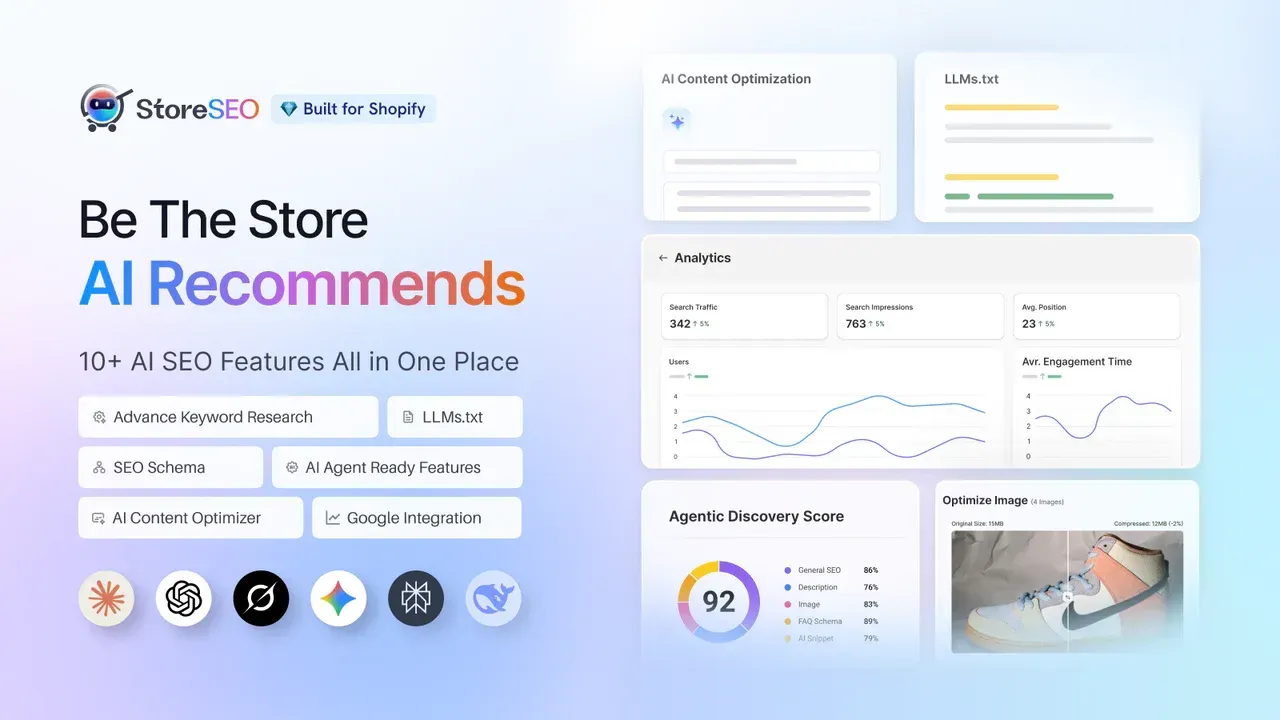
StoreSEO is the only Shopify SEO app on this list, purpose-built from the ground up for the AI search era. We are upfront that we own it. But after benchmarking every meaningful app in this category against the same six criteria, we genuinely believe it covers the most ground for the price. Full JSON-LD automation across Product, Review, FAQ, Breadcrumb, Organization, and Article schema; one-click LLMs.txt generation and maintenance; AI description and snippet generators trained on eCommerce intent; on-page SEO scoring with prescriptive fixes; keyword cluster generation; rank tracking; and bulk alt-text optimization. All in one dashboard, all built specifically for Shopify.
Beyond the standard AI-SEO stack, StoreSEO ships two things no other app on this list does: the Shopify AI Readiness Score (SAIRS) (a proprietary framework that tells you exactly how AI-discoverable your store is, with a clear remediation path) and the Agentic Discovery Score, which measures how findable you are by AI shopping agents. Our research base also goes deeper than feature parity: we analyzed 300 Shopify product pages to identify schema patterns of top performers and correlated 50 on-page SEO factors against Shopify rankings, then engineered the app around what actually moves the needle.
Pros
- Full JSON-LD schema across Product, Review, FAQ, Breadcrumb, Organization, Article
- One-click LLMs.txt generation with auto-maintenance as your catalog changes
- AI Description Generator and AI Snippets Generator trained on eCommerce buying intent
- SAIRS + Agentic Discovery Score (proprietary measurement frameworks)
- Keyword Cluster Generator + Keyword Rank Tracker bundled in
- Native Shopify integration: no theme edits, no developer required
Cons
- Plans are capped by product count (the free plan covers 25 products; paid plans start at $14.99/mo)
Quick stats
Schema: Full (6 types)
LLMs.txt: Yes (one-click + auto-maintenance)
AEO / GEO: Native
Shopify-native: Yes (purpose-built)
Pricing: Free plan (25 products); paid plans from $14.99/mo
2. SearchPie: Best All-in-One for High-Volume Stores
★★★★ 4.9 / 5
SearchPie has built one of the largest user bases in the Shopify SEO category: thousands of reviews, mature infrastructure, and a feature set that bundles JSON-LD schema (Product, FAQ), LLMs.txt support, AI sitemap generation, image compression, and bulk AI-generated meta tags into a single platform. For high-volume stores that want one dashboard to handle the bulk of technical SEO without juggling apps, it is a solid pick.
Where SearchPie loses ground vs. StoreSEO is depth on the AI side: the schema library is narrower (no Organization or Article schema out of the box), AEO content tooling is thinner, and there is no native AI-readiness measurement equivalent to SAIRS. But for stores prioritizing speed plus the SEO basics in one app, it is defensible.
Pros
- Mature platform with thousands of reviews
- Speed SEO plugin with image compression and lazy loading
- AI sitemap and bulk meta tag generation
- Auto 404 fixes, indexing checks, and Google Search Console integration
Cons
- Narrower schema coverage (Product + FAQ only)
- No native AI citation tracking
- AEO output is thinner than dedicated AI-search tools
Quick stats
Schema: Partial (Product, FAQ)
LLMs.txt: Yes
AEO / GEO: Partial
Shopify-native: Yes
Pricing: Free / Paid tiers
3. Webrex AI SEO Optimizer: Best Technical SEO Depth
★★★★ 4.9 / 5
Webrex is the deepest technical SEO suite in this roundup. JSON-LD schema engine covering Product, FAQ, Video, Review, and Recipe; 50+ technical SEO audit checks (meta, schema, sitemap, 404s, redirects); bulk AI-generated meta/descriptions/alt text; and a 5-level breadcrumb architecture that is particularly useful for multi-category catalogs with subcollections. If your site architecture is complex, Webrex’s crawl-friendliness is a real edge.
The gap vs. StoreSEO is twofold: LLMs.txt support is partial (no auto-regeneration as the catalog changes), and AI citation tracking is absent. Webrex is the best pick if your weakness is technical audits and architecture; pair it with a dedicated AEO tool if AI visibility is the priority. For merchants weighing whether to prioritize product pages or collections, see our breakdown of product page SEO vs collection page SEO.
Pros
- 50+ technical audit checks
- 5-level breadcrumb architecture for deep catalogs
- Wide schema library (Product, FAQ, Video, Review, Recipe)
- Integrates with GSC, Core Web Vitals, and 30+ review apps
Cons
- LLMs.txt support is partial
- No AI citation tracking
- AEO content generation is thin
Quick stats
Schema: Wide (5 types)
LLMs.txt: Partial
AEO / GEO: Partial
Shopify-native: Yes
Pricing: Free / Paid tiers
4. Schema Plus: Best for Schema-First Merchants
★★★★★ 5.0 / 5
Schema Plus is a dedicated structured-data app reportedly built by former Google engineers. It is laser-focused on accurate, comprehensive JSON-LD across Product, Review, Merchant Listings, Video, FAQ, Recipe, Organization, Collections, Pages, and Website schemas. If you have ever stared at the Google Search Console “Rich Results” report, wishing every warning would disappear, this app is built for that pain.
It is not an all-in-one SEO tool. It does schema, and it does it exceptionally well. Pair it with another app if you also need content tools, audits, or LLMs.txt automation. For Shopify stores that already have content tools in place and just need rich-result depth, Schema Plus is the cleanest pick.
Pros
- Deep JSON-LD coverage across a wide schema library
- Designed to help LLMs like ChatGPT understand your store
- GSC performance reporting is built in
- Live expert support via Zoom, chat, and email
Cons
- Schema only: no content tools or audits
- LLMs.txt support is partial
- No free tier
Quick stats
Schema: Deepest in roundup
LLMs.txt: Partial
AEO / GEO: Indirect (via schema)
Shopify-native: Yes
Pricing: From $10.99/mo
5. TinySEO: Best Image SEO + LLMs.txt Combo
★★★★★ 5.0 / 5
TinySEO (formerly TinyIMG) started as an image compression tool, but in 2026, it has matured into a credible SEO app that also auto-generates LLMs.txt files. That combo (fast images plus AI-readability signals) is genuinely useful for stores with thousands of SKUs and large product galleries. Aggressive lossless compression for PNG and JPG, one-click lazy loading, asset preloading, and coding-free JSON-LD setup.
For image-heavy verticals (fashion, jewelry, home decor, print-on-demand), TinySEO is the speed-plus-AEO pick. It does not do content, does not do keyword work, and does not track AI citations. Pair it with StoreSEO if you need both layers.
Pros
- Automatic LLMs.txt file generation
- Aggressive lossless image compression
- One-click lazy loading and asset preloading
- Bulk metadata editing
Cons
- No content generation tools
- No AI citation tracking
- Narrow schema scope
Quick stats
Schema: Basic JSON-LD
LLMs.txt: Yes (auto)
AEO / GEO: Partial
Shopify-native: Yes
Pricing: From $14/mo
6. FSEO (ChatGPT SEO + LLMs.txt Generator): Best AI Citation Tracker
★★★★ 4.1 / 5
FSEO is newer to the Shopify scene but has carved a clear niche. While most apps treat AI search as a feature, FSEO treats it as the whole product. Its AI Prompt Tracker actually tracks how often your store is cited by ChatGPT, Gemini, Perplexity, Claude, and Grok, which is unusual and useful data to have.
The trade-off is breadth: FSEO is thin on traditional Shopify SEO (no deep schema library, no keyword clustering, no on-page scoring). Best layered on top of an all-in-one app like StoreSEO for the citation-measurement edge.
Pros
- Native AI citation tracking across ChatGPT, Gemini, Perplexity, Claude, Grok
- Automatic LLMs.txt generation and maintenance
- AEO Optimizer with zero-code automation
- AI sitemap generation for agentic storefronts
Cons
- Thin on traditional schema depth
- No keyword clustering or rank tracking
- Best as a layer, not a primary app
Quick stats
Schema: Partial
LLMs.txt: Yes (auto)
AEO / GEO: Native (citation tracking)
Shopify-native: Yes
Pricing: Free / Paid tiers
7. Smart SEO by Sherpas: Best AI-Written Meta at Scale
★★★★★ 5.0 / 5
Smart SEO has built a clean reputation for one thing: AI-generated meta descriptions and alt text powered by GPT-4. The output reads naturally, sounds contextually relevant, and saves hours of manual work for stores with large catalogs. It also handles broken links, structured data, and multi-language SEO.
Good pick if you specifically want AI to write your SEO copy at scale, but you will still need to layer schema and LLMs.txt elsewhere if you want full AI search visibility.
Pros
- GPT-4-powered meta tag and alt text generation
- JSON-LD structured data without code
- Broken link detection and bulk redirects
- Multi-language SEO
Cons
- No LLMs.txt support
- No AI citation tracking
- AEO content tooling is shallow
Quick stats
Schema: Yes (JSON-LD)
LLMs.txt: No
AEO / GEO: Partial (GPT-4 meta-gen)
Shopify-native: Yes
Pricing: From $14.99/mo
8. AVADA SEO Suite: Best Free-Tier Starter
★★★★ 4.9 / 5
AVADA is known for one of the most generous free tiers in the Shopify SEO category. It covers meta tag management, sitemap submission, JSON-LD basics, image alt text, and an SEO audit feature that highlights page-level issues. For merchants on a tight budget who want a working baseline today, AVADA is hard to beat.
Best for beginners and side-project stores. As you grow past $10k MRR, you will outgrow the AI search side and need to layer on a dedicated AEO tool.
Pros
- Generous free tier covering unlimited products on essentials
- SEO audit dashboard with page-level scores
- JSON-LD basics, including Product schema
- AI-assisted meta tag generation
Cons
- Partial LLMs.txt support
- No AI citation tracking
- Free-tier limits hit quickly beyond base SEO
Quick stats
Schema: Yes (basic JSON-LD)
LLMs.txt: Partial
AEO / GEO: Partial
Shopify-native: Yes
Pricing: Free / Paid tiers
9. Booster SEO: Best Hands-Off for Small Stores
★★★★ 4.8 / 5
Booster SEO is one of the longest-standing apps in the Shopify SEO ecosystem and remains popular with smaller stores that want low-effort image optimization, alt text automation, and basic JSON-LD. Reliable and accessible, but not the most advanced AI search tool on this list.
If you want a curated alternatives list for Booster, we put one together: best Booster SEO alternatives, expert-tested.
Pros
- AutoPilot mode for URL and alt text optimization
- Bulk image compression and filename automation
- Google Search Console integration inside the Shopify admin
Cons
- No LLMs.txt support
- Basic schema only
- Almost no AEO/GEO tooling
Quick stats
Schema: Basic
LLMs.txt: No
AEO / GEO: Limited
Shopify-native: Yes
Pricing: Free / Paid tiers
10. SEOWILL (formerly SEOAnt): Best AI Blog Content Bundle
★★★★ 4.8 / 5
SEOWILL combines AI-assisted blog content creation with technical SEO basics: speed optimization, alt text automation, broken link redirects, and JSON-LD structured data. A respectable mid-tier pick if blog content velocity is a primary need.
Review pricing and refund policies carefully. Some users report friction on cancellation.
Pros
- AI-generated, SEO-optimized blog posts
- Automated speed optimization and meta tag generation
- Broken link redirects and JSON-LD structured data
- Keyword suggestions and ongoing content optimization
Cons
- Partial LLMs.txt support
- Refund/billing friction reported
- AEO output thinner than category leaders
Quick stats
Schema: Yes (JSON-LD)
LLMs.txt: Partial
AEO / GEO: Partial
Shopify-native: Yes
Pricing: Free / Paid tiers
11. Tapita AI SEO: Best Multi-Language Freemium
★★★★★ 5.0 / 5
Tapita rounds out the list with a feature-rich freemium offering. It bundles SEO audits, content optimization checklists, a speed booster, JSON-LD setup, broken link fixing, sitemap management, and keyword research. Multi-language support makes it appealing for international Shopify stores.
Strong starter pack with room to grow into paid plans. Just know that the deeper AEO and LLMs.txt work usually requires a more specialized tool.
Pros
- Generous free plan
- No-code structured data setup
- Multi-language SEO
- Speed booster with bulk image compression
Cons
- Partial LLMs.txt support
- Thin AEO/GEO output
- Specialist work requires a layered tool
Quick stats
Schema: Yes (no-code)
LLMs.txt: Partial
AEO / GEO: Limited
Shopify-native: Yes
Pricing: Free / Paid tiers
How To Choose The Right Shopify SEO App For Your Store
If you want one app to handle everything (schema, LLMs.txt, AEO, content, on-page SEO, citation readiness) → pick StoreSEO. This is the right pick for 90% of Shopify brands under $20M GMV. See also our broader Shopify SEO services and apps comparison.
If you want deep schema control with expert support → Schema Plus. Pair it with StoreSEO for content + LLMs.txt automation.
If your weakness is image speed plus AEO basics → TinySEO or SearchPie. Both handle Core Web Vitals + the AI search basics.
If you want a dedicated AI citation tracker → FSEO, layered on top of StoreSEO. Use StoreSEO as the foundation and FSEO as the measurement lens.
If you want AI-written meta at scale → Smart SEO by Sherpas. Layer schema and LLMs.txt elsewhere.
If you are on a tight budget and need a baseline today → AVADA SEO Suite. Plan to upgrade as you cross $10k MRR.
If you run a multi-language store with audit needs → Tapita.
Friendly word of caution: do not stack two schema apps. Overlapping JSON-LD will trip Google Search Console warnings and confuse AI crawlers. Pick one primary SEO app, and only layer specialist tools (image compression, citation tracking) on top.
Which Shopify Apps Handle Schema Markup and LLMs.txt?
Some readers come here for two jobs only: schema markup and LLMs.txt. This section, merged in from our earlier guide to LLMs.txt and schema apps, covers just those two.
Why Schema Markup and LLMs.txt Matter
Schema markup is structured data, added to your pages in JSON-LD format, that tells search engines and AI models what your products, prices, reviews and business details mean. A good product page is not enough on its own. Machines need the same facts in a format they can parse.
LLMs.txt is a newer idea. It is a plain-text file, similar to robots.txt, that points large language models to the content on your store you want them to read and cite.
Together, the two are the base of what we call AI readiness for a Shopify store. You do not need to be a developer to set up either one, because the apps below do the heavy lifting. For the wider checklist, see our guide to optimizing Shopify stores for AI search.
What to Look for in a Schema and LLMs.txt App
- Ease of use: can you install and configure it without touching code?
- Schema coverage: does it support Product, Review, FAQ, Breadcrumb, Organization and the other schema types your store needs?
- LLMs.txt support: does it create the file and keep it current as your catalog changes?
- AI search compatibility: is the output readable by ChatGPT, Gemini, Perplexity and other AI engines?
- Reliability and support: does the team keep the app updated as search changes?
Apps for Schema Markup
- StoreSEO: adds JSON-LD for products, collections, articles, FAQs, breadcrumbs and your organization, with no manual coding. It is the pick if you want schema, LLMs.txt and on-page SEO in one app.
- Schema Plus: a schema-only app that covers Product, Review, Merchant Listings, Video, FAQ, Recipe, Organization, Collections, Pages and Website schemas, with a Google Search Console performance report built in.
- Webrex: a JSON-LD engine for Product, FAQ, Video, Review and Recipe schema, alongside 50+ technical audit checks and 5-level breadcrumbs.
- GP JSON-LD Schema & AI SEO (by GroPulse): a lighter option that is not part of the 11-app ranking above. Its listing shows Product, FAQ, recipe, video, local business and breadcrumb schema without coding, AI alt text and meta tags, and Google Search Console integration. It is free to install, with paid plans from $8.99/mo, and rated 4.9 from 56 reviews (listing checked on November 22, 2026).
Apps for LLMs.txt
- StoreSEO: generates your LLMs.txt in one click and keeps it maintained as your catalog changes. Here is how to generate LLMs.txt with StoreSEO.
- FSEO: generates and maintains LLMs.txt, and tracks how often AI models such as ChatGPT, Gemini and Perplexity cite your store.
- SearchPie: offers LLMs.txt support together with JSON-LD schema, an AI sitemap and bulk AI meta tags.
- TinySEO: auto-generates LLMs.txt next to its image compression tools.
Whichever you choose, run only one schema app at a time, for the reason given in the word of caution above.
How These Apps Help You Win At AEO And GEO (Not Just Traditional SEO)
Quick refresher: traditional SEO optimizes for Google’s ten blue links. AEO (Answer Engine Optimization) optimizes for direct answers in AI Overviews and chatbots. GEO (Generative Engine Optimization) optimizes for being cited inside AI-generated responses. We broke this down with examples in our GEO vs AEO vs traditional SEO guide for Shopify stores.
The short version: in 2026, you need all three working together.
Most of the apps above do a piece of this puzzle. The leaders (StoreSEO, SearchPie, Webrex, FSEO) explicitly invest in AEO and GEO. Others (Booster, AVADA, Tapita) cover the traditional SEO base layer that AEO and GEO still depend on. We recommend you start with the layer you are weakest in:
- No schema? Start with StoreSEO or Schema Plus.
- No LLMs.txt? StoreSEO, FSEO, TinySEO, or SearchPie.
- Want to know if AI engines mention you? FSEO (for tracking) plus StoreSEO (for fixing).
- Bad page speed? SearchPie, TinySEO, or pair StoreSEO with a Core Web Vitals fix sprint.
- Weak content depth? Read how keyword clusters actually help your Shopify store for the playbook.
What Should an AI-Ready Shopify SEO App Include?
Whichever app you pick, these are the features to ask for this year. They map to the signals AI search engines rely on: a valid LLMs.txt file, complete Product and FAQ schema, fast pages, clear product descriptions, and content built around topics instead of single keywords.
- An LLMs.txt generator. The file gives AI engines a curated map of your best content. Look for one that updates as you add products and pages.
- Structured data, including FAQ schema. Product, Offer, AggregateRating, FAQ and Review schema give AI engines facts they can cite with confidence. See how to pair FAQ schema with Product schema and why SEO schema improves Shopify CTR and rich results.
- An AI description generator. Writing hundreds of product descriptions by hand is slow. A good generator works from your product details and target keywords, and you still review the result before publishing.
- Keyword clusters. AI engines understand topics, not isolated keywords, which is why keyword clusters matter for product descriptions.
- Snippet-ready answers. Featured snippets and AI Overviews favor lists, tables, short answers and direct definitions.
- An AI readiness score. You cannot fix what you do not measure. A score should tell you which pages need work, not just give you a number.
- Rank and AI visibility tracking. Google positions are half the picture now. In StoreSEO, the Keyword Rank Tracker covers rankings and AI Brand Visibility shows how often AI answer engines mention your brand (Essential plan and above).
If your current app is missing more than two of these, it may be time to switch.
How to Set Up AI Search Optimization With StoreSEO
This is the setup we walk new merchants through. Plan for about an hour.
- Install StoreSEO and connect Google Search Console (about 5 minutes). Connect Search Console so the app has baseline data on how your store performs in search.
- Run the Agentic Discovery Score audit (about 3 minutes). One scan shows where your store falls short on AI search readiness, so you know what to fix first.
- Generate and publish LLMs.txt (one click). Generate LLMs.txt from inside the app. No coding and no manual editing.
- Turn on schema for your top 20 products (about 15 minutes). Start with Product, FAQ and Review schema. Our guide on implementing schema markup on your Shopify store covers each type.
- Build keyword clusters for your top collections (about 10 minutes). Use the clusters to refine product copy, blog topics and internal link text.
- Write fuller descriptions for thin or new product pages (about 15 minutes for 30 products). Let the AI Description Generator draft them, then review, adjust and publish. A two-sentence description gives AI engines very little to cite.
- Add FAQs to your storefront and product pages (about 10 minutes). Use the storefront FAQ feature, and write each answer in the wording formats AI Overviews prefer.
- Check your visibility every week. Watch rankings in the Keyword Rank Tracker, fix what slipped, and repeat.
Which Mistakes Should You Avoid With AI Search Optimization?
We see the same patterns again and again. Avoiding them saves time and lost revenue.
- Running several apps that all output schema. Overlapping JSON-LD throws structured data warnings in Search Console and confuses AI parsers. Pick one primary app for schema and meta tags.
- Treating AI SEO as a separate strategy. It is built on top of traditional SEO. If your on-page SEO factors are weak, an LLMs.txt file will not save you. And if your schema is in place but your store is still not ranking on Google or ChatGPT, the problem is usually upstream.
- Ignoring E-E-A-T. AI engines care about trust. An About page, clear contact details, author bios and reviews all count. See our E-E-A-T guide for Shopify stores.
- Having no plan for AI shopping agents. AI agents are starting to buy on behalf of shoppers, so make your store agentic-commerce-ready. Here is why every Shopify store needs an agentic AI strategy.
- Expecting overnight results. There is no magic button. AI search optimization is a system that compounds over weeks and months.
How We Evaluated These Shopify SEO Apps For AI search
We did not pull this list from the Shopify app store rankings. Here is the actual rubric we used (and use internally when we benchmark competitors against StoreSEO):
- Schema coverage and accuracy: Does the app generate valid JSON-LD across the schema types that AI engines actually look for? We tested with Google’s Rich Results Test and Schema.org validators.
- LLMs.txt automation: Does the app create and maintain LLMs.txt without manual upkeep?
- AEO and GEO output: does it help produce content (FAQs, short answers, descriptions) that LLMs actually cite?
- AI citation visibility: Does the app surface real data on whether AI engines mention your store?
- Workflow friction: how many clicks from install to first visible improvement? Theme edits required? Dev help needed?
- Pricing fairness: Does the paid tier reflect value, or is it priced like enterprise software for a $50/mo feature set?
- Support quality: When something breaks, do you get a real human?
The deeper “why” behind these criteria comes from our ongoing research on the 12 on-page SEO factors that actually correlate with Shopify rankings. Those 12 factors are the ones we engineered StoreSEO around and the ones we look for in any competitor.
Frequently asked questions
What is the best Shopify SEO app for AI search visibility in 2026?
The best Shopify SEO app for AI search visibility in 2026 is StoreSEO, because it bundles JSON-LD schema markup, LLMs.txt generation, AEO and GEO optimization, AI description writing, keyword clustering, and on-page SEO scoring in a single, Shopify-native app. SearchPie, Webrex, Schema Plus, and FSEO are strong runners-up depending on your store’s specific needs.
Do I need a separate app for AI search visibility on Shopify?
Not necessarily. If you pick an all-in-one app like StoreSEO, SearchPie, or Webrex, you can cover both traditional SEO and AI search visibility in one tool. Specialist apps like FSEO are useful as a second layer if you specifically want AI citation tracking or deeper LLMs.txt control.
What is LLMs.txt and why does my Shopify store need one?
LLMs.txt is a plain-text file placed at the root of your Shopify domain that tells large language models (ChatGPT, Gemini, Perplexity, Claude, and others) what content they can read, index, and cite. Think of it as robots.txt, but for AI. Without it, AI engines may skip your store or misrepresent your content. We wrote a full setup guide here: how to implement LLMs.txt on your Shopify store.
Does schema markup actually help with AI search like ChatGPT?
Yes. AI engines treat structured data as a confidence signal when extracting product details, prices, reviews, and brand info. A clean schema makes your store easier (and safer) for AI engines to cite. We covered the mechanics of how ChatGPT, Gemini, and Perplexity recommend Shopify products.
Can I use two Shopify SEO apps at the same time?
You can, but we do not recommend it for schema and meta-tag apps. Two apps emitting overlapping JSON-LD or competing meta tags will trip Google Search Console warnings and confuse both Google and AI crawlers. Pick one primary SEO app, and only layer a specialist tool (image compression or AI citation tracking) on top.
Is StoreSEO free to use?
Yes. StoreSEO has a free plan for up to 25 products, and it includes the LLMs.txt generator. Paid plans start at $14.99/mo and add one-click schema markup, Google Search Console and higher product, image and AI credit limits. See current plans on the StoreSEO pricing page.
What schema types should every Shopify store have in 2026?
At a minimum: Product, Review (or AggregateRating), BreadcrumbList, Organization, and Website schema. If you have blog content, add Article schema. If you have FAQs, FAQ schema is a high-leverage addition for AEO and voice search. Our research on 300 Shopify product pages and their schema patterns found that most stores are missing two or more of these.
How long does it take to see results from a Shopify SEO app?
For traditional Google SEO, expect 4 to 12 weeks before meaningful ranking shifts after fixing schema, meta, and on-page issues. For AI search visibility (LLMs.txt, AEO content), results are typically faster, often within 2 to 4 weeks, because AI engines re-crawl and re-summarize more often than Google updates its index. Patience plus consistency wins.
Will AI search visibility replace traditional Shopify SEO?
Not anytime soon. Google still drives a huge share of eCommerce discovery, and traditional SEO signals (schema, performance, content, and backlinks) also feed AI engines. The right play in 2026 is to do both at once, and the apps in this list make that doable for solo merchants and lean teams.
Can AI SEO apps get me cited by ChatGPT?
Yes. This is Generative Engine Optimization (GEO). AI-first apps like StoreSEO and FSEO specifically optimize for it through structured schema, entity-rich descriptions, snippet-ready answers, and LLMs.txt. Traditional Shopify SEO apps that have not added these features do not address GEO.
What is AI search optimization for Shopify stores?
AI search optimization is the practice of making your store content, product pages and structured data easy for AI search engines such as ChatGPT, Google Gemini, Claude, Perplexity and Microsoft Copilot to find, read and recommend. It combines Answer Engine Optimization (AEO), Generative Engine Optimization (GEO) and traditional SEO in one strategy.
How is AI search optimization different from regular SEO?
Regular SEO optimizes your store to rank in Google’s list of links. AI search optimization makes your store recommendable by engines that give direct, synthesized answers. It leans more on structured data, semantic content, FAQ formatting, E-E-A-T signals and LLMs.txt, while traditional SEO leans more on keywords, backlinks and meta tags.
What is schema markup in Shopify and how does it improve SEO?
Schema markup is structured data added to your store pages in JSON-LD format. It tells search engines what your content means: a product name, its price, review rating, availability and more. That information powers rich snippets in Google results, such as star ratings, prices and FAQ answers. For a deeper look, see our guide to product rich snippets for Shopify.
Final thoughts: get your Shopify store AI-search ready in 2026
Here is the truth, no sugarcoating in 2026: the Shopify stores winning right now are the ones that stopped optimizing only for Google and started optimizing for the AI engines where buyers actually search. Schema, LLMs.txt, AEO content, GEO citations, and AI agent readiness are no longer “nice to have.” They are the new baseline.
Every app on this list can move the needle on at least one of those layers. We genuinely believe StoreSEO is the most complete starting point, especially for merchants who do not want to glue five tools together. But we are not here to twist your arm. Pick the app that solves the layer you are weakest in today, and start there.
If you want a deeper read before you commit, our Shopify SEO guide, our breakdown of SEO strategies for Shopify stores, and our research on how the AI shopping revolution is reshaping eCommerce will give you a much sharper picture of where to invest your next hour.
The AI search era is not coming. It is already here. Your future buyers are already asking ChatGPT about products you sell. The only question is whether your store shows up in the answer. We built StoreSEO to make sure it does, and we are rooting for you to win either way.
Keep reading
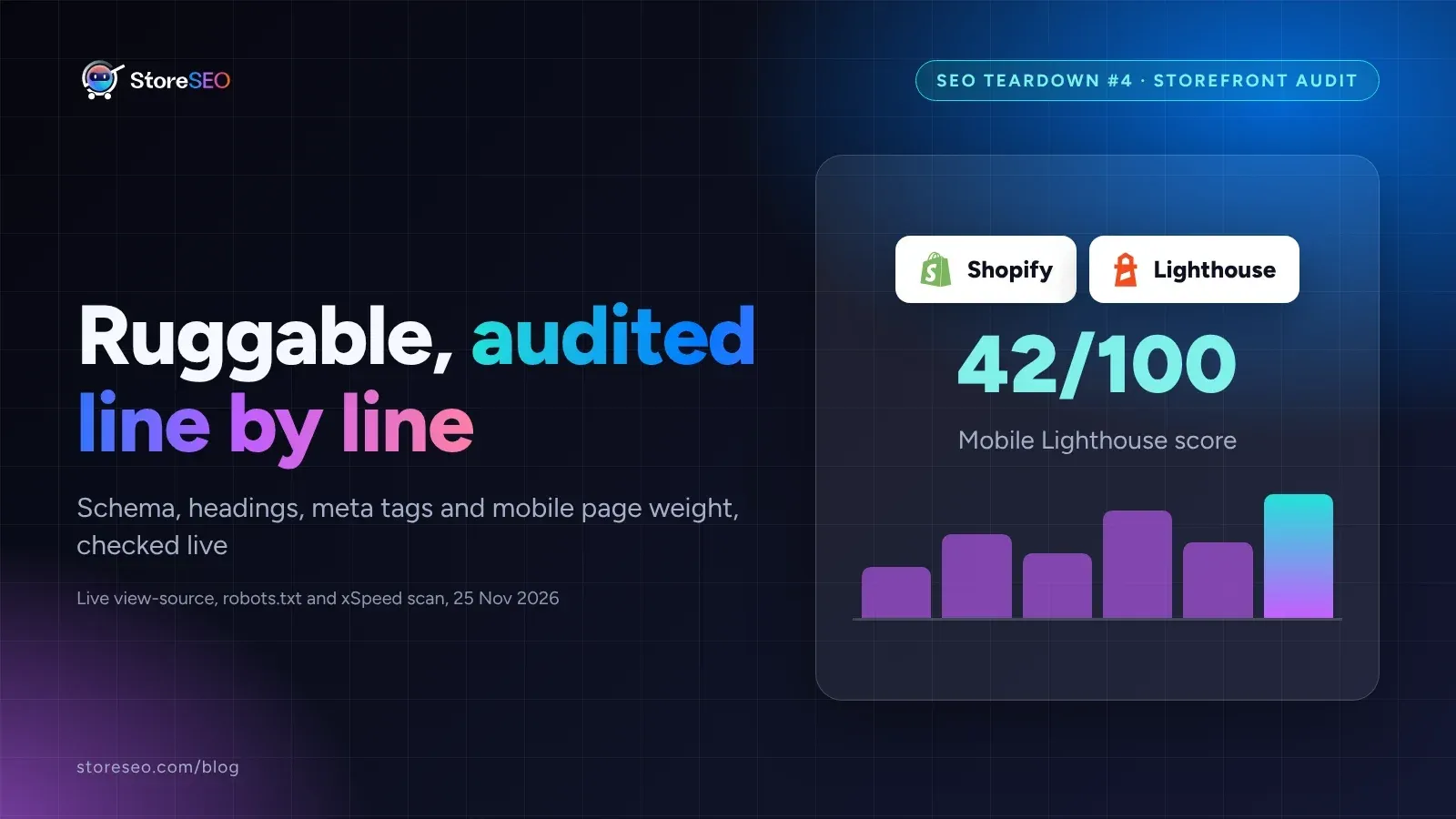
Shopify SEO Teardown #4: Ruggable
We audited Ruggable's live Shopify pages and found a 42-out-of-100 mobile Lighthouse score, three duplicate H1 tags, and genuinely strong product schema.
Read article
Does Shopify Duplicate Content Hurt Rankings?
Shopify's duplicate content is not a ranking penalty: it's a crawl-budget and consolidation issue, and canonical tags already fix most of it by default.
Read article
Does Shopify Markets Replace Hreflang?
Shopify Markets auto-generates hreflang tags and canonical URLs, but only for markets you give their own domain, subdomain or subfolder and a language.
Read article