
Do Product Reviews Help Shopify SEO? The Evidence
 Written by M Asif Rahman
No, not directly. Google has never listed review text or star ratings as a ranking factor, and its own guidelines say a structured data penalty changes rich result eligibility, not rankings. Reviews change click-through rate instead, through the AggregateRating schema that turns a plain link into a star rated listing, and what AI shopping answers quote back to buyers.
TL;DR: the evidence on review schema, weighed by what each piece actually proves.
| Evidence | Source | Verdict (strength) |
|---|---|---|
| Review schema is not a named ranking signal | Google’s own structured data policy | Strong, directly stated |
| A structured data penalty removes rich-result eligibility, not rankings | Google’s general structured data guidelines | Strong, directly stated |
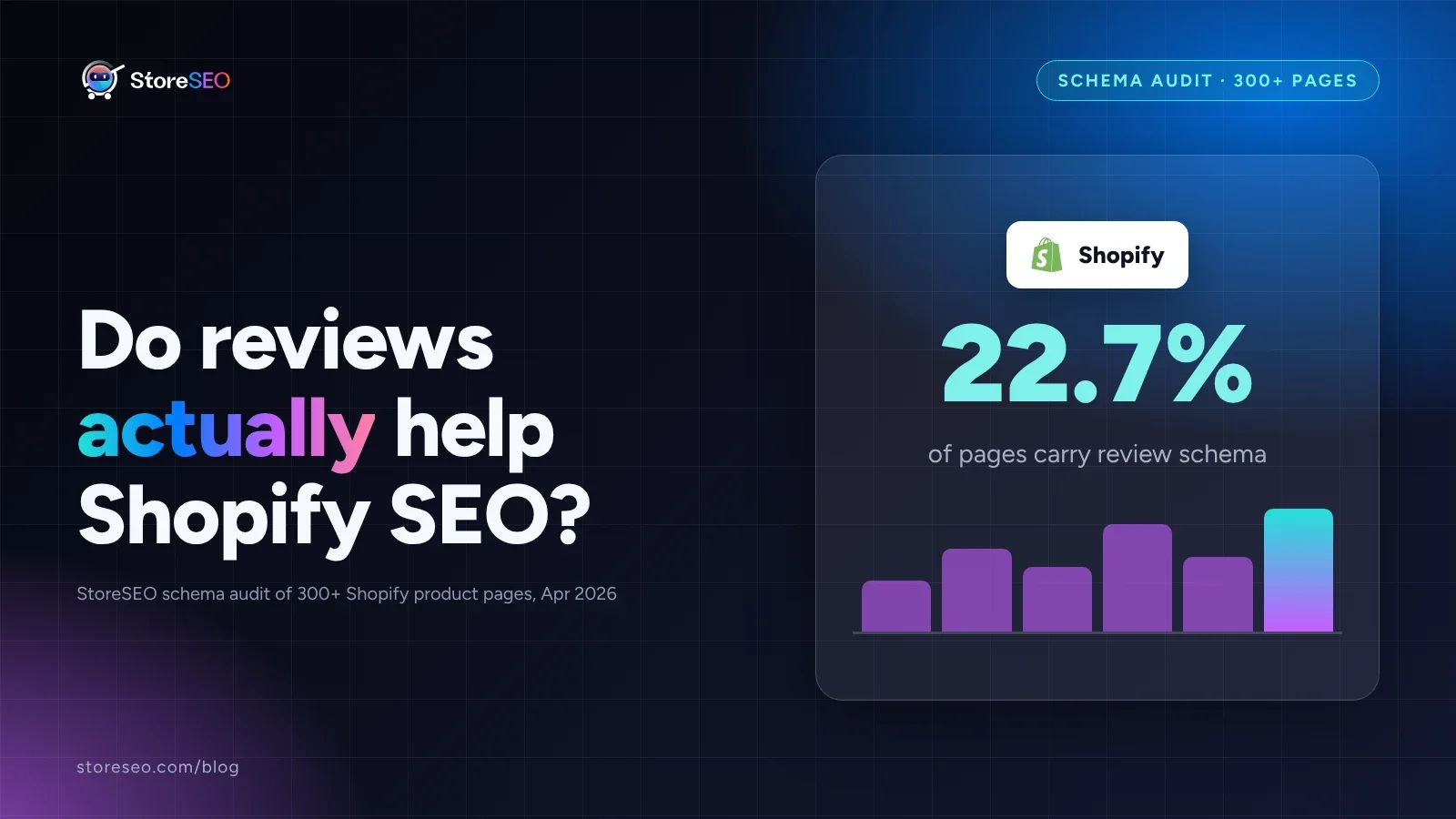
| Only 22.7% of audited Shopify pages carry AggregateRating schema, 17% error-free | StoreSEO’s audit of 300+ product pages | Strong, first-party |
| Automated schema reaches rich results about 4 times more often than manual markup | Same 300-page audit | Moderate, correlational |
| AI shopping answers draw on review signals for product recommendations | Pattern across ChatGPT, Perplexity and Gemini citing stores with complete schema | Emerging, not yet quantified |
Does Google Use Review Schema as a Ranking Factor?
Google answers this one directly, which is unusual for SEO. Its general structured data guidelines say that a manual action against your structured data “means that a page loses eligibility for appearance as a rich result; it doesn’t affect how the page ranks in Google web search.” Review and AggregateRating markup sit under that same rule. Marking up your reviews does not move your product page up the results. It changes whether that result can show stars, a price and availability directly in the SERP.
That distinction matters more than it sounds. A star rating next to your listing does not out-rank a competitor without one, but it does change which blue link a shopper clicks first. Google’s own quality guidance for structured data is explicit that it rewards completeness with a better result, not a better position: “the more recommended properties that you provide, the higher quality the result is to users.” Rich result eligibility is a click-through lever, not a ranking lever, and the two get conflated constantly in Shopify SEO advice.
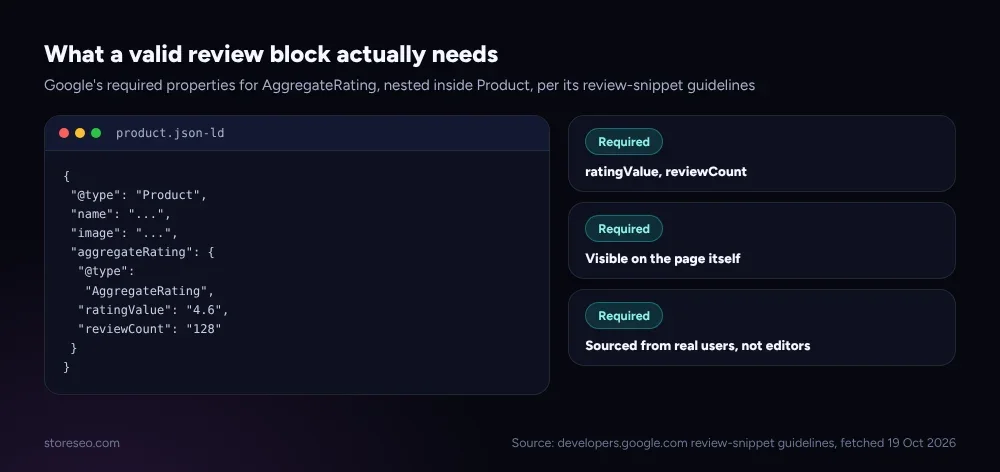 A minimal AggregateRating block, with the three things Google’s review-snippet guidelines actually require.
Google’s technical requirement is narrow: mark up the aggregate with schema.org/AggregateRating, make sure the rating is genuinely visible to a reader on the page itself, and never source it from editors or from another site. Meet those three conditions and the markup is eligible. Miss any one of them and it is not, whatever the ratingValue says.
What Did a Schema Audit of 300+ Shopify Pages Actually Find?
We put a number on how rare this is. In StoreSEO’s own audit of 300+ Shopify product pages, only 22.7% carried any AggregateRating schema at all, and once pages with validation errors were excluded, roughly 17% had a clean, eligible block. The gap was not a reviews gap. Many of the pages with no AggregateRating markup still showed customer reviews and star widgets to a human visitor. The reviews existed. They were simply never connected to the page’s structured data, so Google’s crawler could not see what a shopper could.
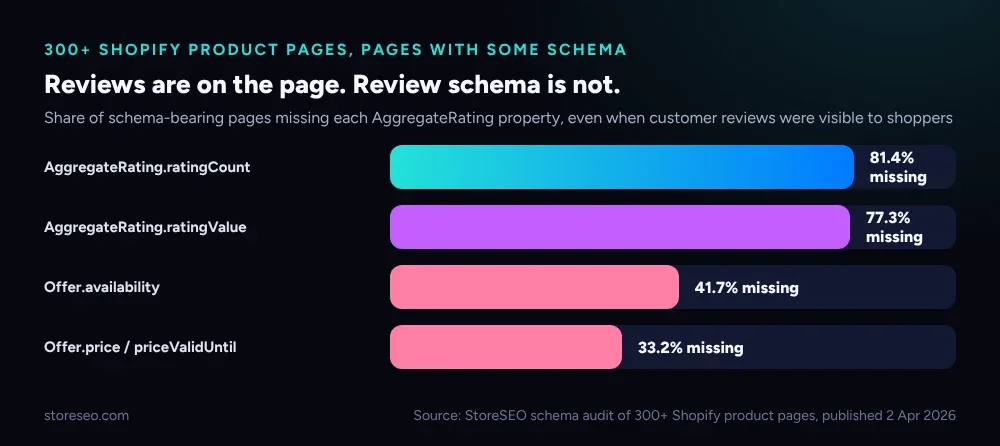 Even among pages with some schema already present, ratingValue and reviewCount were the two most commonly missing properties.
Shopify’s own Dawn theme is part of why. Dawn’s default product template outputs Product, Offer and price schema automatically, but it does not emit Review or AggregateRating blocks on its own. A store running an unmodified theme, with no review app connected to its schema, simply has no path to a star rating in search, no matter how many five-star reviews sit on the page. That is a configuration gap, not a content gap, and StoreSEO’s SEO Schema feature exists specifically to close it: it connects to the review apps merchants already use and writes the AggregateRating block Dawn leaves out, without hand-editing theme code.
Is It “Self-Serving” When the Reviews Come From Your Own Store?
A common worry stops merchants before they even try: is a rating you collected on your own product page too self-interested for Google to trust? The answer is narrower than most merchants assume. Google’s self-serving review restriction names LocalBusiness and Organization markup specifically, the case where a business reviews itself about itself. Product review schema on your own product page is a different situation, and it is explicitly allowed, including when the review app that powers it is a paid tool you installed yourself.
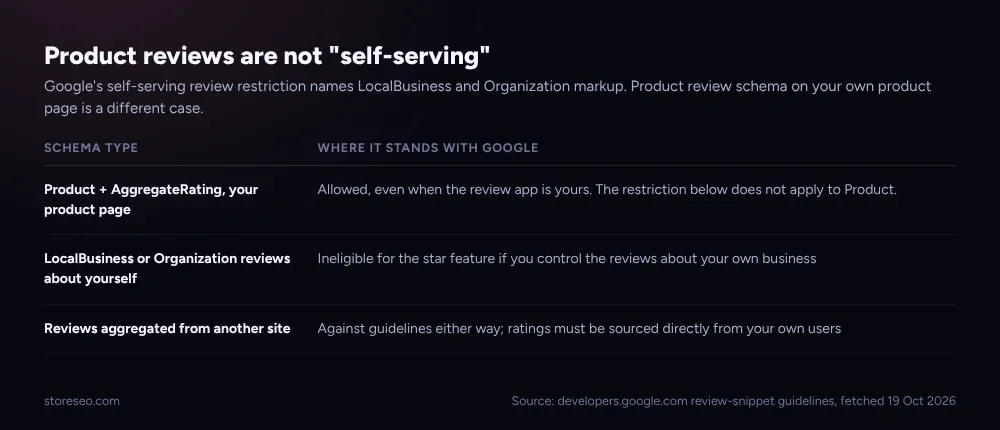 The restriction Google documents is about reviewing your own business, not about reviewing the product you sell.
What is genuinely against the rules, for any schema type, is aggregating ratings collected on a different website and republishing them as your own, or using fake and undisclosed incentivized reviews. StoreSEO is named here deliberately: its Product Schema integration only pulls ratings a merchant’s own review app already collected from real buyers, the same data already visible on the storefront, so there is nothing in the pipeline that crosses into either restriction.
What Do AI Shopping Answers Use Review Data For?
Traditional rankings are only half the picture in 2026. When a shopper asks ChatGPT, Perplexity or Gemini to compare products, the assistant is reasoning over whatever machine-readable signals it can parse, not over a page it has to interpret visually. A complete Product schema, including a connected AggregateRating, gives those systems a rating and a review count they can cite directly in an answer. A page with reviews rendered only as HTML stars, with no schema behind them, gives the same assistant nothing it can confidently quote.
This is still an emerging signal rather than a proven ranking input, and no AI platform has published a formula for how heavily it weighs review schema against other factors. What is measurable is exposure: a product an AI assistant cannot confidently describe with a rating is a product it is less likely to recommend in a comparison. Merchants who want to check whether their own store’s structured data is actually readable to these systems, separate from whether it ranks, can run it through AIScan, a free agent-readiness checker that reports which of a page’s schema blocks an AI crawler can actually parse.
So Should You Add Review Schema to Your Shopify Store?
Yes, but for the right reason. Do it for click-through rate and AI answer visibility, not because a salesperson promised it would move your rankings. The audit data backs the “how” as much as the “whether”: stores using a schema automation tool or app reached complete AggregateRating markup on 44.7% of pages, against 9.3% for manual or theme-default implementations, and reached rich result eligibility on 49.2% of pages against 12.4% manually.
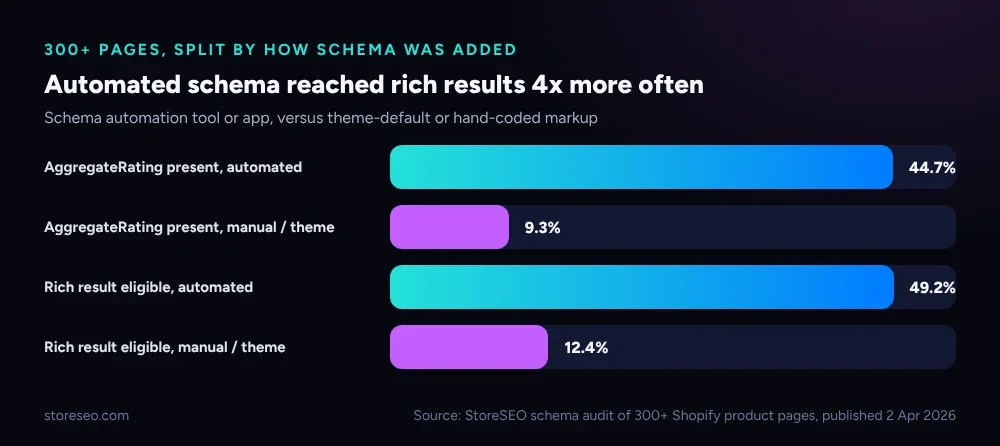 Across the same 300+ page sample, split by how the schema was implemented.
If you already run a review app, the fastest fix is connecting it to your product schema rather than leaving stars as page decoration Google cannot read. StoreSEO does this from one dashboard panel: connect the review app, validate the output against Google’s Rich Results Test rules, and the AggregateRating block updates itself as new reviews come in, with no code edits to Dawn or any other theme. For a broader look at what else your product pages are likely missing beyond reviews, our guide to Shopify product page SEO and our rundown of common Shopify SEO myths are the next two things worth reading, and our walkthrough on reaching a 100 SEO score covers the rest of the checklist this post does not.
Frequently Asked Questions (FAQs)
1. Does adding review schema directly improve my Google ranking?
No. Google’s own documentation treats structured data eligibility and search ranking as separate systems; losing rich-result eligibility does not change where a page ranks. What review schema changes is whether your listing can show a star rating, which affects click-through rate rather than position.
2. Do I need a developer to add AggregateRating schema, or can an app do it?
Most Shopify review apps already store ratings and counts. The remaining step is connecting that data to your page’s Product schema, which a schema tool like StoreSEO’s SEO Schema feature handles from a dashboard panel rather than requiring a theme code edit.
3. Is it against the rules to use my own store’s reviews in schema?
No, as long as the reviews are genuinely from your own customers and visible on the page. Google’s self-serving restriction applies to LocalBusiness and Organization markup, where a business reviews itself about itself, not to Product review schema about the item you sell.
4. Can Google penalize me for broken review schema?
A validation error does not trigger a penalty on its own; it simply makes that block ineligible for a rich result. A manual action is a separate, more serious outcome reserved for fake, incentivized or aggregated-from-elsewhere reviews, and it affects eligibility, not your page’s ranking.
5. Do AI assistants like ChatGPT or Perplexity actually use review schema?
They can read it when it is present and connected, and a rating or review count is something they can cite directly in a product comparison. This is an emerging use rather than a measured ranking factor, and no platform has published exactly how much weight it carries.
6. How many reviews do I need before adding AggregateRating schema?
Google does not set a minimum review count. The requirement is that the rating and count you mark up are accurate and visible to a reader on the same page, whether that is three reviews or three hundred.
Reviews will not move your rankings by themselves, but the schema connecting them to your page decides whether Google and AI shopping assistants can see them at all, and that is worth fixing even before it is worth debating. try StoreSEO on the Shopify App Store
Keep reading
How Long Shopify SEO Takes, Month by Month
Most new Shopify pages get crawled within days to a few weeks, and most stores see real organic traffic building between month 3 and month 6.
Read article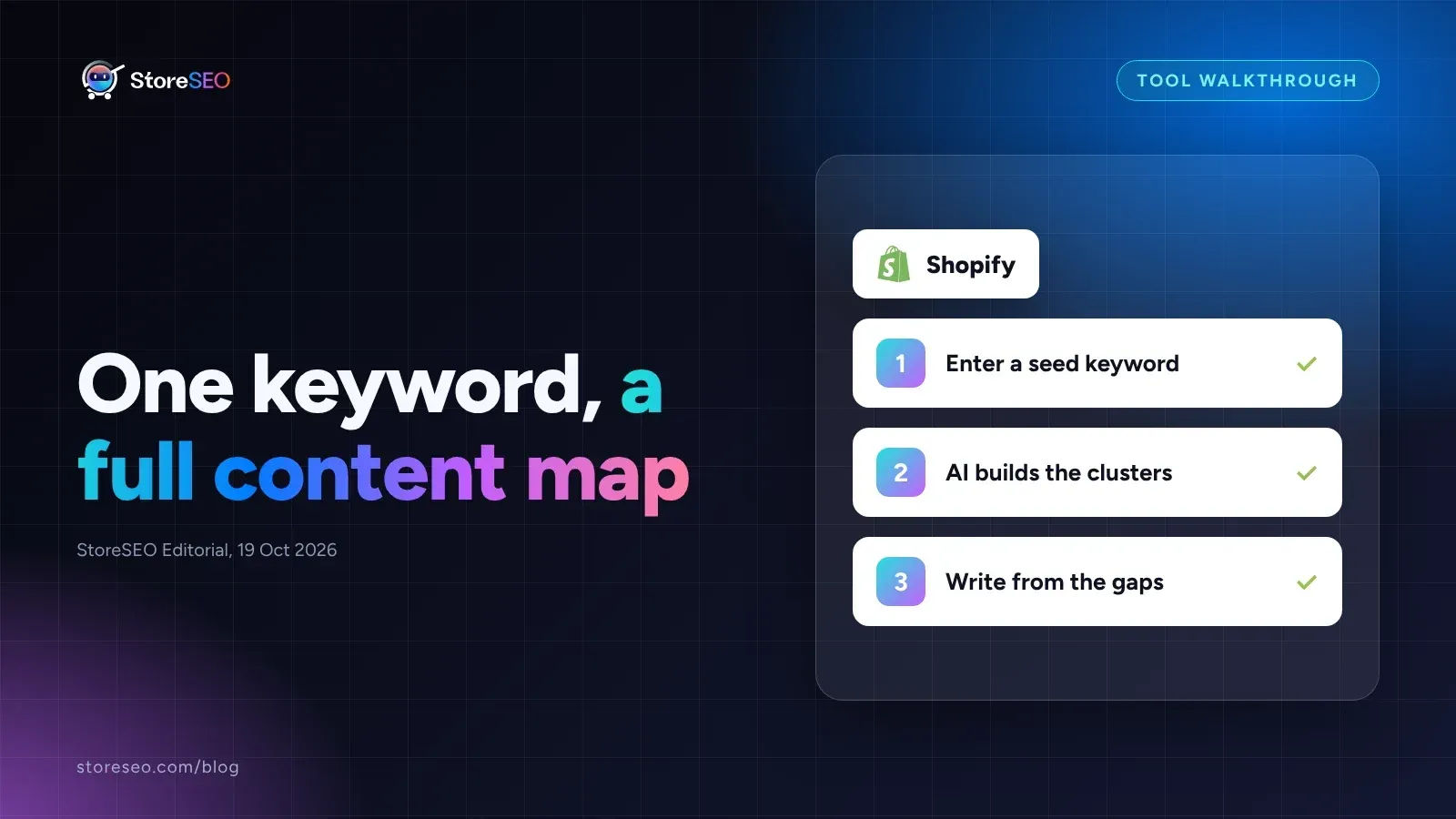
Shopify Keyword Cluster Generator: How to Use It
StoreSEO's Keyword Cluster Generator turns one seed keyword into intent-tagged topic clusters inside your Shopify dashboard, with a worked example below.
Read article
Shopify SEO App Feature Matrix: 11 Apps, 29 Features
We checked 11 Shopify SEO apps against 29 features on their own Shopify App Store listings, from FAQ schema to AI credits to image compression caps.
Read article