
Free Shopify SEO App Alternatives, Compared
 Written by M Asif Rahman
StoreSEO is our product, so here is the comparison the way we would want it done to us: the same criteria across every app, pulled live from its own Shopify listing, our losses shown rather than skipped. Our own free tier caps out at 25 products; three of the five compared here publish no cap at all.
TL;DR: six free Shopify SEO plans, compared on their own listings
| App | Best for | Free plan caps | AI features (free tier) | Rating |
|---|---|---|---|---|
| StoreSEO | small catalogs that also want AI content and a migration tool | 25 products, 25 images | 200 AI credits | 5.0 (775) |
| Avada AI SEO Visibility | a first AI audit pass before paying | no product cap; 20 onpage audits | 100 AI credits | 4.9 (4,690) |
| Booster AI SEO + AEO Optimizer | hands-off weekly checks with no setup | no product cap; 50 images synced weekly | not published as a credit count | 4.8 (5,478) |
| SearchPie | an AI tag and schema pass bundled in from day one | no product cap stated | AI SEO and alt-tag generation, no published credit count | 4.9 (2,459) |
| Smart SEO | testing MCP and AEO tooling before upgrading | 100-page link check, 50 images, 20-page audit | 20 AI generations | 5.0 (958) |
| SEO King | catalogs that outgrow a 25- or 100-item cap but only need text fields fixed | no product or page cap stated | unlimited text AI, scoped to the four fields it edits for free | 4.7 (544) |
Six apps, six different ways of drawing the free-tier line: some cap a count of products or images, some cap an AI-credit allowance instead, and a few publish no cap at all because they limit which fields the free plan touches rather than how many items it touches.
What Should You Actually Compare Before Picking a Free Plan?
One quality signal costs nothing to check before any of the three below: whether the app carries Shopify’s own “Built for Shopify” badge, which Shopify’s Help Center describes as certification across performance, design and integration standards, reviewed annually. Of the six compared here, every app except Booster currently carries it, per each app’s own Shopify App Store listing.
Three numbers matter more than the star rating. First, is there a hard cap on products, pages or images, or does the app instead limit which fields it edits for free? StoreSEO, Avada and Smart SEO all publish a count; Booster, SearchPie and SEO King do not, at least not on their current free-tier listing. Second, does the app publish an AI-credit or AI-generation count at all? StoreSEO (200), Avada (100) and Smart SEO (20 generations) do; Booster and SearchPie describe AI features on the free tier without attaching a number to them, which is worth knowing before you assume “AI SEO” means an unlimited allowance. Third, check what moves to the paid tier: on Booster, the free plan finds and reports problems, but automatic fixing and meta-tag rewriting are Pro-only; on Smart SEO, bulk editing, MCP access and llms.txt generation sit behind the $14.99 Pro plan.
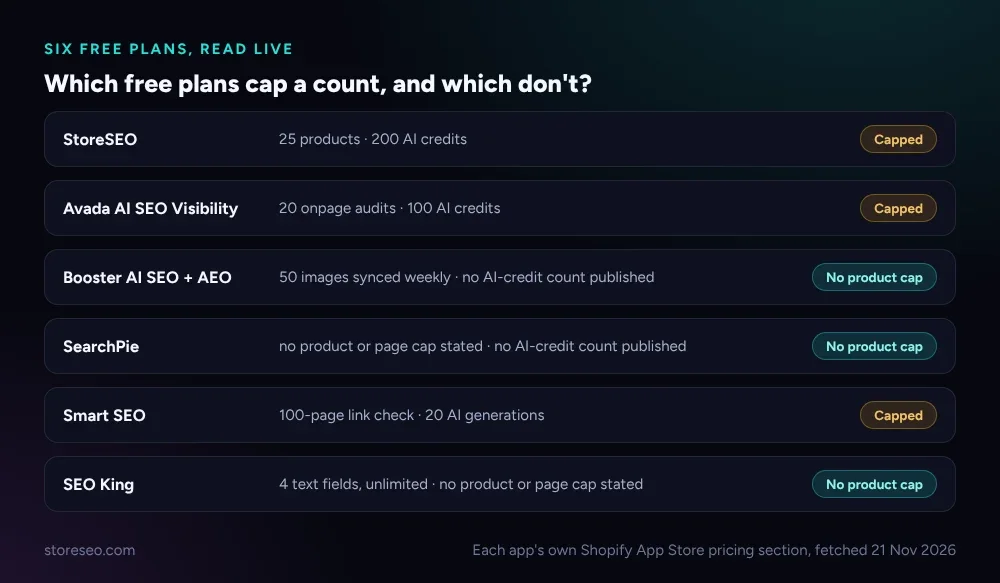 Each app’s own Shopify App Store pricing section, fetched 21 Nov 2026.
Is Avada’s Free Audit Worth Trying Before You Pay?
Avada AI SEO Visibility’s free plan includes a 100-item image optimizer, a basic speed booster, an HTML sitemap, meta-tag editing, 20 onpage audits and 100 AI credits, plus a basic version of Google’s structured data and an image alt-text optimizer, all per its current App Store listing. The free plan is the right size for running one AI audit pass and seeing what it flags before committing to the Pro plan’s unlimited onpage audits and 1,000 AI credits. At 4.9 stars across 4,690 reviews, it is also one of the most reviewed apps in this list, which is a wider sample than StoreSEO’s own 775.
Does Booster’s Free Plan Really Run Itself?
Booster’s free tier covers an SEO score and health badge, alt-text optimization with custom templates, broken-link detection and reporting, manual SEO audits, a weekly image sync capped at 50 images, weekly email summaries and 24/7 chat support, with no stated product cap. What it does not do for free, per its own listing, is fix meta titles and descriptions automatically or run “Auto Pilot SEO Fixes” (both Pro-only, $39/mo), so “Booster uses AI to continuously scan your store, fix SEO issues… without manual work,” its own tagline, describes the paid plan more than the free one. The free plan finds problems reliably across an unlimited catalog; it needs the upgrade to fix most of them on its own.
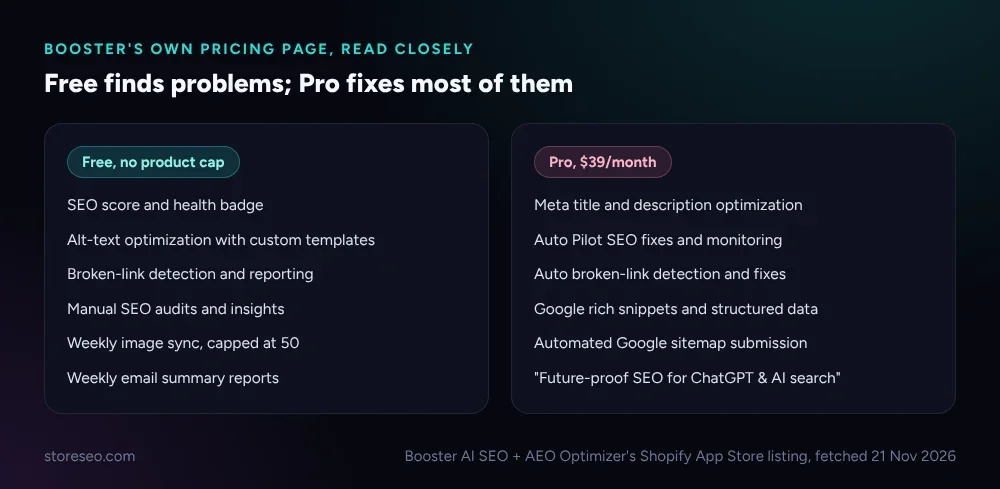 Booster AI SEO + AEO Optimizer’s Shopify App Store pricing section, fetched 21 Nov 2026.
What Does SearchPie Give You for Free?
SearchPie’s free Starter plan monitors your SEO health score and AI readiness, adds breadcrumbs, store schema and a sitemap, compresses images and minifies CSS, applies bulk meta tags and alt text from templates, generates AI SEO and alt tags plus an llms.txt file, and runs IndexNow and 404 detection, with 24/7 support promising under a minute’s response. Like Booster, it states no product or page cap and no specific AI-credit count, bundling the AI generation into the feature list itself rather than metering it. That makes it the broadest free feature list of the six by count, with the tradeoff that nothing here tells you in advance how much AI output the free tier actually allows before you hit a limit you cannot see on the pricing page.
Is Smart SEO’s Free Tier Enough to Test Before Upgrading?
Smart SEO’s free plan is scoped by pages rather than products: a broken-links check across 100 pages, image optimization for 50 images, 20 AI generations, meta-tag and alt-tag optimization, a sitemap, noindex tags and an automatic SEO audit across 20 pages. What stays on the $14.99 Pro plan is the part most relevant to an AI-era store: Google Search Console integration “with MCP and Sidekick,” llms.txt and Agents.md catalogue generation, and bulk meta and alt-tag optimization. If testing an MCP connection or an Agents.md file is the reason you are looking at Smart SEO, the free tier will not show you that part; it is built to prove the basic optimization works first.
Does SEO King’s Free Plan Beat Everyone on Catalog Size?
SEO King’s “Free basics” plan is the one unusual case: unlimited alt-text updates, unlimited meta title and meta description updates, unlimited photo renaming and optimization, a store scan, Google Search Console analytics and keyword analytics, with no product or page cap published on the free tier itself. Its two paid plans are even named by page count, “500 Pages” at $9.99 a month and “5,000 Pages” at $13.99, which only confirms that the cap sits on the paid side, not the free one. The free plan’s own limit is narrower in a different way: it edits four text fields and nothing else for free. Structured data, robots.txt and llms.txt editing, and “50+ features” are reserved for the paid tiers.
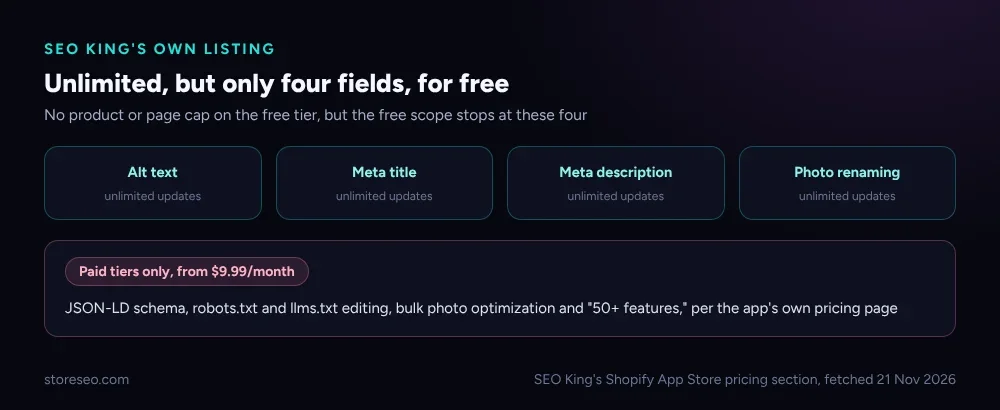 SEO King’s Shopify App Store pricing section, fetched 21 Nov 2026.
How Do You Switch Without Losing Your SEO Data?
Our own free plan runs on the same AI Content Optimizer every paid tier uses, just capped at 200 AI credits where the paid tiers run 1,000 to 50,000; upgrading does not switch tools, it only raises the ceiling. The free plan also carries the SEO Migrator, which pulls existing meta titles, descriptions, alt text and schema in from whatever app a store is leaving, so trying it does not mean starting every product page over from blank fields. Before switching off any of the other five, check that app’s own export or data tools first; none of the free-tier listings compared here advertise an equivalent import-on-the-way-in feature, so the safest order is export from the old app, then install the new one.
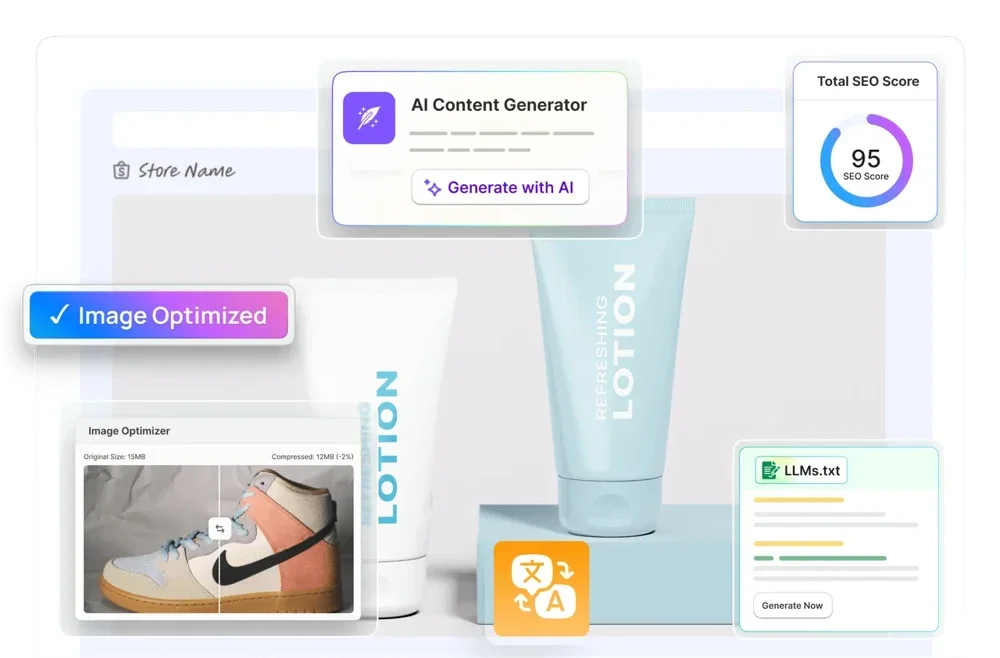 StoreSEO’s own product screen, storeseo.com, 21 Nov 2026.
If a 25-product ceiling is the thing that will push you off this free plan fastest, Do You Need an SEO App on Shopify? covers what Shopify already does natively before you add any app at all, and our fuller Best Shopify SEO Apps roundup ranks every paid tier side by side once a catalog outgrows what any free plan offers. For a single head-to-head instead of a six-way table, StoreSEO vs SEO Manager runs the same feature-by-feature comparison against one specific competitor.
Frequently Asked Questions (FAQs)
1. Which free plan has no product or page cap at all?
Booster, SearchPie and SEO King’s free tiers state no product or page limit on their current Shopify listings. Each caps something else instead: Booster syncs images weekly at 50, SearchPie publishes no AI-credit number for its bundled AI features, and SEO King’s free plan edits only four text fields rather than a count of items.
2. How many AI credits do these free plans actually give you?
StoreSEO’s free plan includes 200 AI credits, Avada’s includes 100, and Smart SEO’s includes 20 AI generations, all stated directly on their own pricing pages. Booster and SearchPie describe AI features on their free tier without publishing a specific credit or generation count, so there is no number to compare there yet.
3. Can I switch between these apps without losing my existing SEO work?
StoreSEO’s free plan includes an SEO Migrator that imports meta titles, descriptions, alt text and schema from whichever app a store is leaving, so switching to it does not mean starting from blank fields. None of the other five free tiers compared here advertise an equivalent import tool, so export your data from the app you are leaving before installing the next one, regardless of which direction you switch.
4. Is a 5.0 rating with fewer reviews weaker evidence than a 4.8 with thousands?
Not weaker, just a smaller sample. Booster’s 4.8 stars across 5,478 reviews and StoreSEO’s or Smart SEO’s 5.0 stars across 775 and 958 reviews are both drawn from Shopify’s purchase-linked review system; a bigger sample gives more confidence in the exact decimal, but a near-perfect score at hundreds of reviews is still real evidence, not a fluke from too few raters.
5. Does “free plan available” always mean you avoid a credit card?
Each app listed here shows a distinct “Free plan available” badge on its Shopify listing, separate from the “Free trial available” badge some of the same apps also carry for their paid tiers. The two are different things: a free plan runs indefinitely at no cost within its stated limits, while a free trial is a time-boxed preview of a paid tier that typically ends in a charge unless cancelled.
6. Do these free-plan limits ever change without notice?
Yes, and that is true of every app’s pricing page, not just one of them. The numbers above were read live from each app’s own Shopify App Store listing on 21 Nov 2026; re-check the current listing before relying on a specific cap, since any of these apps can revise its free tier the same way StoreSEO has revised its own over time.
Start with whichever free plan matches your catalog size today, and try StoreSEO on the Shopify App Store.
Keep reading
StoreSEO vs Tapita: Which Should You Install?
StoreSEO wins on price and a dedicated multilingual SEO workflow below 10,000 products; Tapita wins on review volume and flat usage-based pricing.
Read article
Smart SEO vs Avada SEO: Which Should You Install?
Smart SEO costs less to start and adds an AI search LLM Catalog; Avada SEO Suite has far more Shopify App Store reviews and a one-click AI audit agent.
Read article
TinySEO vs Booster SEO: Which Shopify SEO App?
TinySEO combines SEO, speed, and AI content optimization and works with Shopify Sidekick; Booster SEO has far more reviews and offers the Autopilot feature.
Read article