
AI Shopping Search Statistics: 35 Sourced Numbers
AI referral traffic to US retail sites grew 138% year over year by May 2026, and Shopify’s own data shows those shoppers converting at roughly 50% higher rates than organic search. The dollar volume is still small, under 2% of total US ecommerce, but every number below is climbing, not flattening.
Here is the TL;DR: the five numbers that matter most, and what to actually do about each one.
| Number | What it means | What to do about it |
|---|---|---|
| 50M/day ChatGPT shopping queries (about 2% of prompts) | AI is already a mainstream shopping channel, not a novelty | Write pages that answer a question directly, not just pages built to rank |
| AI-referred traffic to US retail sites up 138% YoY (May 2026) | The channel is compounding month over month | Track AI referrals as their own line in analytics, not folded into “other” |
| Shopify AI-referred orders up roughly 13x YoY (Q1 2026) | Early movers are already seeing real orders, not just visits | Confirm your store is actually crawlable by AI bots (see below) |
| AI-referred traffic converts 42% to 54% better than non-AI traffic | Shoppers who arrive via AI are closer to a buying decision | Prioritize the exact pages AI already sends people to |
| Agentic commerce is still under 2% of US ecommerce in 2026 | The dollar volume is still small today | Treat this as positioning for 2027 to 2030, not a current revenue line |
How Many Shoppers Are Actually Using AI To Shop?
For the strategy side of this shift, see the AI shopping revolution and how merchants can survive it. ChatGPT alone processes roughly 50 million shopping-related queries a day, about 2% of its total prompt volume, inside a base of 700 million weekly users. Google’s AI Mode crossed 1 billion monthly users in its first year, while AI Overviews now reach 2.5 billion people a month across all of Google Search. Perplexity’s shopping agent is smaller but growing fast: its Buy Now feature passed 2 million monthly active shoppers in July 2026, with the shopping layer running at a $2 billion annualized GMV rate.
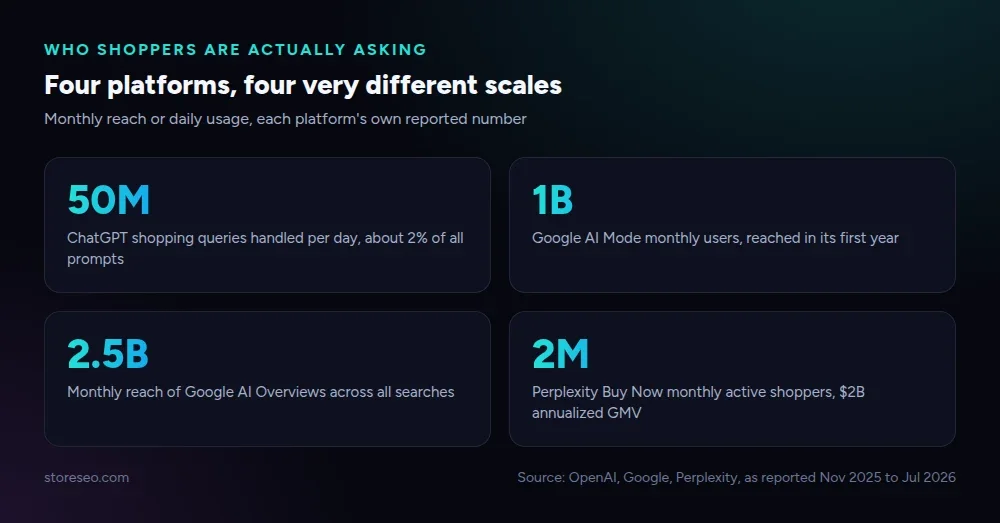 Source: OpenAI, Google and Perplexity, as reported November 2025 to July 2026.
| Stat | Source | Date |
|---|---|---|
| ChatGPT handles about 50 million shopping queries a day, roughly 2% of all prompts | OpenAI, reported by Search Engine Journal | 24 Nov 2025 |
| ChatGPT has 700 million weekly active users | OpenAI, reported by Search Engine Journal | 24 Nov 2025 |
| Google AI Mode passed 1 billion monthly users in its first year | Google Search | 19 May 2026 |
| Google AI Overviews reach 2.5 billion monthly users | Google Search | 19 May 2026 |
| Perplexity’s Buy Now shopping agent crossed 2 million monthly active shoppers | Perplexity, reported by Novadata | 2 Jul 2026 |
| Perplexity’s shopping layer runs at a $2 billion annualized GMV rate | Perplexity, reported by Novadata | 2 Jul 2026 |
How Big Is The Agentic Commerce Market Right Now?
The headline growth rates are large; the dollar totals, so far, are not. Juniper Research puts total agentic commerce transaction value at $8 billion worldwide in 2026, rising to $1.5 trillion by 2030. McKinsey’s own estimate for 2030 lands in a wider range, $3 trillion to $5 trillion of global consumer commerce mediated by AI agents, built on a finding that shopping-related generative-AI queries grew 4,700% year over year through mid-2025. For now, AI platforms such as ChatGPT, Gemini and Perplexity are forecast to handle about $20.57 billion of US retail ecommerce sales in 2026, close to 1.5% of the total. More than half of that AI-driven volume, 54.1%, runs through retailers’ own AI assistants rather than general-purpose chatbots.
| Stat | Source | Date |
|---|---|---|
| Total agentic commerce transaction value projected at $8 billion worldwide in 2026 | Juniper Research | 7 Apr 2026 |
| That figure is projected to reach $1.5 trillion by 2030 | Juniper Research | 7 Apr 2026 |
| AI agents could mediate $3 trillion to $5 trillion of global consumer commerce by 2030 | McKinsey | Oct 2025 |
| Shopping-related generative-AI queries grew 4,700% year over year through mid-2025 | McKinsey | Oct 2025 |
| AI platforms will handle about $20.57 billion of US retail ecommerce sales in 2026, near 1.5% of the total | eMarketer | Dec 2025 |
| Retailer-built AI assistants, not ChatGPT or Gemini, drive 54.1% of US AI-driven retail sales in 2026 | eMarketer | Dec 2025 |
How Much AI Referral Traffic Are Shopify Stores Actually Getting?
The traffic curve is steep almost everywhere it has been measured. Adobe Analytics, working from more than a trillion visits to US retail sites, found AI-referred traffic up 138% year over year by May 2026, and up 1,324% since October 2024. Shopify’s own merchant data tells a similar story from the inside: AI referral sessions grew more than 8x year over year in Q1 2026, AI-referred orders grew nearly 13x, and by Q2 2026 both traffic and orders had tripled again year over year, with three quarters of AI-attributed purchases coming from outside the platform’s top 100 product categories.
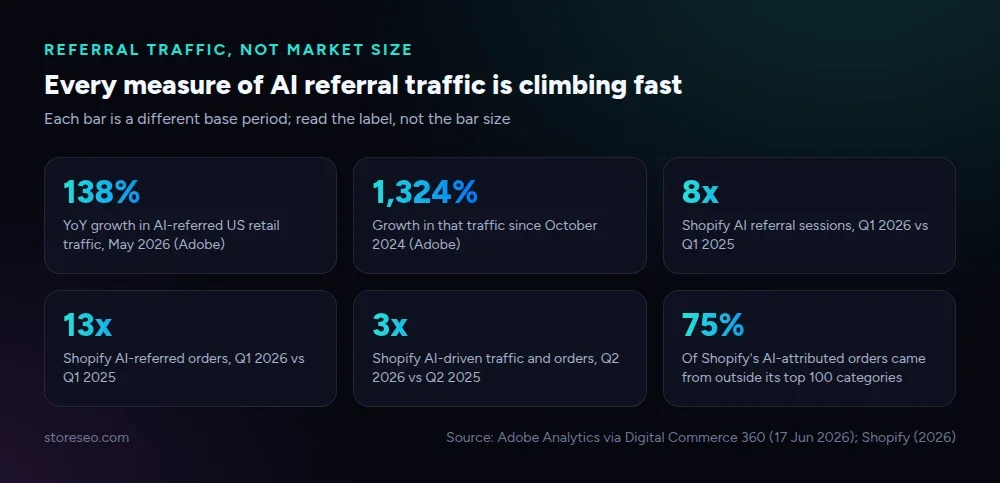 Source: Adobe Analytics via Digital Commerce 360 (17 Jun 2026); Shopify (2026).
| Stat | Source | Date |
|---|---|---|
| AI-referred traffic to US retail sites grew 138% year over year by May 2026 | Adobe Analytics, via Digital Commerce 360 | 17 Jun 2026 |
| That traffic has grown 1,324% since October 2024 | Adobe Analytics, via Digital Commerce 360 | 17 Jun 2026 |
| Shopify merchants’ AI referral sessions grew more than 8x year over year | Shopify | Q1 2026 |
| Shopify merchants’ AI-referred orders grew nearly 13x year over year | Shopify | Q1 2026 |
| Shopify’s AI-driven traffic and orders each tripled year over year | Shopify, reported by Retail TouchPoints | Q2 2026 |
| 75% of AI-attributed Shopify purchases came from outside the top 100 product categories | Shopify | Q2 2026 |
StoreSEO’s AI Referral Traffic Analytics tags this traffic automatically instead of leaving it buried inside “other” in a generic analytics report (set it up here), so a merchant can see the 13x without waiting for a platform-level report to confirm it.
Does AI Traffic Actually Convert Better Than Organic Search?
On the numbers available so far, yes, and by a wide margin. Shopify reports AI-referred visitors converting at nearly 50% higher rates than organic search on product detail pages, carrying 14% higher average order values, and outperforming organic search in 23 of 25 merchant categories by an average of 56%. More than half of AI-referred sessions land directly on a product page, against roughly 20% for organic search, which is consistent with a shopper who already did the comparison shopping inside the chat and arrived ready to buy. Adobe’s numbers point the same way from a different data set: AI-referred traffic converted 54% better than non-AI traffic in May 2026, a reversal from 2025 when AI-referred conversion still trailed non-AI traffic, with those shoppers spending 53% more time on site and viewing 23% more pages per visit.
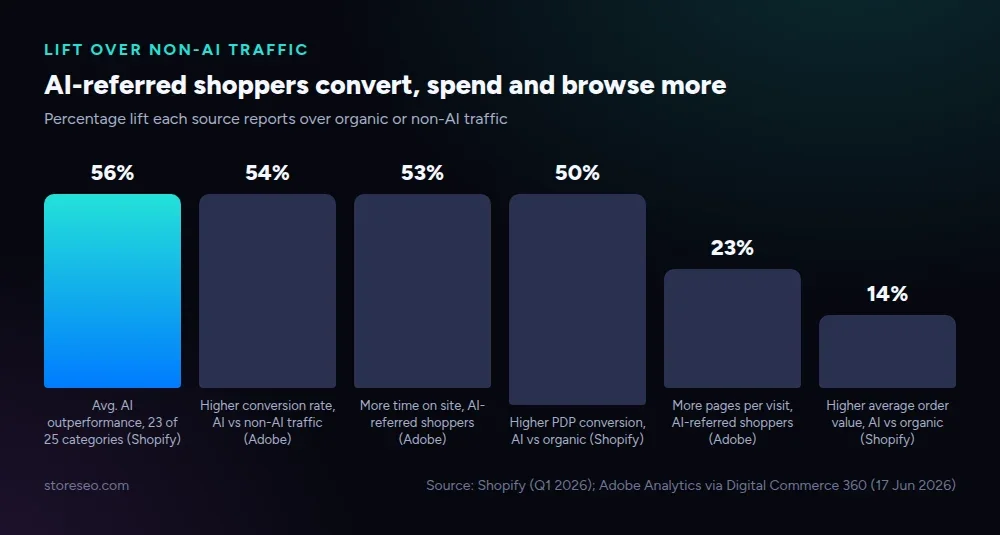 Source: Shopify (Q1 2026); Adobe Analytics via Digital Commerce 360 (17 Jun 2026).
| Stat | Source | Date |
|---|---|---|
| AI-referred visitors convert at nearly 50% higher rates than organic search on product pages | Shopify | Q1 2026 |
| Orders from AI-powered search carry 14% higher average order value than organic search | Shopify | Q1 2026 |
| AI outperforms organic search in 23 of 25 merchant categories, by 56% on average | Shopify | Q1 2026 |
| More than half of AI-referred sessions start on a product page, versus about 20% for organic | Shopify | Q1 2026 |
| AI-referred traffic converted 54% better than non-AI traffic in May 2026, a reversal from 2025 | Adobe Analytics, via Digital Commerce 360 | 17 Jun 2026 |
| AI-referred shoppers spent 53% more time on site and viewed 23% more pages per visit | Adobe Analytics, via Digital Commerce 360 | 17 Jun 2026 |
What Happened To ChatGPT’s Instant Checkout?
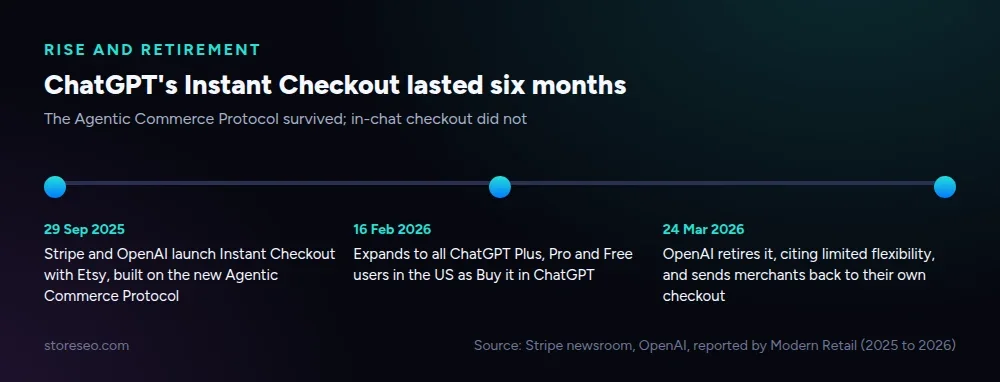
It shipped, expanded, and then OpenAI pulled it back, all inside six months. Stripe and OpenAI launched Instant Checkout on 29 September 2025 with Etsy as the first US merchant, built on the open Agentic Commerce Protocol the two companies codeveloped. By 16 February 2026 it had expanded to every ChatGPT Plus, Pro and Free user in the US as “Buy it in ChatGPT.” On 24 March 2026, OpenAI retired it, stating that the initial version “did not offer the level of flexibility we aspire to provide,” and sent merchants back to their own checkout experiences while it focused on product discovery instead. One widely cited reason: Walmart found checkout inside ChatGPT converted roughly 3x worse than a click-through to walmart.com. The protocol itself outlived the feature; Juniper Research’s 2026 leaderboard for agentic commerce payments infrastructure still ranks Mastercard, Visa and Stripe as the top three providers. The Agentic Commerce Protocol is not the only standard merchants are being asked to support; our guide to the Universal Commerce Protocol covers how that one compares and what it actually requires from a Shopify store.
 Source: Stripe newsroom, OpenAI, reported by Modern Retail (2025 to 2026).
| Stat | Source | Date |
|---|---|---|
| Stripe and OpenAI launch Instant Checkout with Etsy, built on the new Agentic Commerce Protocol | Stripe newsroom, reported by TechCrunch | 29 Sep 2025 |
| Instant Checkout expands to all ChatGPT Plus, Pro and Free users in the US as Buy it in ChatGPT | OpenAI, widely reported | 16 Feb 2026 |
| OpenAI retires Instant Checkout about six months later, pointing merchants back to their own checkout | OpenAI, reported by Modern Retail | 24 Mar 2026 |
| Walmart found checkout inside ChatGPT converted roughly 3x worse than a click-through to its own site | Reported by Modern Retail | Mar 2026 |
| Juniper Research’s 2026 leaderboard for agentic commerce payments ranks Mastercard, Visa and Stripe first | Juniper Research | 2026 |
Are Shopify Stores Even Reachable By AI Crawlers?
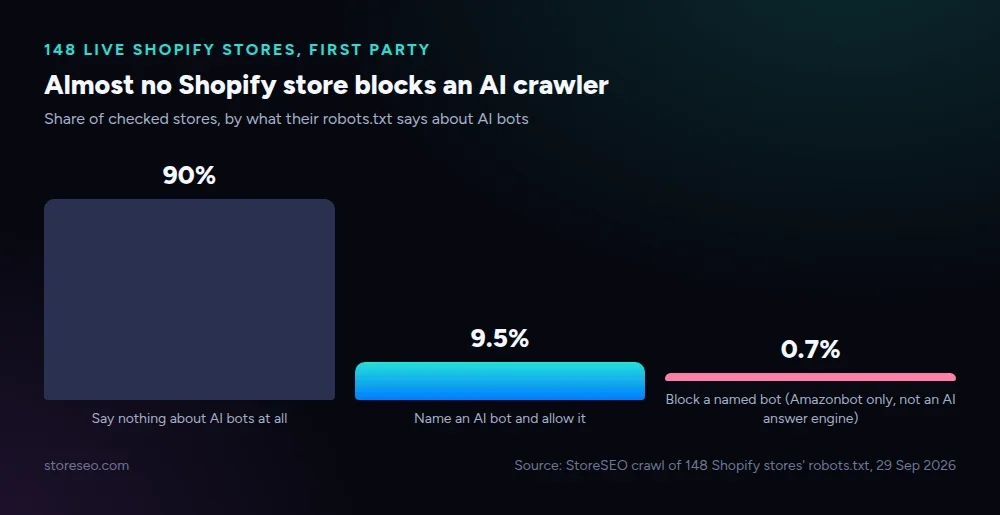
Mostly yes, by default, whether or not the merchant did anything about it. For a dedicated crawl study, we checked robots.txt on 148 live Shopify stores confirmed to be running the platform and found exactly one explicit block, aimed at Amazonbot, not at GPTBot, ClaudeBot or PerplexityBot. Zero of the 148 stores block any of those three. Ninety percent of the stores say nothing about AI bots at all, which by default leaves every product and blog page open to them; of the 10% that do name a bot, every single named group is an explicit allow, not a block, and OAI-SearchBot is the one most likely to appear. A separate, earlier StoreSEO audit of more than 300 live Shopify product pages found a less reassuring number: only 29% carried complete structured data, and more than 61% had at least one schema error, which matters because a page an AI bot can fetch is not the same as a page it can parse correctly.
 Source: StoreSEO crawl of 148 Shopify stores’ robots.txt, 29 Sep 2026.
| Stat | Source | Date |
|---|---|---|
| Only 1 of 148 checked Shopify stores (0.7%) blocks any named AI crawler, and it blocks Amazonbot | StoreSEO crawl | 29 Sep 2026 |
| Zero of the 148 stores block GPTBot, ClaudeBot or PerplexityBot | StoreSEO crawl | 29 Sep 2026 |
| 90% of the 148 stores say nothing about AI bots at all in robots.txt | StoreSEO crawl | 29 Sep 2026 |
| OAI-SearchBot is the most-named AI bot, appearing (always as an allow) in 11 of 148 stores | StoreSEO crawl | 29 Sep 2026 |
| An earlier StoreSEO audit of 300+ Shopify product pages found only 29% carried complete structured data | StoreSEO audit | 2 Apr 2026 |
| The same audit found more than 61% of pages had at least one schema error | StoreSEO audit | 2 Apr 2026 |
If a store wants to know what AI engines actually see and cite about it, not just whether its robots.txt allows the crawl, StoreSEO’s AI Insights checks that directly against the same brand-visibility signals this page is tracking (set it up here). The deeper mechanics of how ChatGPT, Gemini and Perplexity actually choose which Shopify products to recommend are covered separately in how AI answer engines recommend Shopify products.
Which Numbers Here Are Already Out Of Date?
The single biggest trap in any AI shopping statistics page right now is treating Instant Checkout as if it still exists: dozens of 2026 articles still describe in-chat checkout as a live ChatGPT feature, six months after OpenAI retired it. Any post, including an earlier one on this blog, that frames “buying inside ChatGPT” as the near-term default is describing something OpenAI itself walked back. The blog’s own two older stats roundups, from 2022 and 2023, predate AI shopping entirely and cover different ground, general ecommerce and Shopify growth numbers, not AI-specific behavior; they are not superseded by this page so much as simply about something else. Every number above carries the date it was reported, specifically so a reader six months from now can tell which rows have likely moved and which have not. This page gets refreshed on the same quarterly cycle as the first-party crawl data, the fastest-moving part of the mix.
Frequently Asked Questions (FAQs)
1. How many people actually use AI to shop right now?
The clearest available number is ChatGPT’s: about 50 million shopping-related queries a day, roughly 2% of its prompt volume, inside a weekly user base of 700 million. Google AI Mode adds another 1 billion monthly users, though not all of that usage is shopping-specific. Perplexity’s dedicated shopping agent is smaller, at 2 million monthly active shoppers.
2. Is agentic commerce generating real revenue yet, or is it still mostly hype?
Both things are true at once. The growth rates are large (138% year-over-year referral traffic, agentic transaction value rising toward $1.5 trillion by 2030), but the current dollar total is still small, under 2% of US ecommerce in 2026. Treat the growth curve as the signal, not the current size.
3. Why did ChatGPT’s Instant Checkout feature disappear?
OpenAI retired it in March 2026, about six months after launch, stating that the initial version did not offer the flexibility it wanted to provide to merchants. Walmart’s own data showing checkout inside ChatGPT converting roughly 3x worse than a direct click-through is a widely cited reason. The underlying Agentic Commerce Protocol survived; the in-chat checkout experience did not.
4. Do Shopify merchants need to worry about AI crawlers being blocked?
For the large majority of stores, no. Our crawl of 148 live Shopify stores found zero blocking GPTBot, ClaudeBot or PerplexityBot, and only one blocking any named AI bot at all. The bigger risk is not a block, it is a page an AI bot can fetch but cannot parse cleanly because its structured data is incomplete or wrong.
5. How often do these numbers get updated?
This page is refreshed on a quarterly cycle, the same cadence as the first-party crawl and audit data it cites. Every stat here carries the exact date it was reported, so a reader can judge for themselves whether a given row is likely to have moved since.
6. Which AI platform sends the highest-value shopping traffic?
On the numbers reported so far, Shopify’s own data shows AI-referred traffic overall converting close to 50% better than organic search and carrying higher average order values, without breaking that figure out by individual AI platform. Adobe’s broader retail data shows a similar lift. No source in this roundup publishes a platform-by-platform conversion comparison yet.
What To Do With These Numbers
None of this is a reason to rebuild a store around ChatGPT this quarter; the dollar volume still does not justify that. It is a reason to make sure the basics are already true: a crawlable robots.txt, structured data that actually parses, and traffic tagged well enough to see the next quarter’s number instead of guessing at it. try StoreSEO on the Shopify App Store
Written by
StoreSEO Editorial Team