
12 Shopify Product Titles That Rank (Annotated)
 Written by M Asif Rahman
Twelve real Shopify product-page titles, read directly from each page’s live HTML on 31 October 2026, share the same three habits when they work: name the product type, add exactly one differentiator, and put the brand name last, once. Five of the twelve skip at least one habit, and each failure teaches something specific.
TL;DR
| Pattern | What It Looks Like | Do This |
|---|---|---|
| Product type named | The actual category word appears (“Sneakers,” “Serum,” “Hoodie”) | Never let a product-line nickname stand in for the category |
| One differentiator added | A material, feature, ingredient or benefit sits next to the type | Add exactly one: more crowds the title, none loses the click |
| Brand once, last | The store name appears exactly once, at the end | Never omit it or repeat it; both confuse a shopper and an AI answer |
Why Do Product Titles Default to the Product Name?
A Shopify product title tag defaults to whatever the admin’s Title field holds, and most merchants fill that field with the name they already use for the product internally, not the words a shopper types into Google or asks an AI assistant. Google’s own guidance on title links says a title should be descriptive, concise and unique to the page, which a product-line nickname rarely is on its own. A product called “Felicity” or “Rainfall” means something to the brand’s own catalog. It means nothing to a search engine or a shopper who has never heard of either name.
The twelve pages below are not a random sample picked to make a point. Each is a live, public Shopify product page on a working store, fetched directly rather than guessed at, so every pattern below is something you can check yourself by opening the same URL.
 Title tags read from each site, 31 Oct 2026
12 Shopify Product Titles, Annotated
Here is what each one does with its title tag, read straight from the page, and what it does well or poorly.
| Store | Title | What It Does |
|---|---|---|
| Allbirds | Men’s Strider Sneakers | Lightweight All-Day Comfort - Allbirds | Well: names the type (“Sneakers”) and pairs it with a benefit a shopper searches for |
| ColourPop | Rainfall 2% HA Serum | Hyaluronic Acid Serum - ColourPop | Well: leads with the product-line name, but still states the exact type and ingredient twice |
| ColourPop | Felicity | Super Shock Highlighter - ColourPop | Mixed: the type is there, but the proper noun “Felicity” leads with nothing a shopper would search |
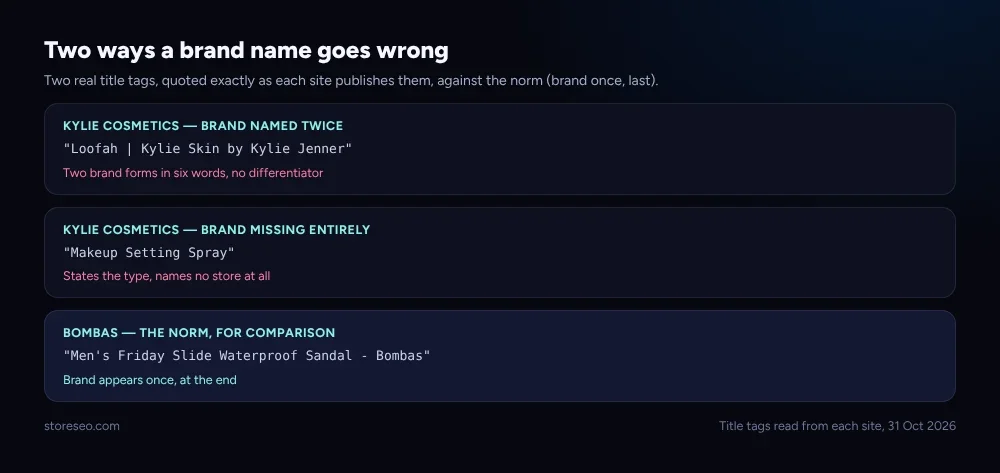
| Kylie Cosmetics | Loofah | Kylie Skin by Kylie Jenner | Poorly: no differentiator, and the brand appears twice in two different forms in six words |
| Kylie Cosmetics | Makeup Setting Spray | Poorly: states the type plainly, but the brand is missing entirely, so nothing separates it from any other setting spray |
| Chubbies | The Espresso Yourself - Chubbies Shorts | Poorly: the product-line nickname stands in for the category; “Knit Polo” never appears in the tag at all |
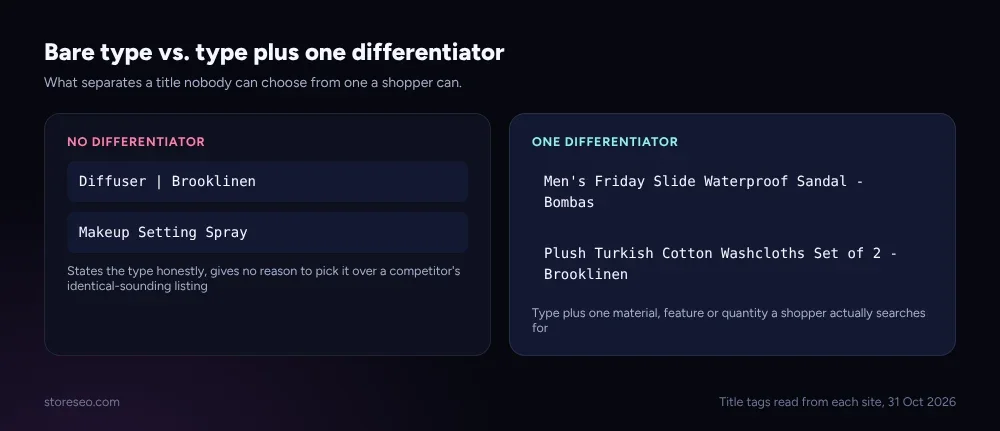
| Brooklinen | Diffuser | Brooklinen | Mixed: states the bare type, adds nothing else to separate it from a competitor’s diffuser |
| Brooklinen | Plush Turkish Cotton Washcloths Set of 2 - Brooklinen | Well: material, quantity and type together, brand last |
| Bombas | Men’s Friday Slide Waterproof Sandal - Bombas | Well: product-line name plus the type plus the one feature a buyer cares about most |
| Death Wish Coffee | Defiantly Strong Coffee | Medium Roast Coffee - Death Wish Coffee | Mixed: the word “Coffee” appears three times across the tag, crowding out room for anything else |
| Taylor Stitch | The Cuyama Jacket in Cognac | Taylor Stitch | Well: type and color stated plainly, even though the product-line name “Cuyama” carries no search meaning on its own |
| Tentree | Mens Reynard Hoodie | Recycled Materials - Tentree | Well: gender, type and the brand’s own sustainability differentiator, brand last |
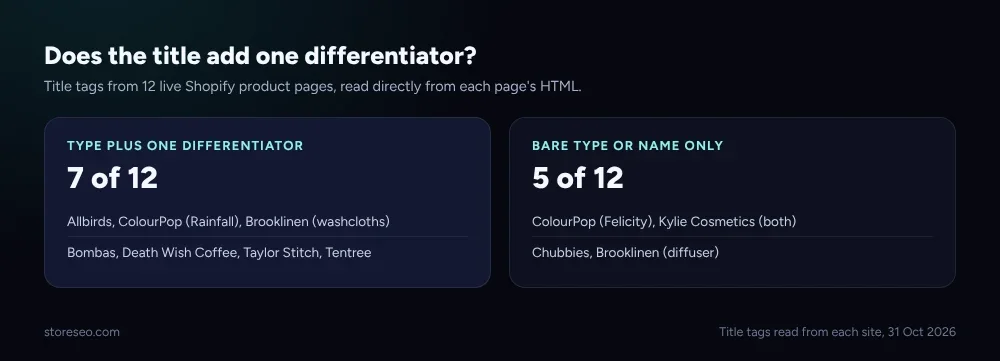
Eleven of the twelve state the actual product type somewhere in the tag; only Chubbies’ omits it entirely, leaning on a nickname a shopper has no reason to search for. The gap that actually splits this group in half is the differentiator: seven pair the type with one material, feature, ingredient or benefit word, and five stop at the bare type or a proper noun, giving a shopper nothing to choose that listing over the next one.
 Title tags read from each site, 31 Oct 2026
Which Pattern Should You Copy First?
Brand placement is the pattern worth fixing first, because getting it wrong costs the most and is the easiest to miss. Ten of the twelve titles above put the store name exactly once, at the end, after the product has already been named. Two do not: Kylie Cosmetics’ Loofah page names the brand twice in two different forms in a six-word tag (“Kylie Skin” and “Kylie Jenner”), which reads as cluttered rather than confident, and the Makeup Setting Spray tag names no brand at all, so nothing in the title separates it from any other store’s identical product. Both mistakes cost the same thing: a shopper (or an AI answer summarizing search results) cannot tell at a glance which store this result belongs to.
The differentiator is the second pattern, and it is the one that actually splits winners from the rest here. “Diffuser,” “Loofah” and “Makeup Setting Spray” state the type honestly, but none of them says anything else, so a shopper comparing five identical-sounding results has no reason to click one over another. “Men’s Friday Slide Waterproof Sandal” and “Plush Turkish Cotton Washcloths Set of 2” each add exactly one extra word that matters: a feature, a material, a quantity. Exactly one is the right number. A title stuffed with every attribute a product has reads as keyword stuffing and gets harder to read in a search result; a title with none reads as generic and gives a shopper no reason to pick it.
 Title tags read from each site, 31 Oct 2026
How Do You Apply These Patterns in Shopify?
All three patterns live in one field Shopify already gives every product. Open a product in your Shopify admin, scroll to Search engine listing preview, and edit the Page title directly: name the actual product type first or close to first, add exactly one differentiator that a shopper would search for, and put the store name once, at the end.
Checking that one field per product is quick for a handful of items. Checking it across a catalog of hundreds is where the work piles up, and seeing what the title and meta description will actually look like in a search result before you publish is what StoreSEO’s SERP Preview Snippets is built for: it renders the live preview beside the editing fields so you can judge length and wording before a shopper ever sees it, instead of guessing and checking Google later.
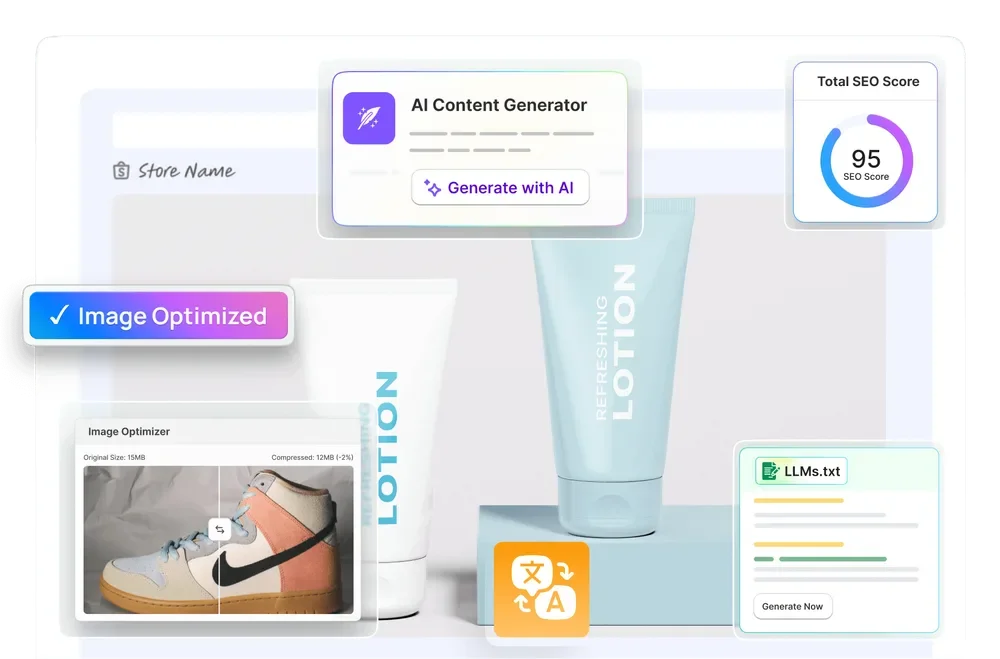 StoreSEO product screen, 31 Oct 2026
StoreSEO’s SERP Preview Snippets docs page covers the field this preview sits next to, and Shopify product page SEO: tips and best practices covers the wider picture a title sits inside, from structured data to images. If you want the homepage version of this same lesson, 12 Shopify homepage title and meta description examples is the earlier roundup these patterns first showed up in, and page titles in Shopify: all you need to know is the mechanics-first how-to version of the same field. A title’s partner in the address bar matters too: do Shopify URL handles affect SEO rankings? covers the slug half of the same product page.
Frequently Asked Questions (FAQs)
1. What should a Shopify product title lead with?
Lead with the actual product type, the word a shopper would type or say to an AI assistant, not an internal product-line nickname. Eleven of the twelve titles in this roundup name the type somewhere in the tag; the one that does not, Chubbies’ “Espresso Yourself,” relies entirely on a name that means nothing outside the brand’s own catalog.
2. How many differentiators should a product title have?
One. A single material, feature, ingredient or benefit word next to the product type is enough to separate a listing from a competitor’s. More than one starts to read as keyword stuffing and gets harder to scan in a search result; zero leaves a shopper with no reason to pick that listing over an identical-sounding one.
3. Should the brand name go first or last in a product title?
Last, and exactly once. All five of the clearly strong titles in this roundup put the store name at the end, after the product has already been named. The two weakest examples both mishandle brand placement in opposite ways: one omits the brand entirely, the other names it twice in two different forms in the same short tag.
4. Does Shopify fill in a product title automatically?
Shopify uses the product’s Title field as the page title by default, and that field is whatever a merchant typed when creating the product, which is often an internal product-line name rather than search-friendly wording. Nothing about the default template adds a category word or a differentiator on its own; a merchant or an app has to write that in.
5. Can changing a product title hurt its existing ranking?
A title change does not touch the URL, so it carries no redirect risk the way renaming a slug does. Google re-crawls and re-indexes a new title on its own schedule, typically within days to a few weeks, and a title that states the actual product type and one differentiator tends to help click-through rather than hurt it.
6. Can StoreSEO show what a new title will look like in search results before I publish?
Yes. StoreSEO’s SERP Preview Snippets render the title and meta description the way a search result will actually display them, next to the editing fields in the Shopify admin, so a merchant can judge length and wording before a shopper ever sees the live version.
Twelve titles are a small sample next to the millions of Shopify product pages online, but the three habits they share, a stated type, one differentiator, one brand mention at the end, cost nothing to copy and live in a field every store already has. try StoreSEO on the Shopify App Store
Keep reading
What Happens When You Skip Google Product Category?
Skipping Google Product Category rarely blocks a sale, but in apparel, phones, software and alcohol it can quietly get a listing disapproved.
Read article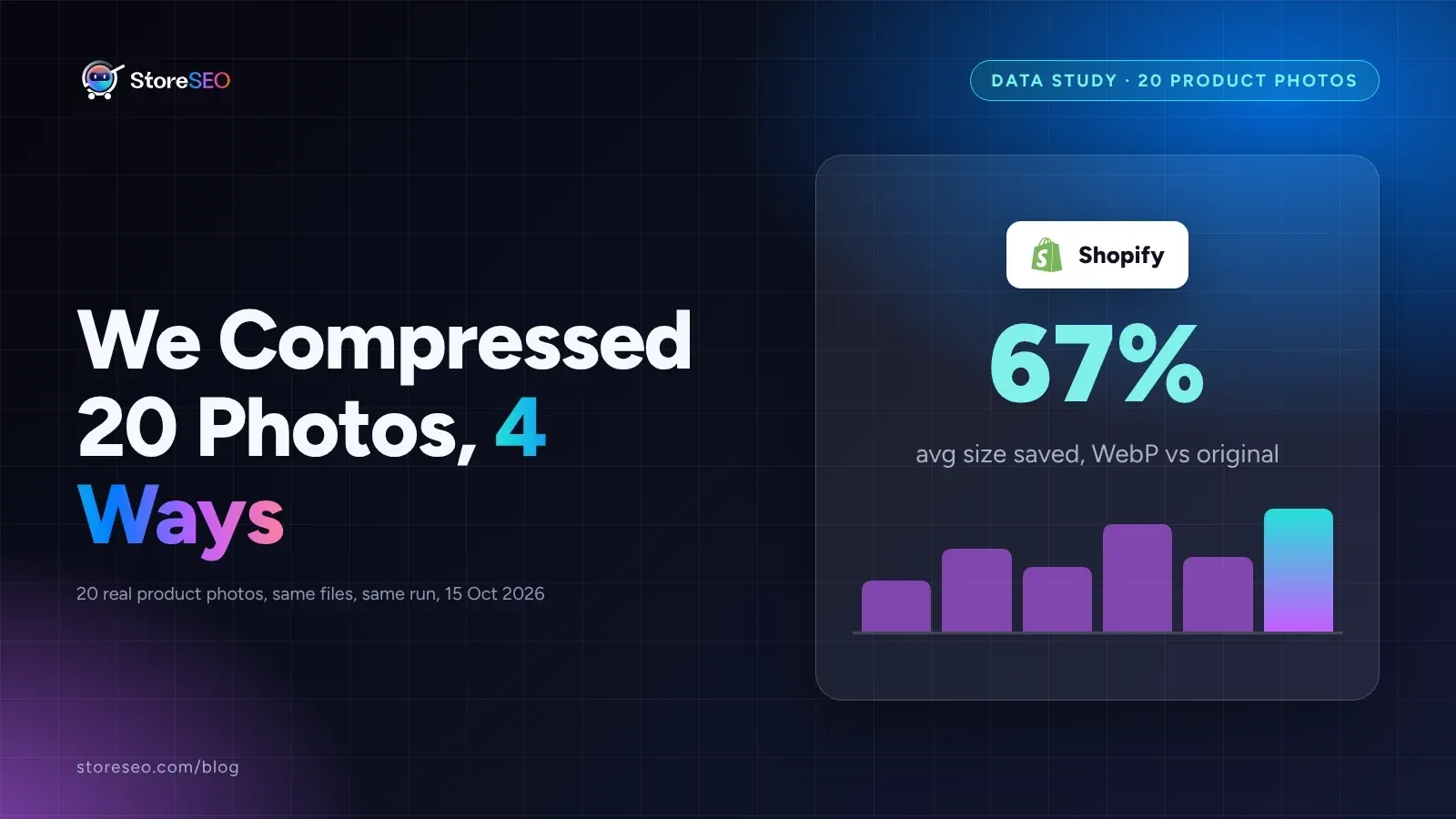
We Compressed 20 Shopify Product Photos 4 Ways
We compressed 20 real Shopify product photos 4 ways and found WebP cuts average file size by 67 percent, the biggest saving of the four we tested.
Read article
Shopify Product Description Template (6 Formats)
A Shopify product description template is a fill-in-the-blank structure for one niche that keeps every listing consistent, specific and fast to write.
Read article