
What's a Normal Shopify Blog Post Length?
 Written by M Asif Rahman
Most Shopify store blog posts run 500 to 1,999 words. In a StoreSEO crawl of 20 real Shopify blogs, 14 of 20 posts, 70%, landed in that range; only 2 topped 2,000 words, and the 4 posts under 500 words were also the most likely to link to nothing else on the same blog.
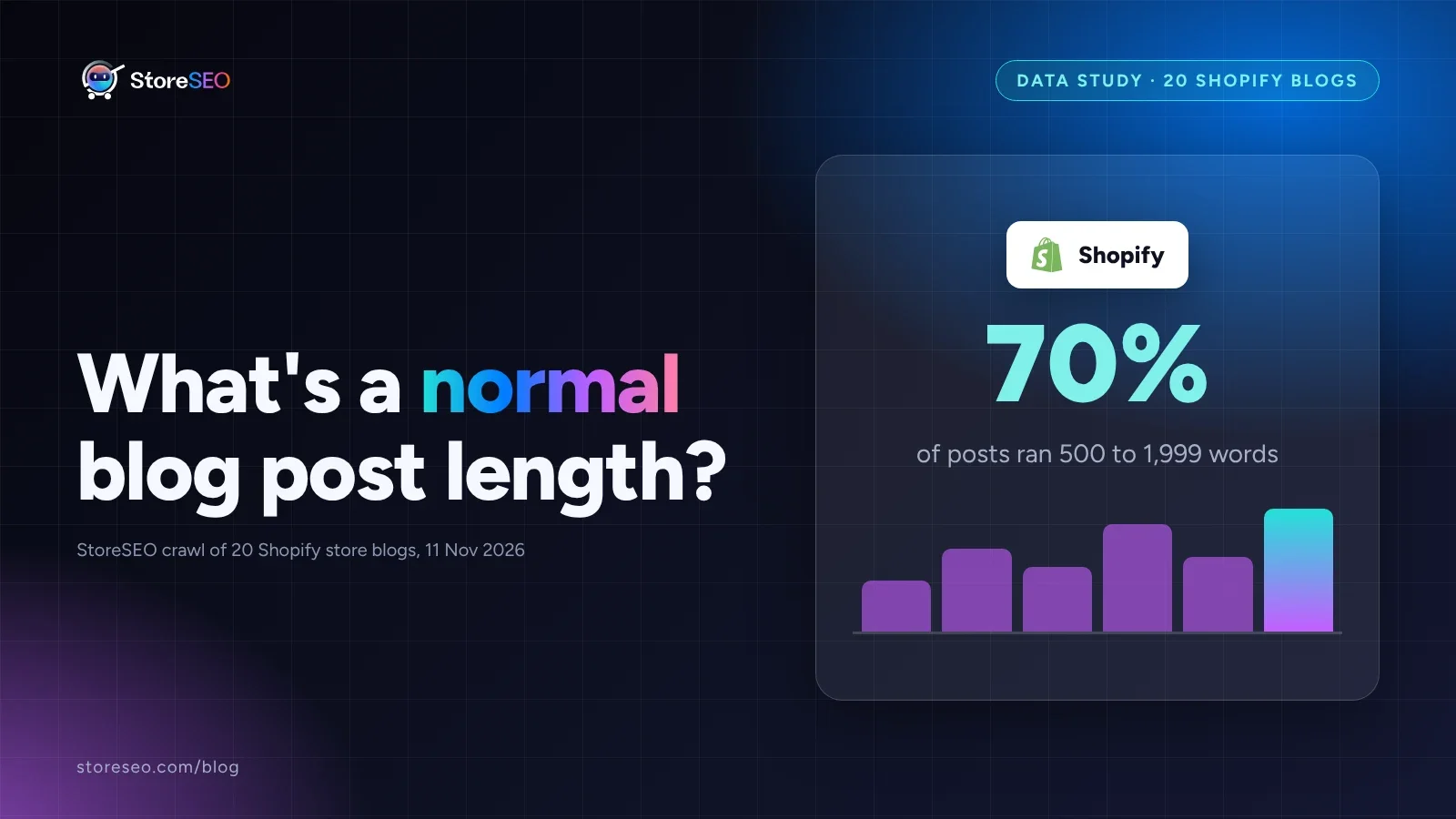
TL;DR: what a real sample of Shopify blog posts actually looks like, length band by length band.
| Length band | Share of the 20-post sample | What to do about it |
|---|---|---|
| Under 500 words | 4 of 20 (20%) | Treat as a draft; add internal links or extend it |
| 500 to 999 words | 7 of 20 (35%) | Fine for a narrow question; check it still links out |
| 1,000 to 1,999 words | 7 of 20 (35%) | The safest default band; aim here first |
| 2,000 or more words | 2 of 20 (10%) | Only for topics that genuinely need the depth |
There is no official minimum. Google itself says it has no preferred word count, so “normal” here means what real Shopify store blogs actually publish, not a rule handed down from a search engine.
Where Does This Data Come From?
This is the same 20-post sample StoreSEO already crawled for its internal-linking study: 125 candidate Shopify-platform brand domains, narrowed to 66 confirmed live storefronts, 50 with a reachable blog index, 26 with an extractable post link, and 20 whose post body the script could isolate cleanly enough to count. That first study reported the internal-link side of the same crawl; this post reports the length side in full.
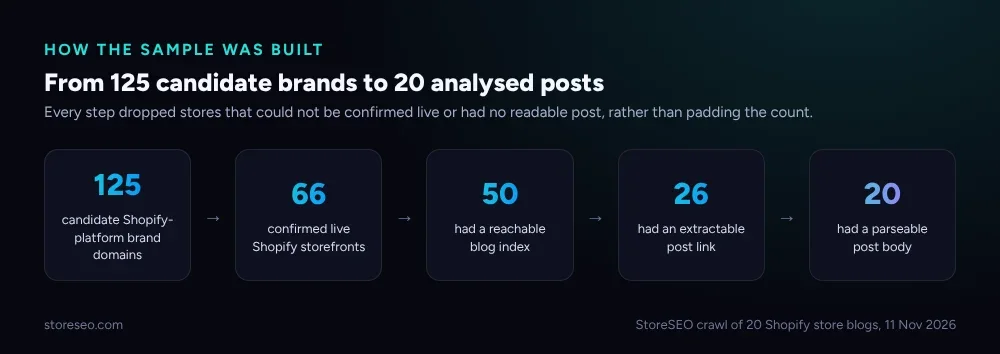 StoreSEO crawl of 20 Shopify store blogs, 11 November 2026.
How Many Shopify Blog Posts Fall Under 500 Words?
4 of the 20 posts, a fifth of the sample, ran under 500 words. That matters past the length itself: three of those four thin posts were also the ones linking to nothing else on their own blog, the worst combination in the earlier study’s sample. A short post that also sits disconnected from the rest of the blog has almost no path for a reader, or a crawler, to find anything else on the site from it.
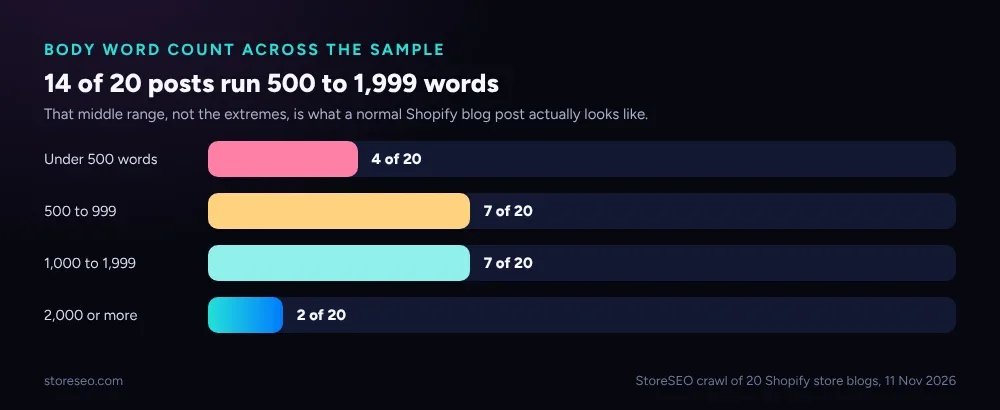 Body word count across the sample: StoreSEO crawl of 20 Shopify store blogs, 11 November 2026.
Does a Longer Post Mean a Better-Linked Post?
Not strictly, but the pattern in this sample leans that way. Here are six of the 20 posts, word count and link count read straight from the live page on the same day:
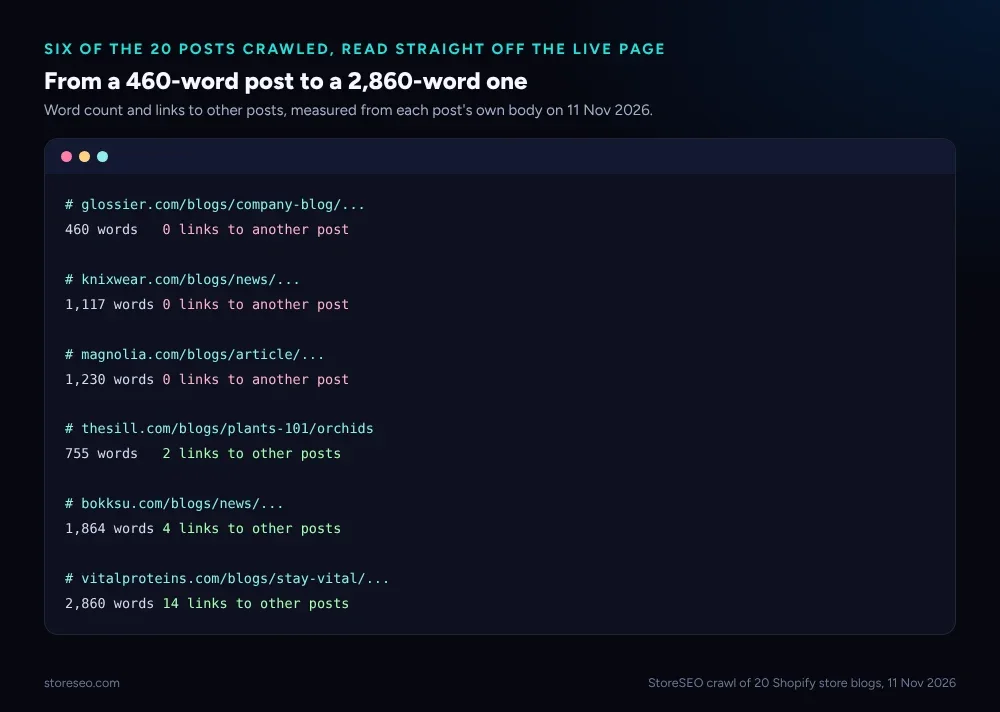 Word count and links to other posts, measured from each post’s own body, 11 November 2026.
Glossier (460 words), Knixwear (1,117 words) and Magnolia (1,230 words) each published a genuinely readable post and linked it to nowhere else on their own blog, so length alone did not earn them a link. At the other end, Vital Proteins ran 2,860 words and linked to 14 other posts, the best-linked page in the sample. Length did not cause the links; it is more likely that a store that already treats its blog as a real content library, with a plan for what links to what, also tends to let individual posts run longer.
What Length Should You Actually Aim For?
1,000 to 1,999 words is the safest default from this data: it is the single most common band (7 of 20, tied with 500 to 999), and it gave every post room to also carry two or more internal links without padding. Treat under 500 words as a draft rather than a finished page unless it is deliberately a short announcement, and do not chase 2,000-plus words just because the two longest posts in this sample happened to be well-linked; both of those stores also had an active internal-linking habit that a short post can copy at any length.
The honest answer is still that length is not the lever. Google’s own guidance is explicit about this:
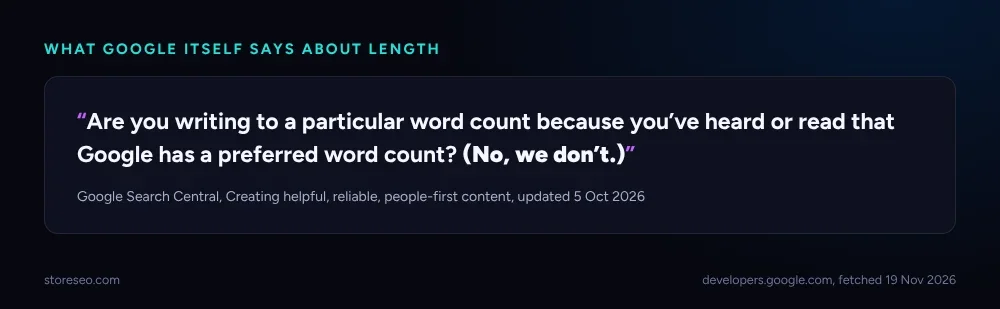 Google Search Central, “Creating helpful, reliable, people-first content,” updated 5 October 2026, fetched 19 November 2026.
Write to the length the question actually needs, then make sure the post links to at least two or three others already on the blog. That second part is the one this sample’s shortest posts skipped.
Can StoreSEO’s AI Blog Writer Target a Length for You?
Yes. StoreSEO’s AI Blog Writer generates a draft from a topic and keyword brief and lets you set the target length before it writes, so a store that wants to default to the 1,000 to 1,999-word band this sample favours can set that once instead of trimming or padding every draft by hand afterward. It still will not pick a number for you; that part of the editorial call is yours, the same way Google leaves it to the page, not a word-count rule.
Method and Limits
The sample is small: 20 posts across a handful of Shopify-platform brands found live and parseable on 11 November 2026, not a statistically representative cross-section of every Shopify blog. Word count is the main content block only, with navigation, related-post grids and footers excluded where the script could isolate them cleanly; a few page-builder layouts it could not separate with confidence were dropped rather than estimated. Treat these bands as a real, dated snapshot to compare your own blog against, not a universal formula. For a deeper look at your own blog’s internal-link health specifically, see the internal-linking guide and the full SEO checklist.
Frequently Asked Questions (FAQs)
1. What is the average Shopify blog post length?
In this 20-post sample, the two most common bands were 500 to 999 words and 1,000 to 1,999 words, each holding 7 of the 20 posts (35%). There was no single “average” post; length clustered in the middle rather than at one number.
2. Is a 500-word blog post too short for SEO?
Not automatically, but in this sample the posts under 500 words were also the ones most likely to carry zero links to any other post on the same blog. A short post that stands alone with no path to the rest of the site is a weaker page than a short post that links out.
3. Does Google penalize short blog posts?
No. Google’s own helpful-content guidance explicitly states it has no preferred word count and says writing to a target count for Google’s sake is the wrong reason to do it. Length is not a ranking factor on its own.
4. What word count should a Shopify product-adjacent blog post target?
1,000 to 1,999 words is a reasonable default based on this sample: it was the most common band and left room for proper internal linking. Treat it as a starting point, not a rule, and let the topic decide when a shorter or longer page genuinely serves the reader better.
5. Why do some long blog posts still perform poorly?
Length alone did not predict link health in this sample; a few posts in the 1,000-plus range still carried few or no internal links. A long post with nowhere for the reader to go next is still a weaker page than a shorter one that is well connected to the rest of the blog.
6. How can I check my own Shopify blog’s post lengths and links at once?
StoreSEO’s SEO Reports and Content Gap Analysis surface both the content and the linking gaps across your blog’s live posts, and the AI Blog Writer lets you set a target length on new drafts so future posts do not drift to either extreme.
A normal Shopify blog post, by what real stores actually publish, lands in the 500-to-1,999-word range far more often than at either extreme, and the length matters less than whether the post then points somewhere else on the same blog.
Keep reading
5 ChatGPT Prompts for Thin Collection Descriptions
Five ChatGPT prompts rewrite duplicated, missing, or keyword-stuffed Shopify collection descriptions, each tested on a real, live collection page.
Read article
Does Multi-Currency Checkout Hurt Shopify SEO?
Multi-currency checkout risks Shopify SEO only when the price changes without the URL changing, since Google's own crawler then sees one currency.
Read article
A Shopify Product Title Template You Can Fill In
A Shopify product title works when it fills four blanks in order, product type, key feature, use case, and brand, not when it names the category alone.
Read article