7+ Best Shopify Apps to Get Your Products Into ChatGPT, Google AI Mode & Perplexity in 2026
Your next customer may never visit your Shopify store before buying from it. Bain & Company’s November 2025 consumer research found that 17% of unique online shoppers planned to begin their holiday shopping with an AI platform like ChatGPT or Perplexity, with another 30% starting from AI-enabled Google search. During that same late 2025 holiday season, Shopify’s own data recorded a 694% jump in store traffic arriving from generative AI tools.
We at StoreSEO have spent the last two years helping Shopify merchants get discovered by AI search engines, and 2026 raised the stakes again. Shopify’s Agentic Storefronts announcement opened AI selling to millions of merchants, syndicating catalogs to ChatGPT, Microsoft Copilot, Perplexity, and Google AI Mode from a single setup. The infrastructure is ready. The question is whether your product data is.
That is what this guide answers. We ranked the 7+ best Shopify apps that prepare your products for AI shopping agents in 2026, scored against six weighted criteria. Yes, our own app is on the list, and yes, we will be upfront about that at every step. Honest comparisons, real feature data, and a clear answer for every type of store.
Quick Summary: Best Shopify Apps for AI Shopping Agents in 2026
Under the six weighted criteria in our methodology below, StoreSEO scored highest overall because it pairs the two purpose-built agent-readiness metrics in the category (the Shopify AI Readiness Score and the Agentic Discovery Score) with full JSON-LD schema, one-click LLMs.txt, and AI content tools in one Shopify-native dashboard. FSEO leads on one specific job: tracking how often ChatGPT, Gemini, Perplexity, Claude, and Grok actually cite your store. SearchPie suits high-volume stores that want speed and AI basics together, Schema Plus wins for schema-first merchants, and TinyIMG fits image-heavy catalogs that need fast pages plus automatic LLMs.txt.
| If You Want To… | Best App | Why | Pricing |
|---|---|---|---|
| Cover the full agentic stack in one app | StoreSEO | SAIRS + Agentic Discovery Score + schema + LLMs.txt + AI content | From $14.99/mo |
| Track AI citations across 5 platforms | FSEO | AI Prompt Tracker for ChatGPT, Gemini, Perplexity, Claude, Grok | Free / Paid |
| Combine speed with AI search basics | SearchPie | Image compression + LLMs.txt + AI sitemap | Free / Paid |
| Maximize schema depth for agent parsing | Schema Plus | Widest JSON-LD library in the category | From $10.99/mo |
| Fix slow pages that agents skip | TinyIMG | Lossless compression + auto LLMs.txt | From $14/mo |
| Audit deep technical issues | Webrex | 50+ technical checks, 5-level breadcrumbs | Free / Paid |
| Generate AI meta content at scale | Smart SEO | GPT-4 powered meta and alt text | From $14.99/mo |
Best for most merchants: StoreSEO, because measurement plus fixes in one app beats stitching three tools together. Best for proof of AI visibility: FSEO, layered on a full-stack app. Best for image-heavy catalogs: TinyIMG, paired with a data-depth app.
Why AI Shopping Agents Change Shopify SEO in 2026
Until recently, optimizing for AI meant optimizing for AI search: getting cited in ChatGPT answers or Google AI Overviews. We covered that shift in depth in our guides on how ChatGPT, Gemini, and Perplexity recommend Shopify products and GEO vs AEO vs traditional SEO. Agentic commerce goes one step further: the AI recommends your product, builds the cart, and on some platforms completes the purchase for the shopper.
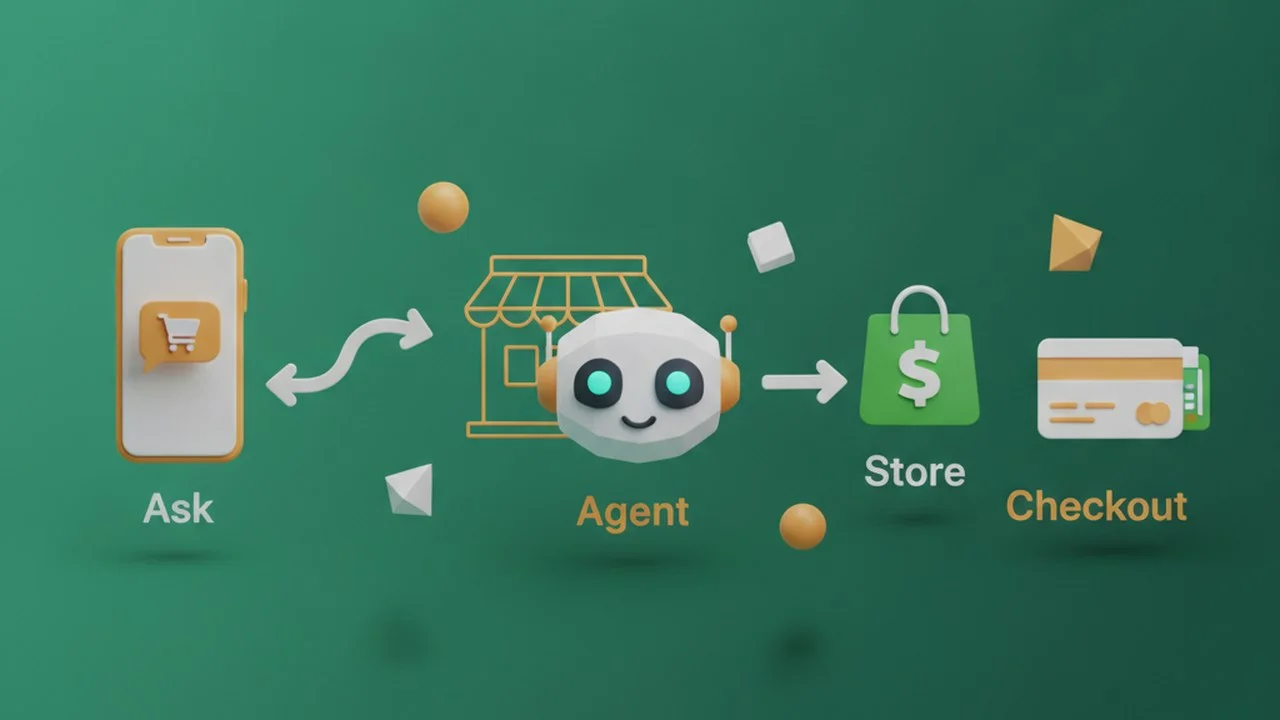
Here is what changed in the first half of 2026 alone:
- Shopify Agentic Storefronts went live for millions of merchants. According to Shopify’s official announcement, products sync through Shopify Catalog and become discoverable in ChatGPT automatically, while Google AI Mode requires an opt-in through the Shopify admin. Orders from these channels flow straight into your admin with AI channel attribution.
- Microsoft Copilot Checkout launched in January 2026 with Shopify, PayPal, and Stripe as launch partners. Microsoft’s own announcement reported 53% more purchases within 30 minutes for journeys that include Copilot, and 194% higher purchase likelihood when shopping intent is present.
- Google AI Mode passed 75 million daily active users and connects to a Shopping Graph of roughly 50 billion products, with autonomous purchasing features rolling out to select merchants.
- Perplexity shoppers spend 57% more per order than average, according to platform comparison research, making its free Merchant Program one of the higher-value listings available.
- Amazon blocked ChatGPT’s crawlers in robots.txt. As Elogic Commerce documented, Amazon listings cannot appear in real-time ChatGPT shopping results. That hands independent Shopify brands a structural head start on the largest AI discovery surface in the world.
One more number worth knowing: Elogic’s 2026 commerce statistics show Claude converting referred shoppers at 16.8%, the highest rate of any LLM platform, with ChatGPT close behind at 14 to 16%. AI referral traffic is still a small share of total visits, but it converts at rates most channels never touch.
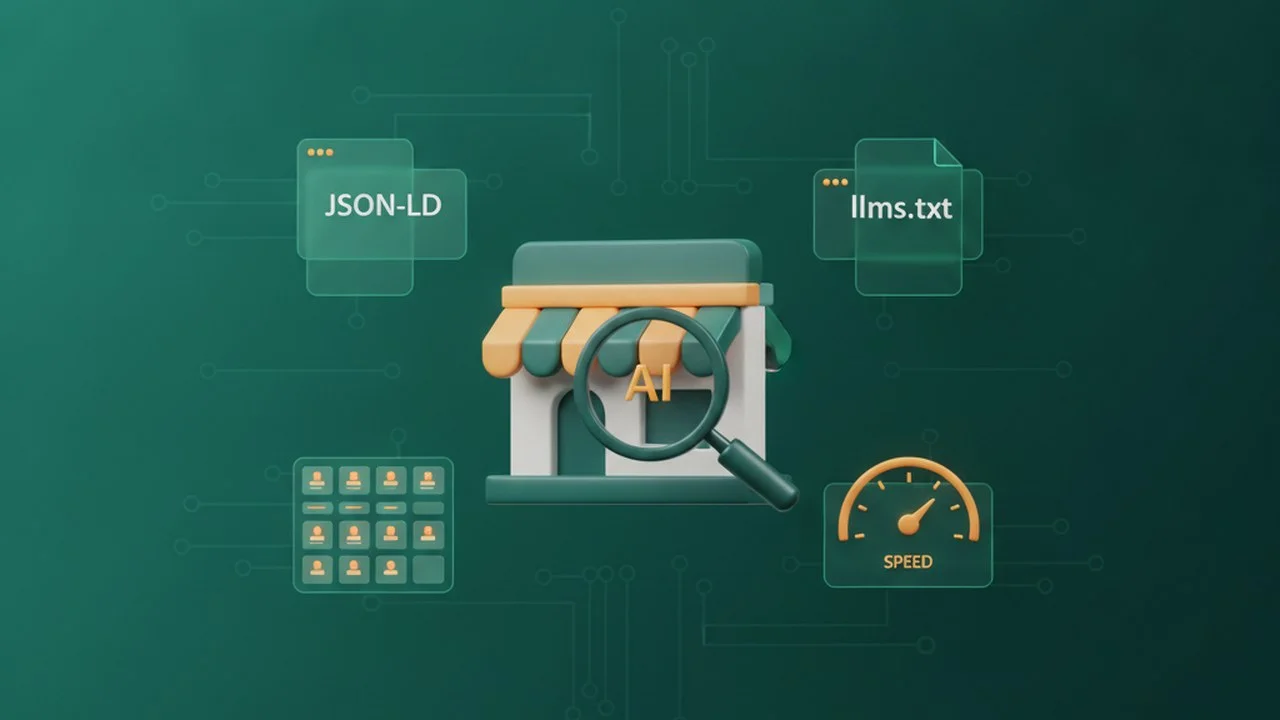
The catch: AI agents read stores differently than humans do. They parse structured data, LLMs.txt files, product feeds, and page speed signals. Our analysis of 300+ Shopify product pages found most stores are missing two or more of the schema types agents rely on. The apps below exist to close exactly that gap.
For a visual walkthrough of how Agentic Storefronts work in practice, this YouTube breakdown of Shopify’s Agentic Storefront launch shows the merchant setup and the shopper experience side by side.
First, Turn On the Free Foundation: Shopify Agentic Storefronts
Before any app, activate what Shopify gives you natively. Agentic Storefronts let you set up once and syndicate your catalog to ChatGPT, Perplexity, and Microsoft Copilot simultaneously, with Google AI Mode available as an opt-in. Shopify Catalog is open to every brand through the Agentic plan, and the admin now shows AI channel attribution so you can see which orders came from which assistant.
This is the plumbing rather than the strategy. Agentic Storefronts move your product feed into AI platforms, but they do not fix thin product data, missing schema, absent LLMs.txt files, or slow pages. An agent that receives your feed and finds weak content will simply recommend a competitor whose data answers the shopper’s question. We broke down the full preparation checklist in our guides on agentic commerce readiness and the Universal Commerce Protocol. The seven apps below are how you win the recommendation once the plumbing is connected.
How We Ranked These Shopify Apps for Agentic Commerce
We scored each app against six weighted criteria, built from our research into the on-page factors that correlate with Shopify rankings and adjusted for what AI shopping agents specifically parse:
- Agent-readable data depth (25%): JSON-LD schema coverage, LLMs.txt automation, and clean product data. Agents cannot recommend what they cannot parse.
- Agentic measurement (20%): Does the app tell you how AI-ready your store actually is, or whether AI platforms cite you? Features without measurement are guesswork.
- Shopify-native depth (15%): Products, collections, blogs, metadata, and theme integration without developer help.
- Content and on-page automation (15%): AI descriptions, snippets, alt text, and FAQ scaffolding at catalog scale.
- Speed and Core Web Vitals (10%): AI crawlers deprioritize slow pages the same way Google does.
- Pricing and value (15%): 12-month cost of ownership against the work the app replaces.
Star ratings carry over from our expert-tested benchmark of Shopify SEO apps for AI search visibility, where we tested each app against real Shopify stores. Transparency note: StoreSEO is our own product. We apply the same criteria to it as to everyone else, and we list its genuine limitations the same way.
Master Comparison: Best Shopify Apps for AI Shopping Agents

| Rank | App | Rating | Schema | LLMs.txt | Agentic Measurement | Pricing | Best For |
|---|---|---|---|---|---|---|---|
| 🥇 1 | StoreSEO | 4.9 ★ | Full (6 types) | Yes, one-click + auto | SAIRS + Agentic Discovery Score | From $14.99/mo | Full agent-readiness stack |
| 🥈 2 | FSEO | 4.6 ★ | Partial | Yes, auto | AI citation tracking (5 platforms) | Free / Paid | Measuring AI citations |
| 🥉 3 | SearchPie | 4.9 ★ | Partial | Yes | None | Free / Paid | High-volume speed + SEO |
| 4 | Schema Plus | 4.9 ★ | Deepest (10 types) | Partial | None | From $10.99/mo | Schema-first merchants |
| 5 | TinyIMG | 5.0 ★ | Basic | Yes, auto | None | From $14/mo | Image-heavy stores |
| 6 | Webrex | 4.9 ★ | Wide (5 types) | Partial | None | Free / Paid | Technical audits |
| 7 | Smart SEO | 4.8 ★ | Yes | No | None | From $14.99/mo | Meta content at scale |
Insider note: StoreSEO and FSEO are the only two apps in the table with any form of agentic measurement, and StoreSEO is the only one that pairs measurement with the full fix-it toolkit. Everyone else ships features and leaves the scoreboard to you.
7+ Best Shopify Apps for AI Shopping Agents in 2026, Reviewed
Each entry follows the same template: rating, honest review, key features, implementation steps, pros and cons, quick stats, and who it fits best.
1. StoreSEO — Best for the Full Agent-Readiness Stack
★★★★★ 4.9 / 5 · Highest score under the six weighted criteria
StoreSEO is our app, so read this section knowing that. Here is why it scored highest under the criteria above: it is the only app in the category with purpose-built measurement for agentic commerce. The Shopify AI Readiness Score (SAIRS) grades how discoverable your store is across ChatGPT, Perplexity, Gemini, and Google AI Overviews, and the Agentic Discovery Score measures how findable your products are for the AI shopping agents completing purchases in 2026. Every other app on this list ships features. These two scores tell you whether the features worked.
Around that measurement core sits the complete data layer agents parse, plus a Shopify Sidekick extension so you can ask about your store’s SEO in plain language inside the Shopify admin.
Key Features
- SAIRS + Agentic Discovery Score: the only two agent-readiness metrics in the category, tracked over time
- JSON-LD schema across 6 types: Product, Review, FAQ, Breadcrumb, Organization, and Article, validated against Google’s Rich Results Test
- One-click LLMs.txt with automatic maintenance as your catalog changes
- AI description and snippet generators trained on eCommerce buying intent
- Rank tracking across 5 SERP verticals including AI overview visibility, plus keyword clustering and bulk image alt text
How to Implement
- Install StoreSEO from the Shopify App Store and connect your catalog
- Run SAIRS from the dashboard to get your baseline and gap list
- Fix schema and LLMs.txt with the one-click tools, then upgrade thin product descriptions with the AI generator
- Track your Agentic Discovery Score as the improvements land over the next 30 days
Pros and Cons
| Pros | Cons |
|---|---|
| ✅ Only app with dedicated agentic-readiness scoring | ❌ No free plan for live stores (free for development stores only) |
| ✅ Full JSON-LD schema across 6 types | ❌ SAIRS and the Agentic Discovery Score are StoreSEO’s own metrics with no independent third-party validation yet, so treat movements as directional |
| ✅ One-click LLMs.txt with auto-maintenance | ❌ Entry plan caps the number of optimized products, so large catalogs need higher tiers to cover everything |
| ✅ Shopify-native, no theme edits or developer needed | ❌ Purpose-built for Shopify, so multi-platform brands need a separate tool elsewhere |
Quick Stats
Schema: Full (6 types) · LLMs.txt: Yes, one-click with auto-maintenance · Agentic measurement: SAIRS + Agentic Discovery Score · AI citation tracking: AI overview rank tracking · Pricing: From $14.99/mo with free trial
Best for: Shopify merchants and agencies who want measurement plus fixes in one dashboard instead of stitching together three or four single-purpose apps.
2. FSEO — Best AI Citation Tracker
★★★★ 4.6 / 5
FSEO treats AI search as the whole product rather than a feature. Its AI Prompt Tracker monitors how often your store gets cited by ChatGPT, Gemini, Perplexity, Claude, and Grok, which remains rare data to have in 2026. If your first question is “do AI assistants mention my store at all,” FSEO answers it faster than anything else on this list.
Where it thins out is the traditional layer: schema depth is partial, and there is no keyword clustering, rank tracking, or on-page scoring. Most merchants run FSEO as a measurement layer on top of a full-stack app rather than as their primary SEO tool.
Key Features
- AI Prompt Tracker covering 5 platforms: ChatGPT, Gemini, Perplexity, Claude, and Grok
- Automatic LLMs.txt generation and maintenance
- AI sitemap generation aimed at agentic storefront crawling
- Zero-code AEO automation for answer-engine visibility
How to Implement
- Install FSEO from the Shopify App Store on the free tier
- Add your top 10 to 20 buying-intent prompts to the AI Prompt Tracker (for example, “best organic dog treats”)
- Review the citation report after the first crawl cycle, then re-check every two weeks to see whether your data fixes move citations
Pros and Cons
| Pros | Cons |
|---|---|
| ✅ Native citation tracking across 5 AI platforms | ❌ Partial schema coverage |
| ✅ Automatic LLMs.txt generation | ❌ No keyword clustering, rank tracking, or on-page scoring |
| ✅ AI sitemaps for agent crawling | ❌ Works best layered on another app, which adds total cost |
Quick Stats
Schema: Partial · LLMs.txt: Yes, automatic · Agentic measurement: AI citation tracking · Pricing: Free / Paid tiers
Best for: Stores that already have their data layer handled and want hard evidence of AI visibility across ChatGPT, Gemini, Perplexity, Claude, and Grok.
3. SearchPie — Best All-in-One for High-Volume Stores
★★★★ 4.9 / 5
SearchPie has one of the largest user bases in the Shopify SEO category, and its 2026 feature set covers a wide agentic baseline: LLMs.txt support, AI sitemap generation, JSON-LD schema for Product and FAQ types, bulk AI meta tags, and a speed module with image compression and lazy loading. For stores pushing thousands of SKUs that want technical SEO and speed handled in one dashboard, it is a dependable pick.
The gaps show on depth. Schema stops at Product and FAQ, so Organization and Article types need another tool, AEO content tooling is thinner than the category leaders, and there is no AI citation tracking or agent-readiness scoring. SearchPie tells you your pages are fast and indexed. It cannot tell you whether an AI agent would recommend them.
Key Features
- Speed module with image compression and lazy loading
- LLMs.txt support and AI sitemap generation
- Bulk AI meta tags for large catalogs
- Auto 404 fixes and Google Search Console integration
How to Implement
- Install SearchPie and run the built-in SEO audit to surface speed and indexing issues
- Turn on image compression and lazy loading in the speed module
- Enable LLMs.txt and the AI sitemap, then bulk-generate meta tags for your largest collections first
Pros and Cons
| Pros | Cons |
|---|---|
| ✅ Mature platform with a large review base | ❌ Schema limited to Product and FAQ types |
| ✅ Speed and SEO handled in one dashboard | ❌ No AI citation tracking or readiness scoring |
| ✅ Auto 404 fixes and GSC integration | ❌ AEO output is lighter than dedicated AI-search apps |
Quick Stats
Schema: Partial (Product, FAQ) · LLMs.txt: Yes · Agentic measurement: None · Pricing: Free / Paid tiers
Best for: High-volume stores that want speed plus SEO basics in one place and will accept lighter AI-specific depth.
4. Schema Plus — Best for Schema-First Merchants
★★★★ 4.9 / 5
Schema Plus does one job exceptionally well: structured data. Built by former Google engineers, it covers the widest JSON-LD library in this roundup, including Product, Review, Merchant Listings, Video, FAQ, Recipe, Organization, Collections, Pages, and Website schema. Since AI agents treat structured data as a confidence signal when extracting prices, availability, and reviews, deep schema directly improves how safely an agent can cite and transact with your store.
It is deliberately a specialist app. There are no content tools, no audits, no LLMs.txt automation beyond partial support, and no measurement. Pair it with a content-focused app if you go this route. For merchants who watch the Google Search Console rich results report like a hawk and want every warning gone, this is the cleanest specialist choice.
Key Features
- 10 schema types, the deepest JSON-LD coverage in the category
- Built by former Google engineers specifically to help machines parse store data
- Google Search Console performance reporting inside the app
- Live expert support over Zoom, chat, and email
How to Implement
- Install Schema Plus and let it auto-apply Product and Review schema to your catalog
- Enable Organization, Collection, and FAQ schema from the dashboard
- Validate a sample of product URLs in Google’s Rich Results Test, then clear any remaining Search Console warnings
Pros and Cons
| Pros | Cons |
|---|---|
| ✅ Deepest JSON-LD coverage in the roundup | ❌ Schema only, no content tools or audits |
| ✅ Purpose-built for machine parsing | ❌ Partial LLMs.txt support |
| ✅ GSC reporting and live expert support | ❌ No free tier |
Quick Stats
Schema: Deepest in roundup (10 types) · LLMs.txt: Partial · Agentic measurement: None · Pricing: From $10.99/mo
Best for: Merchants with content and speed already handled who want maximum structured-data depth for agent parsing.
5. TinyIMG — Best Speed + LLMs.txt Combo
★★★★★ 5.0 / 5
AI crawlers skip slow pages, and shopping agents working against a response deadline skip them even faster. TinyIMG attacks that problem from the image side with aggressive lossless compression, one-click lazy loading, and asset preloading, then adds automatic LLMs.txt generation on top. That pairing of fast pages and AI-readability signals makes it genuinely useful for stores with large product galleries.
TinyIMG does not do content generation, keyword work, or citation tracking, and its schema scope stays basic. For image-heavy verticals like fashion, jewelry, home decor, and print-on-demand, it is the right speed layer. Pair it with a data-depth app for the rest of the agentic stack.
Key Features
- Lossless image compression with automatic optimization on upload
- Automatic LLMs.txt file generation
- One-click lazy loading and asset preloading
- Bulk metadata editing for alt text and filenames
How to Implement
- Install TinyIMG and run the initial bulk compression on your existing image library
- Turn on auto-compression for new uploads plus lazy loading
- Enable LLMs.txt, then re-test your slowest product pages in PageSpeed Insights to confirm the gains
Pros and Cons
| Pros | Cons |
|---|---|
| ✅ Strong lossless compression at catalog scale | ❌ No content generation tools |
| ✅ Automatic LLMs.txt generation | ❌ No AI citation tracking or readiness scoring |
| ✅ Lazy loading and preloading in one click | ❌ Basic schema scope |
Quick Stats
Schema: Basic JSON-LD · LLMs.txt: Yes, automatic · Agentic measurement: None · Pricing: From $14/mo
Best for: Image-heavy stores where page weight is the main blocker to AI crawler coverage.
6. Webrex AI SEO Optimizer — Best Technical SEO Depth
★★★★ 4.9 / 5
Webrex runs the deepest technical audit engine in this group: 50+ checks across meta, schema, sitemaps, 404s, and redirects, plus a JSON-LD engine covering Product, FAQ, Video, Review, and Recipe types. Its 5-level breadcrumb architecture stands out for agentic commerce because breadcrumbs help agents understand catalog hierarchy in complex, multi-category stores.
The agentic gaps: LLMs.txt support is partial with no auto-regeneration as your catalog changes, and there is no citation tracking or readiness measurement. Webrex fits stores whose weakness is technical structure rather than content or measurement.
Key Features
- 50+ technical audit checks across meta, schema, sitemaps, 404s, and redirects
- 5-level breadcrumbs for deep, multi-category catalogs
- JSON-LD library across 5 types including Video and Recipe
- Integrations with Google Search Console and 30+ review apps
How to Implement
- Install Webrex and run the full technical audit
- Work through the flagged issues in priority order, starting with broken links and redirect chains
- Enable the 5-level breadcrumbs and schema types that match your catalog structure
Pros and Cons
| Pros | Cons |
|---|---|
| ✅ Deepest technical audit engine in the group | ❌ Partial LLMs.txt support without auto-regeneration |
| ✅ Breadcrumb depth suited to complex catalogs | ❌ No AI citation tracking |
| ✅ Wide integration surface | ❌ Thin AEO content generation |
Quick Stats
Schema: Wide (5 types) · LLMs.txt: Partial · Agentic measurement: None · Pricing: Free / Paid tiers
Best for: Complex, multi-category catalogs where site architecture and technical hygiene block agent crawling.
7. Smart SEO by Sherpas — Best AI-Written Meta at Scale
★★★★ 4.8 / 5
Smart SEO earned its reputation on one strength: GPT-4 powered meta descriptions and alt text that read naturally at catalog scale. It also handles JSON-LD structured data, broken link detection with bulk redirects, and multi-language SEO, which matters if your store sells internationally and needs agent-readable data in several languages.
For agentic commerce specifically, the misses are real: no LLMs.txt support at all, no citation tracking, and shallow AEO tooling. Use Smart SEO when your bottleneck is writing thousands of meta fields, and layer LLMs.txt and measurement elsewhere.
Key Features
- GPT-4 powered meta descriptions and alt text at catalog scale
- JSON-LD structured data without code
- Broken link detection with bulk redirects
- Multi-language SEO for international catalogs
How to Implement
- Install Smart SEO and connect your product catalog
- Bulk-generate meta descriptions and alt text for your highest-traffic collections first, then review a sample by hand
- Run the broken link scan and apply bulk redirects before the next crawl cycle
Pros and Cons
| Pros | Cons |
|---|---|
| ✅ Natural-sounding AI meta at scale | ❌ No LLMs.txt support at all |
| ✅ Multi-language support for international stores | ❌ No AI citation tracking |
| ✅ Broken link detection with bulk redirects | ❌ Shallow AEO content tooling |
Quick Stats
Schema: Yes (JSON-LD) · LLMs.txt: No · Agentic measurement: None · Pricing: From $14.99/mo
Best for: Large multi-language catalogs where meta content volume is the main bottleneck.
Feature Comparison Matrix
A single view of the capabilities that matter most for agentic commerce:
| Feature | StoreSEO | FSEO | SearchPie | Schema Plus | TinyIMG | Webrex | Smart SEO |
|---|---|---|---|---|---|---|---|
| Agent-readiness scoring | ✅ | ❌ | ❌ | ❌ | ❌ | ❌ | ❌ |
| AI citation tracking | Partial | ✅ | ❌ | ❌ | ❌ | ❌ | ❌ |
| Full JSON-LD schema (5+ types) | ✅ | ❌ | ❌ | ✅ | ❌ | ✅ | Partial |
| Automatic LLMs.txt | ✅ | ✅ | ✅ | ❌ | ✅ | ❌ | ❌ |
| AI content generation | ✅ | Partial | ✅ | ❌ | ❌ | Partial | ✅ |
| Image / speed optimization | Partial | ❌ | ✅ | ❌ | ✅ | ❌ | ❌ |
| Rank tracking | ✅ | ❌ | Partial | ❌ | ❌ | ❌ | ❌ |
| Multi-language SEO | Partial | ❌ | Partial | ❌ | ❌ | Partial | ✅ |
Implementation Difficulty Matrix
| App | Technical Skill Needed | Time to First Value | Requires Developer? | Beginner Friendly? |
|---|---|---|---|---|
| StoreSEO | Low | Under 1 hour (SAIRS baseline) | No | Yes |
| FSEO | Low | 1 to 2 weeks (first citation cycle) | No | Yes |
| SearchPie | Low | Under 1 hour (speed module) | No | Yes |
| Schema Plus | Low to Medium | Under 1 day (schema applied) | No | Yes |
| TinyIMG | Low | Under 1 hour (bulk compression) | No | Yes |
| Webrex | Medium | 1 to 3 days (audit backlog) | No | Mostly |
| Smart SEO | Low | Under 1 day (bulk meta) | No | Yes |
Implementation Guide: Your First 30 Days of Agentic Readiness

Week 1: Turn on the plumbing and get a baseline. Activate Agentic Storefronts under Sales channels in your Shopify admin, opt in to Google AI Mode, and join Perplexity’s free Merchant Program. Then run a readiness baseline: a GEO audit or SAIRS gives you the gap list everything else follows from.
Week 2: Fix the data layer. Ship JSON-LD schema across your products, collections, and organization pages, generate LLMs.txt, and validate a sample of URLs in Google’s Rich Results Test. This week does more for agent recommendations than any other single change.
Week 3: Upgrade content and speed. Rewrite your top 20 product descriptions to answer buying questions directly, bulk-fix image alt text, and compress your heaviest pages. Check the results against our Core Web Vitals guide.
Week 4: Measure and iterate. Re-run your readiness score, set up citation or AI-overview tracking, and compare AI channel attribution in your Shopify admin against week 1. From here, re-check monthly and refresh product data as your catalog changes.
Cost Breakdown: Free vs Paid Options in 2026
| App | Free Option | Entry Paid Plan | 12-Month Cost (Entry) | What the Paid Tier Unlocks |
|---|---|---|---|---|
| StoreSEO | Development stores only | $14.99/mo | ~$180 | Full SAIRS + Agentic Discovery Score, schema, LLMs.txt, AI content |
| FSEO | ✅ Free tier | Paid tiers vary | $0 to ~$120 | More tracked prompts and platforms |
| SearchPie | ✅ Free tier | Paid tiers vary | $0 to ~$240 | Speed module depth, bulk AI meta |
| Schema Plus | ❌ | $10.99/mo | ~$132 | Full 10-type schema library |
| TinyIMG | Limited free credits | $14/mo | ~$168 | Unlimited compression, LLMs.txt |
| Webrex | ✅ Free tier | Paid tiers vary | $0 to ~$180 | Full audit depth, more schema types |
| Smart SEO | ❌ | $14.99/mo | ~$180 | Unlimited AI meta generation |
Budget guidance: a single full-stack app runs $11 to $15 per month at entry level. A layered setup, such as a full-stack app plus a citation tracker, typically lands between $25 and $50 per month. That compares favorably against stacking four single-purpose apps or hiring an agency for the same work. Free tiers are genuine starting points for FSEO, SearchPie, and Webrex, but every app on this list gates its agentic depth behind the paid plans.
How to Choose the Right App for Your Store
You want one app to prepare and measure everything → StoreSEO. The highest-scoring option for most Shopify brands, especially now that Agentic Storefronts put every eligible catalog in front of AI agents by default.
You mainly want proof of AI visibility → FSEO, layered on a full-stack app. Its 5-platform citation tracker answers the “is any of this working” question directly.
You run a huge catalog and speed is the bottleneck → SearchPie or TinyIMG. Fix crawlability first, then deepen the data layer.
Your Search Console rich results report is a mess → Schema Plus, paired with a content app.
Your store architecture is complex and audits keep surfacing issues → Webrex.
You need thousands of meta fields written in multiple languages → Smart SEO.
A caution that applies to every combination: never run two schema apps at once. Overlapping JSON-LD trips Google Search Console warnings and confuses the same AI crawlers you are trying to win over. Pick one primary schema source, then layer only non-overlapping specialists like citation tracking or image compression on top.
Common Mistakes Merchants Make with Agentic Commerce Apps
Turning on Agentic Storefronts and stopping there. Feed syndication gets you into the room. Product data quality decides whether the agent recommends you. Thin descriptions and missing schema lose recommendations you never see.
Installing features without measurement. If you cannot answer “what is our AI readiness score” or “which platforms cite us,” you are optimizing blind. Start with a baseline from a GEO audit before you spend on fixes.
Stacking overlapping apps. Two schema generators or two meta-tag writers create duplicate signals. Audit your app stack before adding anything from this list.
Ignoring page speed as an AI factor. Shopping agents operate on tight response budgets. A product page that loads in six seconds may as well not exist to them. Our Core Web Vitals guide covers the fixes that matter.
Skipping LLMs.txt because it feels optional. It is one of the cheapest signals you can ship, and four of the seven apps on this list automate it entirely. There is little excuse to leave it missing in 2026.
Frequently Asked Questions
What is the best Shopify app for AI shopping agents in 2026?
StoreSEO scored highest for most merchants under our six weighted criteria, because it combines agent-readiness measurement (SAIRS and the Agentic Discovery Score) with full JSON-LD schema, one-click LLMs.txt, AI content generation, and rank tracking in one Shopify-native app. FSEO is the strongest alternative if AI citation tracking is your single priority. Full disclosure applies throughout this guide: StoreSEO is our own product.
What is agentic commerce on Shopify?
Agentic commerce means AI agents discover products, build carts, and complete purchases on behalf of shoppers. On Shopify, this became concrete through Agentic Storefronts, which syndicate your catalog to ChatGPT, Microsoft Copilot, Perplexity, and Google AI Mode from a single setup, with orders and channel attribution flowing back into your admin.
Do I still need an SEO app if Shopify Agentic Storefronts syndicate my products automatically?
Yes. Agentic Storefronts move your product feed to AI platforms, but the agent decides what to recommend based on data quality: schema depth, description clarity, reviews, speed, and LLMs.txt signals. The apps in this list improve the inputs that win recommendations. Syndication without optimization mostly benefits competitors with better data.
How do AI shopping agents read my Shopify store?
Agents parse structured data (JSON-LD schema), product feeds through Shopify Catalog, LLMs.txt files, page content, and speed signals. They favor stores whose data is complete, consistent, and machine-readable. Our checklist on making your Shopify store AI-readable walks through each signal.
Which AI platform should Shopify merchants prioritize first?
Start with ChatGPT because Shopify Catalog makes products discoverable there automatically and its user base is the largest in AI. Then opt in to Google AI Mode through your Shopify admin for access to Google’s Shopping Graph, and join Perplexity’s free Merchant Program, where shoppers spend 57% more per order according to platform comparison research. Copilot arrives through the same Shopify syndication.
Can these apps get my products recommended by ChatGPT?
They improve your odds materially, though no app can guarantee a recommendation. Agents weigh structured data, content quality, reviews, and speed. Apps like StoreSEO fix those inputs and measure the result, and FSEO tracks whether citations actually happen. Treat it like SEO: you control the signals, not the ranking.
How much should I budget for agentic commerce apps?
A single full-stack app runs $11 to $15 per month at entry level (StoreSEO from $14.99, Schema Plus from $10.99, TinyIMG from $14). A layered setup, such as a full-stack app plus a citation tracker, typically lands between $25 and $50 per month. See the cost breakdown table above for 12-month totals per app.
How long until I see results from AI search optimization?
AI platforms typically reflect improvements within 2 to 4 weeks because they re-crawl and re-summarize more often than Google updates its index. Traditional Google rankings usually take 4 to 12 weeks. Measurement tools like SAIRS or FSEO’s citation tracker show movement earlier than revenue reports will.
Is LLMs.txt actually necessary for agentic commerce?
Yes, and it is one of the easiest wins available. LLMs.txt tells AI models what they can read, index, and cite on your domain, which reduces both invisibility and misquotation. StoreSEO, FSEO, TinyIMG, and SearchPie all automate it. Our LLMs.txt implementation guide covers the setup in detail.
Will AI shopping agents replace my regular Shopify SEO?
No. Traditional signals like schema, speed, content quality, and reviews feed both Google and AI agents, so the work compounds rather than splits. The winning 2026 setup treats Google rankings, AI citations, and agent recommendations as three outputs of one optimization effort. Our Shopify SEO strategies guide shows how to run them together.
Expert Picks: Your 2026 Agentic Commerce Roadmap
AI shopping agents already influence real revenue: 17% of unique online shoppers planned to start holiday shopping in AI platforms according to Bain & Company, Claude referrals convert at 16.8% according to Elogic, and Shopify syndicates eligible catalogs to four AI surfaces by default. The merchants winning recommendations are the ones whose product data answers the agent’s question better than the next store’s.
| Your Goal | Best Choice | Why |
|---|---|---|
| Best overall agent readiness | StoreSEO | Measurement + full fix-it stack in one app |
| Best proof of AI visibility | FSEO | Citation tracking across 5 AI platforms |
| Best for large, slow catalogs | SearchPie or TinyIMG | Speed + LLMs.txt baseline |
| Best schema depth | Schema Plus | 10 schema types for agent parsing |
| Best technical cleanup | Webrex | 50+ audit checks, deep breadcrumbs |
| Best multi-language scale | Smart SEO | GPT-4 meta in several languages |
Here is the practical plan: activate Agentic Storefronts in your Shopify admin this week, run a readiness baseline with StoreSEO’s SAIRS, fix the schema and LLMs.txt gaps it surfaces, and re-check your score after 30 days using the week-by-week guide above. Buyers are already asking ChatGPT, Copilot, Perplexity, and Google AI Mode about products you sell. The only question left is whose store shows up in the answer.
Written by
StoreSEO Editorial Team