
Does Pinterest Help Shopify SEO? The Evidence
 Written by M Asif Rahman
Pinterest will not move your Shopify product pages up Google’s rankings; no documented mechanism connects a pin to a ranking boost. What it reliably does is sync real product data through Rich Pins and send shopping-intent traffic through its own search and its official Shopify app, a parallel channel rather than an SEO signal.
TL;DR: what the evidence actually shows
| Evidence | Source | Verdict |
|---|---|---|
Google’s structured-data gallery lists no dedicated schema type for pins, unlike the DiscussionForumPosting type it built specifically for forum threads, and Pinterest does not appear among its supported rich-result types | Google Search Central, Search Gallery (fetched 26 Nov 2026) | Weak, no ranking mechanism |
| Rich Pins (Product Pins) sync price, availability and product details from your site’s own meta tags roughly every 24 hours, and only display for in-stock products that meet Pinterest’s merchant guidelines | Pinterest Business Help, Rich Pins (fetched 26 Nov 2026) | Moderate, a data signal, not a ranking one |
| Pinterest’s Verified Merchant Program requires weekly page-visit, add-to-cart and checkout events, with currency and product ID on every checkout event, sustained for 30 days, before a store can even qualify | Pinterest Business Help, Verified Merchant Program (fetched 26 Nov 2026) | Moderate, a commerce signal |
| No 2026 AI-citation study we checked breaks out a Pinterest-specific share the way Reddit’s is documented; Reddit is named the top-cited domain across ChatGPT Search, Google AI Mode and Perplexity, and drives up to 89% of ChatGPT’s social-platform citations in one heatmap | Tinuiti AI Citation Trends Report; Higoodie AI’s Social Diet study (both 2026, checked 26 Nov) | Thin, do not overclaim |
| Shopify’s own current sales-channels help page names Facebook, Instagram, TikTok, Google, Amazon, Temu, Shop and Shopify Collective as channel types; Pinterest is not among them, though Pinterest’s own app (4.1 stars, 1,698 reviews) is still live and official on the Shopify App Store | help.shopify.com Sales channels overview; Shopify App Store Pinterest listing (both fetched 26 Nov 2026) | Caveat, the integration is Pinterest’s, not Shopify’s |
What Does Google Actually Say About Pinterest?
Nothing specific, and that silence is itself informative. Google’s Search Gallery, the list of every rich-result type its structured data supports, carries nothing built for a pin the way DiscussionForumPosting was built for a Reddit-style thread. There is no “Pin rich result,” no dedicated eligibility criteria, no schema type a Shopify merchant could add to a product page to tell Google “this is pinnable.” Compare that with Google’s documented, named treatment of forum content, and the gap is the whole answer: Google has never built ranking infrastructure around Pinterest the way it has for a handful of other platforms.
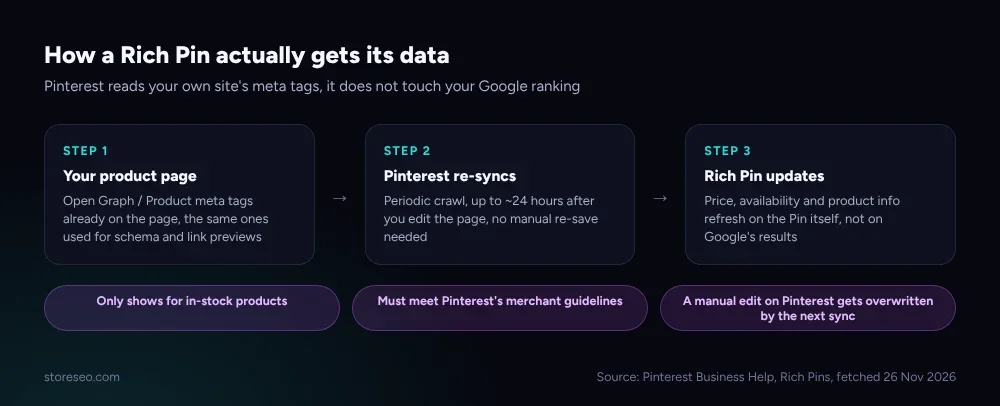 How a Rich Pin actually gets its data: your site’s own meta tags, re-synced roughly every 24 hours. Source: Pinterest Business Help, Rich Pins, fetched 26 Nov 2026.
That does not make Pinterest worthless, it makes it a different kind of channel. Rich Pins read the same Open Graph and product meta tags a store likely already has in place for link previews and schema, then periodically re-sync, typically within about 24 hours of an edit. A Product Pin only shows current price and availability for items that are actually in stock and meet Pinterest’s merchant guidelines; a manual edit made directly on Pinterest gets overwritten by the next automatic sync, which tells you plainly that this is a one-way data feed from your site outward, not a two-way ranking relationship.
What Does Pinterest’s Own Data Show?
The clearest signal of what Pinterest actually rewards is not a ranking factor, it is a commerce one. To join the Verified Merchant Program and earn the blue-checkmark status that makes a store look vetted to shoppers, Pinterest requires a business account at least three months old, a claimed website at least nine months old with 75% or more of its catalog successfully ingested, and, for the last 30 days straight, at least one page-visit event every seven days, one add-to-cart event every seven days and one checkout event every seven days, with every checkout event carrying a currency and a product ID.
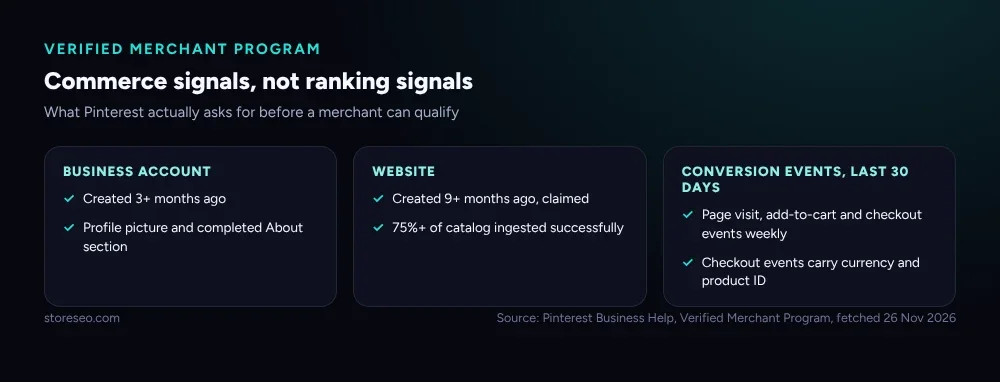 What Pinterest asks for before a merchant can qualify for verification. Source: Pinterest Business Help, Verified Merchant Program, fetched 26 Nov 2026.
Read that list again: every requirement measures whether real shoppers are actually visiting, adding to cart and buying through a pin, not whether the store’s pages are structured, crawlable or well-linked the way an SEO signal would be. Pinterest is explicitly optimizing its own program for verified commerce activity, which is the strongest evidence that its internal incentive for a merchant has nothing to do with Google and everything to do with proven conversions on its own platform.
What Do AI Engines Do With Pinterest Content?
This is where the evidence runs thin, and the honest answer matters more than a confident one. Multiple 2026 studies track what ChatGPT, Perplexity, Google AI Mode and Google AI Overviews cite when they answer a question: a Semrush analysis of 325,000 prompts names Reddit the top-cited domain across ChatGPT Search, Google AI Mode and Perplexity, and Higoodie’s 2026 citation heatmap puts Reddit’s share of ChatGPT’s social-platform citations as high as 89%. Neither study, nor Tinuiti’s Q1 and Q2 2026 Citation Trends Reports, breaks out a Pinterest-specific citation share the way each of them names Reddit and YouTube by platform.
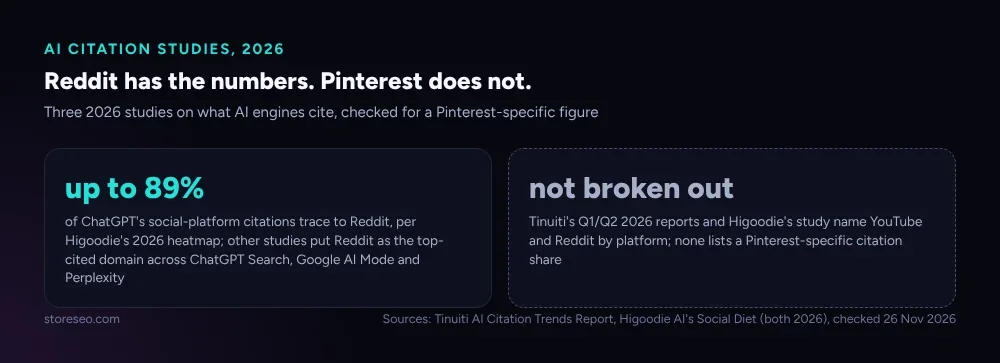 Reddit has the numbers. Pinterest does not, in any 2026 citation study checked for this post. Sources: Tinuiti AI Citation Trends Report, Higoodie AI’s Social Diet, checked 26 Nov 2026.
That absence is not proof that AI engines never surface Pinterest content, only that no dated, public study puts a number on it the way Reddit’s citation share is documented. Publishing an invented figure here would be the wrong move; the honest read is that Pinterest’s role in an AI engine’s answer is currently unmeasured, not confirmed strong or confirmed weak. If the real concern is whether an AI assistant can read your store’s own pages at all, independent of anything a pin does, AIScan’s free agent-readiness checker answers that directly in a few seconds, which is a more reliable lever than hoping a pin gets cited.
So Should A Shopify Store Use Pinterest?
Yes, for what it actually does, which is not SEO. Set up Rich Pins so your current price, availability and product details show correctly wherever a shopper encounters your pin, install Pinterest’s own app from the Shopify App Store so your catalog stays in sync, and treat the Verified Merchant Program’s requirements as a conversion checklist worth meeting on their own terms. What you should not do is pin content expecting it to move a product page up Google’s results, because neither Google’s own documentation nor any dated AI-citation study supports that mechanism today.
One lever actually sits inside your control before a pin is ever created: what your page itself hands Pinterest, or any other platform, to build that preview from. StoreSEO’s Social previews feature lets you set a custom Open Graph title, description and image per page, so the card a shopper sees when your product is pinned, or shared anywhere else, is one you wrote on purpose rather than whatever a theme happened to generate. StoreSEO cannot make Pinterest cite you or rank you, but it can make sure the one surface you do control looks deliberate.
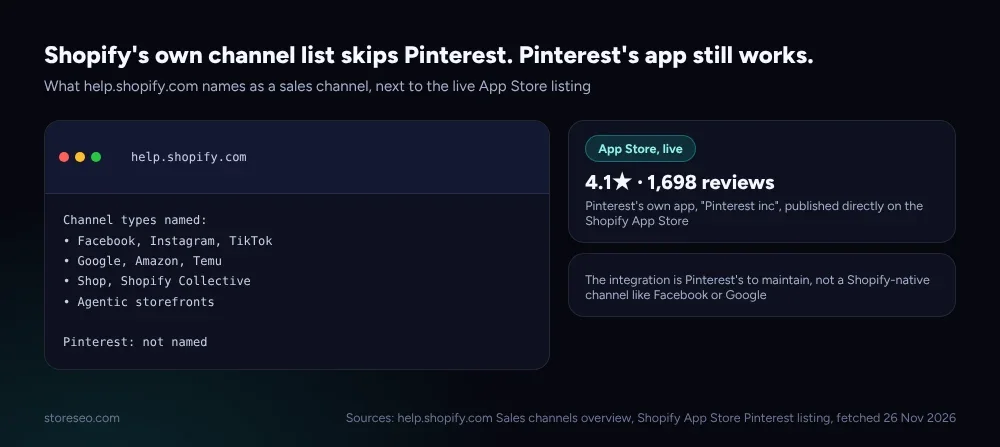 Pinterest’s integration is its own to maintain, not a Shopify-native channel. Sources: help.shopify.com Sales channels overview, Shopify App Store Pinterest listing, fetched 26 Nov 2026.
Notably, Shopify’s own current sales channels overview names Facebook, Instagram, TikTok, Google, Amazon, Temu, Shop and Shopify Collective as its channel types, with no mention of Pinterest at all. That is not a sign Pinterest stopped working; Pinterest’s own app, published directly by “Pinterest inc”, is still live on the Shopify App Store rated 4.1 stars across 1,698 reviews. It simply means the integration today is Pinterest’s to build and maintain, not a channel Shopify promotes alongside its own first-party partnerships, which is one more reason to set expectations by what Pinterest itself documents rather than by where it sits on Shopify’s channel list. For the fuller picture of how a card actually looks when someone shares your product, our Shopify social preview card examples post covers the on-page half of this, and does Reddit help Shopify SEO runs the identical evidence-first test on a different platform with a very different answer. For the broader question of how AI engines decide what to recommend at all, our AI search visibility pillar walks through the rest of it.
Frequently Asked Questions (FAQs)
1. Does pinning my Shopify products improve my Google ranking?
No. Neither Google’s own structured-data documentation nor any rich-result type it has published treats a pin as a ranking input. Pinterest can send you traffic directly, but it does not move your product pages up Google’s results.
2. What is the actual benefit of setting up Rich Pins?
Rich Pins keep the price, availability and product details on your pins current automatically, by reading the same meta tags your site already serves, re-syncing roughly every 24 hours. That accuracy builds shopper trust and can improve clicks and saves, which is a real benefit, just not an SEO one.
3. Does Pinterest’s Verified Merchant Program affect search rankings?
No. Its requirements, weekly page-visit, add-to-cart and checkout events plus catalog and account age thresholds, measure commerce activity on Pinterest itself. None of them are inputs to Google’s ranking algorithm.
4. Do AI tools like ChatGPT or Perplexity cite Pinterest when recommending products?
The honest answer is we do not know at a measured level. The 2026 citation studies that document Reddit’s and YouTube’s share of AI citations do not report a Pinterest-specific figure, so there is no dated evidence either confirming or ruling out AI engines citing pins.
5. Why doesn’t Shopify list Pinterest as a sales channel anymore?
Shopify’s current sales-channels help page names its first-party partnerships (Facebook, Instagram, TikTok, Google, Amazon, Temu, Shop, Shopify Collective) and leaves Pinterest off that list. Pinterest’s own app remains live and official on the Shopify App Store; the integration is maintained by Pinterest rather than promoted as a Shopify-native channel.
6. Is Pinterest worth a Shopify store’s time at all?
Yes, as a shopping-intent discovery and traffic channel in its own right, not as an SEO tactic. Accurate Rich Pins and a catalog that meets the Verified Merchant Program’s bar are the levers that actually matter on Pinterest’s own terms, alongside a deliberate Open Graph preview set through a tool like StoreSEO rather than left to a theme default.
Pinterest earns a place in a Shopify store’s marketing mix on its own evidence, real product-data syncing and measurable shopping-intent traffic, not on a borrowed promise that it moves Google rankings. try StoreSEO on the Shopify App Store
Keep reading
Shopify vs Wix for SEO: What You Control
Shopify and Wix both let you edit titles and slugs, but Wix generates an llms.txt file and tracks AI citations automatically; Shopify does not.
Read article
Shopify vs BigCommerce for SEO: What You Control
Shopify and BigCommerce both let you edit page titles and meta descriptions, but they diverge sharply on robots.txt, URLs and AI-crawler rules.
Read article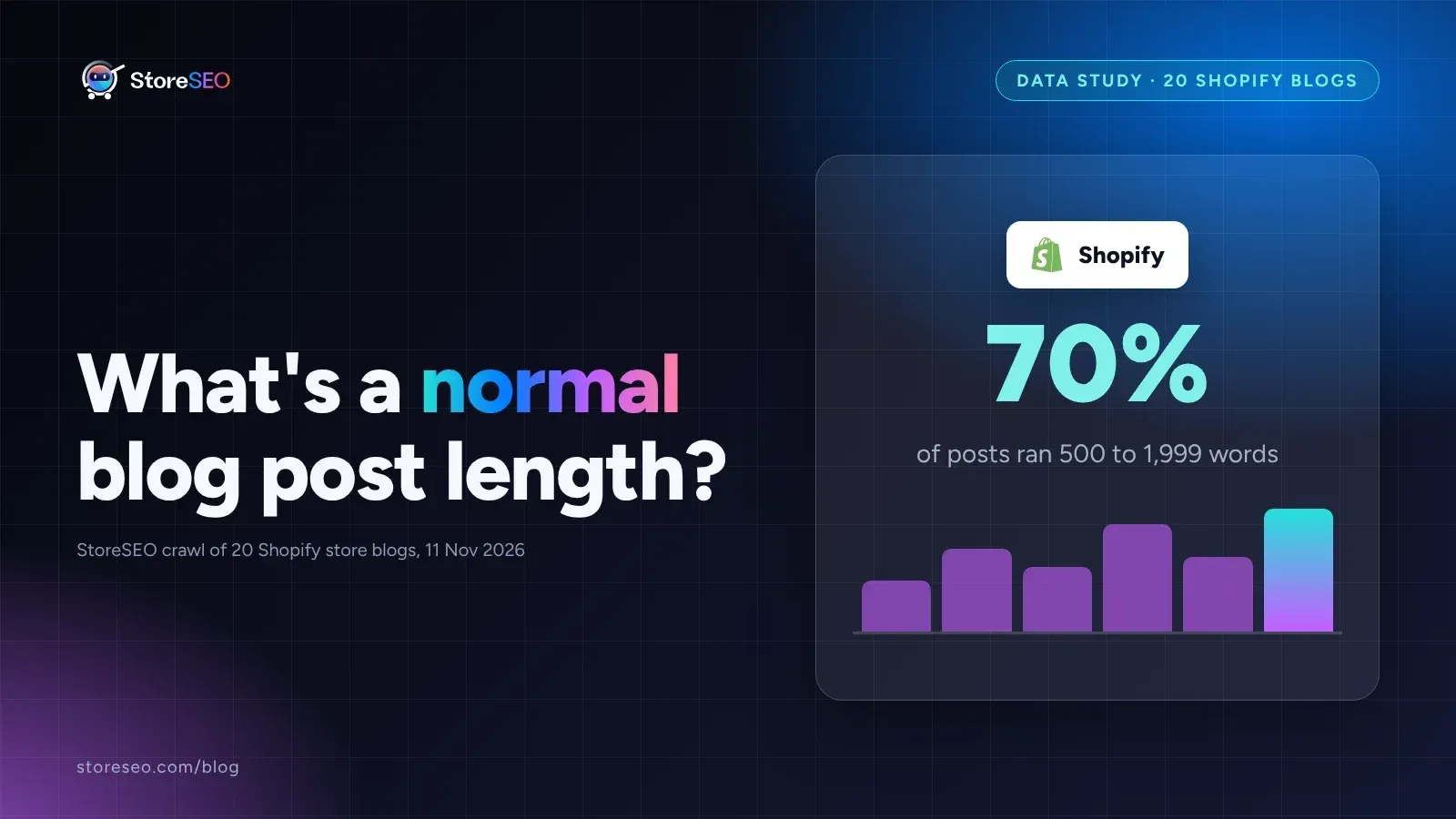
What's a Normal Shopify Blog Post Length?
In a StoreSEO crawl of 20 real Shopify store blogs, 70% of posts ran 500 to 1,999 words, and the shortest posts carried the fewest internal links.
Read article