
What's a Normal Shopify SEO Score? Two Benchmarks
Normal is lower than most merchants assume. Two of our own published studies set the bar: only 29% of 300+ audited Shopify product pages carry complete required schema, and even our best-optimized pages cap near an AI readiness score of 79 because of a site-wide indexing gap, not a content flaw.
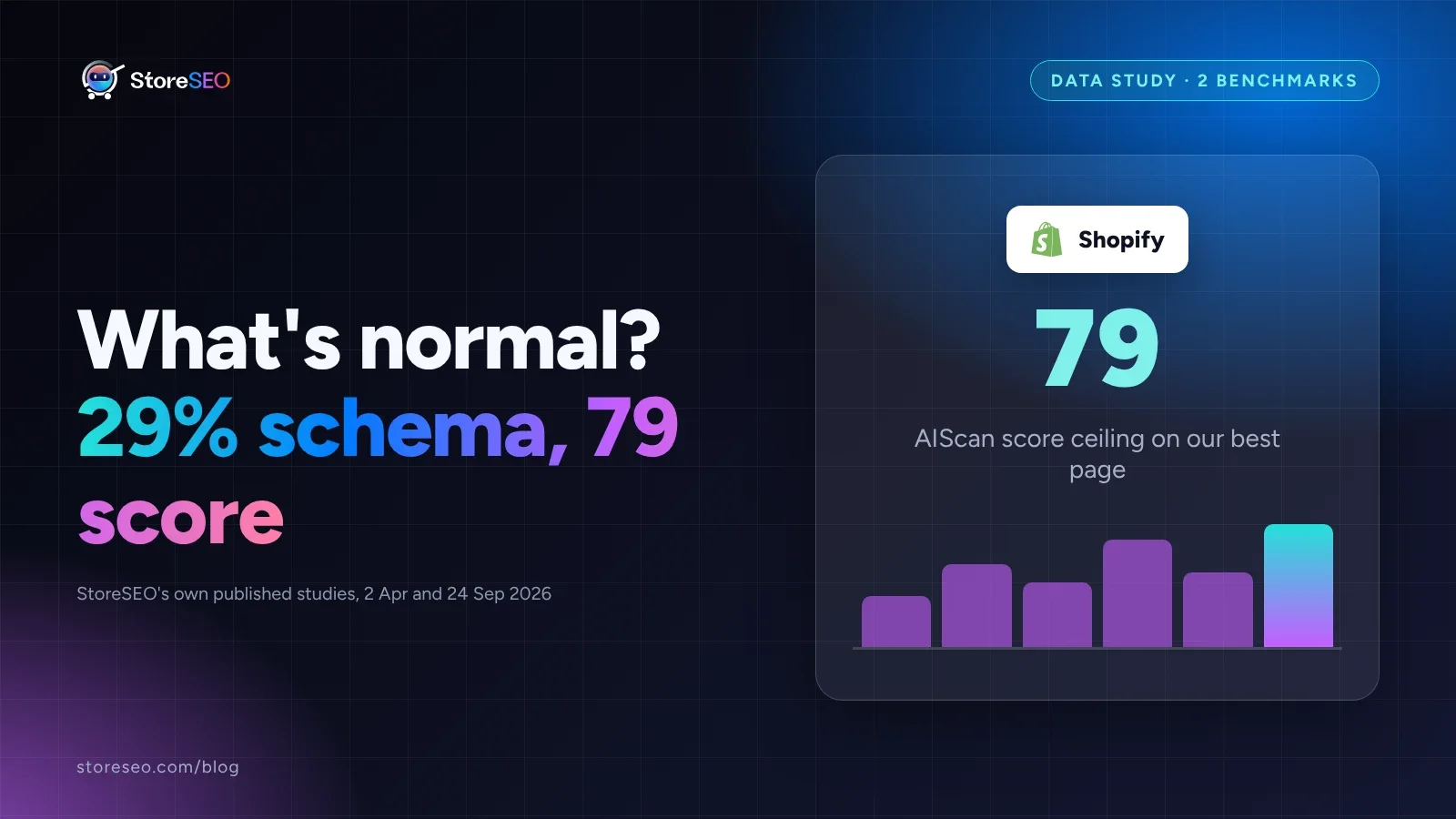
TL;DR: two already-public StoreSEO studies, read together as a rough benchmark for where your own store probably sits.
| Benchmark | What It Measures | Typical Finding | What To Fix First |
|---|---|---|---|
| 300-page schema audit (2 Apr 2026) | Required Product schema on live Shopify product pages | Only 29% complete; 61%+ carry at least one validation error | Fix Product schema before anything else on the page |
| AI readiness score ceiling (24 Sep 2026) | Page-level AI-agent readiness on a single published post | 79 out of 100 on a clean, fully optimized page | Pass the page-level checks first; the last points are a site-wide fix, not yours to chase |
Neither number is an aggregate across every Shopify store in existence. Both are first-party, StoreSEO’s own, and both are the closest public answer to “what’s normal” that currently exists for either question.
What Did the 300-Page Schema Audit Find?
In April 2026 StoreSEO analyzed over 300 Shopify product pages across fashion, beauty, home goods, electronics, fitness, and a dozen other niches, checking each one for complete, valid Product schema. Only 29% carried every required field. More than 61% had at least one schema validation error, most often a missing price, a broken availability value, or review markup copied from a different product entirely.
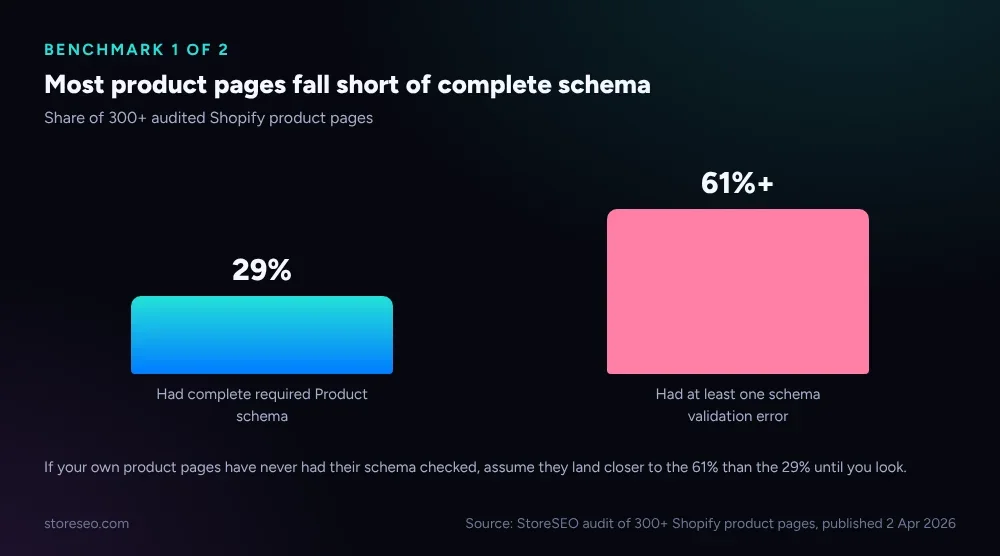 Share of 300+ audited Shopify product pages. Source: StoreSEO audit of 300+ Shopify product pages, published 2 Apr 2026.
That means a store with clean, complete schema on every product page is already ahead of roughly seven in ten competitors, before it has written a single extra word of content. Schema is not a ranking factor Google confirms directly, but it is a prerequisite for rich results and for the structured facts an AI assistant can quote back to a shopper with confidence.
Why Does a Clean Page Still Cap Out Near 79?
The second benchmark is StoreSEO’s own dogfooding result. AIScan, our sibling product for AI-agent readiness scoring, grades a single page across checks like crawlability, canonical tags, Open Graph data, and a single well-formed H1 with a matching title, description, and JSON-LD block. Run against our own cleanest, most fully optimized posts, the score tops out at 79.
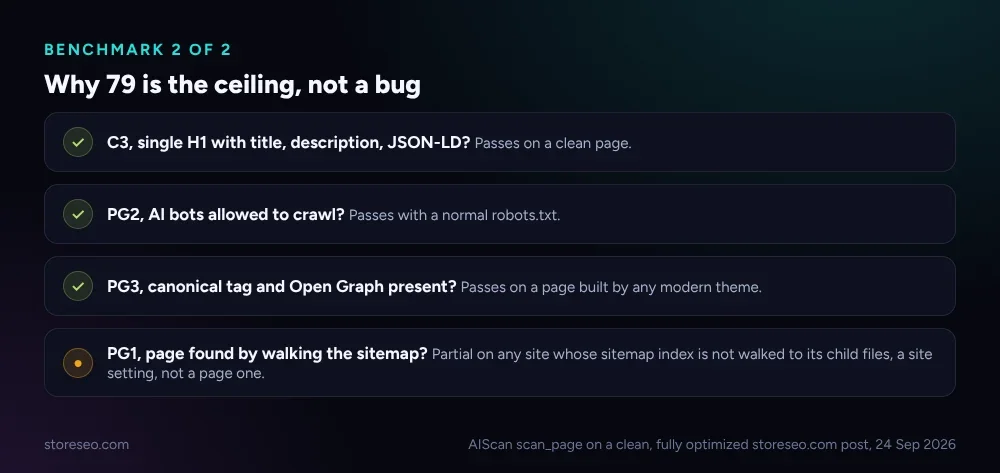 AIScan scan_page on a clean, fully optimized storeseo.com post, 24 Sep 2026.
That cap is not a content problem. It traces to one site-level check, PG1, which marks a page as only partially discoverable whenever a sitemap index points to child sitemap files that are never walked and crawled in turn. Every page-level check a single post can control, C3, PG2 and PG3, already passes. A merchant chasing an 80 or 90 on a single product or blog post is chasing a number that site architecture, not page content, determines.
What Counts as a Good Score, Realistically?
Put the two benchmarks side by side and a pattern holds across both: the gap between common and rare is almost entirely about fundamentals, not polish.
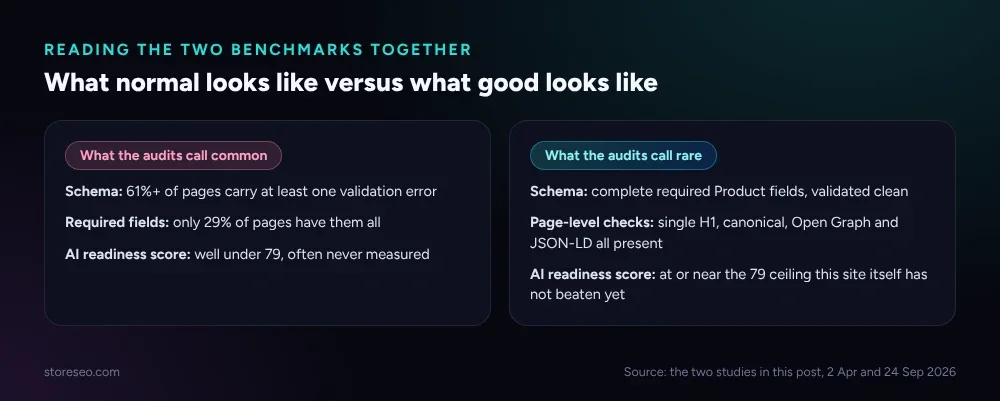 Source: the two studies in this post, 2 Apr and 24 Sep 2026.
A realistic target for an individual Shopify merchant is complete, validated Product schema on every page, plus a clean single-H1, canonical, and Open Graph setup on every post and product page a crawler would read. Both are achievable without a developer. Chasing a page-level AI readiness score past the high 70s, on the other hand, usually means fixing something at the site level first, such as a sitemap a crawler can actually walk end to end.
How Does Your Store Compare?
Neither benchmark requires guessing. A schema validator shows whether a single product page’s structured data is complete in under a minute, and StoreSEO’s SEO Analysis and score runs that same check across an entire catalog at once instead of one product at a time, flagging exactly which fields are missing on which page.
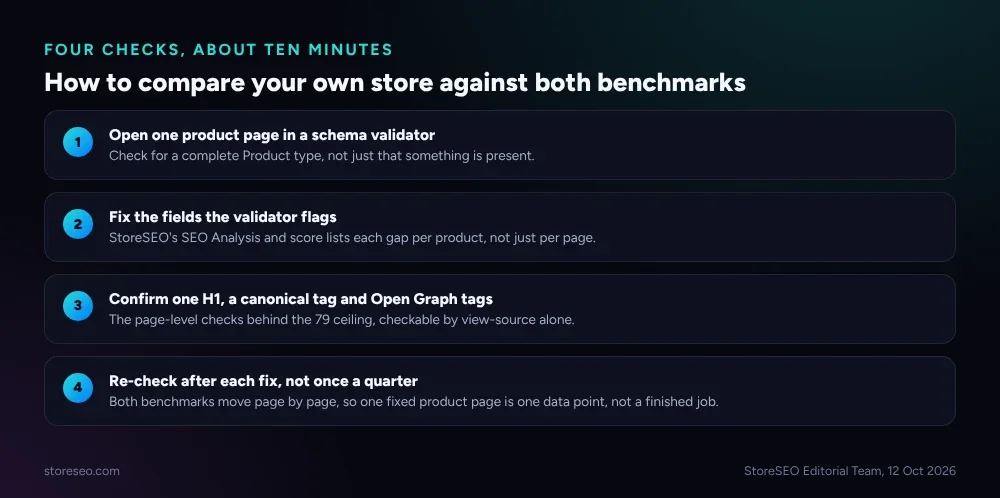 StoreSEO Editorial Team, 12 Oct 2026.
Most merchants who run this check for the first time land closer to the 61% with errors than the 29% without them, which is exactly why these two numbers are worth publishing as a benchmark rather than leaving every store to guess where it stands alone. For a step-by-step walkthrough of closing that gap on your own store, see how to get a 100 SEO score on Shopify.
Method and Privacy
Both benchmarks are already public, and neither uses private merchant or install data. The schema audit crawled 300+ live, public Shopify product pages across a dozen niches and ran each through a schema validator; the full methodology, sample selection and tooling are in the original study. The AI readiness ceiling comes from running AIScan’s own scan_page check against StoreSEO’s own published posts, the same way we audited our own blog against our own editorial standards. Neither figure claims to be the aggregate benchmark built from anonymized installs across every store using StoreSEO; that version needs data-team sign-off and is not what this post reports. Read the ultimate SEO checklist for the full baseline these two benchmarks sit inside.
Frequently Asked Questions (FAQs)
1. What is a normal Shopify SEO score?
There is no single official “Shopify SEO score.” The closest public answers are the two benchmarks in this post: 29% of product pages carry complete schema, and a clean, fully optimized page tops out near an AI readiness score of 79. Most stores that have never checked either number sit well below both.
2. Why does my AI readiness score stop improving?
If every page-level check already passes, the remaining gap is usually a site-level issue such as a sitemap index that is never walked to its child files. Fixing content on one more page will not move that number; fixing the sitemap setup will.
3. Is 29% schema completeness a Shopify platform problem?
No. Shopify’s own theme and Admin API support complete Product schema. The gap in the study came from themes and apps that ship partial or duplicated schema, not from any platform limit.
4. Does complete schema guarantee a higher Google ranking?
No, and this post does not claim it does. Schema is a prerequisite for rich results and for AI assistants to quote your product facts accurately, not a direct ranking signal Google has confirmed.
5. How is this different from an aggregate benchmark across every StoreSEO install?
It is scoped down on purpose. An aggregate, install-wide benchmark would need anonymized data and data-team sign-off, which this post does not have. These two numbers come from public studies you can read in full, linked above.
6. How long does it take to check my own store against these benchmarks?
Checking one product page’s schema and one post’s page-level checks takes about ten minutes by hand. Checking an entire catalog at once is what StoreSEO’s SEO Analysis and score is built to do in one pass.
Normal, for most Shopify stores today, is lower than either benchmark in this post, and that gap is the opportunity. Start with one product page’s schema, confirm the page-level checks on your best post, and try StoreSEO on the Shopify App Store.
Written by
StoreSEO Editorial Team