Google & AI Search Changes for Shopify, Tracked
 Written by M Asif Rahman
Google and AI search change faster than a once-a-quarter blog post can track, so this page is a running log instead. Every confirmed change that affects Shopify SEO goes in below, newest first, with its source, its date, and the one thing to actually do about it.
TL;DR: the table below is the whole log. Newest entry first, each one checked against its own primary source before it goes in.
| Date | Change | Affects Shopify stores how | What to do | Source |
|---|---|---|---|---|
| 29 Sep 2026 | A crawl of 148 live Shopify stores found almost none write explicit rules for AI bots | Most stores rely on the single default User-agent: * group and never name an AI crawler at all | Add named Allow groups for GPTBot, OAI-SearchBot and ChatGPT-User so your intent is explicit, not inherited by default | StoreSEO crawl study |
| 26 Sep 2026 | OpenAI documented three separate crawler roles instead of one | Blocking GPTBot does not block ChatGPT’s search answers or its on-demand page fetches | Decide on GPTBot, OAI-SearchBot and ChatGPT-User separately rather than treating “block ChatGPT” as one switch | OpenAI bot docs |
| 26 Sep 2026 | Shopify’s Dawn theme was confirmed to ship with no named AI-bot group | A store on a stock Dawn theme signals nothing specific to AI crawlers, by name, out of the box | Add the named groups yourself if you want explicit intent on record, since the theme will not do it for you | Live fetch, Dawn demo theme |
| 24 Sep 2026 | AI Overviews were found on 86 of this blog’s own top 100 ranked keywords | Classic snippets increasingly share the top of the page with an AI-written summary, even for low-competition terms | Write a complete, extractable 40 to 60 word answer high on the page, since that is the block AI Overviews tend to lift | OpenSEO ranked-keyword data |
| 7 May 2026 | Google removed the FAQ rich result from Search entirely | A store’s FAQ schema stopped earning the expandable snippet in Google results that day | Keep FAQ schema for AI-answer citation, but stop promising or expecting the rich result in Google itself | Google Search Central |
What Were the Biggest Shopify SEO and AI Search Changes This Year?
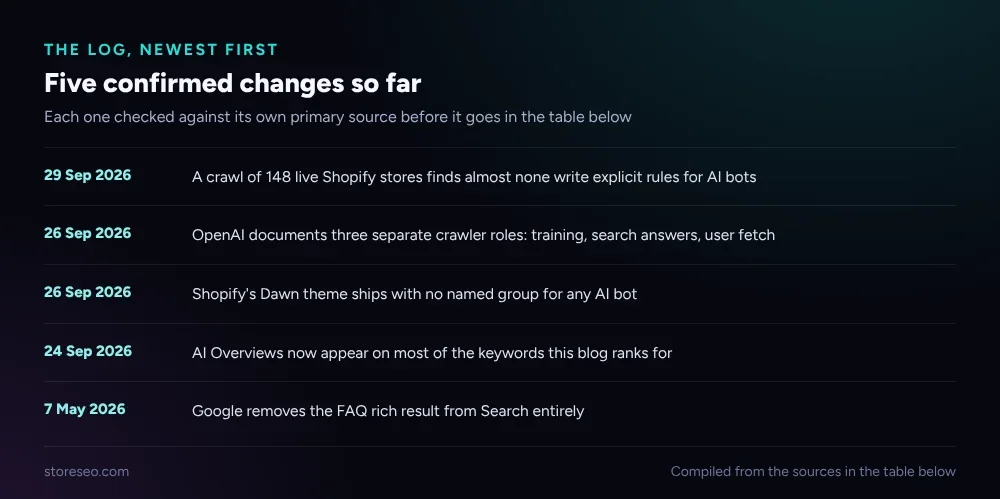 The five entries in the table above, compiled from their own primary sources.
The two changes worth the most attention both touch AI crawlers. On 29 September 2026 StoreSEO’s own crawl of 148 confirmed Shopify stores found that 90 percent say nothing about AI bots in their robots.txt at all, and only 0.7 percent block a named AI crawler on purpose (one store, and it was blocking Amazon’s bot, not an AI-answer one). That crawl sits next to a smaller, easy-to-miss fact from the same week: OpenAI’s own bot documentation, re-checked 26 September 2026, spells out that GPTBot, OAI-SearchBot and ChatGPT-User do three different jobs. Treating “AI bots” as one switch, on or off, misreads both findings at once: almost nobody is making a deliberate choice, and the choice itself is not one decision but three.
The quieter change is Google’s. On 7 May 2026 Google removed the FAQ rich result from Search, which is why this log does not promise one anywhere. StoreSEO still recommends FAQ schema, because an AI-answer engine reading a page for a citation benefits from the same structured data Google’s rich result used to display. The schema did not stop working. Its one visible payoff in classic Google results did.
StoreSEO advises on robots.txt as part of its wider SEO checks (see the docs on why a store is not appearing in Google search results), precisely because the default Shopify setup leaves this decision unmade rather than making it for you. This log exists for the same reason the Ultimate SEO Checklist exists: a changing landscape rewards the store that checks back, not the one that set its SEO once and left it.
How Do We Track These Changes?
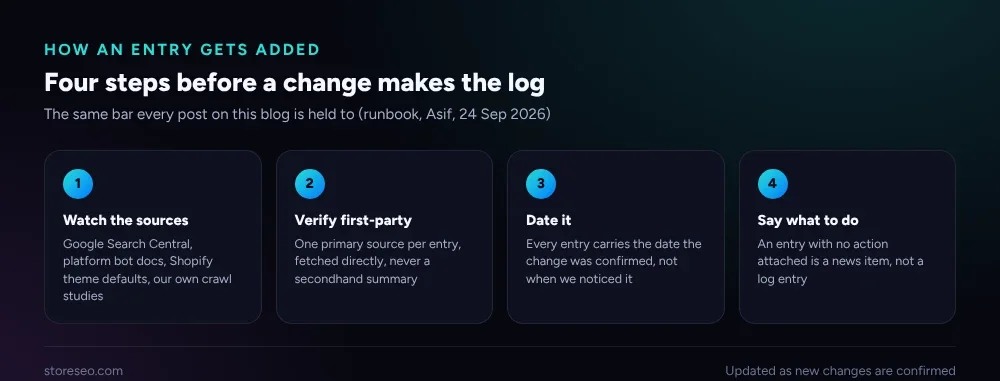 The bar every entry on this page has to clear before it gets added.
An entry earns its place in the table above through four steps, not one. First, we watch a short, fixed list of sources: Google’s own Search Central channel, the published bot documentation from OpenAI, Anthropic and Perplexity, the default robots.txt that ships with Shopify’s own Dawn theme, and StoreSEO’s own first-party crawl studies. Second, every entry is checked against a primary source directly, fetched at the time of writing, never summarized secondhand from another blog’s recap. Third, each entry carries the date the change was confirmed, not the date we happened to notice it, since those are often weeks apart. Fourth, and the step that actually makes this a log instead of a news feed: an entry with no action attached does not get added. “Google changed something” is not useful by itself. “Google changed something, and here is what to do about it on your own store” is the whole point.
This is the same discipline StoreSEO’s crawl study of 148 Shopify stores was built on, and the same one behind the Shopify robots.txt guide: a dated, sourced claim, or no claim.
What Should You Check on Your Own Store Right Now?
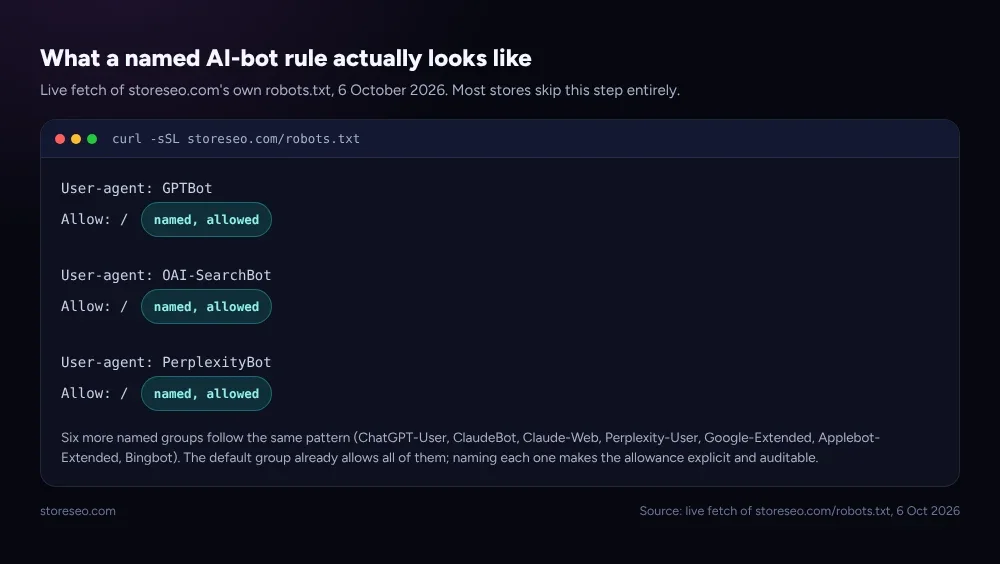 A named group is a decision on record; silence just inherits whatever the default group already allows.
Three checks come straight out of the table above, and all three take under ten minutes.
Open your store’s robots.txt and look for a named group for GPTBot, OAI-SearchBot and ChatGPT-User. If none of the three appears by name, your default User-agent: * group is almost certainly already allowing all three anyway, same as 90 percent of the stores StoreSEO’s crawl checked, so this is about making an existing allowance explicit and auditable, not about opening a door that was closed. If you are on Shopify’s Dawn theme specifically, assume nothing AI-specific is there until you check, since the confirmed default ships with no named AI-bot group at all.
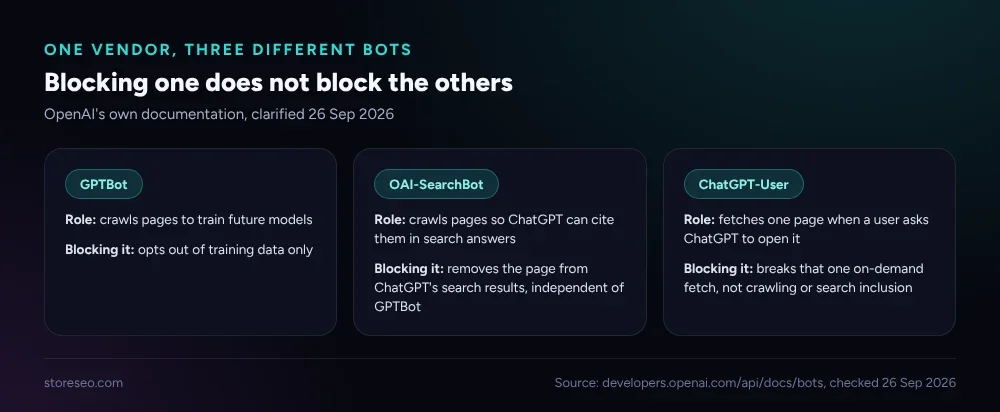 One vendor, three different jobs. A rule for one says nothing about the other two.
Second, if you blocked GPTBot at some point to opt out of AI training, check whether you meant to block OAI-SearchBot and ChatGPT-User too. They are separate roles under OpenAI’s own documentation, re-confirmed 26 September 2026, and a rule written for one does not carry over to the others. This is the same distinction covered in full in our Shopify SEO myths teardown, where “blocking one AI bot blocks them all” is one of the claims checked against the primary source and found false.
Third, if any page on your store still promises an FAQ rich result in Google, that promise has been wrong since 7 May 2026. Keep the FAQ schema itself; AI-answer engines still read it. Just stop telling shoppers to expect the expandable snippet in Google, because Google stopped showing it.
Frequently Asked Questions (FAQs)
1. What counts as an entry in this log?
A confirmed change to how Google or an AI search engine treats a Shopify store, each one checked against its own primary source and dated to when it was confirmed. A rumor, a forum post or an unconfirmed pattern does not get an entry until a primary source backs it.
2. How often is this page updated?
There is no fixed schedule. A new entry goes in as soon as a change is confirmed against a primary source, which in practice has meant roughly one entry every week or two so far. Check back rather than expecting a set cadence.
3. Does FAQ schema still get a rich result in Google?
No. Google removed the FAQ rich result from Search on 7 May 2026, and that has not changed since. FAQ schema is still worth adding for AI-answer engines that read structured data when forming a citation, but do not promise the expandable snippet in Google itself.
4. Does blocking GPTBot stop ChatGPT from citing my store?
Not by itself. GPTBot, OAI-SearchBot and ChatGPT-User are three separate crawlers under OpenAI’s own documentation, each with a different job. Blocking GPTBot opts a store out of training-data crawling only; OAI-SearchBot and ChatGPT-User need their own rules if you want to affect search citations or on-demand fetches too.
5. Do I need to add named AI-bot rules if my robots.txt already says nothing about them?
Not strictly. A store that names no AI bot is almost always already allowing all of them through its default User-agent: * group, the same as 90 percent of the stores in StoreSEO’s own crawl. Naming each bot does not change that allowance; it just puts the decision on record instead of leaving it implicit.
6. Where do the numbers in this log come from?
Each one is linked to its primary source in the table at the top: Google’s Search Central channel, OpenAI’s own bot documentation, a live fetch of Shopify’s Dawn theme, StoreSEO’s own crawl of 148 Shopify stores, and StoreSEO’s own ranked-keyword data. None of them is a secondhand summary of another blog’s post.
New Shopify SEO and AI search changes land here as soon as they are confirmed, so bookmark this page rather than this week’s entry, and try StoreSEO on the Shopify App Store.
Keep reading
Discover BFCM Tips: 10+ Essential Store Optimizations for Black Friday Traffic Boost
Black Friday and Cyber Monday 2025 are approaching fast! Last year, Shopify merchants made a record $11.5B in sales. Prepare your store with our step-by-step Shopify BFCM optimization guide. Learn how to analyze data, speed up your site, deploy winning apps, forecast inventory, engage loyal fans early, and run marketing campaigns to maximize revenue.
Read article
What Happens When You Skip Google Product Category?
Skipping Google Product Category rarely blocks a sale, but in apparel, phones, software and alcohol it can quietly get a listing disapproved.
Read article
Shopify Product Schema JSON-LD: Copy-Paste Code Blocks
Shopify's Dawn theme outputs Product and Offer JSON-LD automatically but ships no AggregateRating block at all, so here are the exact ones to add.
Read article