
Shopify SEO App Features Worth Paying For
Bulk AI content, keyword rank tracking and schema automation are worth paying for, because none of them have a real Shopify-native substitute at scale. A single-product score badge or a checklist that copies Shopify’s own settings is usually fluff dressed up as a feature.
TL;DR: the short version, before the detail.
| If you are paying for… | Verdict | Why |
|---|---|---|
| Bulk AI content across your catalog | Worth it | No Shopify-native way to rewrite hundreds of fields at once |
| Keyword rank tracking over time | Worth it | Shopify has no native equivalent at all |
| Schema automation (product, FAQ, local) | Worth it | Hand-editing JSON-LD does not scale past a handful of products |
| A single-product SEO score badge alone | Usually fluff | Reassuring, but changes nothing unless it comes with fix steps |
| A checklist that copies Shopify’s own settings | Usually fluff | Native fields already cover this below about 50 products |
A quick note on where we stand. This is the StoreSEO blog, and StoreSEO is our product, so we have a reason to make every app feature sound essential. To keep this honest, the criteria above come before any verdict, the fluff table below names one of StoreSEO’s own features alongside competitors’, and the section further down lists StoreSEO features we would call nice-to-have rather than must-have.
Which Shopify SEO App Features Are Worth Paying For?
A feature earns its keep when Shopify’s native admin cannot do the same job at the same scale, not because an app’s marketing page calls it “powerful.” The five below pass that test on most stores above a few dozen products.
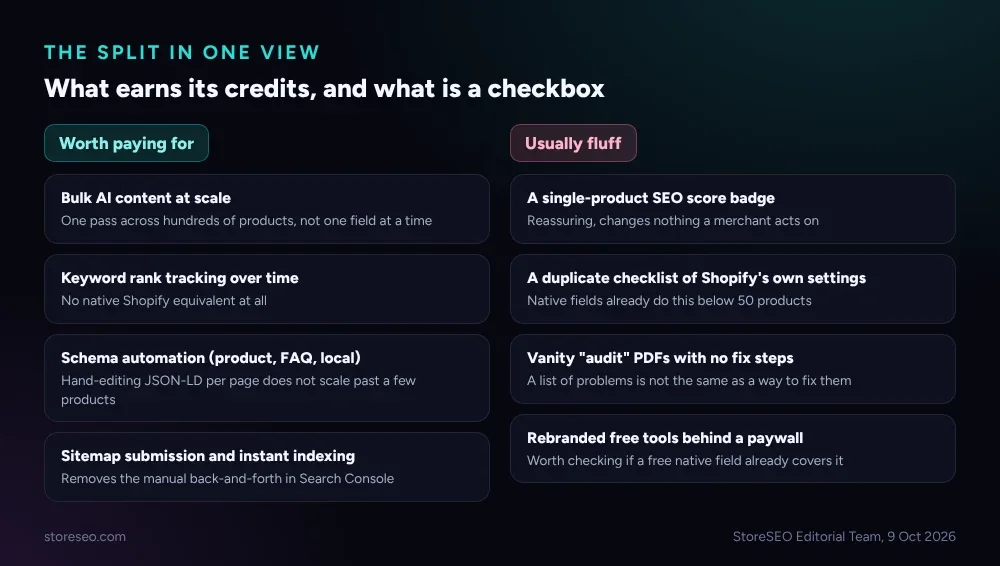 The split between features that save real time and features that are mostly reassurance.
| Feature | Why it earns its keep | Which apps have it |
|---|---|---|
| Bulk AI content (titles, descriptions, alt text) | Turns a week of manual editing into one pass across hundreds of products | Most full-suite SEO apps, StoreSEO included |
| Keyword rank tracking over time | No native Shopify equivalent at all, so the alternative is a separate paid tool | Common in paid tiers; rare on free plans |
| Schema automation (product, FAQ, local business) | Hand-editing JSON-LD per page does not scale past a handful of products | Most full-suite apps; depth varies by plan |
| Sitemap submission and instant indexing | Removes the manual back-and-forth inside Search Console | Common, usually included on free tiers |
| Bulk image optimization | Compressing and resizing hundreds of images by hand is a full day lost, not an afternoon | Common in image-focused and full-suite apps |
Bulk AI Content Is the Clearest Case for Paying
A merchant with 25 products can write titles and meta descriptions by hand in an afternoon. A merchant with 1,000 cannot, and that gap is exactly where an app’s AI content credits earn their price. StoreSEO’s AI Content Optimizer drafts meta titles, descriptions and keywords against an SEO score, and its AI Model Picker lets a store choose a cheaper model for a bulk first pass and save a stronger one for pages that earn the most traffic, with the credit cost shown before anything is spent.
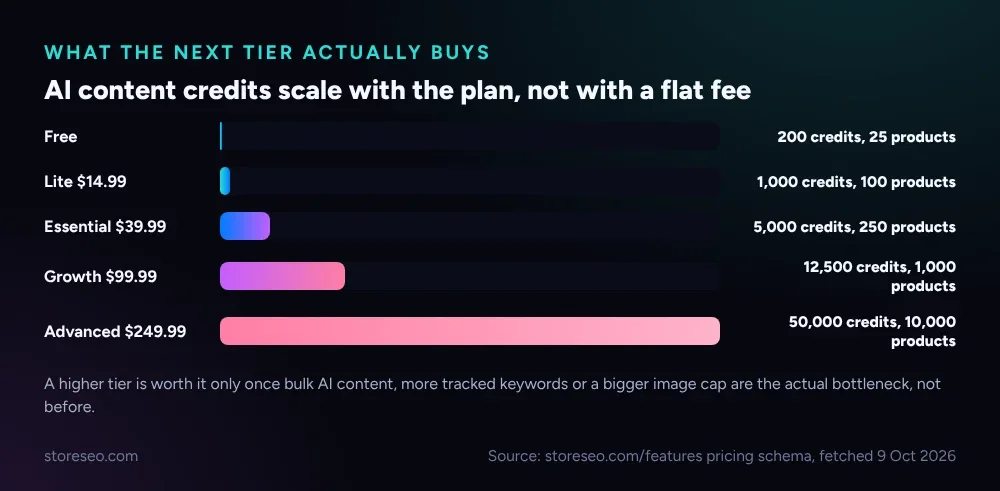 Credits and product caps by StoreSEO plan, fetched live from storeseo.com, 9 October 2026.
The credits scale with the plan, and that is the right way to think about whether to upgrade: pay for more capacity only once the current tier’s product cap or credit allowance is the actual bottleneck, not because a higher number sounds safer.
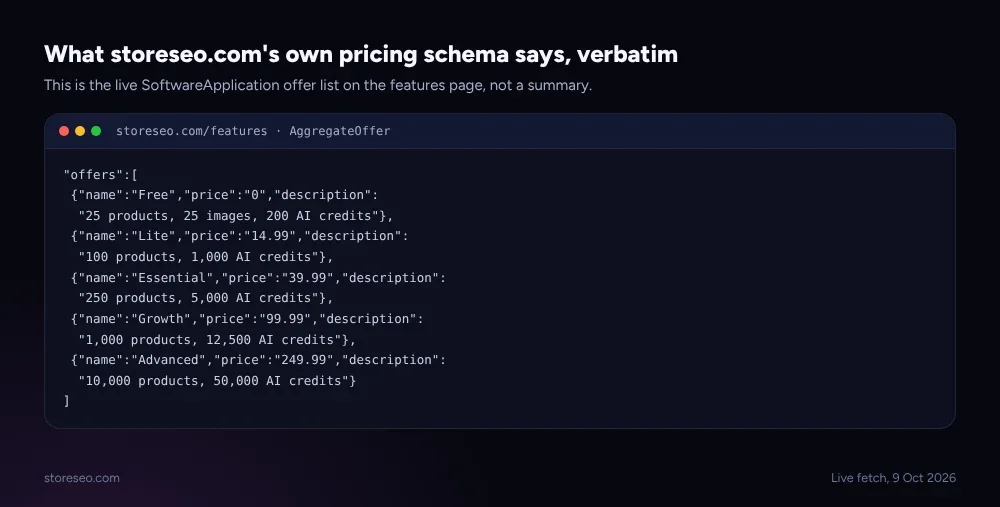 The live SoftwareApplication offer list on storeseo.com/features, fetched 9 October 2026.
If cost rather than features is the deciding factor, our Shopify SEO cost breakdown compares apps against agencies and freelancers directly.
What Counts as SEO App Fluff You Can Skip?
Fluff is not a feature that does nothing. It is a feature that looks like progress without changing what a merchant does next, and every SEO app, StoreSEO included, ships at least one.
| Feature | Why it is usually fluff | Which apps have it |
|---|---|---|
| A single-product SEO score badge alone | Reassuring, but changes nothing a merchant acts on unless it comes with fix steps | Nearly every SEO app, including StoreSEO’s own score |
| A duplicate checklist of Shopify’s native settings | Native fields already cover this below roughly 50 products | Common in budget and free apps |
| Vanity “audit” reports with no fix instructions | A list of problems is not the same as a way to fix them | A handful of lead-generation-style apps |
| A rebranded free tool behind a paywall | Worth checking whether a free native Shopify field already covers it | Occasional, more common in bundled suites |
StoreSEO’s own SEO Analysis score is a real example: the number itself is not the value. StoreSEO’s SEO Analysis is worth paying for only because the score comes with the exact fix for every issue it finds, not because the number exists. If your current app only shows a score with no next step, you are paying for the fluff half of this feature.
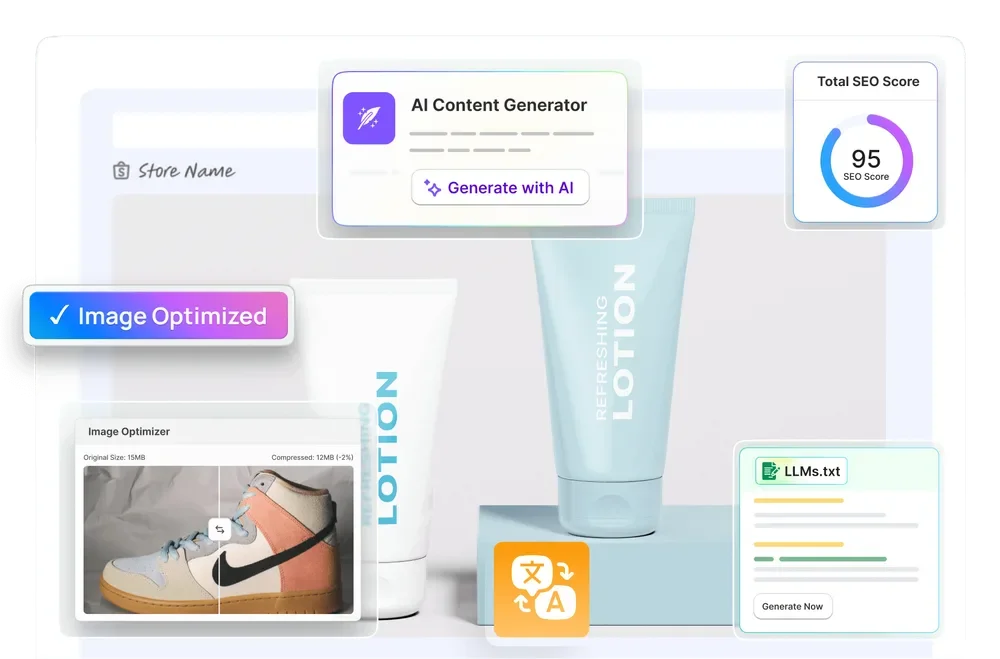 StoreSEO’s admin screen: the score sits beside the AI content, image and LLMs.txt tools that act on it.
Whether you need any app at all below that product count is a separate question; our native vs app comparison covers it in full.
Which StoreSEO Features Are Nice to Have, Not Must-Have?
Honesty about our own product means saying which of its features are not for every store, not just which ones are.
- AI Model Picker, letting you choose Claude or GPT-5.6 Sol per task. Nice to have if you run content at real volume and want to control credit spend by model; most stores on a single plan do fine leaving the default model selected.
- Local Business Schema, publishing real store locations as LocalBusiness schema. Must-have for a brand with physical locations; not relevant at all for an online-only store with no address to publish.
- Multilingual SEO, translating products, pages, FAQs and AI snippets across languages. Nice to have the moment a second market opens; dead weight on a single-language, single-market store.
- AI Brand Visibility tracking, showing how often AI answer engines mention your brand. Worth paying for once a store is actively trying to earn AI citations; premature for a brand-new store with no citations to track yet.
None of these four are fluff. They are each genuinely useful to a specific kind of store, and genuinely unnecessary to a different one, which is the honest answer to “is this worth paying for”: it depends what you run, not whether the feature exists.
How Do You Decide Which Tier to Pay For?
Match the tier to the bottleneck you actually hit, not the one you expect to hit eventually. A 40-product store writing its own copy rarely needs more than a free or entry tier; a 2,000-product catalog doing a bulk AI pass every month needs the credits and product cap a mid or top tier buys. If you are choosing the app itself rather than just its tier, our best Shopify SEO apps roundup and our Avada alternatives comparison cover the wider field on the same worth-it-or-not basis as this post.
Frequently Asked Questions (FAQs)
1. Do I need to pay for a Shopify SEO app at all?
Not always. Below roughly 50 products with titles and descriptions already written, Shopify’s native fields usually cover the basics. An app earns its price once bulk AI content, rank tracking or schema automation at scale becomes the actual bottleneck.
2. What is the single clearest worth-paying-for feature?
Bulk AI content across a catalog, because there is no faster native alternative and because the time saved compounds with every additional product. Keyword rank tracking is a close second, since Shopify has no native equivalent at all.
3. Is an SEO score by itself worth paying for?
No, on its own. A score only earns its place in a paid tier when it comes bundled with the exact fix for each issue it finds, not as a standalone number with nothing actionable attached to it.
4. Does StoreSEO have any fluff features?
Honestly, yes, in the sense that any standalone score badge risks being fluff. StoreSEO’s own SEO Analysis score avoids that trap because it always ships with detailed fix instructions, which is the condition that makes a score worth paying for rather than decorative.
5. Should I pay for every feature an SEO app offers?
No. Features like AI Model Picker, Local Business Schema and Multilingual SEO are genuinely useful to specific stores and unnecessary to others. Pay for the tier that matches your actual catalog size and market, not the one with the longest feature list.
6. Can I mix Shopify’s native SEO fields with a paid app?
Yes. A paid app typically edits the same native fields Shopify already exposes, rather than replacing them, so there is nothing to migrate away from if you later decide an app is not worth the cost for your store.
Pay for the features that replace real hours, bulk AI content, rank tracking and schema automation among them, and skip the ones that only replace a glance at a settings page. If you want to try the worth-paying-for list on your own catalog, try StoreSEO on the Shopify App Store.
Written by
StoreSEO Editorial Team