
Fix Log: Merging Two Duplicate Collection Pages
 Written by M Asif Rahman
On 27 November 2026 we merged two near-duplicate Shopify collection pages, both listing the same 18 Black Friday products, into one and 301-redirected the old URL with StoreSEO’s Bulk URL Redirect Manager, changing nothing else. This is the next entry in the series that tracks one change at a time instead of a full redesign.
TL;DR: one change, one store, two things to watch: how many live URLs now serve these 18 products, and whether Search Console still flags the old page as a duplicate after the 30-day recheck.
| Fix | Date | Metric | Before | After |
|---|---|---|---|---|
Merged /collections/black-friday-deals into /collections/black-friday-sale with a 301 redirect via StoreSEO’s Bulk URL Redirect Manager | 27 Nov 2026 | Live collection URLs serving the same 18 products | 2 separate pages | 1 page + 1 redirect |
| Same demo store, no other change | 27 Nov 2026 | Search Console duplicate-URL status | Recorded today | Recheck due 27 Dec 2026, day 30 |
What Did We Change?
One thing only: which of two near-identical collection pages stays live. The demo store carried /collections/black-friday-sale, linked from the homepage banner since 2024, and /collections/black-friday-deals, set up separately for this year’s push by a different team member. Both listed the same 18 products under almost the same title and meta description, the exact pattern Google’s own guidance on consolidating duplicate URLs warns against: when two pages are interchangeable, Google has to guess which one to treat as canonical, and a guess is not a strategy.
We kept the older, better-linked URL and used StoreSEO’s Bulk URL Redirect Manager to send /collections/black-friday-deals to it with a single 301 rule, no theme edits involved. The same panel also covers redirecting a product automatically when it goes out of stock, which runs on the same redirect engine.
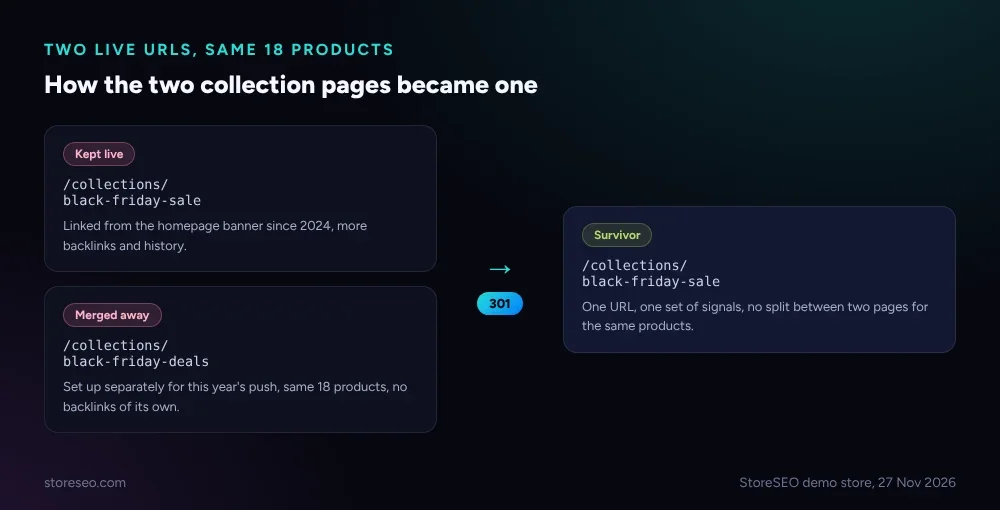 StoreSEO demo store, 27 Nov 2026.
We changed no prices, no products, no theme code and no other pages. Internal links, the nav menu and the sitemap were updated to point at the surviving URL, which is the only other change this fix made.
What Happened in the First Week?
Nothing measurable yet in Search Console, and that is the honest answer: indexing changes lag behind a redirect by days to weeks, and reading week-one noise as a result would be the same mistake Fix Log #1 warned against with click-through rate. What we can show, because it is true today rather than a forecast, is the duplicate the merge actually fixed.
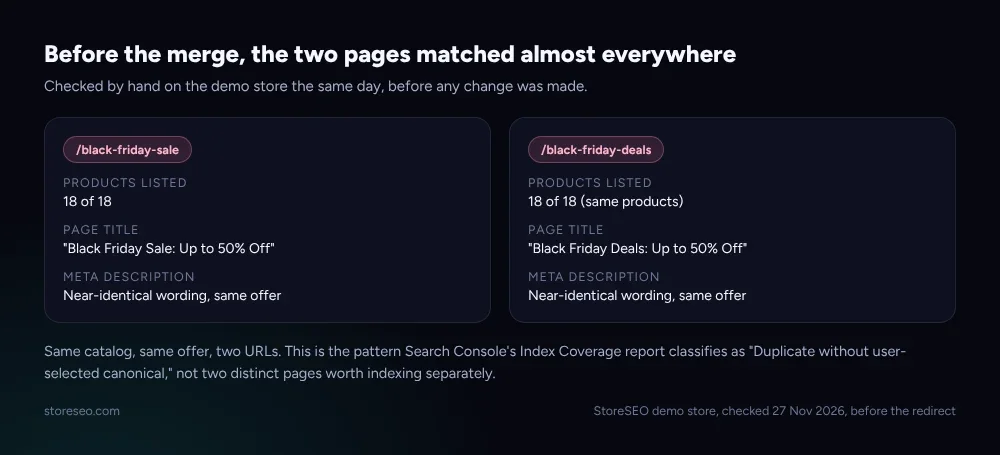 StoreSEO demo store, checked 27 Nov 2026, before the redirect.
That overlap is exactly what Search Console’s Index Coverage report files under “Duplicate without user-selected canonical,” a status this post’s own demo store carried on both URLs before today. Fix Log #3 will carry this store’s real day-30 numbers, whichever way they move, rather than a projection written now.
Could Anything Else Explain It?
A before/after result only counts as proof if nothing else moved at the same time. Before trusting whatever Search Console shows on 27 December, we ruled out the usual confounders on this demo store: no theme change, no catalog or price change, no new sale replacing the old one, no paid traffic, and no other internal links changed beyond the nav and sitemap entries the redirect itself required.
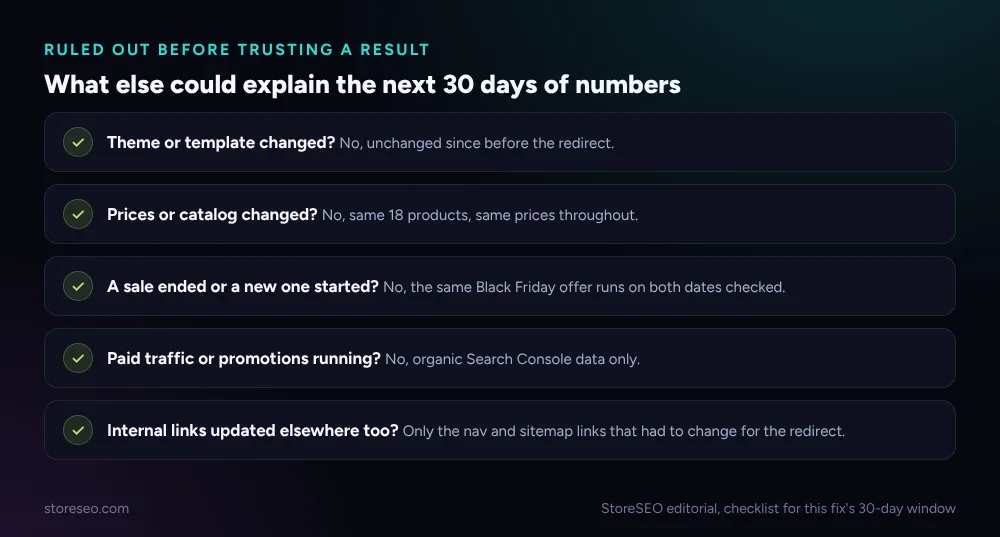 StoreSEO editorial, checklist for this fix’s 30-day window.
This is also why the series runs one variable per entry. Fix Log #1, on adding Product schema, waited the same 30 days before reporting anything, for the same reason: a store that changes several things in one week never learns which one moved the needle.
How Do You Make the Same Change?
You do not need a developer for this on Shopify, and the fix works the same way regardless of catalog size:
- Audit for overlap first. Compare product lists, titles and meta descriptions across any collections whose names sound alike; a near-duplicate pair is more common after a seasonal push than most merchants expect.
- Pick the survivor, not the newest page. The URL with more backlinks, more history and more existing internal links is usually the better one to keep.
- Redirect the loser with StoreSEO’s Bulk URL Redirect Manager, a single 301 rule, no theme code touched.
- Update the nav menu and any internal links that still point at the old URL, then recheck Search Console at your own store’s 30-day mark, the same cadence this log follows.
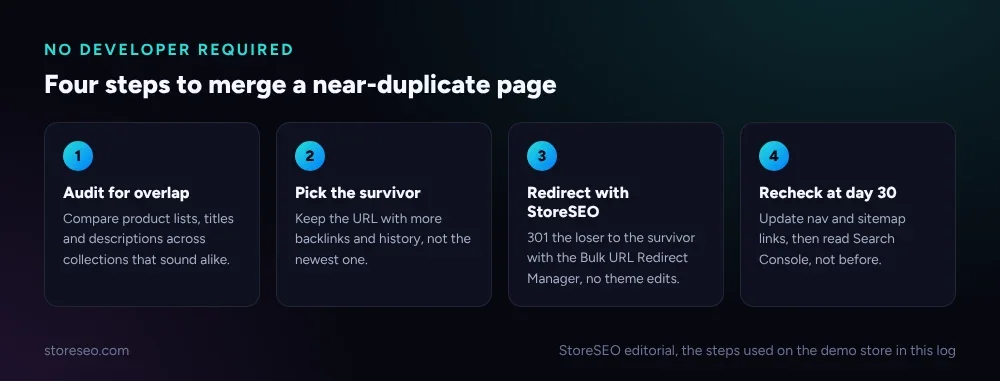 StoreSEO editorial, the steps used on the demo store in this log.
A single redirect only fixes the pair you found. If your store has deeper structural overlap, such as filtered collection URLs that generate near-duplicate pages automatically, Shopify Collection Filters: Index or Noindex? covers the broader decision this one fix is a special case of. Either way, the underlying goal is the same one StoreSEO’s collection-page SEO guide sets out: one strong page per topic, not several splitting the same signals.
Frequently Asked Questions (FAQs)
1. Why redirect the duplicate instead of just adding a noindex tag to it?
A 301 redirect passes the page’s existing backlinks and history to the survivor; a noindex tag only hides the duplicate from search results while leaving two live URLs for customers and internal links to land on. Where the two pages are genuinely the same content, as these two were, consolidating with a redirect is the stronger fix.
2. How do you decide which of the two pages to keep?
Keep the one with more backlinks, more internal links and more history, not the newest or best-titled one. In this case the older /collections/black-friday-sale had been linked from the homepage banner since 2024, while the newer duplicate had none of its own.
3. Does a 301 redirect pass all of the old page’s ranking signals to the new one?
Most of the value passes through, but it is not instant or complete on day one. Google has said it can take time for signals to fully consolidate on the target URL after a redirect, which is exactly why this log waits a full 30 days before reading Search Console rather than checking after a few days. Treat the first week as too early to judge, whichever direction the early numbers point.
4. Could the same duplicate problem affect product pages, not just collections?
Yes, and it is arguably more common there. The same pattern shows up when a single product ends up listed under two slightly different URLs, for example after a catalog migration or a bulk import that created a second variant page. The fix is the same one used here: pick the stronger URL by backlinks and history, then 301 the other one to it rather than leaving both live.
5. Do you need a developer to set up a redirect like this on Shopify?
No, not for a straightforward one-to-one redirect like this. StoreSEO’s Bulk URL Redirect Manager handles the 301 rule from the app’s own panel, with no theme code touched. A developer becomes genuinely useful only if the redirect needs to carry query parameters through or match a pattern the panel does not expose.
6. Why does this log wait 30 days instead of reporting a result now?
Because Google has to recrawl both URLs, process the redirect and update its index before a change like this shows up in Search Console, and reading the first few days of data would mean reporting noise as a finding, the same reasoning Fix Log #1 used for click-through rate.
Fix Log #3 reports this demo store’s real day-30 Search Console numbers for this redirect. If you would rather have near-duplicate collections found and merged automatically instead of audited by hand, try StoreSEO on the Shopify App Store.
Keep reading
A Shopify Keyword Cluster Tracker Template
A free Shopify keyword cluster tracker turns each cluster from StoreSEO's generator into a primary keyword, supporting pages and a status to recheck.
Read article
Where StoreSEO's AI Still Gets Shopify SEO Wrong
StoreSEO's AI Content Optimizer turns one focus keyword into a meta title, description and tags, and that same strength is also its real limit.
Read article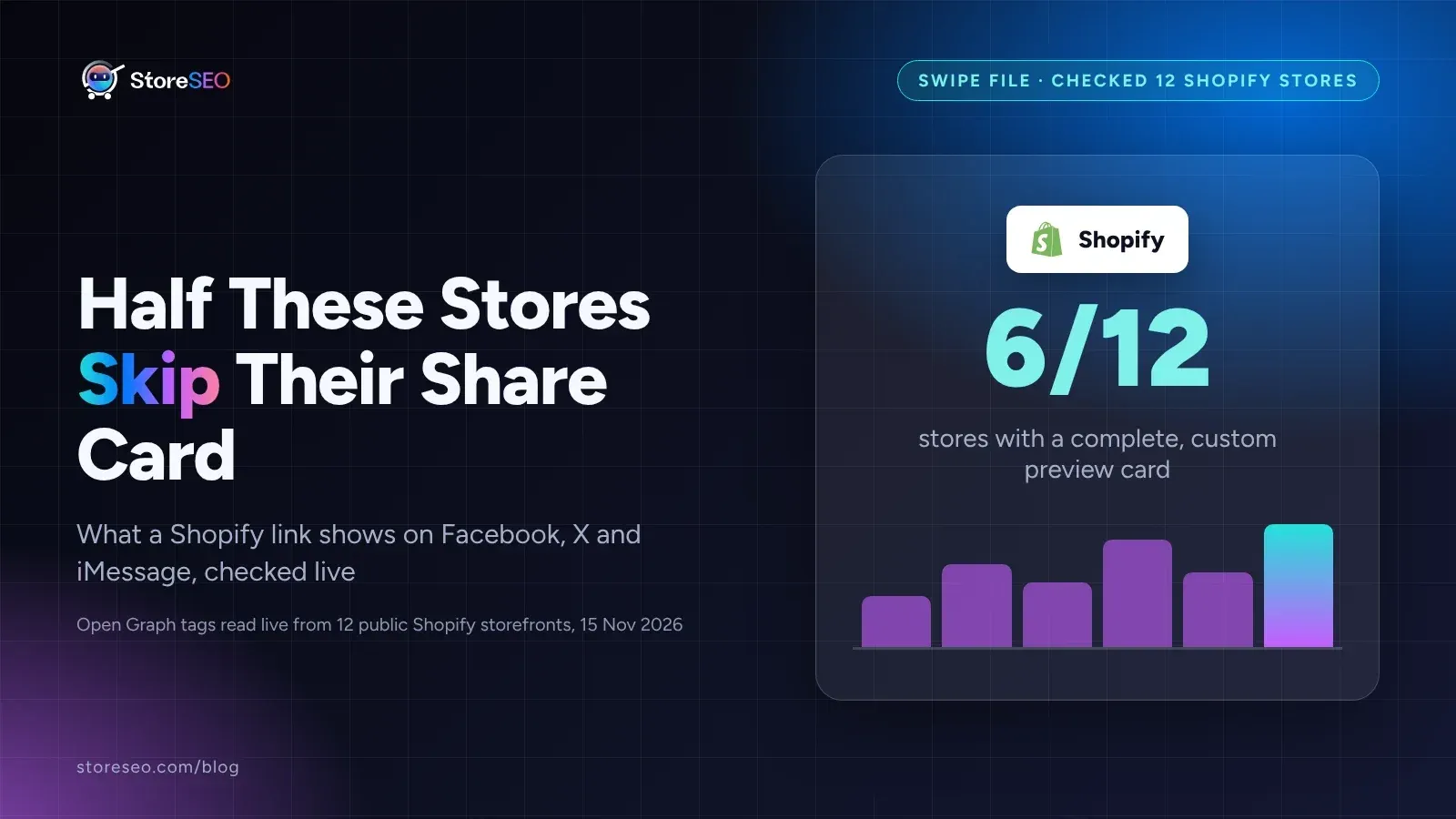
12 Shopify Social Preview Cards That Get Clicks
We checked 12 live Shopify stores' social preview cards, and only half ship a complete one; here is exactly what the other half are missing.
Read article