
Shopify SEO ROI Calculator: Formulas and an Example
SEO ROI measures the dollar return of your search investment: subtract what you spent from the value of the orders it produced, then divide by what you spent. A small Shopify store paying under $40 a month for an SEO app can show a return many times that cost once AI and organic traffic start converting into orders.
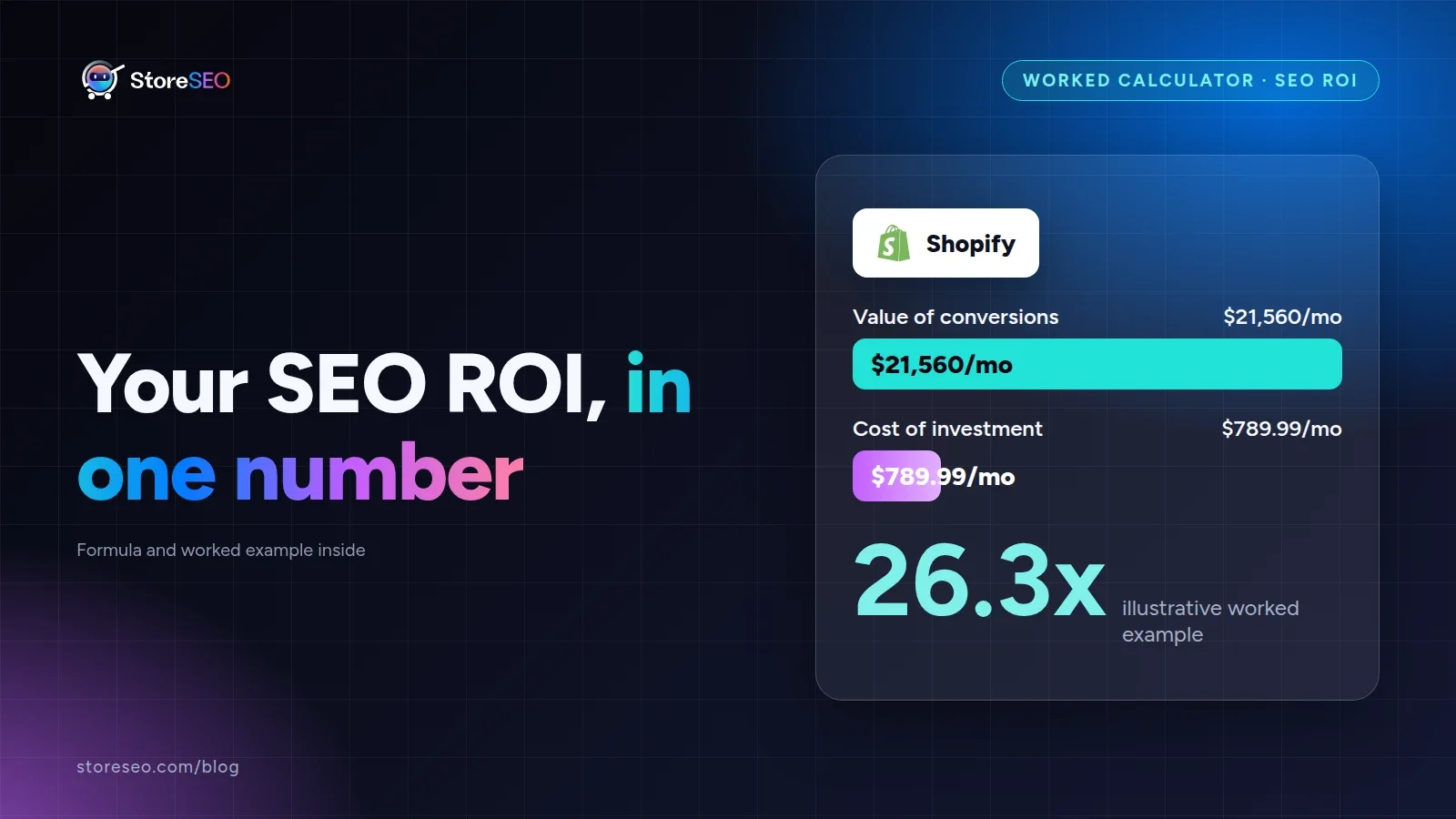
TL;DR: how to value the top and bottom of the formula, and what to do with the result.
| Situation | Where the number comes from | Recommendation |
|---|---|---|
| You already track AI and organic orders separately | StoreSEO’s AI Insights Orders and Revenue tab, which reads your store’s own checkout events | Use that revenue figure directly in the formula |
| You have no channel-level attribution yet | Sessions for a keyword, multiplied by that keyword’s Google Ads cost per click | Treat it as a floor estimate, not a real revenue number |
| Either way | SEO ROI = (value of conversions minus cost of investment) divided by cost of investment | Recalculate it every month, not once a year |
What Inputs Does the Calculator Need?
Before the formula outputs anything, gather five numbers for one period, usually a month. Four build the value side, one builds the cost side:
- Sessions. Visits from organic search and AI assistants (ChatGPT, Gemini, Perplexity, Claude), for the period you are measuring.
- Conversion rate. The share of those sessions that placed an order, from Google Analytics or StoreSEO’s AI Insights.
- Orders. Sessions multiplied by conversion rate, or read straight from a channel report.
- Average order value. Revenue divided by orders, for the same channel and period.
- Cost of investment. Every dollar spent to get those rankings and that traffic: an app fee, a freelancer or agency retainer, and staff hours valued at an hourly rate.
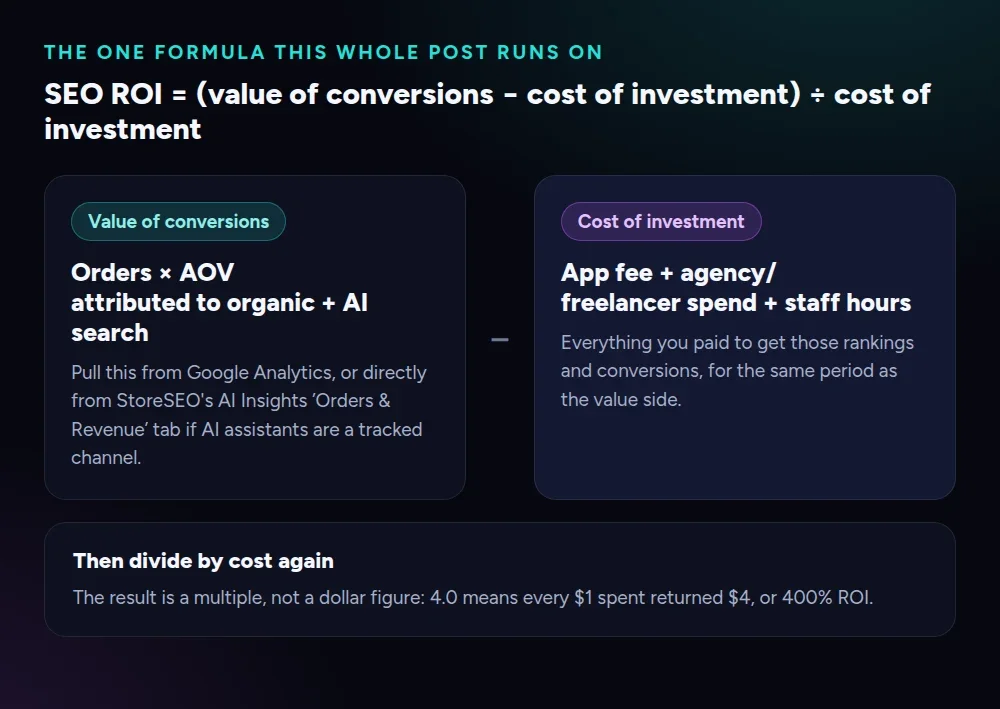 The two sides of the formula: what the traffic was worth, and what it cost to get it.
Multiply orders by average order value to get the value of conversions, the top half of the formula. Add up every cost from the same period to get the bottom half. StoreSEO’s AI Orders and Revenue by channel feature inside AI Insights builds the value side for you: once its tracking pixel is active, it attributes sessions, orders, revenue, conversion rate and average order value to AI Search, Organic Search, Paid Search and Direct separately, so the first four inputs above come from one report instead of four.
Worked Example: A $50k a Month Store
Here is the formula run through real-looking numbers for an illustrative Shopify store doing $50,000 a month in total revenue. Nothing below is this store’s actual data; every input is labelled as illustrative or sourced to where it came from.
| Input | Value | Source |
|---|---|---|
| Organic + AI search sessions/month | 14,000 | Illustrative |
| Conversion rate | 1.4% | Littledata Shopify benchmark (421 stores, Sep 2026) |
| Orders | 196 | 14,000 sessions times 1.4% |
| Average order value | $110 | Littledata Shopify benchmark (421 stores, Sep 2026) |
| Value of conversions | $21,560/mo | 196 orders times $110 |
| Cost of investment | $789.99/mo | StoreSEO Essential ($39.99) plus a part-time freelancer ($750, illustrative) |
| Net profit | $20,770.01/mo | Value of conversions minus cost of investment |
| SEO ROI | 26.3, or 2,629% | Net profit divided by cost of investment |
The conversion rate and average order value are not invented. Littledata’s benchmark of 421 Shopify stores, updated September 2026, puts the median conversion rate at 1.4% and the median order value at $110. The cost side mixes a real StoreSEO tier (Essential, $39.99 a month, from its Shopify App Store listing checked 30 September 2026) with an illustrative freelancer cost of $750 a month, roughly half of the $1,348 a month average Ahrefs found across 439 surveyed businesses in its 2026 pricing survey.
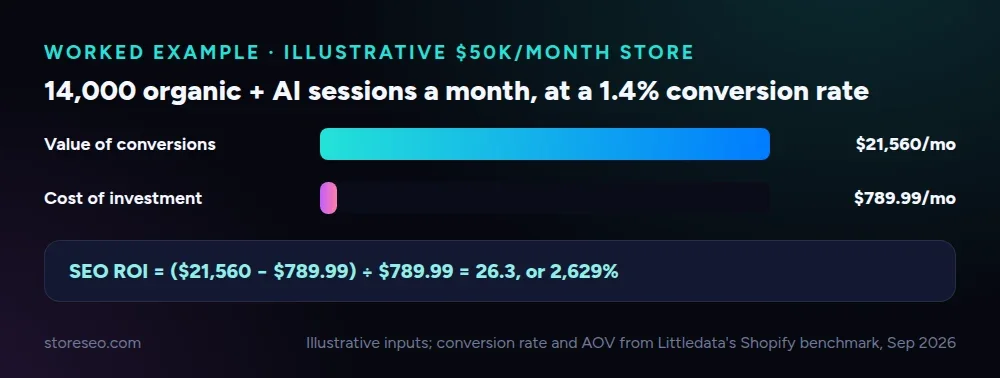 Illustrative inputs; conversion rate and AOV sourced to Littledata, September 2026.
Run the same table with your own sessions, conversion rate, average order value and cost, and the formula does not change. A store converting at the 10th percentile (0.3%, per the same Littledata benchmark) with a $3,209-a-month agency retainer will show a far smaller multiple than this example, and that is the point of calculating it rather than assuming it.
How Do You Value AI-Referral Traffic?
AI assistants send sessions that rarely carry a dollar figure with them, so stores either estimate the value or read it directly once tracking is in place. Both are legitimate; they just answer different questions.
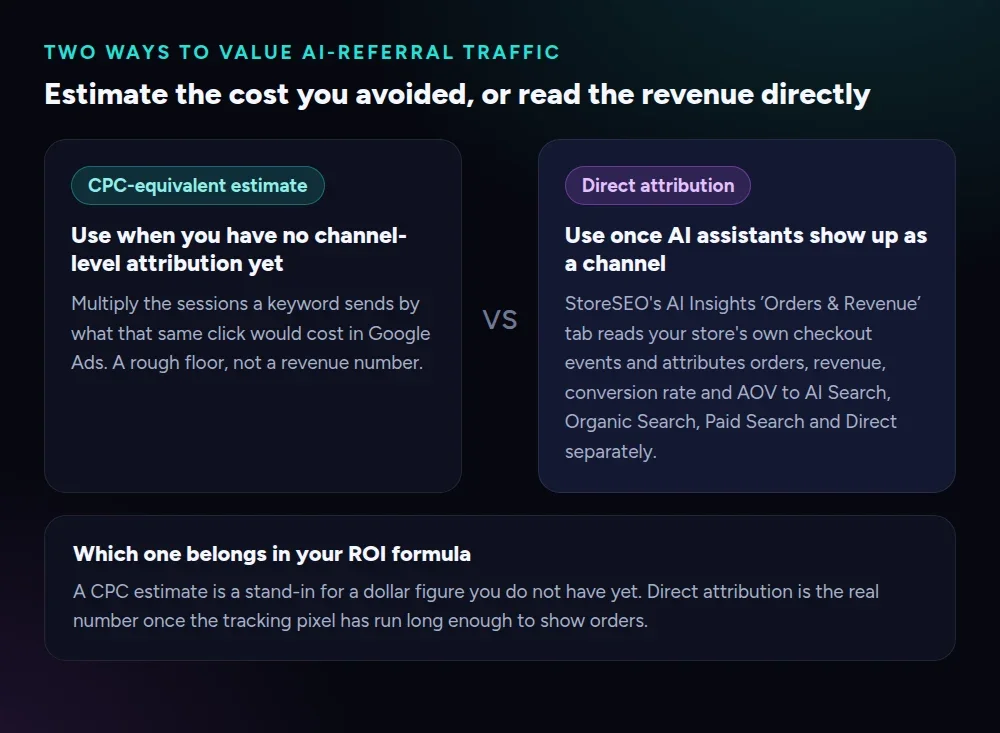 Based on StoreSEO’s Orders and Revenue documentation, fetched 5 October 2026.
The estimate method multiplies the sessions a keyword or topic sends by what that same click would cost in Google Ads, a floor on value rather than a real revenue number. The chart below uses real, dated cost-per-click data for a handful of Shopify SEO search terms: 10 clicks on “shopify seo expert” would cost $580 in Google Ads at today’s rate, so sessions that arrive free through AI citation or organic ranking are worth at least that much before a single order closes.
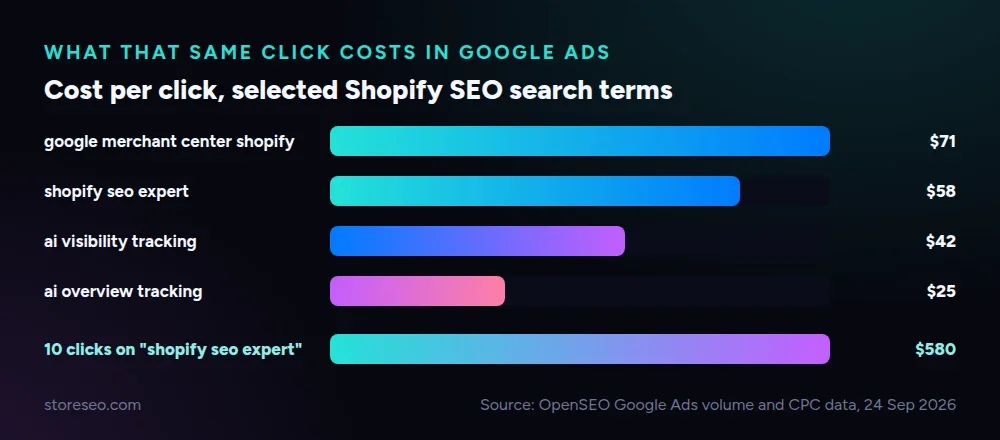 Source: OpenSEO Google Ads volume and CPC data, 24 September 2026.
Direct attribution replaces the estimate once it exists. StoreSEO’s AI Orders and Revenue by channel report reads your store’s own checkout events through its web pixel, so once it has run for a full period it shows real orders, revenue, conversion rate and average order value for AI Search as its own line, next to Organic Search, Paid Search and Direct. Put that revenue figure straight into the value side of the formula instead of the CPC estimate, and the ROI calculation stops being a guess.
What Doesn’t This ROI Calculation Capture?
The formula is honest about one period at a time, which means it misses everything that compounds beyond that period. A branded search that started with an AI citation, a customer who converted on their fourth visit instead of their first, and the retention value of a store that ranks consistently all sit outside a single month’s input and output.
Treat a single month’s ROI as a snapshot, not a verdict. StoreSEO’s own SEO Analysis and score tracks the technical groundwork a single ROI number cannot show, and our guide to how much Shopify SEO costs breaks down the spend side across apps, freelancers and agencies in more depth than the one line this calculator uses. For the traffic side, our Shopify SEO checklist and our walkthrough on tracking ChatGPT and Perplexity traffic in GA4 cover the setup this calculator assumes is already in place. If your SEO score is still low, fix that first: a calculator run on traffic that is not ranking yet will just report a loss every month, correctly.
For a second opinion on whether a number this calculator produces looks right, compare it against your own SEO score with our 100 SEO score guide, since a store scoring well technically and still showing poor ROI usually has a conversion problem, not a rankings problem.
Frequently Asked Questions (FAQs)
1. What counts as a good SEO ROI for a Shopify store?
There is no universal number, because the formula is sensitive to how cheaply you got your rankings. A store paying only an app fee and converting near the Littledata median can show a multiple in the double digits, while a store paying a full agency retainer for the same traffic might see a multiple closer to 2 or 3. Compare your own result month over month rather than against someone else’s headline figure.
2. How long does it take to see a measurable SEO ROI?
Most Shopify stores need two to three months of consistent technical and content work before rankings move enough to change the orders side of the formula. Running the calculation in month one will usually show a loss, since the cost lands before the traffic does. Re-run it monthly and expect the multiple to improve as rankings compound.
3. Does this formula include AI referral traffic from ChatGPT and Perplexity?
Yes, as long as you count those sessions on the value side, either through a CPC-equivalent estimate or through direct attribution once your store tracks AI Search as its own channel. Leaving AI assistants out of the sessions input understates the value of conversions and makes the ROI look worse than it is.
4. What if I don’t have reliable cost data for my own SEO work?
Start with whatever you can verify: an app’s listed price, a freelancer invoice, or an agency contract figure. Staff hours are the hardest input to get right, so a reasonable approach is to track hours for one representative week and multiply by an hourly rate you already use elsewhere in the business. An imperfect cost figure still produces a more useful ROI than skipping the calculation.
5. Can I compare an SEO app’s ROI against an agency’s ROI with the same formula?
Yes, the formula does not care what generated the cost side, only the amount. Run it separately for each route over the same period and compare the resulting multiples directly; our Shopify SEO cost guide has the current price ranges for apps, freelancers and agencies if you need a starting cost figure for a route you have not tried yet.
Run the numbers once a quarter, keep the inputs you used so next quarter is a fair comparison, and let the result tell you whether the next dollar into SEO is worth spending. try StoreSEO on the Shopify App Store
Written by
StoreSEO Editorial Team