
12 Shopify Meta Descriptions That Get Clicked
 Written by M Asif Rahman
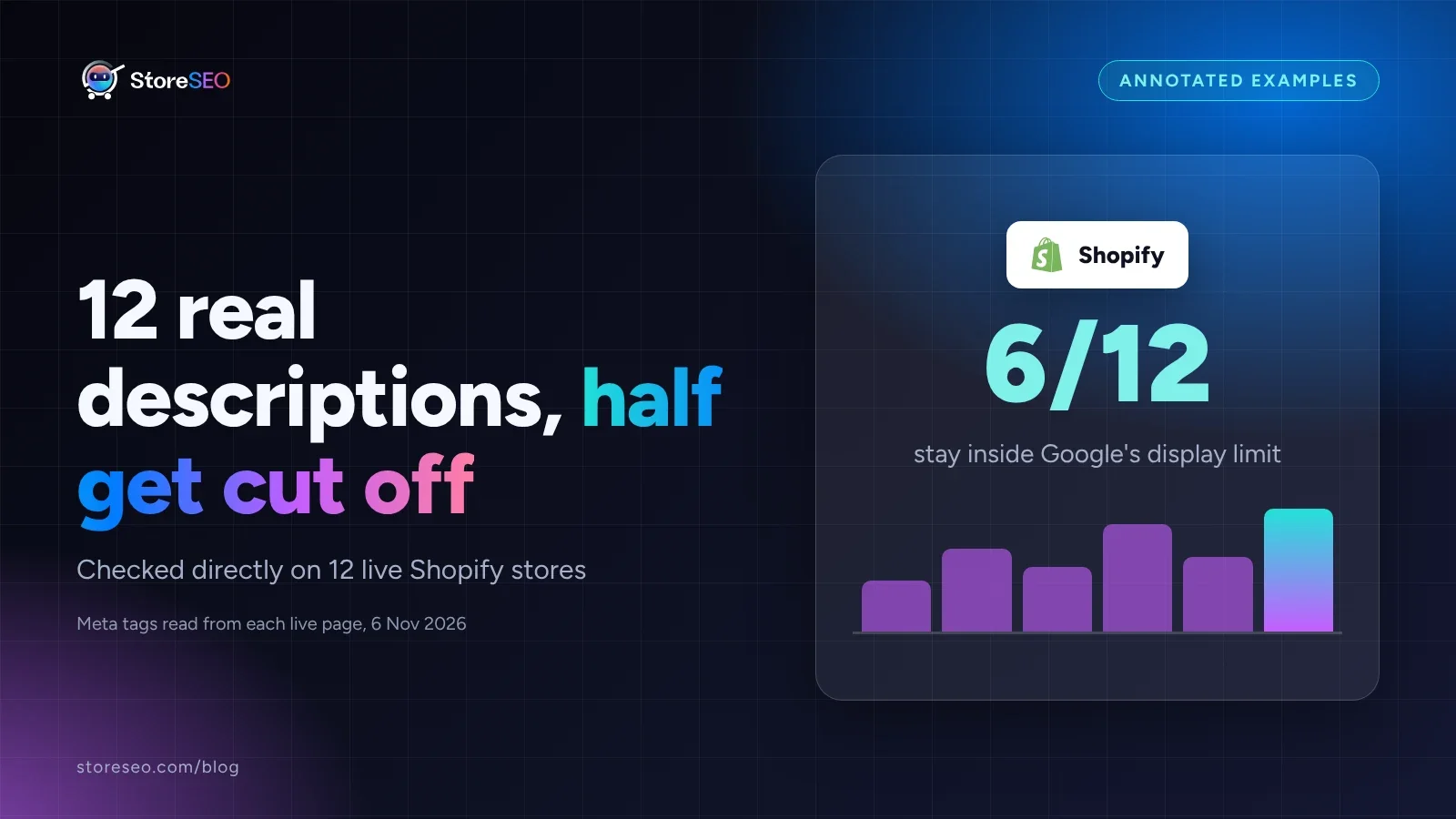
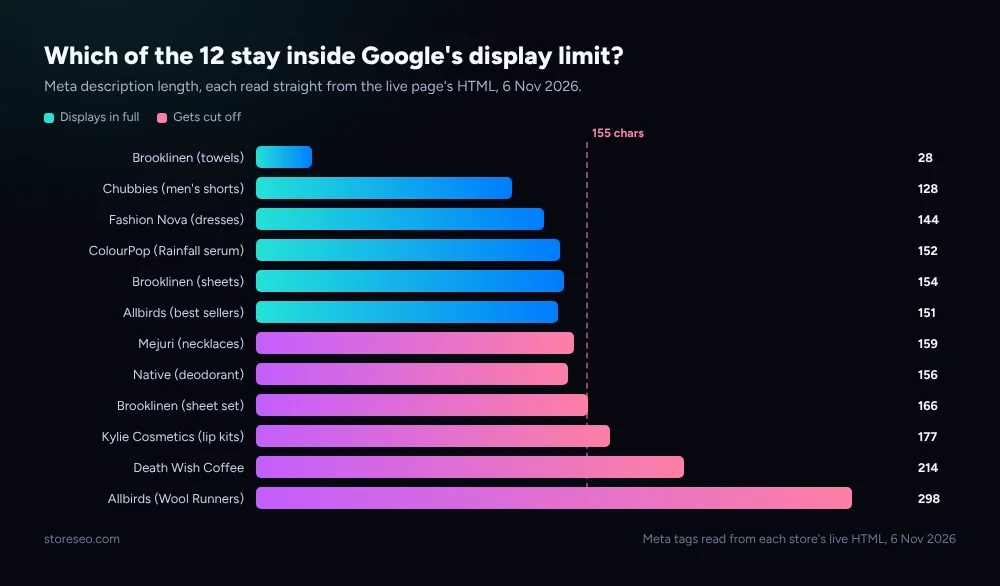
Twelve real Shopify product and collection meta descriptions, read straight from each store’s live HTML on 6 November 2026, split almost evenly: six stay inside the roughly 155 characters Google actually displays, and six run long enough that the back half of the sentence never reaches a search result.
TL;DR
| Pattern | What It Looks Like | Do This |
|---|---|---|
| Under 155 characters | The whole idea fits before Google’s cutoff | Write the sentence, then stop; do not pad it |
| One specific detail | A material, ingredient, size, source or policy, not a mood word | Name the one fact a shopper is deciding on |
| The useful clause goes first | The sentence a shopper needs sits in the opening words | Front-load the clause you cannot afford to lose |
Why Does Google Cut a Meta Description Off?
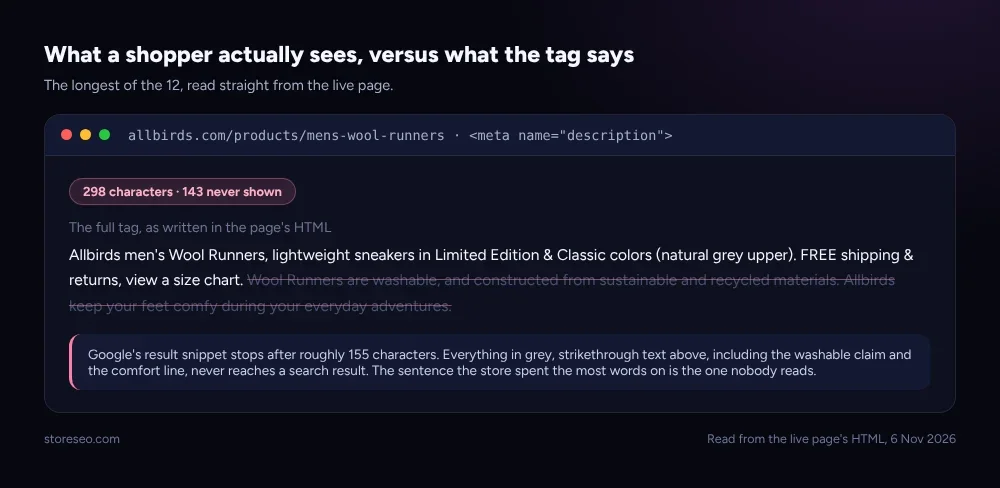
Google does not count characters; it measures the pixel width of the rendered snippet, which is why the cutoff point moves with how wide each letter is, but 155 characters is the number that keeps a plain-English sentence safely inside it on both desktop and mobile. Google’s own guidance on search result snippets confirms there is no fixed character limit and that Google may rewrite or truncate a description that runs long, which is exactly what happens to six of the twelve pages below.
 Read from the live page’s HTML, 6 Nov 2026
A meta description is not a caption. It is the one sentence a store gets to argue for the click before a shopper ever lands on the page, and a cut sentence argues for nothing, because the words that get sliced off are usually the ones written last, which is where a writer tends to put the most persuasive detail rather than the most essential one.
 Meta tags read from each store’s live HTML, 6 Nov 2026
12 Shopify Meta Descriptions, Annotated
Each of these is a live, public meta description on a working Shopify store, fetched directly from the page’s HTML on 6 November 2026, not paraphrased or guessed at.
| Store & Page | Length | Verdict |
|---|---|---|
| Chubbies · shorts collection | 128 chars | Short enough, but names no product at all |
| Brooklinen · towels collection | 28 chars | Not a description: a leftover discount-code string |
| Fashion Nova · dresses collection | 144 chars | Fits, but could describe almost any dress shop |
| ColourPop · Rainfall serum | 152 chars | Fits, and names the ingredient and the benefit |
| Brooklinen · sheets collection | 154 chars | Fits, and names three fabric types by name |
| Allbirds · best sellers collection | 151 chars | Fits, and names the two materials people search for |
| Mejuri · necklaces collection | 159 chars | 4 characters over; the closing phrase gets cut |
| Native · deodorant collection | 156 chars | 1 character over; the ingredient list survives intact |
| Brooklinen · Classic Core sheet set | 166 chars | The Wirecutter credit, its strongest line, is the part cut |
| Kylie Cosmetics · lip kits collection | 177 chars | The finish names survive; the closing sentence does not |
| Death Wish Coffee · coffee collection | 214 chars | Cuts mid-list, right after “Fair Trade Certified” |
| Allbirds · Wool Runners product | 298 chars | Cuts mid-sentence; the washable claim never shows |
 Meta tags read from each store’s live HTML, 6 Nov 2026
Which Pattern Should You Copy First?
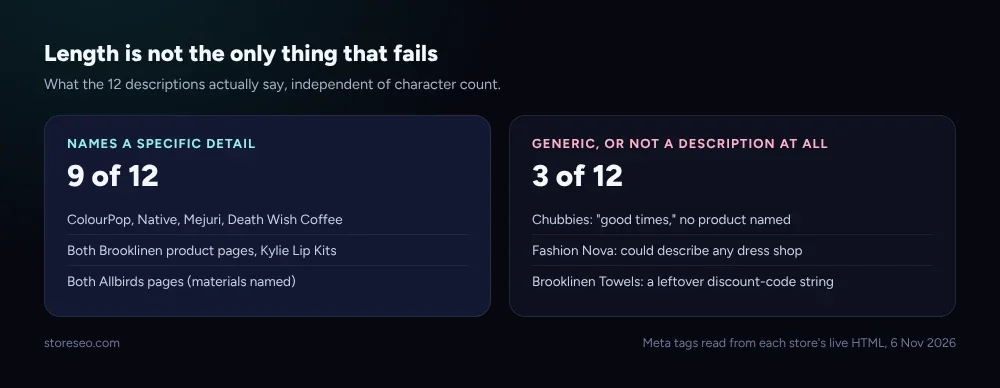
Length is not the only thing separating these twelve. Nine of the twelve name a specific detail: a material, an ingredient, a sourcing claim, a quantity or a named product line, the kind of fact a shopper is actually weighing before they click. The other three do not. Chubbies’ shorts collection talks about “the weekend” and “good times” without naming a single product. Fashion Nova’s dresses collection is true of almost any store that sells dresses; swap the brand name and nothing else would need to change. Brooklinen’s towels collection is the most instructive failure of the twelve: the live meta tag is not a description at all, just the text “for THESKIMM20 discount code,” a promo string that leaked into a field meant for search copy, on a brand whose own product pages elsewhere in this roundup get it right.
The length problem and the specificity problem compound each other. A description that runs long but says nothing new, like Kylie Cosmetics’ lip kits collection, wastes its extra characters restating the product type a shopper already knows from the page title. A description that is short but vague, like Chubbies’, wastes the opposite way: it had room for a detail and chose a mood instead. The fix for both is the same one sentence, written to the length, with the one fact that matters in it.
How Do You Fix This in Shopify?
Shopify gives every product and collection a Meta Description field under its page’s search engine listing settings, and the field accepts far more text than Google will ever show, which is exactly how five of these twelve stores ended up with a sentence that gets cut.
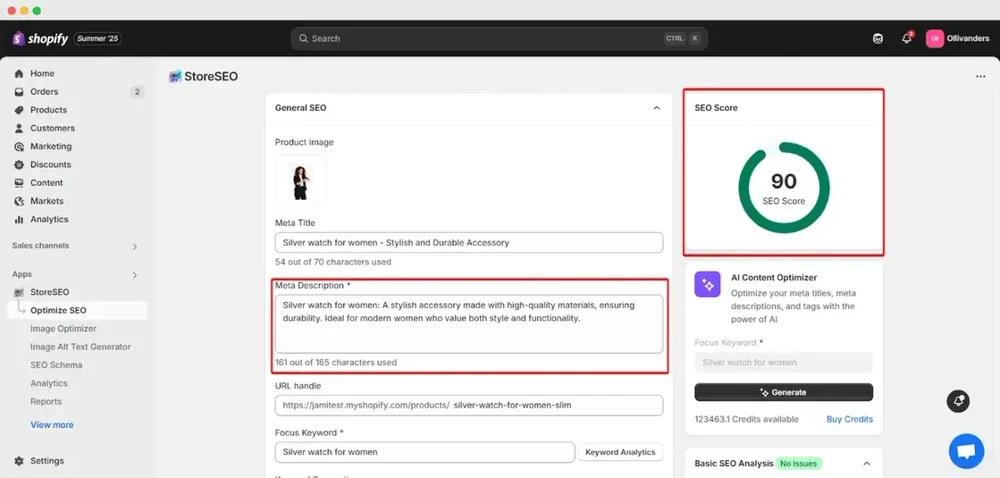 StoreSEO’s meta description field, with its live character counter, 6 Nov 2026
Checking that length by eye, one product at a time, is how a store ends up with a 298-character tag nobody caught before it went live. StoreSEO’s SERP Preview Snippets tool solves the same problem these twelve pages illustrate: it shows a live character count and a rendered preview beside the editing field, for every product and collection, so a description that runs long gets caught while it is still a draft, not after a shopper never sees the end of it.
For the homepage version of this same audit, 12 Shopify homepage title and meta description examples covers the same lesson on the page that matters most for brand searches, and 12 Shopify product titles that rank (annotated) is the title-tag half of the same search result. If a description is already too long and you are not sure how much to cut, fix log: cutting a meta description from 220 to 155 walks through one real edit, line by line. SEO for a Shopify store: meta descriptions, meta titles and more is the wider guide this roundup sits inside.
Frequently Asked Questions (FAQs)
1. How long should a Shopify meta description be?
Keep it to roughly 140 to 155 characters. Google measures pixel width, not a fixed character count, so the exact cutoff moves slightly by letter shape, but a plain sentence under 155 characters stays inside the display limit on both desktop and mobile in every case checked for this roundup.
2. What happens if a meta description runs too long?
Google truncates it, usually mid-sentence, as seen in 6 of the 12 live examples above. The words cut are whatever came last, which is often the most persuasive detail a store wrote, since writers tend to add their best line at the end rather than the start.
3. Does Shopify limit how long a meta description can be?
No. Shopify’s own admin field accepts far more text than Google will display, which is exactly how five of the long descriptions in this roundup went live unnoticed. Nothing in Shopify warns a merchant that a description has run past the point search engines will show.
4. Should a meta description repeat the page title?
No. A title tag and a meta description appear together in a search result, so repeating the same words in both wastes the one sentence a store gets to add a reason to click. Use the title for the product type and the description for a new fact: a price, a material, a policy or a proof point the title did not already say. Several of the twelve pages above waste their description restating the title instead.
5. Can a short meta description still fail?
Yes. Three of the twelve examples in this roundup are well under the 155-character limit and still underperform, because they name no specific product, material or benefit. Chubbies’ shorts collection and Fashion Nova’s dresses collection are both short and generic; length alone does not make a description work.
6. Can StoreSEO show how a meta description will look in search results before I publish?
Yes. StoreSEO’s SERP Preview Snippets field renders a live character count and a search-result preview beside the editing box for every product and collection, so a description that runs long or says nothing specific gets caught before a shopper ever sees the cut version.
The pattern across all twelve pages is the same one: the stores that stay inside the limit and still convert are the ones that pick one fact and lead with it, not the ones that write the most words. try StoreSEO on the Shopify App Store
Keep reading
12 Shopify Product Titles That Rank (Annotated)
Twelve real Shopify product titles share three habits that work: name the product type, add exactly one differentiator, and put the brand name last.
Read article
What Happens When You Skip Google Product Category?
Skipping Google Product Category rarely blocks a sale, but in apparel, phones, software and alcohol it can quietly get a listing disapproved.
Read article
We Compressed 20 Shopify Product Photos 4 Ways
We compressed 20 real Shopify product photos 4 ways and found WebP cuts average file size by 67 percent, the biggest saving of the four we tested.
Read article