
Does a Sitemap Actually Speed Up Shopify Indexing?
 Written by M Asif Rahman
A sitemap genuinely helps Google and Bing discover new Shopify pages, especially on a new or large store. IndexNow, the protocol behind StoreSEO’s instant indexing, does the opposite of what most merchants assume: it speeds up Bing, Yandex and a handful of others, but Google has never adopted it.
TL;DR:
| Claim | Evidence | Verdict |
|---|---|---|
| A sitemap speeds up Google’s discovery of new or large sites | Google Search Central’s own “Do I need a sitemap?” guidance | True |
| A sitemap directly improves ranking | Google: sitemaps help crawling, not ranking | False |
| IndexNow speeds up Google specifically | Google’s Search Central community forum: “Google does not support Index Now” | False |
| IndexNow speeds up Bing, and through Bing, AI assistants | IndexNow.org’s own participant list (Bing, Yandex, Naver, Seznam, Yep) | True |
| Shopify needs a manually built sitemap | Shopify generates /sitemap.xml automatically | False |
What Does a Sitemap Actually Do for Shopify SEO?
A sitemap is a file listing a site’s pages so a search engine can find them without having to follow every internal link. Google’s own sitemap guidance is specific about when it helps: a new site with few external links, a large site where some pages might not be reachable by normal navigation, or a site with a lot of image or video content. None of that is about ranking. It is about discovery, which is the step that has to happen before ranking can.
Shopify already handles the mechanical part. Every store gets /sitemap.xml for free, rebuilt automatically as products and pages change, with no app required. What StoreSEO adds on top is control: choosing which products, pages and collections actually belong in it, so thin or duplicate URLs are not the first thing a crawler sees.
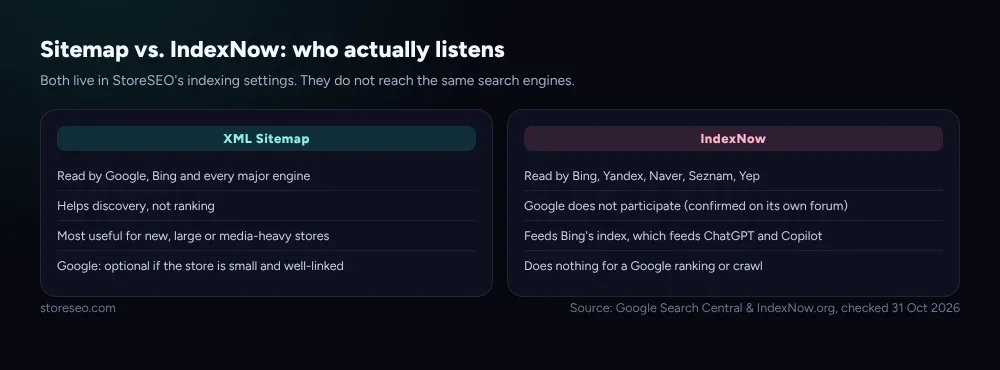 Both live in StoreSEO’s indexing settings. They do not reach the same search engines.
Google’s own guidance also says the opposite is true for a small, well-linked store: if a site has roughly 500 pages or fewer and every important page can already be reached by following links from the homepage, a sitemap is not strictly necessary. Most Shopify stores fall somewhere between these two cases, which is exactly why the sitemap is worth keeping on rather than worth debating.
Does IndexNow Help Your Google Ranking?
No, and this is the part worth getting right before anyone promises “instant Google indexing” to a merchant. IndexNow is an open protocol, not a Google product. It was built by Microsoft Bing and Yandex, and IndexNow.org’s own participant list names the engines that actually use it: Bing, Yandex, Naver, Seznam.cz and Yep (DuckDuckGo’s underlying index). Google is not on that list, and a thread on Google’s own Search Central community forum states it directly: Google does not support IndexNow.
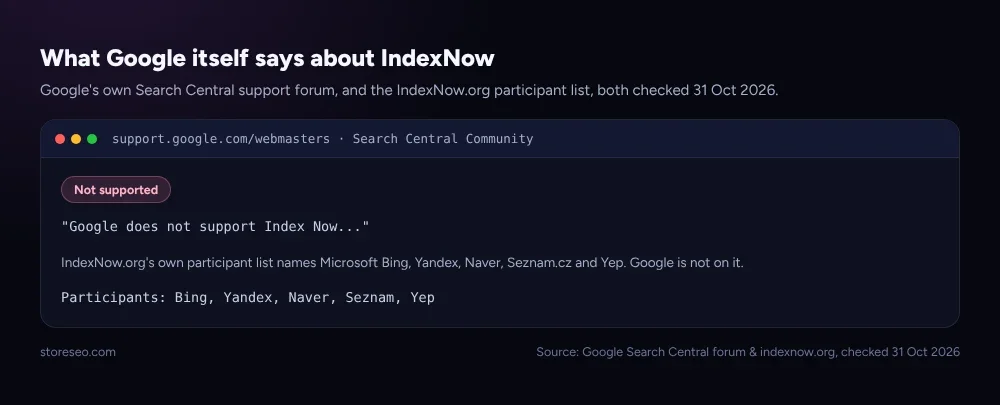 Google’s own Search Central support forum, and the IndexNow.org participant list, both checked 31 October 2026.
That does not make IndexNow pointless on a Shopify store. Bing’s index feeds Microsoft Copilot, and a fast Bing re-crawl is one of the more reliable ways to get a brand-new or just-updated product page in front of an AI assistant quickly, even while Google is still catching up through its normal crawl schedule. The mistake is assuming the word “instant” in “instant indexing” applies to Google too. It does not.
So Should You Bother With Either on Shopify?
Yes, both, because they solve different problems and neither costs anything extra to leave running. A sitemap is the baseline every engine reads; IndexNow is the fast lane for the one group of engines that actually honours it.
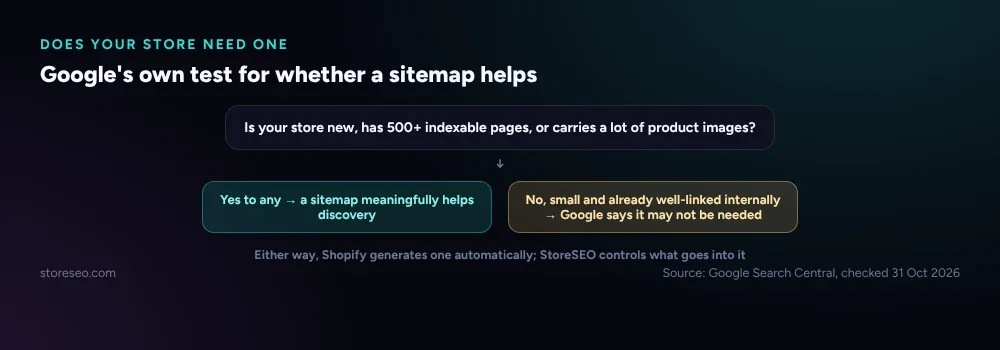 Source: Google Search Central, checked 31 October 2026.
For Google specifically, the only direct lever a merchant has is Search Console’s URL Inspection tool, used by hand on a page that matters right now, plus the ordinary crawl schedule that a clean sitemap and clean internal links support. There is no public, free “instant indexing” switch for Google the way there is for Bing through IndexNow. Google does run its own Indexing API, but it is scoped to job postings and livestream pages by its own terms of use, not ordinary product or blog content, so it is not a substitute here.
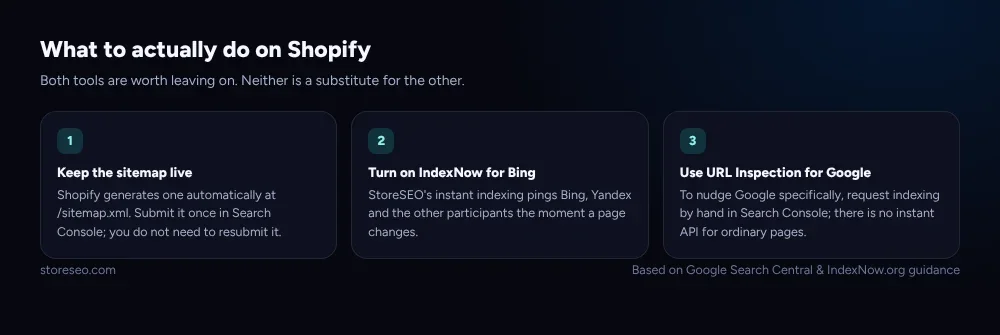 Based on Google Search Central and IndexNow.org guidance.
How Does StoreSEO Handle Sitemaps and IndexNow?
StoreSEO’s Sitemap submission, instant indexing tools cover both halves without extra setup: the sitemap control decides what belongs in /sitemap.xml, and the instant-indexing step pings IndexNow the moment a page publishes or changes, so Bing and the other participating engines hear about it immediately instead of waiting for their own next crawl. Submitting the sitemap once in Search Console is still worth doing, mainly so Search Console’s own indexing statuses have something to report against.
None of this replaces understanding how Google actually crawls a Shopify store in the first place, or the basics of getting a Shopify store indexed at all, which covers the steps before a sitemap matters. Checking whether AI crawlers specifically can reach a store’s pages is a related but separate question, which our own robots.txt study covers. A sitemap and IndexNow both assume the page is reachable to begin with; neither fixes a robots.txt block.
Frequently Asked Questions (FAQs)
1. Does submitting a sitemap improve my Google ranking?
No. Google’s own documentation describes a sitemap as a discovery and crawling aid, not a ranking signal. It can help a new or large store get found faster, but the page still has to earn its position the same way any page does.
2. Does IndexNow work for Google?
No. Google has never adopted the IndexNow protocol, and a thread on its own Search Central community forum states this directly. IndexNow only reaches Bing, Yandex, Naver, Seznam.cz and Yep.
3. How long does Google actually take to index a new Shopify page?
There is no fixed number, and Google does not publish one. A clean sitemap, reachable internal links and a request through Search Console’s URL Inspection tool are the things within a merchant’s control; the rest depends on Google’s own crawl schedule for that domain.
4. Do I need to manually create a sitemap on Shopify?
No. Shopify generates /sitemap.xml automatically for every store and keeps it updated as products and pages change. StoreSEO’s sitemap control decides what belongs in it rather than building it from scratch.
5. What is the difference between IndexNow and Google’s Indexing API?
IndexNow is an open protocol run by Bing and Yandex that several other engines also honour; Google is not one of them. Google’s own Indexing API exists separately, but by Google’s own terms it is scoped to job posting and livestream pages, not ordinary product or blog content.
6. Should I turn off IndexNow since it does not reach Google?
No. It still speeds up Bing’s re-crawl, and Bing’s index is what feeds Microsoft Copilot, so a merchant who cares about AI-assistant visibility still gets a real benefit from it. It is simply not the lever for Google.
If a sitemap and IndexNow still are not enough, the fastest way to see what else might be blocking a page is to try StoreSEO on the Shopify App Store.
Keep reading
Black Friday SEO Brief for Your Shopify Developer
A one-page brief hands your theme developer the freeze window dates, the SEO fields to protect, and the checks that sign off before Black Friday.
Read article
Canonical vs Redirect vs Noindex on Shopify
Use canonical to point Google at the preferred URL, redirect when the old URL should disappear, and noindex to keep a page live but out of search results.
Read article
Crawl, Understand, Recommend: A Shopify SEO Model
Most Shopify stores pass the crawl layer, fail the understand layer, and never reach the recommend layer where AI engines cite pages by name.
Read article